
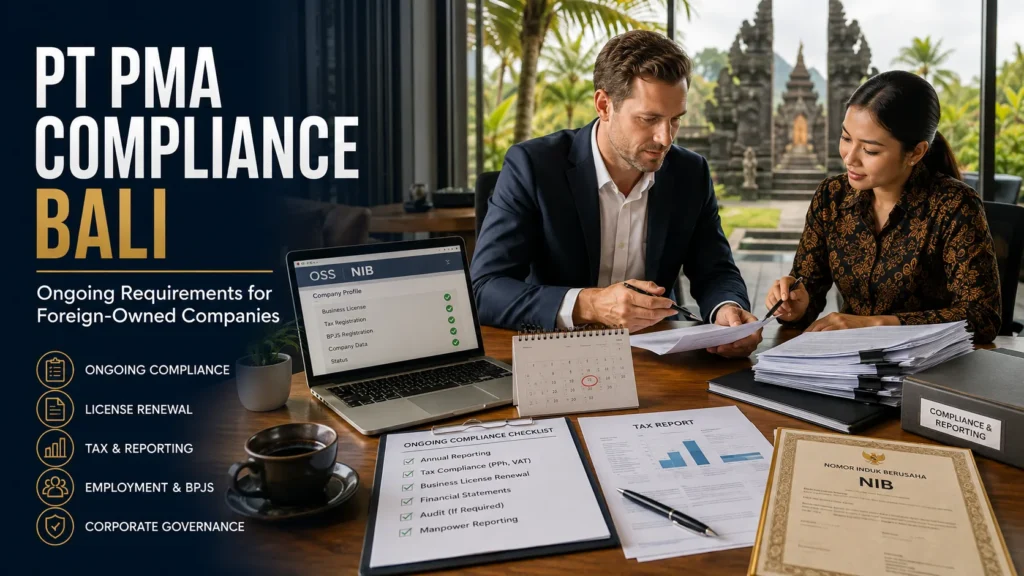
This PT PMA compliance Bali calendar organizes routine, reporting-period, annual and event-driven reviews. Use it to assign responsibilities and reconcile company records across the year.
Establishing a PT PMA is only the beginning of operating a foreign-owned company in Indonesia. After incorporation, the company must continue maintaining its business licensing, investment reporting, tax records, corporate information and sector-specific obligations.
For investors managing PT PMA compliance Bali, the most useful approach is to stop treating each filing as an isolated task. OSS data, accounting records, tax returns, LKPM reporting and corporate documents should tell the same story about what the company actually does, where it operates and how much investment has been realized.
Indonesia’s current risk-based licensing framework is governed by Government Regulation No. 28 of 2025 on the Implementation of Risk-Based Business Licensing, while Minister of Investment and Downstreaming/Head of BKPM Regulation No. 5 of 2025 provides the current procedures for risk-based business licensing and investment administration through OSS. Both regulations are listed as in force by JDIH BKPM.
PT PMA Compliance Bali Does Not End After Company Registration
Obtaining a deed of establishment, legal-entity approval, tax registration and an NIB does not mean the company’s compliance work is finished.
The obligations that continue after setup depend on the company’s activities, KBLI classifications, risk levels, locations, employees, tax status and sector regulations. A tourism company in Bali may therefore have different operational requirements from a consulting, trading or technology company even though both use a PT PMA structure.
A useful starting point is Bali Legal ID’s existing PT PMA Financial Reporting Requirements guide, which addresses the accounting and reporting side of foreign-owned companies. The broader compliance process also requires regular attention to licensing and corporate data.
Keep OSS Business Activities and Licensing Data Aligned
The company’s registered business activities should continue to reflect its real activities.
Management should periodically compare:
- KBLI activities registered in OSS
- Actual products and services being sold
- Project and business locations
- Risk-based licenses and certificates already issued
- PB UMKU or supporting approvals relevant to the activity
- Operational status recorded in OSS
A company that changes its business model should not assume its original licensing package automatically covers the new activity.
For example, a PT PMA originally established for consulting should review its OSS position before adding a materially different regulated activity. Likewise, a hospitality business should not rely solely on its corporate registration if the property, accommodation model or supporting services have changed.
Review Additional Business Licenses as Operations Change
Growth can create new compliance requirements.
Common triggers for a licensing review include:
- Adding a new KBLI
- Opening another project location
- Entering a more highly regulated activity
- Changing the use of a property
- Adding food, tourism, wellness or other sector-specific services
- Moving from preparation into commercial operation
The correct response depends on the actual business activity and the current OSS output. The OSS Risk-Based Business Licensing system classifies business activities according to their risk level and displays the licensing requirements and obligations associated with the selected activity.
LKPM Investment Reporting for PT PMA Companies
LKPM, or Laporan Kegiatan Penanaman Modal, is an important part of ongoing investment compliance.
For management purposes, the important lesson is that LKPM should not be prepared only when the reporting window opens. The information should be supported continuously by company records.
Build LKPM Data from the Accounting Records
Investment reporting becomes much easier when the company’s financial and project data is maintained consistently.
Management should keep records that allow it to reconcile items such as:
- Investment realization
- Capital expenditures
- Equipment or asset purchases
- Project development progress
- Commercial or operational status
- Employment data where required
- Funding and capital realization
The values reported through OSS should be traceable to supporting documentation rather than reconstructed shortly before submission.
BKPM has expressly reminded businesses that LKPM is an obligation and that inaccurate or late reporting can lead to administrative consequences. Badan Koordinasi Penanaman Modal
Tax and Accounting as Core PT PMA Compliance
Reliable accounting is the foundation of several other compliance obligations.
A PT PMA should maintain organized transaction records, supporting invoices, bank information, payroll documentation and other accounting evidence needed for financial statements and tax reporting.
The exact taxes applicable to a company depend on its transactions, employees, tax status and business activities. A company should therefore avoid using a generic tax checklist without first determining which obligations actually apply.
Bali Legal ID’s existing Business Accounting and Tax Services Bali guide explains the relationship between bookkeeping, corporate accounting, tax reporting and financial statement preparation in more detail.
Annual Corporate Income Tax Return
The Directorate General of Taxes currently states that an Annual Corporate Income Tax Return must be filed no later than four months after the end of the tax year. For a company using a calendar tax year, this generally corresponds to 30 April. A different accounting year can change the corresponding calendar date. Direktorat Jenderal Pajak
Periodic tax obligations can also apply during the year depending on the company’s circumstances. For example, withholding taxes, VAT obligations and other periodic returns should be reviewed based on the company’s transactions and taxpayer status rather than assumed to apply identically to every PT PMA. Direktorat Jenderal Pajak
A good compliance process therefore connects bookkeeping with the tax calendar instead of treating tax filing as an end-of-year exercise.
Corporate and AHU Compliance
PT PMA compliance also includes maintaining the company’s legal and corporate records.
Indonesia’s Directorate General of General Legal Administration, or AHU, published a specific announcement in January 2026 concerning the obligation to submit company annual reports. Portal AHU This reinforces the need for company owners to include corporate reporting in their annual compliance review rather than focusing only on OSS and tax filings.
Corporate information should also be reviewed when material changes occur, including changes involving:
- Shareholders
- Directors or commissioners
- Capital structure
- Company address
- Articles of association
- Business activities
The exact legal process depends on the type of change. Some changes may require a notarial deed, approval or notification through the relevant company-administration system, while related OSS and tax records may also need updating.
The practical goal is consistency. A company’s deed, AHU records, OSS profile, tax profile and actual management structure should not contain conflicting information.
Bali-Specific Operational Compliance Checks
A PT PMA in Bali is governed primarily by national company, investment, licensing and tax rules, but operating requirements can become location-specific.
A company in tourism, accommodation, property-related services, restaurants, wellness or other physical-location businesses should therefore review the site itself as part of the compliance process.
Property and Business Location Should Match the Licensed Activity
A registered company address does not automatically establish that every operational activity can be conducted at that property.
Depending on the business, the review may need to consider:
- Whether the property is legally available to the company
- Whether the lease permits the intended business use
- Whether the business location corresponds with OSS project data
- Spatial or land-use compatibility
- Building documentation relevant to the intended activity
- Environmental requirements where applicable
- Sector-specific operating standards
These matters are particularly important for businesses whose revenue depends on a physical property in Bali.
A company that moves, adds locations or changes the way a property is used should review the consequences before assuming the existing licensing package remains sufficient.
Practical PT PMA Compliance Calendar
A simple internal calendar can prevent many compliance problems. Rather than waiting for a government deadline, assign responsibility for each category.
Monthly or routine review
- Maintain bookkeeping and supporting documents
- Reconcile company bank transactions
- Review applicable periodic tax obligations
- Check payroll and withholding records where relevant
- Record new assets and investment expenditure
Quarterly or reporting-period review
- Check the current LKPM reporting period in OSS or BKPM announcements
- Reconcile investment-realization data before submission
- Review project status and operational changes
- Check whether new business activities or locations have been added
Annual review
- Prepare year-end financial statements
- Prepare the Annual Corporate Income Tax Return
- Review AHU and corporate annual-report requirements
- Check shareholder, director, commissioner and capital data
- Review whether licenses and supporting approvals remain consistent with actual operations
Event-driven review
- Changes in shareholders or management
- Changes to capital
- A new KBLI
- A new business location
- A new regulated service
- A major lease or property change
- Restructuring, acquisition or closure of an activity
The most effective compliance system is one in which accounting, legal, tax and OSS records are reviewed together. Correcting inconsistencies after an inspection, tax review or investment-reporting deadline is usually more difficult than identifying them during routine internal review.
Conclusion
Maintaining a foreign-owned company requires more than keeping its NIB active. A structured PT PMA compliance Bali program should connect OSS licensing, LKPM investment reporting, accounting, tax filings, corporate records and the company’s real activities in Bali.
The exact obligations differ by KBLI, sector, risk level, company changes and project location. For that reason, owners should use a recurring compliance calendar and review the company whenever its activities, management, property or investment structure changes.
Review Your PT PMA Compliance Before Issues Accumulate
If your company is already operating in Bali, a compliance review can help identify inconsistencies between OSS licensing, LKPM data, accounting records, tax obligations and corporate information before they become more difficult to correct.
Discuss your current company status with Bali Legal ID to identify which compliance areas need review and which filings or updates should be prioritized. For tax-specific matters, the Tax Consulting service can also be reviewed as part of the company’s ongoing compliance planning.
For help coordinating the records and next steps discussed above, review our business setup services in Bali.
Read More: Business Setup Bali for PT PMA, PT PMDN & OSS RBA Registration
FAQ PT PMA compliance Bali
What does PT PMA compliance in Bali include after incorporation?
Ongoing compliance can include OSS licensing maintenance, LKPM investment reporting, accounting records, corporate and periodic tax reporting, corporate/AHU requirements and sector-specific permits. The exact obligations depend on the company’s KBLI, risk classification, activities, location and tax status.
Does a PT PMA still have compliance obligations after obtaining an NIB?
Yes. An NIB is an important business identifier, but a company may still have continuing investment reporting, tax, accounting, corporate and operational licensing obligations after registration.
What is LKPM and why is it important for a PT PMA?
LKPM is the Investment Activity Report submitted through OSS. It is used to report the progress and realization of investment activities. Companies should maintain supporting project and financial records so the reported information can be reconciled accurately.
How often should a PT PMA review its OSS data?
OSS data should be reviewed whenever material business circumstances change and as part of routine compliance management. Changes in activities, KBLI, locations or operational status can make an OSS review necessary even when no fixed annual review date has arrived.
When is the Annual Corporate Income Tax Return due in Indonesia?
The Directorate General of Taxes currently states that the Annual Corporate Income Tax Return is due no later than four months after the end of the tax year. For a calendar-year taxpayer, that generally means 30 April.
Does every PT PMA have the same monthly tax obligations?
No. Periodic tax obligations depend on the company’s transactions, employees, withholding responsibilities, VAT status and other circumstances. The applicable tax calendar should be determined from the company’s actual activities.
Do PT PMA companies need to maintain accounting records even before they become profitable?
A company should maintain organized financial records from the beginning of its activities. Proper records support tax reporting, financial statements, LKPM reconciliation and management decisions regardless of whether the company has reached profitability.
Should corporate changes also be updated outside the company’s notarial deed?
Potentially. Depending on the nature of a change, the company may need to review AHU, OSS and tax records in addition to its corporate deed. Shareholder, management, capital, address and business-activity changes should be assessed individually.
Are PT PMA compliance requirements different in Bali from the rest of Indonesia?
The primary corporate, investment, OSS and national tax rules apply across Indonesia. However, operational requirements can differ according to the company’s sector, physical location, property use and local implementation, making project-specific review particularly important for location-dependent businesses in Bali.
When should a PT PMA conduct a full compliance review?
A review is useful periodically and whenever there is a significant change such as a new activity, new location, shareholder or director change, capital restructuring, major property transaction, acquisition or change in operational model.
References & Sources
- JDIH BKPM – Peraturan Pemerintah Nomor 28 Tahun 2025
- JDIH BKPM – Peraturan Menteri Investasi dan Hilirisasi Kepala BKPM Nomor 5 Tahun 2025
- OSS Indonesia – Laporan Kegiatan Penanaman Modal LKPM
- Directorate General of Taxes – Due Date for Tax Return Filing
- AHU – Announcement on Company Annual Report Submission Obligation
Other Articles
Related overview: See our broader guide to business compliance requirements in Bali.