
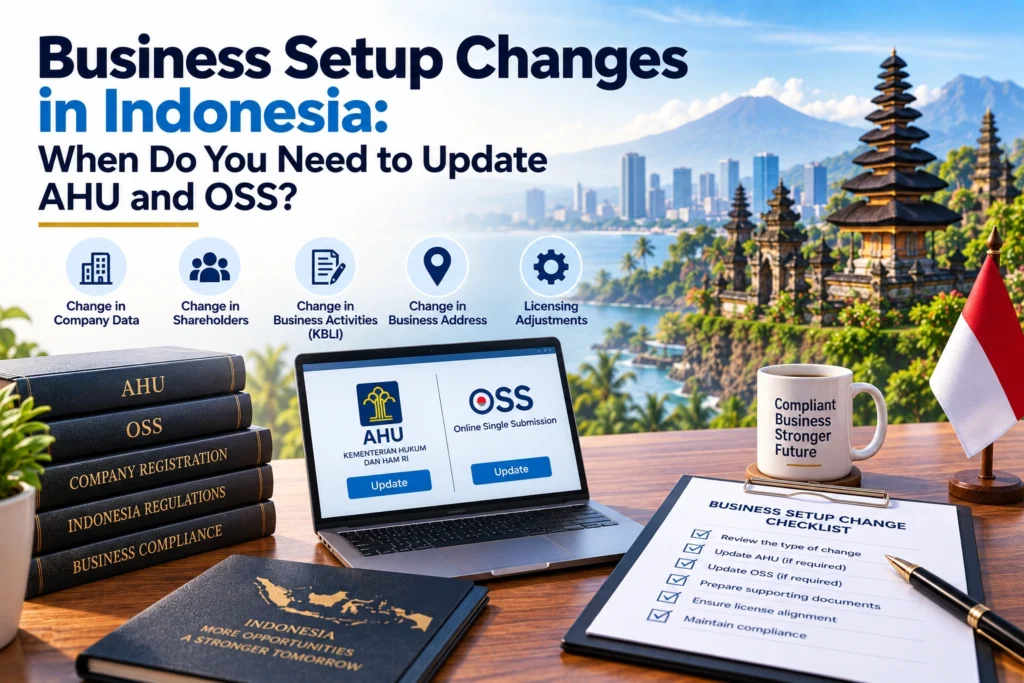
When an existing Indonesian company changes, the first question is not simply whether to open AHU or OSS. The correct sequence depends on what changed: the company’s legal or corporate data, its business activities, its location, its licensing status, or more than one of those layers.
Use four questions to determine which records and licenses need review: Change–Corporate–Activity–License.
- Change: What fact about the business is different?
- Corporate: Does the change affect the articles of association or other formal company data?
- Activity: Does the company need a new or different KBLI or business activity?
- License: Does the change affect the OSS licensing output or obligations?
If the answer affects more than one layer, AHU and OSS should be reviewed as a coordinated sequence rather than as independent systems. For the broader establishment sequence before these post-incorporation changes arise, see Bali Legal ID’s How to Start a Business in Bali guide.
Business Setup Changes in Indonesia: When Do You Need to Update AHU and OSS?
A practical rule is:
- Review AHU first when the change affects the company’s formal corporate position or articles of association
- Update OSS when the change concerns registered business activities, business locations or licensing data
- Review both when new OSS data depends on updated company purposes, ownership or other corporate information
The order matters because the company deed, AHU data and OSS profile should describe the same business.
Start by Identifying What Actually Changed
Do not begin with the portal. Begin with the transaction or business decision.
Common changes include:
- Company name
- Domicile or registered seat
- Purposes and objectives
- Business activities
- Shareholders or ownership status
- Capital structure
- Directors or commissioners
- Business location
- New KBLI activity
- Replacement of an existing activity
- Addition of another operating location
- Licensing status for an existing activity
Different changes can follow different routes. Bali Legal ID’s business-setup mistakes guide explains why operating first and aligning the corporate or licensing records later can create avoidable mismatches.
When AHU Usually Comes First
AHU is the corporate-law layer. If the company’s formal legal data or articles of association must change, that corporate step may need to be completed before OSS is updated.
The Ministry of Law’s AHU Limited Liability Company FAQ lists company amendments handled through the AHU system, including amendments to the articles of association and company data.
AHU also explains that a PT’s business fields refer to KBLI, which is why a material change in business activity can have both corporate and OSS consequences.
Practical examples where AHU may need review first
- The company changes its legal name
- The company’s purposes and objectives no longer cover the intended activity
- The company changes its registered domicile
- The ownership structure changes in a way that affects the company’s corporate or investment position
- A capital or articles-of-association amendment is required before the new business plan can be reflected elsewhere
Stop condition: do not update OSS to describe a materially different business while the company’s corporate documents still describe the old structure or purpose where a formal amendment is required.
When OSS Needs to Be Updated
OSS is the business-activity and licensing layer. It records business activities, locations and licensing information used in Indonesia’s risk-based licensing system.
The OSS portal describes the NIB as the official identity for starting or running a business and states that the Risk-Based Business Licensing System uses four risk levels that determine permits and business obligations.
Current OSS KBLI 2025 guidance directs businesses through Business Licensing → Manage Business → Business Activities and provides a ‘Tambah Kegiatan Usaha’ option for adding a new activity.
This confirms an important distinction between adding an activity and changing existing business data. It should not be generalized into one identical approval path for every sector or risk level.
Where the required change is primarily in the licensing layer, Bali Legal ID’s NIB OSS RBA Registration service is the relevant transactional workstream.
Adding a New KBLI Is Not the Same as Changing an Existing KBLI
This is one of the most important distinctions for an established company.
Adding another activity means the company retains an existing activity and adds another business field, assuming the corporate documents, ownership structure and licensing conditions support it.
Changing an existing KBLI means the current activity classification itself is being replaced or altered.
Current OSS guidance on Business Licensing Changes – Business Data expressly states that the ordinary Business Data Change menu cannot be used to change a KBLI.
The same OSS change guide provides cancellation or revocation routes for certain KBLI changes depending on licensing status rather than treating the change as a normal profile edit.
That means the question should be framed precisely:
- Are you adding a new activity?
- Are you replacing an existing activity?
- Are you removing an activity?
- Does the new activity require the company’s purposes and objectives to be amended first?
Stop condition: do not treat a KBLI replacement as a simple profile edit when current OSS guidance requires a different route.
When Both AHU and OSS Need Coordinated Updates
Many real business changes affect both systems.
Scenario 1: Adding an Activity Not Covered by the Existing Corporate Purpose
First review whether the company’s purposes and objectives need amendment in AHU. After the corporate position is aligned, add and license the relevant activity in OSS.
Scenario 2: Ownership Changes Affect the Company’s Investment Position
The corporate change should be handled through the appropriate AHU process first, followed by a review of the OSS profile and activity eligibility under the resulting ownership structure. For a change from domestic to foreign ownership, see the PT PMDN to PT PMA conversion checklist before updating the registered activities.
Scenario 3: Business Expansion to a New Location
If the corporate purposes already cover the activity, an AHU amendment may not be the central issue, but OSS location and licensing data can still require review or updating.
Scenario 4: Replacing the Existing KBLI
Review both the corporate purposes and current OSS licensing status. If the company’s corporate documents must change, AHU should not be skipped. If the existing KBLI itself must be replaced, use the OSS route applicable to that licensing status rather than the ordinary Business Data Change menu.
Scenario 5: Adding Another KBLI Already Covered by the Corporate Purpose
A purposes-and-objectives amendment may not always be required if the existing articles already cover the intended activity, but the new OSS activity and its licensing obligations still require review.
This is practical sequencing guidance based on the division between corporate and licensing records, not a universal rule that every company with similar facts follows an identical procedure.
AHU or OSS? Decision Matrix
Use the following matrix as an initial routing tool.
| Business change | AHU review | OSS review | Typical sequence |
|---|---|---|---|
| Company name changes | Yes | Review afterward for alignment | AHU → OSS review |
| Purposes and objectives change | Yes | Yes if activity or licensing data changes | AHU → OSS |
| Add new activity already covered by articles | Check whether a corporate amendment is needed | Yes | Corporate coverage review → OSS |
| Add new activity not covered by articles | Yes | Yes | AHU → OSS |
| Replace existing KBLI | Depends on corporate purpose | Yes, using the applicable change route | Corporate review → OSS change route |
| Add a new business location | Depends on whether corporate domicile changes | Yes | Corporate review if needed → OSS |
| Change registered corporate domicile | Yes | Review OSS records for alignment | AHU → OSS review |
| Change shareholders or company status | Yes | Review OSS and licensing consequences | AHU → OSS review |
The matrix is a starting point. Sector rules, licensing status, ownership eligibility and the company’s existing deed can change the correct route.
What to Review Before Submitting Any Change
Before changing AHU or OSS data, collect the current corporate and licensing information and compare it with the proposed business model.
Review:
- Latest deed and articles of association
- Current AHU data
- Current shareholders and management
- Existing KBLI activities
- Current NIB and OSS business activities
- Licensing status of each activity
- Current business locations
- Proposed new activity or location
- Whether the change affects foreign-investment status
- Whether the current corporate purposes already cover the change
- Whether an existing license must be cancelled, revoked or replaced
The current procedural framework is governed by Minister of Investment and Downstream Industry/Head of BKPM Regulation No. 5 of 2025, which BKPM’s legal database currently lists as in force.
If the current deed, AHU record and OSS profile no longer describe the same business, resolve that mismatch before the new activity is treated as operationally ready. For businesses still planning the original company structure rather than a post-establishment change, the broader Business Setup Bali roadmap is the more relevant starting point.
If the plan is to dissolve the entire PT rather than update an activity or license, follow the separate PT dissolution, liquidation and OSS closure checklist. A change to the OSS profile alone does not complete corporate dissolution.
Conclusion
Business changes in Indonesia should be managed by layer, not by guessing which portal to open first.
Use AHU for changes that affect the company’s formal corporate position, use OSS for business activities, locations and licensing data, and review both when the change crosses those boundaries.
The most important distinction is between adding a new activity and changing an existing KBLI. Current OSS guidance provides an activity-addition workflow, while its Business Data Change guide expressly says that ordinary data changes cannot be used to change a KBLI.
Bali Legal ID’s verified Business Setup service separates PT PMDN Setup, PT PMA Setup, Business Closure and NIB OSS RBA Registration into distinct workstreams.
The practical rule is: identify what legally changed first, align the corporate record if required, then update the OSS activity and licensing profile using the route that matches the actual change.
Check Which System Needs to Change First
If your company is adding activities, changing KBLI, relocating, changing ownership or expanding its business model, compare the current deed, AHU data and OSS profile before submitting an amendment.
Discuss the change with Bali Legal ID to determine whether the matter requires a corporate amendment, an OSS update, a KBLI addition or replacement, or a coordinated review of both systems.
For help coordinating the records and next steps discussed above, review our NIB and OSS RBA registration services in Bali.
Read More: OSS RBA Registration Bali: Complete Guide for Businesses and Foreign Investors
FAQ Business Setup Changes in Indonesia
Do I always need to update AHU before OSS?
No. The correct sequence depends on what changed. If the change affects the company’s articles of association or formal corporate data, AHU may need to come first. If the company is adding an activity already supported by its corporate purposes, the main filing work may be in OSS.
Can I change a KBLI through the normal OSS Business Data Change menu?
Current OSS guidance expressly states that the ordinary Business Data Change menu cannot be used to change a KBLI. Different cancellation or revocation routes can apply depending on the current licensing status.
Is adding a new KBLI the same as changing an existing KBLI?
No. Adding a new activity retains the existing activity and adds another business field. Changing an existing KBLI replaces or alters the current activity classification and can require a different OSS route.
Do I need an AHU amendment when adding a new activity?
It depends on whether the existing purposes and objectives already cover the new activity and whether another corporate change is involved. The company’s current deed should be reviewed before assuming an AHU amendment is unnecessary.
Should OSS be reviewed after a shareholder or ownership change?
Yes. The corporate change belongs to the appropriate AHU process first, and the OSS profile should then be reviewed to determine whether the ownership change affects investment status, business eligibility or licensing.
References & Sources
- Bali Legal ID – Business Setup Bali Guide
- Bali Legal ID – Business Setup
- Bali Legal ID – NIB OSS RBA Registration
- Bali Legal ID – 5 Common Business Setup Mistakes in Bali
- Directorate General of General Legal Administration – Limited Liability Company FAQ
- OSS Risk-Based Business Licensing System
- OSS Guide – KBLI 2020 and Earlier Conversion to KBLI 2025
- OSS Guide – Business Licensing Changes: Business Data
- Minister of Investment and Downstream Industry/Head of BKPM Regulation No. 5 of 2025