
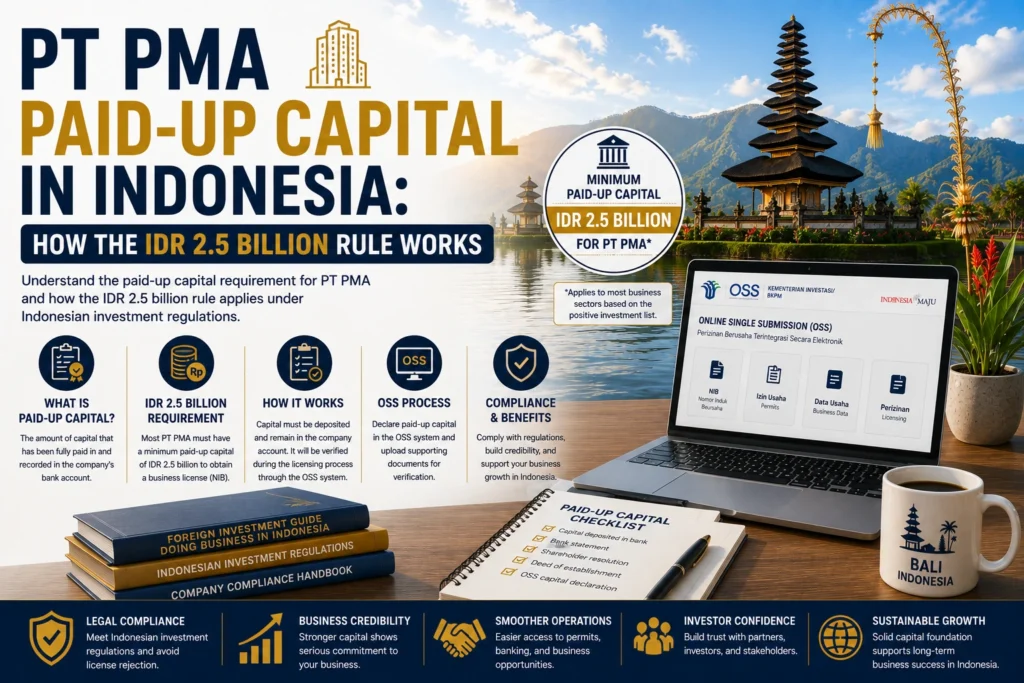
The current general minimum placed or paid-up capital for a PT PMA in Indonesia is IDR 2.5 billion per limited liability company, unless another law or regulation provides otherwise. That figure is different from the PT PMA’s separate minimum investment-value requirement.
The second important point is that the IDR 2.5 billion is subject to a 12-month account-use rule, but it is inaccurate to describe the money as completely frozen. The current regulation expressly allows it to be used for asset purchases, building construction and business operations.
For PT PMA Paid-Up Capital in Indonesia: How the IDR 2.5 Billion Rule Works, use four questions: Capital → Account → Use → Evidence.
PT PMA Paid-Up Capital in Indonesia: How the IDR 2.5 Billion Rule Works
Article 26 of the current Ministerial Regulation No. 5 of 2025 sets minimum placed or paid-up capital for PMA at IDR 2.5 billion per limited liability company, unless another law or regulation provides otherwise.
The wording matters. This is a company-level capital requirement. It is not stated as IDR 2.5 billion per KBLI or per project location.
That makes it different from the minimum investment-value framework, which can depend on business activity and project location.
For the broader company-establishment sequence, Bali Legal ID’s complete PT PMA setup guide remains the more appropriate starting point.
The IDR 2.5 Billion Rule in 2026
The IDR 2.5 billion figure should be understood as minimum placed or paid-up capital for a PT PMA, not as a government registration fee and not as the total planned investment for the business.
The same regulation treats minimum PMA investment value and minimum placed or paid-up capital as separate requirements, so the IDR 2.5 billion company-level capital figure should not be substituted for the separate investment-value test.
This distinction matters when investors are preparing the company deed, capital structure and OSS project information. The table below separates the four money concepts that are most commonly confused during PT PMA planning and shows the function of each one.
| Concept | What it means |
|---|---|
| Placed/paid-up capital | Company-level capital subject to the minimum IDR 2.5 billion rule unless otherwise regulated |
| Total investment value | Broader investment requirement calculated under the investment rules for the relevant activities and projects |
| Setup cost | Professional, notarial, administrative or licensing expenses |
| Operating expenditure | Genuine company spending in the course of business |
The main implication is that these amounts should not be combined into one generic ‘PT PMA cost.’ Paid-up capital belongs to the company’s capital structure, total investment value measures the regulatory investment plan, and setup or operating expenses answer different commercial and accounting questions.
Paid-Up Capital Is Not the IDR 10 Billion Investment Value
A frequent error is to treat the IDR 2.5 billion and IDR 10 billion figures as alternatives. They are not.
For comparison, Article 26 of the same regulation generally requires total PMA investment of more than IDR 10 billion excluding land and buildings per five-digit KBLI business field per project location, subject to sector-specific exceptions.
The basic distinction is therefore:
- IDR 2.5 billion: minimum placed or paid-up capital per PT PMA
- More than IDR 10 billion: general investment-value framework, subject to the activity and calculation rules
One figure does not replace the other.
For investors planning several activities or locations, the investment-value calculation can become substantially more complex than the company-level capital requirement. The capital structure should therefore be reviewed alongside the actual KBLI and project plan rather than from a headline number alone.
What Does the 12-Month Rule Actually Mean?
Article 27 of Ministerial Regulation No. 5 of 2025 states that the placed or paid-up capital cannot be moved from the business entity’s account for at least 12 months from the date it is placed or paid, subject to specified exceptions.
This rule is sometimes summarized as a 12-month capital ‘lock-up.’ That shorthand can be misleading because it suggests the money must remain untouched in cash.
The regulation does not say that.
The 12-month rule is not a complete freeze: the same Article 27 expressly allows the funds to be used for:
- Asset purchases
- Building construction
- Business operations
The practical question is therefore not simply, ‘Can the money leave the account?’ It is:
Is the use of the capital genuinely connected to one of the permitted business purposes?
What Can the Capital Be Used For?
The regulation expressly names three permitted categories during the 12-month period.
Asset Purchases
Capital may be used to acquire assets for the business. The appropriate asset will depend on the company’s actual operation and should be supported by normal company records and transaction evidence.
Building Construction
The rule expressly permits use for building construction. This can be relevant to businesses whose investment plan includes constructing operational premises or another business facility.
Business Operations
The regulation also permits use for business operations. This is important because it confirms that the paid-up capital is not required to sit idle for a year.
However, ‘business operations’ should not be treated as an unlimited exception for removing money from the company. The safer practical approach is to preserve a clear connection between the expenditure and the company’s genuine activities.
How the OSS Self-Declaration Works
Article 27 further provides that the 12-month capital commitment is made through a self-declaration when the business actor applies for business licensing through OSS.
This matters because the 12-month rule is not only an internal budgeting issue. It forms part of the regulatory commitment made in the business-licensing process.
The regulation also states that violation of the self-declaration can result in administrative sanctions. This article does not generalize what sanction would apply to a specific company because enforcement depends on the applicable regulatory process and facts.
The article does not assume that every PT PMA will encounter an identical screen sequence in OSS or that every sector follows an identical licensing route. The relevant OSS workflow should be checked against the company’s actual activity and licensing status.
Paid-Up Capital Is Not a Government or Consultant Fee
Another common misunderstanding is to place the IDR 2.5 billion figure inside a list of company-registration costs.
Paid-up capital and setup fees answer different questions:
- Paid-up capital: capital of the company
- Professional fee: amount charged by a consultant, notary or service provider
- Government or administrative charge: fee imposed through an official process where applicable
- Investment value: broader planned investment under the investment framework
Bali Legal ID’s PT PMA Setup Cost Bali guide addresses the separate commercial cost question. That page should not be used to treat regulatory capital as a service fee.
Likewise, the paid-up capital rule should not be described merely as ‘money you pay to register a PT PMA.’ It forms part of the company’s capital structure.
A Practical Capital Checklist Before PT PMA Setup
Before finalizing the company deed and licensing structure, review these questions:
- Is IDR 2.5 billion the applicable minimum for this PT, or does another sector-specific rule apply?
- Is the paid-up capital clearly distinguished from the total investment-value requirement?
- Who will contribute the capital and how will the company’s capital structure reflect those contributions?
- What business account will hold the funds once placed or paid?
- How does the company expect to use the capital during the first 12 months?
- Are the planned uses connected to assets, building construction or genuine business operations?
- Can the company preserve clear accounting and transaction evidence for those uses?
- Does the investment plan used for OSS match the company’s actual KBLI activities and project structure?
A company should not finalize its capital structure solely from a service quotation or a generic article. The corporate documents, shareholder contributions, investment plan and actual business model should tell the same story.
For investors who need the detailed establishment sequence rather than only the capital rule, Bali Legal ID’s PT PMA Registration Bali guide covers the broader registration process.
Once the shareholders, capital structure, business activities and licensing path have been reviewed, Bali Legal ID’s verified PT PMA Setup service is the relevant transactional next step for company-establishment support.
Conclusion
The IDR 2.5 billion PT PMA rule is a minimum placed or paid-up capital requirement per limited liability company, not a substitute for the separate total investment-value requirement.
The 12-month rule also should not be described as a complete freeze. Article 27 restricts movement of the capital from the business account but expressly permits genuine use for asset purchases, building construction and business operations.
The practical rule is: separate capital from investment value and setup fees, plan how the company will genuinely use the funds, and make sure the corporate and OSS records reflect the same capital and business structure.
Review the Capital Structure Before Incorporation
If you are preparing a PT PMA in Bali, review the intended shareholders, paid-up capital, investment value, KBLI activities and planned use of company funds before finalizing the deed or OSS licensing data.
Discuss the structure with Bali Legal ID to identify whether the next step should involve PT PMA Setup, capital and ownership review, or NIB OSS RBA licensing support.
For help coordinating the records and next steps discussed above, review our PT PMA setup services in Bali.
Read More: Complete Guide to Setting Up PT PMA in Bali: Requirements, Process & Structure (2026)
FAQ PT PMA Paid-Up Capital in Indonesia
What is the minimum paid-up capital for a PT PMA in Indonesia in 2026?
Ministerial Regulation No. 5 of 2025 sets minimum placed or paid-up capital at IDR 2.5 billion per limited liability company unless another law or regulation provides otherwise.
Is the IDR 2.5 billion required for every KBLI?
The regulation states the minimum placed or paid-up capital per limited liability company, not per KBLI. The separate investment-value framework can depend on business field and project location.
Is PT PMA paid-up capital locked for 12 months?
It is more accurate to say that Article 27 restricts movement of the capital from the business account for at least 12 months. The same rule expressly allows use for asset purchases, building construction and business operations.
Can the IDR 2.5 billion be used to operate the business?
Article 27 expressly includes business operations among the permitted uses during the 12-month period. The specific use should still be genuine company use, and appropriate business and accounting evidence should be retained.
Is IDR 2.5 billion the same as the PT PMA investment requirement?
No. Paid-up capital and total investment value are separate requirements. Article 26 separately establishes the general more-than-IDR-10-billion investment-value framework, subject to activity, location and sector-specific calculation rules.
Is the IDR 2.5 billion paid-up capital a government or consultant fee?
No. It is company capital. Professional fees, notarial expenses and other setup costs are separate commercial or administrative expenses.