
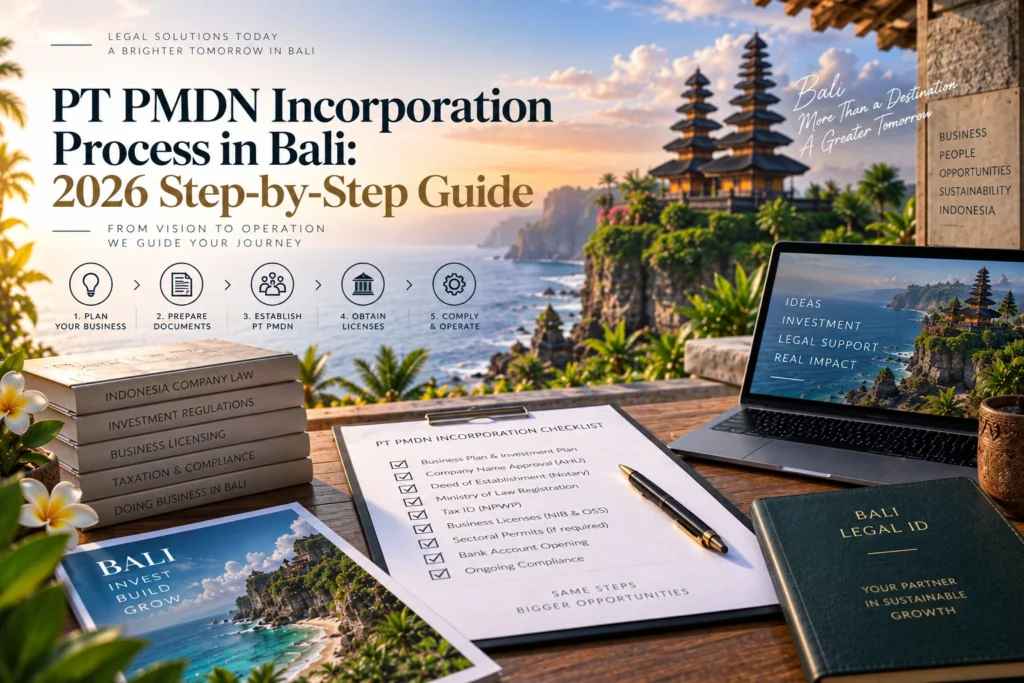
The PT PMDN incorporation process in Bali should be handled in a defined order: domestic ownership → founders and management → capital → KBLI → notarial deed → Ministry of Law registration → NIB and OSS licensing. The company-establishment stage and the business-licensing stage are connected, but they are not the same legal milestone.
Getting that sequence right matters because an incorrect ownership structure, business activity or KBLI choice can require changes after the deed has already been prepared.
PT PMDN Incorporation Process in Bali: The Correct Sequence
Step 1 — Confirm that the investment structure is domestic
Before preparing a company name or deed, determine who will ultimately own the shares.
Under Law No. 25 of 2007 on Investment, domestic investment is investment carried out in Indonesia by a domestic investor using domestic capital, while foreign investment includes investment by a foreign investor either wholly with foreign capital or jointly with a domestic investor.
That distinction should be resolved from the real ownership structure rather than from the preferred company label. If foreign shareholding is intended, review the project under the PT PMA framework before incorporation instead of establishing a domestic company first and correcting the structure later.
For that comparison, Bali Legal ID’s PT PMA formation guide is the more relevant next resource for a foreign-investment structure.
Step 2 — Choose the company form, shareholders and management
For an ordinary capital-partnership PT, Law No. 40 of 2007 on Limited Liability Companies provides the general establishment framework under which the company is formed by two or more persons through a notarial deed in Indonesian.
Before the deed is drafted, the founders should settle the share allocation and decide who will serve in the management and supervisory organs of the company. Those choices should reflect the intended long-term arrangement rather than temporary names inserted only to complete registration.
There is an important exception to the ordinary two-person structure. Government Regulation No. 8 of 2021 also recognizes a separate single-person-company route for businesses that meet the applicable micro and small business criteria, so the two-founder structure should not be described as universal for every Indonesian PT.
For most ordinary multi-owner PT PMDN incorporations, however, the conventional capital-partnership PT remains the relevant process.
Step 3 — Determine the capital structure
Set the company’s capital before the deed is finalized. Avoid copying a universal PT PMDN capital figure from an old article because the general company-capital rule and sector-specific minimum requirements are separate issues.
Under the official text of Government Regulation No. 8 of 2021, the founders determine the authorized capital, at least 25% of that capital must be placed and fully paid, and a company conducting an activity subject to a specific statutory minimum must follow the applicable sector rule.
The practical task is therefore to select a capital structure that satisfies the general company rule, any sector-specific requirement and the actual commercial needs of the planned business.
Capital should also be distinguished from professional incorporation fees, licensing costs and operating expenditure. They answer different questions and should not be combined into one generic ‘PT setup cost.’ For a breakdown of the budget and sequencing, read our PT PMDN incorporation cost and timeline guide.
Step 4 — Map the business to KBLI 2025
Before the articles of association are treated as final, identify what the company will actually sell, produce or provide and map those activities to the current KBLI classification used by OSS.
The official OSS KBLI conversion guide states that a conversion result does not automatically mean every new KBLI 2025 code fits the business activity and instructs users to check the description and scope.
That is especially relevant when founders are reusing a KBLI from an older company, an old NIB or a pre-KBLI-2025 business plan. The corporate purposes and later OSS activities should describe the same real business.
Where a company will have several material revenue streams, review each activity separately rather than assuming that one broad KBLI covers everything.
Step 5 — Prepare and execute the Deed of Establishment
Once ownership, shareholders, management, capital and activities are settled, the notarial deed can be prepared around those decisions.
The deed and articles of association should accurately reflect the company’s founders, share structure, corporate purposes, capital and initial management. Treat this stage as the formal expression of decisions already made rather than the point at which the business model is decided for the first time.
If the ownership structure, KBLI assumptions or capital still remain uncertain, resolving them before execution is generally more efficient than amending the corporate documents immediately afterward.
Step 6 — Complete Ministry of Law legal-entity registration
For the legal-entity filing stage, Minister of Law Regulation No. 49 of 2025 is currently in force and governs the establishment, amendment and dissolution procedures for limited liability companies.
The incorporation documents are processed through the applicable Ministry of Law system so that the company can obtain its legal-entity status under the current company-registration procedure.
This milestone means the company has been established as a legal entity. It should not be described as proof that every planned commercial activity is already licensed to operate.
Before moving forward, check that the company data, purposes, shareholding and management information are consistent with what will later be entered into OSS.
Step 7 — Continue to NIB and OSS risk-based licensing
After incorporation, licensing falls under Government Regulation No. 28 of 2025, the current national risk-based business licensing framework that revoked Government Regulation No. 5 of 2021.
The detailed OSS procedure is currently governed by Minister of Investment and Downstream Industry/Head of BKPM Regulation No. 5 of 2025, which is in force and replaced BKPM Regulations Nos. 3, 4 and 5 of 2021.
At this stage, the company proceeds with its NIB and the business-licensing requirements generated for its selected activities. The exact downstream requirements depend on the KBLI, risk classification and sector.
This is why the process should not end with the phrase ‘company incorporated.’ Legal-entity formation answers who the company is; OSS licensing answers what regulated activities it may undertake and what conditions apply.
For readers who need more detail on this stage, Bali Legal ID’s OSS RBA registration guide covers the licensing workflow separately.
PT PMDN Process Checkpoint
The following table summarizes the main points to compare before choosing the next step.
| Stage | Confirm before moving forward | Review again when |
|---|---|---|
| Ownership | Intended equity is genuinely domestic | Foreign ownership may be introduced |
| Company form | Ordinary PT or qualifying single-person structure is identified | Founders are assuming every PT follows one structure |
| Shareholders | Share allocations reflect the real arrangement | Temporary nominee-style arrangements are being considered |
| Management | Initial corporate management is settled | Director or commissioner roles remain unclear |
| Capital | Authorized, placed and paid-up capital have been planned | A generic online minimum is being copied |
| Activity | The company’s real products and services are defined | The business purpose remains vague |
| KBLI | Current KBLI description and scope fit each activity | An older code is being reused without review |
| Deed | Corporate data matches the intended business | Material commercial decisions are still unresolved |
| Ministry filing | Legal-entity registration is complete | Corporate information contains inconsistencies |
| OSS | NIB and activity-specific licensing requirements are understood | NIB issuance is being treated as universal operating approval |
Use this comparison as a starting point, then confirm how each point applies to the facts and documents in the specific case.
Common Process Mistakes
The first mistake is selecting PT PMDN before confirming who will really own the company. Entity classification should follow the actual investment structure.
The second is preparing the deed before the activity and KBLI analysis is clear. That can leave the corporate purposes and OSS profile describing different businesses.
The third is copying an old fixed capital number without checking the current general rule and any sector-specific minimum that applies to the activity.
Another mistake is treating Ministry approval and NIB issuance as one step. They serve different functions: one concerns establishment of the legal entity, while the other sits within the business-licensing process.
Finally, avoid using a promised number of days as the core planning assumption. Processing depends on document readiness, corporate decisions, government systems, KBLI complexity and downstream licensing requirements.
Conclusion
The PT PMDN incorporation process in Bali is easier to manage when the sequence is fixed before documents are filed. Confirm domestic ownership first, settle the company form and management, determine capital, verify the current KBLI activities, execute the deed, complete Ministry of Law registration and then proceed to NIB and risk-based licensing through OSS.
The central principle is alignment. The shareholders, articles of association, capital, KBLI and OSS profile should all describe the same real business. That provides a more reliable incorporation plan than treating the deed, NIB and operational licences as one administrative event.
Review Your PT PMDN Process Before the Deed Is Finalized
If you are preparing a domestically owned company in Bali, Bali Legal ID lists PT PMDN Setup service for the incorporation work.
Request a consultation to review the proposed ownership, shareholders, management, capital, KBLI activities and licensing sequence before the incorporation documents are treated as final.
For help coordinating the records and next steps discussed above, review our business setup services in Bali.
For help scoping the documents and next steps for your business or transaction, contact Bali Legal ID about our business setup services in Bali.
Read More: Business Setup Bali for PT PMA, PT PMDN & OSS RBA Registration
FAQ pt pmdn incorporation process
What is the first step in the PT PMDN incorporation process in Bali?
Confirm that the proposed shareholding represents domestic investment and define the real business activities. Those decisions affect the company form, deed, KBLI selection and later OSS licensing.
Does a PT PMDN always need two founders?
An ordinary capital-partnership PT generally follows the two-or-more-person establishment framework. A separate single-person-company regime exists for businesses that meet the applicable micro and small business criteria.
How much capital does a PT PMDN need?
Under the general company rule, the founders determine authorized capital and at least 25% must be placed and fully paid. A particular regulated business activity may be subject to a separate statutory minimum, so one universal PT PMDN figure should not be applied to every company.
Should KBLI be chosen before or after the deed?
The intended KBLI activities should be substantially resolved before the deed is finalized so the company’s corporate purposes and later OSS licensing profile describe the same business.
Is the company ready to operate after Ministry approval?
Not necessarily. Ministry approval concerns establishment of the legal entity. The company must still complete the NIB and any activity-specific risk-based or sector licensing requirements generated through OSS.
References & Sources
- Law No. 25 of 2007 on Investment — peraturan.go.id
- Law No. 40 of 2007 on Limited Liability Companies — peraturan.go.id
- Government Regulation No. 8 of 2021 on Company Capital and Qualifying Micro and Small Companies — peraturan.go.id
- Government Regulation No. 8 of 2021 — Official Full Text — peraturan.go.id
- Minister of Law Regulation No. 49 of 2025 on Establishment, Amendment and Dissolution of Limited Liability Companies — peraturan.go.id
- OSS Guide to Understanding KBLI Conversion — oss.go.id
- Government Regulation No. 28 of 2025 on Risk-Based Business Licensing — peraturan.go.id
- Minister of Investment and Downstream Industry/Head of BKPM Regulation No. 5 of 2025 on OSS Risk-Based Business Licensing Procedures — jdih.bkpm.go.id