
Completing the share-transfer deed and corporate amendment does not mean every government, tax, accounting and banking record automatically shows the new ownership structure. Post share transfer compliance Indonesia should therefore be treated as a system-by-system consistency review after the core corporate change has been completed.
The current corporate-data procedure is governed by Minister of Law Regulation No. 49 of 2025, which the official BPK record lists as in force and records as revoking Permenkumham 21/2021.
Post Share Transfer Compliance Indonesia: What Should Be Checked Next?
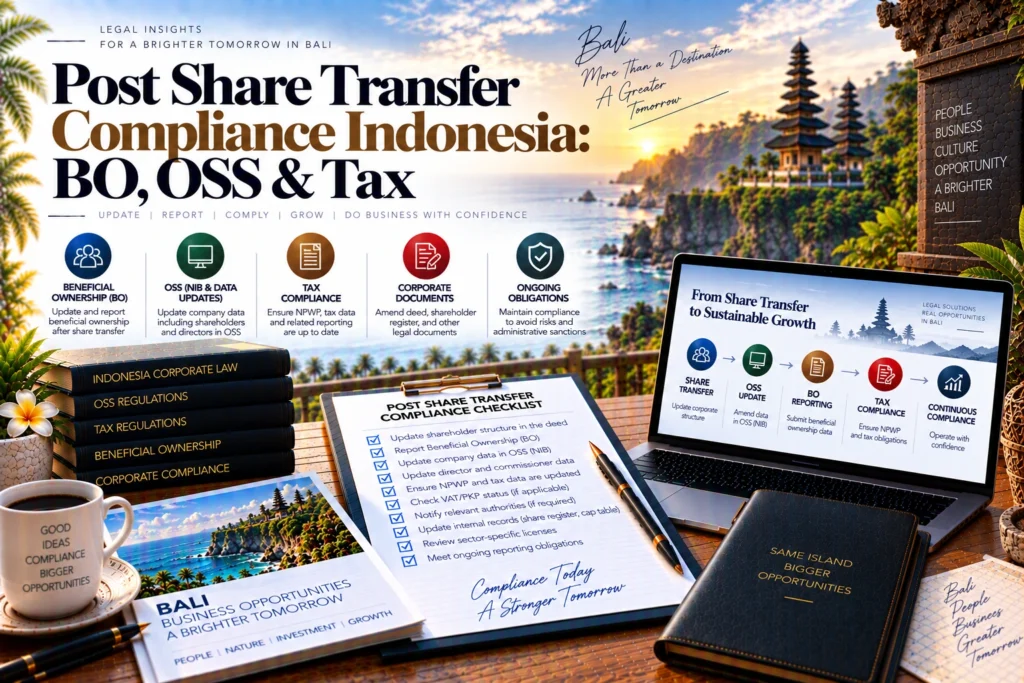
After a share transfer, review at least six record layers: the company’s corporate/AHU records, beneficial-owner information, OSS business data, Coretax related-party data, accounting and equity records, and bank mandates or KYC records.
These systems do not all serve the same purpose. A shareholder amendment establishes the corporate ownership record, while BO, licensing, tax and banking systems can require separate information or review.
The practical rule is simple: start from the updated corporate record, then test every downstream system against it.
Confirm the Corporate and AHU Record First
Before changing downstream records, confirm that the company’s final corporate documents accurately show the completed ownership structure.
Retain the share-transfer document, relevant shareholder decision or deed, updated shareholder register and AHU output together in the closing file. These documents become the reference point when OSS, Coretax, banks, accountants or counterparties ask for evidence of the new ownership.
Do not start by manually changing downstream data to a structure that has not yet been finalized in the corporate record.
Check Beneficial Ownership Separately
A registered shareholder change and a beneficial-owner change are related but not identical events.
The current beneficial-ownership verification and supervision framework is Permenkum 2/2025, which the official BPK database lists as in force and records as revoking Permenkumham 21/2019.
Does the Registered Shareholder Change the Beneficial Owner?
Ask who the natural person is after the transaction who ultimately owns, controls or benefits from the company.
A transfer from one direct individual shareholder to another may clearly change that person. A transfer between companies within the same ownership chain may change the registered shareholder without necessarily changing the ultimate natural person behind the structure.
Do not assume the answer from the shareholder register alone. Review the ownership chain, voting or control rights and the underlying transaction.
If BO Changes, Do Not Wait for the OSS Review
If the share transfer changes the company’s beneficial-owner information, Article 20 of Perpres 13/2018 requires the change to be reported no later than three working days after the beneficial-owner information changes.
That is a separate compliance clock. The BO update should not be delayed merely because another post-closing system, such as OSS or Coretax, has not yet been reviewed.
If the BO does not change, retain the ownership analysis showing why the transaction did not alter the ultimate beneficial owner.
Review OSS Business-Entity Data
OSS is one of the main places where outdated shareholder or management information can remain visible after a corporate transaction.
For a PT whose legality data comes from AHU Online, the official OSS business-entity change guide states that the business data change in OSS follows the prior legal-data change through the notarial/AHU process.
That makes the post-transfer OSS task a reconciliation exercise: compare what OSS currently shows with the updated AHU source data and resolve inconsistencies before treating the licensing record as complete.
Check Shareholders, Management and Investment Data Together
Do not review only the shareholder name.
Check country of origin, capital information, management data, shareholder information and investment status where relevant to the company’s structure. If the transaction changes foreign ownership or investment classification, review whether the company’s licensing assumptions still match the new structure.
The OSS guide does not create one universal post-transfer deadline for every licensing consequence, so the appropriate approach is to identify which OSS data and licenses are affected by the actual transaction rather than inventing one blanket filing period.
Update the Coretax Related-Party Record
Tax-profile information needs its own review after the ownership change.
For tax-profile consistency, current DGT Coretax guidance identifies company directors, commissioners and shareholders as related persons for a corporate taxpayer.
Compare the Coretax Related Parties table with the final shareholder register and corporate documents. Remove or close out the former shareholder as appropriate and add the new shareholder with accurate identity and effective-date information.
Use Effective Dates Carefully
The tax record should preserve the period during which each person was actually a shareholder or manager.
DGT also explains that Coretax uses the Valid From and Valid To dates in the Related Parties table when determining which management or shareholder data appears in the relevant corporate annual-return schedule.
That makes dates important. Simply deleting the old shareholder without recording the correct end date can create inconsistencies when later tax reporting needs to show who was connected with the company during a particular period.
Keep the transfer date and the tax-profile effective dates consistent with the transaction documents.
Reconcile the Accounting and Equity Records
The accounting records should tell the same ownership story as the shareholder register.
Review the paid-in capital and equity ledgers, shareholder sub-ledgers, opening balances, shareholder loans or related-party accounts, dividend records and any transaction entries generated by the transfer.
A transfer between existing shareholders does not necessarily mean the company itself received or paid cash. The accounting entry should reflect what actually happened rather than automatically recording the purchase price as company revenue, expense or capital movement.
Where the transaction also includes a capital increase, capital reduction, new shareholder funding or settlement of shareholder loans, separate those events from the transfer itself and document each one independently.
Retain a reconciliation between the post-transfer shareholder register, equity accounts and any related-party balances so the accounting team does not continue using the former ownership structure in later reports.
Review Bank Mandates and KYC Records
Banking should be treated as a separate operational workstream.
Review which banks hold company accounts and ask each institution what evidence it requires after an ownership change. Depending on the bank and the transaction, its KYC or mandate review may involve the updated deed or AHU record, shareholder information, beneficial-owner information, authorized signatory details or other corporate documents.
Do not assume there is one universal Indonesian deadline or one standard bank document list for every institution. The practical objective is consistency: the bank should not continue relying on an ownership, beneficial-owner or authorized-person record that the company knows has changed.
Also distinguish ownership from signing authority. A shareholder change does not automatically mean the bank signatories have changed, while a transaction involving a new director or authorized person may require a separate mandate update.
Post-Closing Compliance Checklist for Bali Companies
After a share transfer has been completed, use this sequence:
- Retain the final transfer deed and corporate approval documents
- Confirm the updated shareholder register and AHU company record
- Map the post-transfer ownership chain to the ultimate natural persons
- Determine whether beneficial-owner information changed
- If BO changed, complete the separate BO reporting process within the applicable three-working-day window
- Compare OSS shareholder and management data against the updated AHU source data
- Review whether foreign ownership, investment status or licensing assumptions changed
- Update or reconcile Coretax Related Parties data
- Record accurate Valid From and Valid To dates for old and new related persons
- Reconcile shareholder, equity and related-party accounting records
- Review shareholder loans, dividends and capital movements separately from the transfer price
- Contact each company bank for its ownership, KYC and mandate update requirements
- Review authorized signatories independently from shareholder ownership
- Check major contracts, insurance, financing and counterparties that rely on ownership or control representations
- Store the post-closing evidence in one transaction file
The checklist should be adapted to the actual transaction. A simple transfer between individuals, an intra-group restructuring and a change from domestic to foreign ownership can create very different downstream tasks.
Conclusion
A share transfer is not fully operational just because the ownership amendment has been completed at corporate level. The new structure should also be tested against beneficial-owner records, OSS, Coretax, accounting systems and bank information.
The key is not to assume that one system updates every other system. Use the final corporate and shareholder documents as the source record, then reconcile each downstream database and operational record separately. Where a separate regulatory deadline applies—especially a beneficial-owner change—treat that deadline independently from the rest of the post-closing review.
Use the AHU and OSS change checklist to separate corporate amendments from licensing updates, and review PT PMA financial reporting requirements when reconciling the records after the transfer.
Review the Records After the Share Transfer
If your Bali company has completed or is preparing a shareholder change, Bali Legal ID can be consulted to review the corporate documents and identify which ownership, licensing, tax and accounting records should be checked after closing.
Agreement deeds, company amendments, PT PMA or PT PMDN support, tax consulting, accounting services and financial-report preparation can then be scoped according to the actual transaction; the agreed service scope should follow the completed transaction and affected records.
Bali Legal ID can help you review the applicable service scope.
For help coordinating the records and next steps discussed above, review our business setup services in Bali.
For help scoping the documents and next steps for your business or transaction, contact Bali Legal ID about our business setup services in Bali.
Read More: Business Setup Bali for PT PMA, PT PMDN & OSS RBA Registration
FAQ post share transfer compliance indonesia
Does an AHU shareholder change automatically update OSS?
Do not assume it does without review. Current OSS guidance shows new management and shareholder information being sourced from AHU Online and compared with the old OSS data as part of the business-entity change process.
Does every share transfer require a beneficial-owner change?
No. A registered shareholder can change while the ultimate natural person controlling or benefiting from the company remains the same. The ownership chain should be reviewed after each material transfer.
How quickly must a beneficial-owner change be reported?
Where beneficial-owner information changes, Perpres 13/2018 provides a deadline of no later than three working days after the change in beneficial-owner information.
Should shareholder information also be updated in Coretax?
It should be reviewed for consistency. DGT Coretax guidance treats shareholders as related persons of a corporate taxpayer and provides a process for updating related-party information.
Why do the Coretax Valid From and Valid To dates matter?
DGT explains that those dates are used when determining which management and shareholder information appears in the relevant corporate annual-return schedule.
Is there one legal deadline for notifying every bank after a share transfer?
No universal bank-update deadline is stated in the sources used for this article. Banks can have their own KYC and mandate procedures, so each institution should be asked what documents and timing it requires.
References & Sources
- BPK Legal Database — Minister of Law Regulation No. 49 of 2025 — peraturan.bpk.go.id
- OSS — Business Entity Data Change Guide — s3-stg.oss.go.id
- BPK Legal Database — Presidential Regulation No. 13 of 2018 — peraturan.bpk.go.id
- Presidential Regulation No. 13 of 2018 — Official Beneficial Ownership Text — portal.ahu.go.id
- BPK Legal Database — Minister of Law Regulation No. 2 of 2025 — peraturan.bpk.go.id
- Directorate General of General Legal Administration — Beneficial Ownership FAQ — portal.ahu.go.id
- Directorate General of Taxes Coretaxpedia — Related Parties — pajak.go.id
- Directorate General of Taxes Coretaxpedia — Add or Remove Related Parties — pajak.go.id
- Directorate General of Taxes Coretaxpedia — Management Data in Corporate Annual Return Schedule L2 — pajak.go.id