
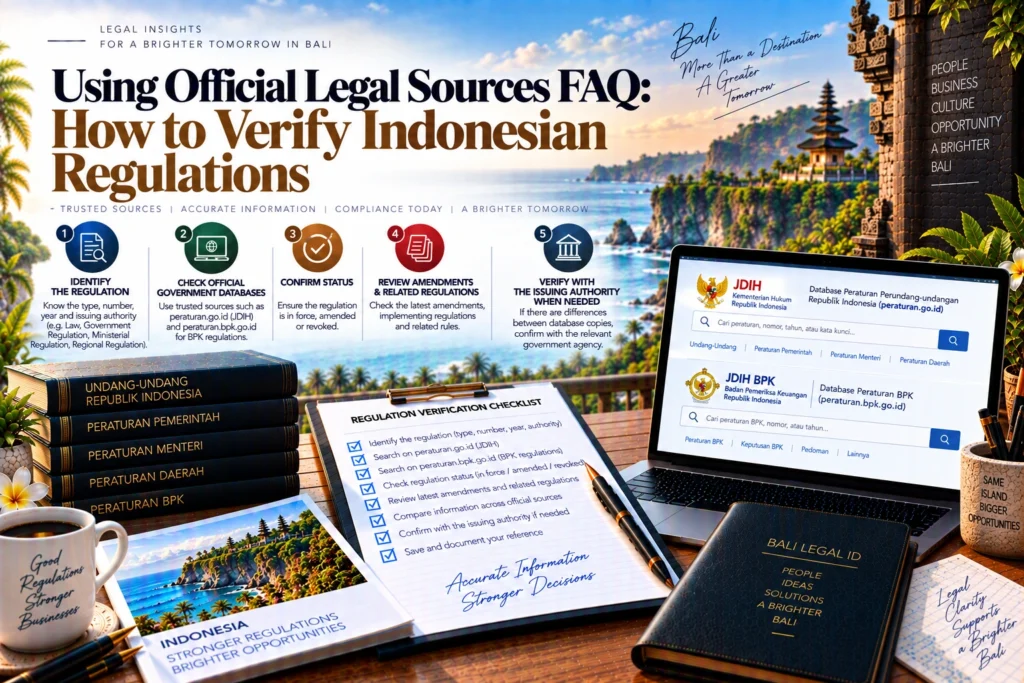
Finding a government webpage is not the same as proving that you have the current rule. A reliable legal-source check should answer four questions: Who issued the rule? Is it still in force? Has it been amended or replaced? And are you reading the binding text or only an explanation of it?
Using Official Legal Sources FAQ: Where Should You Start?
For a using official legal sources FAQ, the best starting point is the legal instrument itself and its current status record, not a search-engine snippet, social-media post or consultant summary.
The institutional basis for that network remains Perpres 33/2012 on Jaringan Dokumentasi dan Informasi Hukum Nasional, which the official BPK database currently lists as in force.
For a business owner, that produces a useful rule of thumb: use integrated databases to find the material, but verify the instrument, status and relevant text before relying on it in a transaction.
What Counts as an Official Legal Source in Indonesia?
There is no need to limit research to one website. Different official sources perform different jobs.
The Ministry of Law’s Directorate General of Legislation database states that it provides information on the type, status and relationships of Indonesian regulations.
These sources can complement one another. One may make the amendment chain easier to see, while another may provide the issuing institution’s document or the official publication record.
Official Regulation Text
When a rule is legally material, open the actual law, government regulation, presidential regulation, ministerial regulation or other instrument instead of relying only on an abstract or summary.
Record the title, number, year, issuing authority, date of enactment or promulgation and the specific article relevant to your question.
If the document is a PDF, make sure the document identity shown inside the file matches the database record you opened. A copied PDF with no reliable source page gives you less assurance about status and provenance.
Official Status and Relationship Metadata
The text tells you what the instrument says. The status page helps tell you whether that text is still the complete rule.
For the legislative framework itself, Law No. 12 of 2011 remains in force but the current BPK status record shows that it has been amended by later legislation.
That is a useful example of why an old PDF can be authentic and still be incomplete for a current legal question. Authenticity and current applicability are separate checks.
Is JDIHN Enough on Its Own?
JDIHN is highly useful for discovery because it brings together documents from many member institutions. But its own disclaimer provides an important verification rule: where there is doubt about a document, confirm it with the relevant member JDIH.
In practice, if JDIHN helps you find a ministerial regulation, follow through to the ministry’s JDIH or another official government source where possible. If the question concerns tax administration, check the relevant Directorate General of Taxes source. For OSS procedures, check official OSS material. For corporate legal administration, check AHU or the applicable official legal database.
This does not mean an integrated portal is unreliable. It means the final verification should follow the institution responsible for the document or procedure when that source is available.
Confirm the Instrument’s Current Version
Confirm the status, effective date and amendments before relying on a provision. Our regulation status checklist explains that separate verification workflow.
Regulation Text vs Government Guidance: What Is the Difference?
Government FAQs, manuals, technical guides and application instructions can be extremely useful, but they do not perform the same function as the regulation itself.
Use the regulation or statute for binding requirements such as legal duties, formal deadlines, eligibility rules and sanctions. Use official agency guidance to understand how the responsible authority currently explains or implements a system or procedure.
For example, a regulation might create the reporting obligation while an official portal explains which menu, field or document is used in the electronic system. Both can be relevant, but they should be cited for different propositions.
If guidance appears inconsistent with the underlying regulation, do not silently choose the easier wording. Recheck the regulation’s current status and seek clarification before making a high-impact decision.
What Information Should You Record From a Source?
A simple source log makes later review much easier. For every rule that materially affects a transaction or compliance decision, record:
- Official title of the instrument or guidance
- Regulation number and year where applicable
- Issuing authority
- Exact official URL
- Current status shown by the official database
- Effective date where relevant
- Amendment or revocation relationships
- Specific article, paragraph or section relied on
- Short description of what the source actually supports
- Date you checked the source
This prevents a common research problem: remembering the conclusion but losing the exact version and source that supported it.
It also makes professional review faster because the adviser can see which legal materials have already been identified and where interpretation is still required.
When Should You Ask a Legal Professional to Interpret the Sources?
Official-source research is useful for checking what instruments exist and what they say. It does not automatically resolve how several rules interact with the facts of a particular transaction.
Professional interpretation is particularly useful when different regulations appear to overlap, when a rule has several amendments, when transitional provisions matter, when a government database and operational system appear inconsistent, or when the decision affects ownership, land rights, licensing, tax exposure or a significant contract.
Also seek clarification where the wording depends on a definition elsewhere in the instrument. Reading one article in isolation can produce a different result from reading the definitions, exceptions, transitional provisions and implementing rules together.
Official Legal Source Checklist for Bali Business Owners
Before relying on a legal rule for a Bali business or investment decision, run this check:
- Identify the exact legal question before searching
- Find the regulation or official guidance in a government legal database
- Confirm the instrument number, year and issuing authority
- Check whether the status is current, amended or revoked
- Open the amendment and revocation relationships shown by the official database
- Verify the actual article or section supporting the proposition
- Confirm the effective date and relevant jurisdiction
- Check the responsible ministry, regulator or member JDIH where appropriate
- Separate binding regulation text from an FAQ, manual or operational guide
- Save the exact URL and access date
- Record the conclusion supported by that source without overstating it
- Obtain professional interpretation when the facts or interaction between rules remain uncertain
This approach is more reliable than building a legal conclusion from a single search result because it preserves both the rule and its current legal context.
Conclusion
The strongest legal research does not depend on one favorite website. It uses official sources according to their function.
Use national and institutional databases to find the instrument, status and amendment chain; open the actual legal text for binding rules; use regulator guidance for current operational procedures; and keep a source record showing exactly what was checked. When the answer depends on how those rules apply to a real investment, property, corporate or tax situation, treat source verification as the beginning of the analysis rather than the end.
To apply this sourcing method, follow the regulation-status checking workflow, then use the legal-versus-tax advice checklist to frame the question that needs professional interpretation.
Bring the Verified Sources Into the Consultation
If you are preparing a Bali property, company, licensing or tax matter and have already identified the relevant regulations, Bali Legal ID can be consulted to review how those sources relate to the facts and documents of the transaction.
Legal documentation, company setup, land-document checks, tax consulting, accounting and financial-report preparation can then be scoped according to the actual matter; the service scope should identify the legal question and the applicable current provisions.
For help coordinating the records and next steps discussed above, review our business setup services in Bali.
For help scoping the documents and next steps for your business or transaction, contact Bali Legal ID about our business setup services for company and licensing matters.
Read More: Bali Legal Service for Business, Property, Tax & Investment Solutions
FAQ using official legal sources
Is JDIHN an official legal source?
Yes. JDIHN is the national legal documentation and information network established under Perpres 33/2012. Its portal also states that documents are sourced from member JDIH sites and recommends confirmation with the relevant member site if there is doubt about a document.
Can I rely on a regulation PDF found through Google?
Use the PDF only after confirming its identity and current status through an official government source. An authentic older PDF can still be incomplete if the regulation has since been amended or revoked.
How can I tell whether an Indonesian regulation has been amended?
Check the official status and relationship information on sources such as BPK’s Regulation Database or the Directorate General of Legislation database, then open the relevant amending instrument before relying on the original provision.
Is an official government FAQ legally the same as a regulation?
No. An official FAQ or manual can explain current administrative practice, but binding legal requirements should be traced to the applicable law or regulation when one exists.
Should I use BPK, JDIHN or the ministry’s own JDIH?
They can be used together. Integrated databases are useful for discovery and status checking, while the responsible ministry or member JDIH can be important for confirming the source document and current operational guidance.
Why should I record the date I checked a legal source?
Legal texts, amendment relationships and administrative guidance can change. Recording the access date helps later reviewers understand which version and status information supported the analysis at that time.
References & Sources
- National Legal Documentation and Information Network — JDIHN Portal — jdihn.go.id
- BPK Legal Database — Presidential Regulation No. 33 of 2012 on JDIHN — peraturan.bpk.go.id
- Directorate General of Legislation — Regulation Database — peraturan.go.id
- BPK Legal Database — Regulation Database — peraturan.bpk.go.id
- BPK Legal Database — Law No. 12 of 2011 on the Formation of Laws and Regulations — peraturan.bpk.go.id
- Ministry of State Secretariat — JDIH Portal — jdih.setneg.go.id