Standard certificate documents in Indonesia are not one universal package for every business. The correct list depends on the company’s KBLI, activity scope, business scale, risk classification, environmental requirements and the technical standards set for that sector.
The current framework is Government Regulation No. 28 of 2025, which BKPM’s official JDIH lists as in force and which replaced the former PP 5/2021 framework.
PP 28/2025 defines a Standard Certificate as a statement and/or evidence of fulfillment of business-activity implementation standards.
Standard Certificate Documents: Is There One Required List?
No. A useful standard certificate documents checklist starts with the specific activity, not with a generic folder downloaded from another company’s application.
PP 28/2025 provides that KBLI, activity scope, business scale, risk level, licensing type, requirements, issuance period, obligations, parameters and licensing authority are specified by sector in Annex I.
This means two companies can both need a Standard Certificate while being asked for different evidence. A tourism activity, construction activity, industrial activity and health-related activity may each have a different technical standard and different verifier.
The safest workflow is therefore: confirm the KBLI, run the OSS risk validation, read the displayed requirements and then prepare documents against that exact list.
First Check Whether the Business Is Medium-Low or Medium-High Risk
The risk level changes what the Standard Certificate means and how much verification is required.
Medium-Low Risk
For a medium-low risk activity, Article 131 provides that the business licensing consists of an NIB and a Standard Certificate, with the certificate taking the form of the business actor’s statement to fulfill the applicable business standards.
The document process is therefore different from a medium-high application requiring technical verification before the Standard Certificate becomes the operational licensing basis.
For both medium-low and medium-high activities, Articles 221 and 222 distinguish between activities requiring the UKL-UPL form and activities using the SPPL form in the OSS process.
Do not upload an environmental document simply because another company used it. Confirm which environmental path OSS assigns to the actual project.
Medium-High Risk
For medium-high risk activities, Articles 132 and 222 provide that OSS first issues a Standard Certificate marked as not yet verified, after which the business actor must fulfill the applicable business standards for verification by the competent authority.
An unverified Standard Certificate is therefore not the end of the document process. It supports preparation while the required standard evidence is completed and reviewed.
For medium-high risk businesses, Article 132 states that the NIB together with the verified Standard Certificate constitutes the business licensing basis for operational and/or commercial activity.
That distinction matters when planning an opening date, signing operational contracts or assuming the business is already ready for commercial activity.
Documents and Data to Prepare Before Opening the OSS Requirement Screen
Even though the final upload list is activity-specific, businesses can organize the supporting file before starting the verification process.
Business and Project Data
Prepare one consistent set of core information covering the company, project location and activity. As a practical working file, this normally means having the corporate identity records, NIB and OSS profile information, selected KBLI, business location, investment data, workforce information and product or service description available for cross-checking.
The purpose of preparing these records is consistency. If the deed, OSS profile, project data and technical documents describe different activities or locations, the verification file can become difficult to reconcile.
Environmental and Basic-Requirement Records
Check the environmental path assigned to the project and retain the corresponding OSS or environmental documentation.
Depending on the activity, location and project characteristics, other basic requirements may also need to be completed before or alongside the business licensing process. Treat these as project-specific requirements rather than a universal Standard Certificate attachment list.
If an existing approval is being reused or a project is migrating from an older licensing process, confirm its current validity and how OSS recognizes it before assuming it satisfies the new application.
Sector-Specific Standard Evidence
This is the part that should never be guessed.
The technical evidence can vary by sector and KBLI. Depending on the activity, the relevant sector rule may ask for plans, technical specifications, professional qualifications, equipment information, operational procedures, facility evidence, certificates or other supporting material.
Use the exact wording shown by OSS and the applicable sector standard. Do not rename a different document as equivalent unless the competent authority accepts that equivalence.
How to Find the Exact Documents Required for Your Standard Certificate
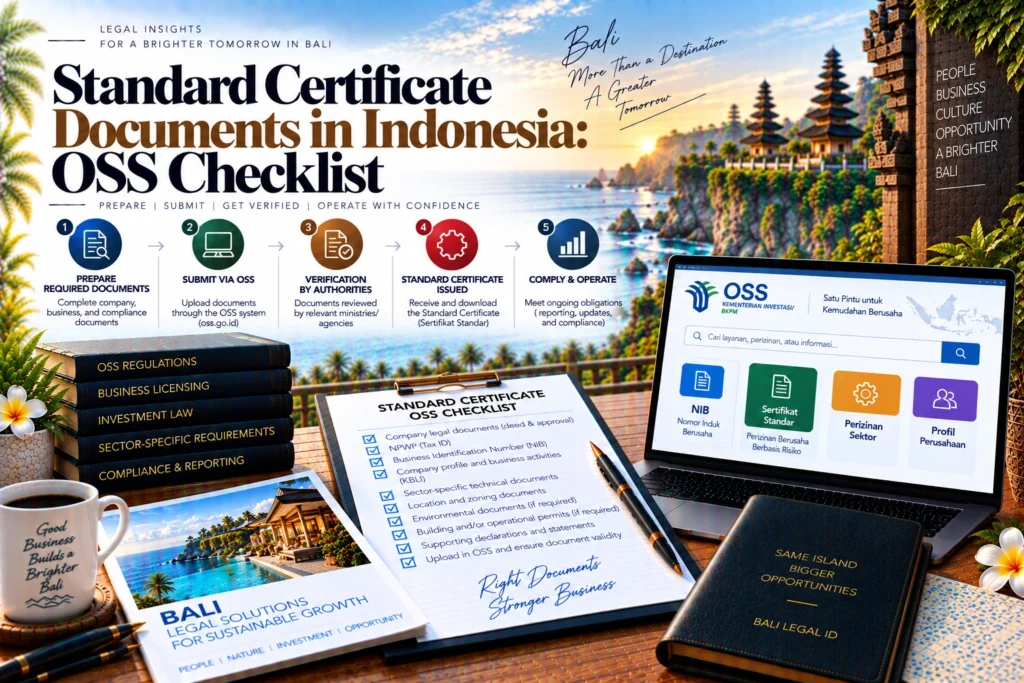
Use this sequence inside the licensing workflow:
- Confirm the correct five-digit KBLI and activity scope
- Confirm the business scale and project location
- Complete or validate the business data
- Run the OSS risk validation
- Read the displayed risk classification
- Review the listed requirements and obligations
- Identify the authority responsible for verification
- Complete the applicable environmental process
- Open the business-standard fulfillment section
- Create a document checklist matching every displayed requirement
- Upload only the current and relevant evidence
- Keep a copy of the submitted version for later review
The current OSS procedural framework also includes Minister of Investment and Downstreaming/Head of BKPM Regulation No. 5 of 2025, which BKPM JDIH lists as in force and records as revoking BKPM Regulations No. 3, 4 and 5 of 2021.
Older tutorials prepared solely under the former 2021 OSS procedural regulations should therefore be checked against the current system before their document lists are reused.
What Should Be Checked Before Uploading Documents?
A correct document can still create problems if it is inconsistent with the application.
Before upload, check the company name, NIB or other identifiers, project address, KBLI, activity description and responsible party across the file set. Make sure the document is complete, readable and still valid where a validity period applies.
Check whether signatures, professional certifications, technical attachments or supporting schedules referenced inside a document are actually included.
For plans and technical documents, confirm that the project described is the same project submitted in OSS. A drawing or operational plan from a different location should not be reused simply because the business activity is similar.
Name files clearly. A verification folder organized by the OSS requirement wording is easier to review than a folder containing generic names such as document1.pdf or final-new-revision.pdf.
What Happens After a Medium-High Risk Submission?
For a medium-high activity, the supporting evidence is reviewed by the competent ministry, regional authority, KEK administrator or KPBPB authority according to the applicable jurisdiction and sector.
If the evidence meets the requirements, OSS records the Standard Certificate as verified. If it does not, the applicant can be required to complete or correct the requirements before another verification.
The current PP 28/2025 process therefore makes document preparation part of operational readiness, not merely an administrative upload exercise.
Keep the submitted documents, reviewer comments, corrections and final verified output together. That creates a licensing record that can later be used for internal compliance, changes to the business and government supervision.
Standard Certificate Document Checklist for Bali Businesses
Before submitting a Bali Standard Certificate file, check the following:
- Confirm the exact KBLI and business scope
- Confirm the risk level in OSS
- Determine whether the Standard Certificate is medium-low or medium-high
- Check the current company and OSS profile data
- Confirm the project address and location data
- Complete the environmental route assigned to the activity
- Read every requirement shown in the OSS licensing result
- Open the applicable sector standard where technical requirements are listed
- Create one file or evidence item for each requirement
- Check names, addresses, identifiers and activity descriptions for consistency
- Check document validity dates where applicable
- Include referenced technical attachments and schedules
- Upload the documents through the correct fulfillment screen
- Save the exact version submitted
- Monitor verification status and respond to correction requests
- Keep the verified Standard Certificate with the underlying evidence file
The important point is that this checklist organizes the process; it does not replace the requirement list generated for the specific KBLI.
Conclusion
There is no reliable one-size-fits-all list of Standard Certificate documents in Indonesia. The correct evidence is determined by the business activity, risk result and applicable sector standards.
Start with the KBLI and OSS risk validation, distinguish medium-low from medium-high risk, complete the applicable environmental or basic requirements, and then build the document file directly from the requirements displayed for that activity. For medium-high risk businesses, treat the verified Standard Certificate—not merely the initial unverified output—as the key licensing milestone before operational or commercial activity.
Read the OSS registration and licensing guide alongside this document checklist so the preparation file stays connected to the wider business-licensing workflow.
Check the OSS Requirements Before Preparing the Upload File
If your Bali business needs help identifying the correct KBLI, reviewing the OSS requirement screen or organizing the documents needed for a Standard Certificate, Bali Legal ID can be consulted before the licensing submission is finalized.
NIB OSS RBA registration, PT PMA or PT PMDN setup, agreement documentation and related compliance support can then be scoped according to the actual business activity; the service scope should follow the requirements shown in OSS.
For help coordinating the records and next steps discussed above, review our NIB and OSS RBA registration services in Bali.
For help scoping the documents and next steps for your business or transaction, contact Bali Legal ID about our business setup services in Bali.
Read More: Business Setup Bali for PT PMA, PT PMDN & OSS RBA Registration
FAQ standard certificate documents
What documents are required for a Standard Certificate in Indonesia?
There is no single universal document list. The exact requirements depend on the KBLI, business scope, scale, risk classification, environmental route and sector-specific standards shown for the activity in OSS.
Does a medium-low risk Standard Certificate require government verification before operating?
Under PP 28/2025, the medium-low Standard Certificate is based on the business actor’s statement to fulfill the applicable standards. Compliance with those standards remains subject to supervision.
What is different for a medium-high risk Standard Certificate?
OSS initially issues a Standard Certificate marked as not yet verified. The business must then fulfill the applicable standards and undergo verification by the competent authority before the NIB and verified Standard Certificate form the licensing basis for operational or commercial activity.
Do I need UKL-UPL or SPPL for the Standard Certificate?
The applicable environmental path depends on the activity and project. PP 28/2025 distinguishes activities requiring the UKL-UPL form from those using SPPL in the medium-risk OSS process.
Where can I see the exact documents my business must upload?
Complete the business data and OSS risk validation, then review the requirements and obligations displayed for the specific activity. The business-standard fulfillment screen is the practical checklist for the supporting evidence that must be submitted.
Can I use a Standard Certificate document checklist from another company?
Use it only as a reference for file organization, not as the controlling requirement list. Different KBLI codes, business scales, locations and sectors can produce different standards, documents and verification authorities.
References & Sources
- BKPM JDIH — Government Regulation No. 28 of 2025 — jdih.bkpm.go.id
- Government Regulation No. 28 of 2025 — Official Text — jdih.bp2mi.go.id
- BKPM JDIH — Minister of Investment and Downstreaming/Head of BKPM Regulation No. 5 of 2025 — jdih.bkpm.go.id
- OSS — Business Licensing Application Guide — s3.oss.go.id
- OSS — Business Licensing Resubmission Guide — s3.oss.go.id