
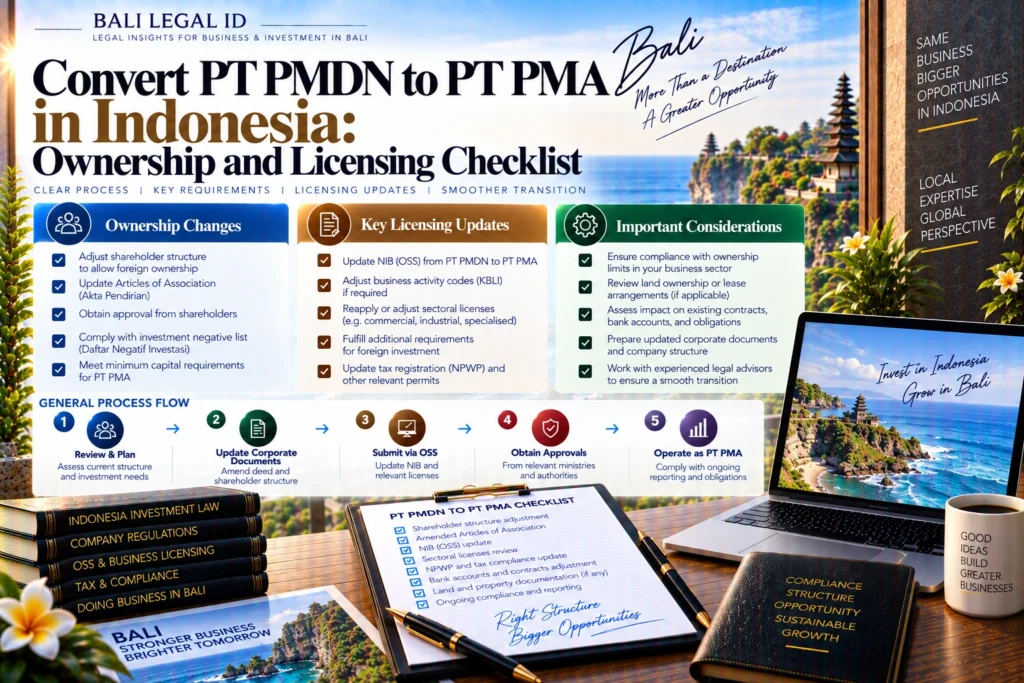
Introducing a foreign shareholder into an existing PT PMDN changes more than the shareholder list. The company must be reviewed against Indonesia’s foreign-investment rules, its corporate shareholder data must reflect the transaction, OSS must recognize the new investment status, and the company’s existing activities and licences must still fit the PMA framework.
The legal starting point is Article 5(2) of the Investment Law, which requires foreign investment to be carried out through an Indonesian limited liability company domiciled in Indonesia unless another law provides otherwise.
PT PMDN to PT PMA Conversion Indonesia: The Short Answer
A PT PMDN to PT PMA conversion Indonesia project should normally be treated as a sequence, not as one administrative click:
- confirm that the existing business activities permit the proposed foreign ownership
- structure and document the foreign shareholder’s entry
- update the company’s shareholder and other affected corporate data
- ensure the updated data is reflected through AHU and recognized by OSS
- process the PMDN-to-PMA status change in OSS
- check PMA investment and paid-up-capital compliance
- review each existing KBLI and business licence under the foreign-investment structure
- complete the relevant post-share-transfer corporate, tax, beneficial-owner, and compliance work
The order matters. If the incoming foreign shareholder, capital, or KBLI information has not been correctly reflected in the underlying corporate data, the OSS status transition may not proceed cleanly.
Step 1: Check Whether Foreign Ownership Is Allowed
Do this before signing an unconditional share transfer.
Before introducing a foreign shareholder, check the company’s business activities against Perpres No. 10 of 2021, which JDIH BPK lists as in force and amended by Perpres No. 49 of 2021.
This review should be performed against the company’s actual KBLI portfolio, not only the commercial description of the business.
Do Not Assume One Foreign Ownership Percentage Fits Every KBLI
There is no safe universal answer such as ‘a foreign investor can always own X%.’ Some activities may be generally open, others may carry ownership conditions, and some may not be compatible with the proposed foreign-investment structure.
For a company with several KBLI codes, review them individually. One problematic activity can become a transaction issue even if the company’s main revenue-generating activity is open to foreign investment.
The existing OSS registration and licensing guide can be used as a separate licensing reference, but the conversion analysis should specifically test foreign-investment eligibility as well.
Step 2: Document the Foreign Shareholder Entry
The company does not become PMA merely because the parties have commercially agreed that a foreign investor will enter.
Corporate changes are now administered under Permenkum No. 49 of 2025, which JDIH BPK lists as in force from 17 December 2025 and as revoking Permenkumham No. 21 of 2021.
The actual transaction may involve a transfer of existing shares, subscription for new shares, a capital increase, or another lawful corporate structure. The documents and approvals required depend on how the foreign investor enters and whether other provisions of the articles of association, shareholder arrangements, or sector regulations apply.
For planning purposes, the company should identify before closing:
- which existing shareholder is transferring shares, if any
- whether new shares will be issued
- the post-transaction ownership percentages
- whether authorized, placed, or paid-up capital must change
- whether directors or commissioners will change
- whether the articles of association need amendment
- which corporate and foreign-investor documents must be available to the notary
Do not treat the OSS status conversion as a substitute for documenting the underlying shareholder transaction correctly.
Step 3: Make Sure AHU and OSS Data Match
OSS publishes a dedicated Guide to Changing the Status of Domestic Investment (PMDN) to Foreign Investment (PMA), and its workflow compares company, management, shareholder, and capital information in OSS with the newer data sourced from AHU Online.
That makes data synchronization a practical conversion requirement. The information in the corporate record should be settled first so OSS has the correct ownership and capital data to compare.
The same official guide shows that the status-transfer process can require shareholder data to be changed through the company’s notary when the AHU-derived data still shows only Indonesian shareholders.
In other words, do not try to use OSS to create a foreign shareholder that has not yet been properly reflected in the underlying company data.
What OSS Checks During the Status Transfer
The official workflow shows review of several data sets, including:
- basic company-formation data
- management and shareholder information
- country of origin for relevant parties
- old and new capital data
- capital-ownership information
- consistency between OSS records and AHU Online data
- whether the company’s KBLI activities can continue under the foreign-investment structure
The status change is not automatic for every existing licence because the OSS guide shows that the process can be blocked when an existing KBLI does not comply with the applicable foreign-investment business-field rules.
Where a problematic KBLI appears, resolve the activity and licensing issue before treating the foreign-investment conversion as complete.
Step 4: Recalculate the Company Under PMA Rules
A company that was compliant with ordinary PT PMDN capital assumptions should not carry those assumptions forward automatically after becoming PMA.
Once the company becomes PMA, the current investment-administration framework includes Permeninves/BKPM No. 5 of 2025, which JDIH BPK lists as in force from 2 October 2025 and as replacing the earlier 2021 BKPM OSS, licensing-procedure, and supervision regulations.
The same regulation separately provides that minimum placed and paid-up capital for a PMA limited liability company is IDR 2.5 billion per company unless another applicable regulation provides otherwise.
These are different concepts. The investment value is not the same thing as the company’s paid-up capital, and neither should be confused with the professional cost of handling the conversion.
If the company needs a broader budget for the foreign-investment structure after conversion, Bali Legal ID’s PT PMA setup cost guide explains the current investment and capital framework in more detail.
Step 5: Review Existing OSS Licences
Changing investment status does not automatically prove that every existing licence remains suitable for the new ownership structure.
The licensing layer must also be rechecked under PP No. 28 of 2025, which JDIH BPK lists as the current Risk-Based Business Licensing regulation and as replacing PP No. 5 of 2021.
Review each activity for:
- KBLI compatibility with foreign investment
- project location
- NIB data
- risk classification
- Standard Certificate or permit status where relevant
- PB UMKU or supporting approvals where relevant
- basic requirements tied to the location or project
- sector-specific foreign-investment conditions
Do not assume that because the PT already operated as PMDN, every pre-existing licence will carry across without review.
Conversion Checklist Before Signing the Share Deal
The following matrix is useful for deciding whether the transaction is ready to proceed.
| Review area | Question before closing | Why it matters |
|---|---|---|
| Foreign ownership | Is the proposed foreign percentage permitted for every relevant KBLI? | A restricted activity can block or reshape the transaction |
| Share transaction | Transfer, subscription, capital increase, or another structure? | Determines the corporate documents and capital changes |
| AHU data | Will the new foreign shareholder be reflected correctly? | OSS relies on AHU-linked corporate data |
| Capital | Will the company meet the PMA capital requirement? | PMA rules differ from ordinary PT PMDN assumptions |
| Investment value | Does each relevant activity/location meet the applicable PMA calculation? | PMA is treated as large business under the current framework |
| OSS status | Can the PMDN-to-PMA transfer be completed with the updated data? | Status conversion is a separate system step |
| Existing KBLI | Does any activity conflict with foreign-investment rules? | OSS can stop the transition for a non-compliant activity |
| Licensing | Do the NIB and licences still fit the post-conversion structure? | Corporate conversion and operational licensing are separate issues |
| Post-transfer work | Which BO, tax, corporate, banking, contract, and compliance updates remain? | Closing the share transaction is not the end of implementation |
The table shows why the safest sequence is to clear foreign-ownership eligibility and corporate data before relying on the OSS status-transfer step.
What Can Delay or Block the Conversion?
Common risk points include:
- an existing KBLI that is restricted for the proposed foreign ownership
- foreign-shareholder data not yet reflected through the corporate record
- mismatches between AHU and OSS data
- incomplete country-of-origin or shareholder information
- insufficient capital for the PMA framework
- existing licences that no longer fit the new investment status
- several project locations requiring separate investment calculations
- sector-specific approvals or ownership conditions
- last-minute changes in the investor, percentage acquired, directors, or capital structure
- tax or contractual issues discovered only after the share agreement has already become unconditional
These issues should be mapped before closing conditions are finalized. Where a material requirement remains unresolved, the transaction documents can be structured so that closing depends on the relevant corporate, regulatory, or licensing condition being satisfied rather than assuming that it will be fixed afterward.
For the broader compliance work after the ownership transfer, Bali Legal ID’s company change and licensing checklist provides a separate checklist covering the period after the transaction itself.
Conclusion
A PT PMDN to PT PMA conversion Indonesia is not merely a change of label in OSS.
The company should first confirm that its existing activities can accept the proposed foreign ownership. The foreign shareholder’s entry must then be properly documented and reflected in the company’s corporate data. Only after the underlying ownership information is aligned should the company rely on the OSS PMDN-to-PMA status-change workflow.
After conversion, the company must be reviewed under the PMA investment and capital framework and its existing KBLI and licences should be checked again under the foreign-investment structure.
The most useful pre-closing question is therefore: if the foreign shareholder entered today, would the company’s ownership, AHU data, PMA capital, investment value, KBLI portfolio, and existing business licences all support the new structure?
Map the PMDN-to-PMA Transition Before the Share Transfer Closes
If an existing Bali company is introducing foreign ownership, Bali Legal ID’s PT PMA setup service can assist with a consultation to map the proposed shareholder change, corporate documents, PT PMA setup implications, NIB OSS RBA registration, KBLI review, capital requirements, and related post-transfer compliance before the transition is implemented.
A useful conversion scope should identify what must happen before closing, what must be updated through corporate and government systems, and which licensing or compliance items remain after the ownership change.
FAQ – PT PMDN to PT PMA Conversion Indonesia
Does a PT PMDN automatically become PT PMA when a foreigner buys shares?
The foreign investment changes the regulatory character of the company, but implementation requires more than the commercial share deal. The new ownership must be reflected in the corporate data and the company’s investment status must be processed through the applicable OSS workflow.
Should foreign ownership eligibility be checked before the share transfer?
Yes. Review every relevant KBLI against the current investment-business-field rules before closing. The official OSS conversion workflow can stop where an existing KBLI does not comply with foreign-investment requirements.
Do shareholder changes need to appear in AHU before the OSS status transfer?
The official OSS PMDN-to-PMA guide compares OSS data with AHU Online data and directs users to change shareholder data through the notary where the AHU-derived data still shows only Indonesian shareholders. Corporate data should therefore be aligned before relying on the OSS status-transfer step.
What capital applies after converting to PT PMA?
Under the current 2025 investment regulation, the general PMA investment-value rule is above IDR 10 billion under the applicable activity-and-location calculation, subject to stated exceptions, while minimum placed and paid-up capital is IDR 2.5 billion per PT unless another applicable regulation provides otherwise.
Will all existing PT PMDN licences remain valid after foreign investment enters?
Do not assume so without review. The business activities, ownership conditions, OSS data, risk-based licences, project locations, and sector requirements should be checked under the post-conversion PMA structure.
Is it better to form a new PT PMA instead of converting the existing PT PMDN?
That is transaction-specific. Conversion can preserve the existing company, contracts, licences, assets, and operating history, but existing liabilities, restricted activities, data problems, or licensing complexity may affect the decision. Compare the legal, tax, licensing, contractual, and commercial consequences before choosing the structure.
References & Sources
- Current Status of Indonesia’s Investment Law — peraturan.bpk.go.id
- Official Investment Law Provision on Foreign Investment Business Form — peraturan.bpk.go.id
- Current Investment Business Field Regulation — peraturan.bpk.go.id
- Current Amendment to Indonesia’s Investment Business Field Regulation — peraturan.bpk.go.id
- Official OSS Guide to Changing Investment Status from PMDN to PMA — s3.oss.go.id
- Current Investment and OSS Administration Regulation No. 5 of 2025 — peraturan.bpk.go.id
- Official PMA Investment Value and Capital Provisions in Regulation No. 5 of 2025 — peraturan.bpk.go.id
- Current Ministry of Law Regulation for Limited Liability Company Changes — peraturan.bpk.go.id
- Current Risk-Based Business Licensing Regulation — peraturan.bpk.go.id
Recommended Next Articles
- PT PMA vs PT PMDN: ownership and setup differences
- PT PMA setup cost guide — balilegalid.com
- OSS registration and licensing guide — balilegalid.com
- company change and licensing checklist — balilegalid.com