
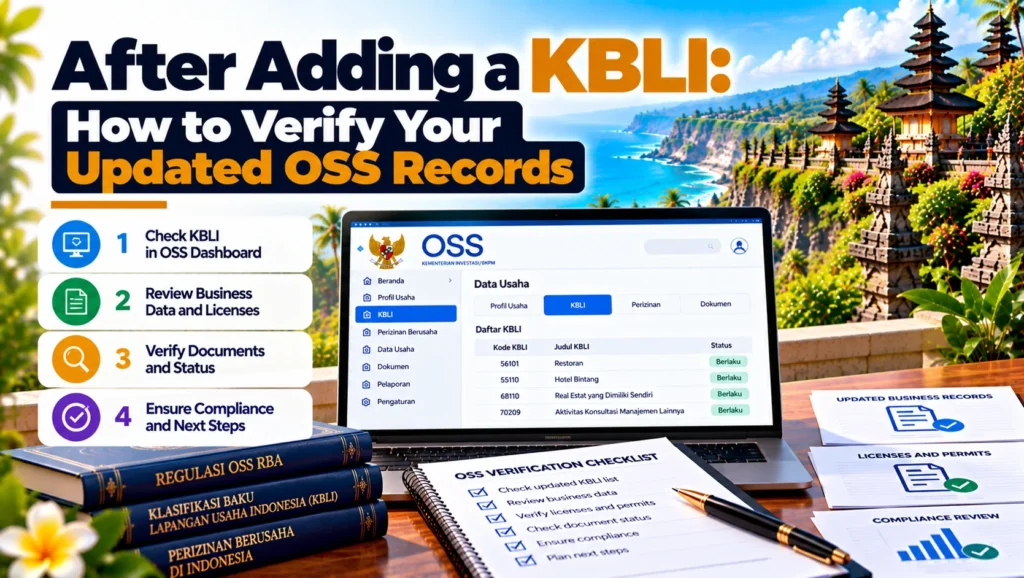
After adding a KBLI activity in OSS, verify three things: the new business activity is recorded correctly, its location and project information match the intended operations, and the relevant licensing outputs reflect the actual business activity. An updated activity entry alone does not establish that every applicable licensing condition has been completed.
For a PT PMA or PT PMDN operating in Bali, the practical goal is to verify updated OSS records after adding KBLI and identify any mismatch before relying on the revised documents for business decisions.
This post-submission review is different from choosing a KBLI or deciding how to add one. It begins with the change that has already been submitted and checks whether the resulting records match what the company intended.
What Should You Verify After Adding a KBLI?
The most useful post-addition review has three layers: business activity information, location information and licensing status.
The official OSS guide on adding business activities and using location mapping identifies activity additions and location information as subjects covered by the government portal’s guidance.
This provides a starting reference, but the company’s own registered information and issued outputs are the evidence that must be examined for its particular case.
Begin by preparing a comparison between the intended change and the information now available in the company account or resulting documents. Note whether each item matches, differs or requires clarification.
A successful submission confirmation is useful evidence that an action was attempted or recorded. It should not be treated as a substitute for verifying the final business activity and licensing information.
Confirm the New Business Activity
First, compare the newly recorded business field with the economic activity the company intends to perform.
Check the KBLI code, activity description and relevant business or project information displayed in the resulting OSS records. Avoid relying solely on a short business label when the classification’s full scope matters.
For example, a business adding an independently operated restaurant should verify that the selected activity actually corresponds to restaurant operations rather than a broadly related hospitality description.
A company expanding its consulting services should likewise check whether the chosen activity reflects the proposed work rather than a different professional service.
These examples illustrate the review process; they do not prescribe particular KBLI numbers.
Compare the New Activity with Existing Business Records
Use the company’s current articles of association, existing business activity records and a written description of its proposed operations as comparison materials.
A company may correctly record a new activity in one system while still needing to reconcile other documentation. That possibility should be assessed separately rather than automatically interpreted as a defect in OSS.
Check whether the new activity is consistent with the company’s documented corporate purposes and whether any prior amendment or additional administrative review remains relevant.
A post-addition review should identify such questions without assuming that every activity addition requires another corporate amendment.
Check Whether the Activity Actually Appears
If the expected activity cannot be located in the company’s available records, first establish exactly what was submitted and what confirmation or resulting document was received.
Compare the intended code, company identity and project information with the visible results. Avoid repeating submissions without understanding whether the original attempt was completed, remains unresolved or created a record requiring correction.
The official OSS guide to changes in business data provides a separate reference for reviewing changes to information within business licensing records.
The correct corrective action should be determined from the current OSS process and the specific mismatch. A general guide title does not establish a universal correction button or technical sequence.
Verify the Business Location and Project Data
A registered economic activity and its operating location are distinct pieces of information that should be checked together.
For businesses with several operating sites, confirm that the updated activity is associated with the intended project or location information.
For example, a Bali hospitality company may operate more than one property. A newly added activity should not be assumed to apply to every site merely because the company’s name and NIB remain the same.
Similarly, an additional commercial operation at a different address may raise location-specific questions even if the economic activity is already familiar to the company.
When reviewing project information, compare the recorded location with the company’s actual intended premises and available supporting records. Any location-based approvals or conditions should be assessed for the relevant activity rather than inferred from another location.
Do not substitute a general company address for a project-location review when the two may differ.
Review the Licensing Output, Not Only the NIB
A particularly important step is checking the business licensing position associated with the newly added activity.
The official BPK record for Government Regulation No. 28 of 2025 identifies risk-based business licensing, supporting business licensing, OSS services and supervision within the regulation’s scope.
The same official regulation status record confirms that Government Regulation No. 28 of 2025 took effect on June 5, 2025 and revoked Government Regulation No. 5 of 2021.
The BKPM legal documentation page for Minister of Investment and Downstreaming Regulation No. 5 of 2025 identifies the applicable procedural regulation for risk-based business licensing and investment facilities through OSS.
These official references establish why licensing review is separate from confirming that a KBLI appears in the company’s registered business information.
Review the actual licensing output associated with the activity and identify any supporting business licensing or further conditions shown for the relevant operation.
The review should answer whether the available licensing records support the intended business activity and whether any matter remains outstanding. The exact licensing outcome depends on the activity, risk treatment and applicable sectoral conditions.
Do not assume that an unchanged NIB number means every newly added activity has the same licensing position as the company’s original business.
Post-Addition OSS Verification Matrix
The following matrix provides a practical way to document the comparison between what the company intended to add and what its available OSS records show. It is an internal review template rather than a prescribed government form.
| Verification item | Compare against | What to confirm |
|---|---|---|
| Business identity | Current corporate information | The updated record belongs to the correct entity |
| Added KBLI code | Intended activity and official classification | The recorded code matches the proposed business |
| Activity description | Actual products and services | The activity scope reflects the planned operations |
| Project or operating location | Current project information | The appropriate business location is recorded |
| Existing activity list | Previous OSS records | Existing and newly added activities are distinguishable |
| Business licensing output | Current OSS results | The new activity’s licensing position can be identified |
| Supporting licensing | Applicable OSS outputs | Any additional displayed conditions are recognized |
| Corporate documentation | Latest articles of association and amendments | Potential inconsistencies have been reviewed |
| Submission and result records | Saved confirmations and issued documents | The company has evidence of the change and its outcome |
The table should produce a short exception list, not simply a collection of screenshots. For each mismatch, record what the company expected, what the system shows and which question needs further verification.
A review is more useful when it distinguishes confirmed matches from unresolved matters. Do not mark a licensing item complete only because no immediate error message appeared during submission.
What to Do When Updated OSS Records Do Not Match
When an inconsistency appears, classify the issue before deciding what to do next.
A wrong activity description, a missing location and an unresolved business license are different problems. Each may require a different review or corrective process.
Separate Data Errors from Licensing Issues
Start by identifying whether the problem concerns business information or licensing status.
A data discrepancy may involve an unexpected company identifier, KBLI code, business description or operating location. The initial task is to compare the intended and recorded information and establish whether a correction or separate submission review is appropriate.
A licensing discrepancy may arise when the activity appears in the available records but the company cannot establish that its licensing status matches the planned operation. In that situation, review the current licensing output and applicable official requirements rather than treating the activity entry itself as proof of authorization.
A corporate-document discrepancy may arise when the newly recorded activity prompts questions about the purposes documented in the company’s articles of association. That should be assessed through the relevant corporate review rather than assuming the OSS data change automatically updates the company’s deed.
Keep these issues separate in an exceptions register so that a correction to one record is not mistaken for completion of every related matter.
Retain Evidence of the Updated Records
A useful post-addition file contains the previous business activity information where available, the intended change, confirmation or transaction records, relevant updated documents and the licensing outputs associated with the added activity.
For each item, record the document date, its source and the business activity or location to which it relates.
Where screenshots help explain a system discrepancy, capture only the information necessary for the internal review and protect sensitive account details or personal information.
Store corrected documents separately from outdated versions so that directors, consultants and future administrative reviewers can determine which records the company currently relies on.
Practical Examples for Bali Businesses
Consider an established accommodation company that adds a restaurant activity. Its post-addition review should compare the restaurant activity description, relevant operating location and licensing results. The company should not simply assume that the licensing position of its accommodation business covers the restaurant.
A consulting company that adds another independent service might focus first on whether the correct classification appears and whether the proposed service is consistent with its company documents.
A business operating several locations may need to prioritize project information and distinguish which updated licensing records correspond to each operation.
These examples show why the verification process should respond to the company’s actual business structure. They do not assign specific licenses or establish universal completion requirements.
For a sector-specific illustration of how OSS, KBLI and premises can interact, Bali Legal ID’s villa business licensing guide discusses the licensing review for Bali accommodation operations.
Conclusion
After adding a KBLI, the most useful next step is to confirm the accuracy of the updated activity, project information and licensing outputs.
A submission record is only one part of the evidence. The company should compare its intended operations with the recorded KBLI, relevant location and applicable licensing position, then document any unresolved differences.
For PT PMA and PT PMDN companies in Bali, this creates a practical basis for management review and future compliance work without assuming that every administrative change follows the same process or produces the same licensing result.
Review Your Updated OSS Business Records
Have you added a new KBLI but remain unsure whether your activity, location or licensing records are consistent? Bali Legal ID can be contacted for a consultation about your updated business information and related OSS registration questions.
Discuss the available OSS results, company documents and intended operations to identify whether further NIB OSS RBA registration assistance or a focused records review would be appropriate.
For help scoping the documents and next steps for your business or transaction, contact Bali Legal ID about our business setup services in Bali.
Read More: Business Setup Bali for PT PMA, PT PMDN & OSS RBA Registration
FAQ updated oss records
What should I check immediately after adding a KBLI in OSS?
Check the recorded business activity, the relevant operating or project location, and the licensing outputs associated with the new activity. Compare these against the company’s intended operations and existing records.
Does a newly displayed KBLI mean the activity is fully licensed?
Not necessarily. The business should separately review the activity’s licensing result and any applicable supporting conditions. A classification appearing in OSS does not by itself establish that every licensing requirement has been completed.
Should an NIB number change when another KBLI is added?
Do not use a change or lack of change in the NIB number as the sole verification test. Review the actual resulting activity and licensing records in the current OSS system for the business concerned.
What if the new KBLI appears under the wrong location?
Compare the registered project information with the intended location and relevant supporting records. Determine the appropriate correction through current OSS guidance before submitting further changes. The specific procedure depends on the records and issue involved.
Can I verify an updated OSS record without changing it again?
The initial review should use the available registered information, confirmations and issued documents. If the records already match the intended activity and applicable licensing position, a further change may not be necessary. Any unresolved discrepancy should be assessed before another submission.
References & Sources
- OSS Guide to Adding Business Activities and Using the Location Map — oss.go.id
- OSS Guide to Changes in Business Licensing Data — oss.go.id
- Government Regulation No. 28 of 2025 on Risk-Based Business Licensing — peraturan.bpk.go.id
- Minister of Investment and Downstreaming Regulation No. 5 of 2025 on OSS Licensing Procedures — jdih.bkpm.go.id
Recommended Next Articles
- villa business licensing and OSS requirements in Bali — balilegalid.com
- PT PMA villa investment checks before OSS registration — balilegalid.com