
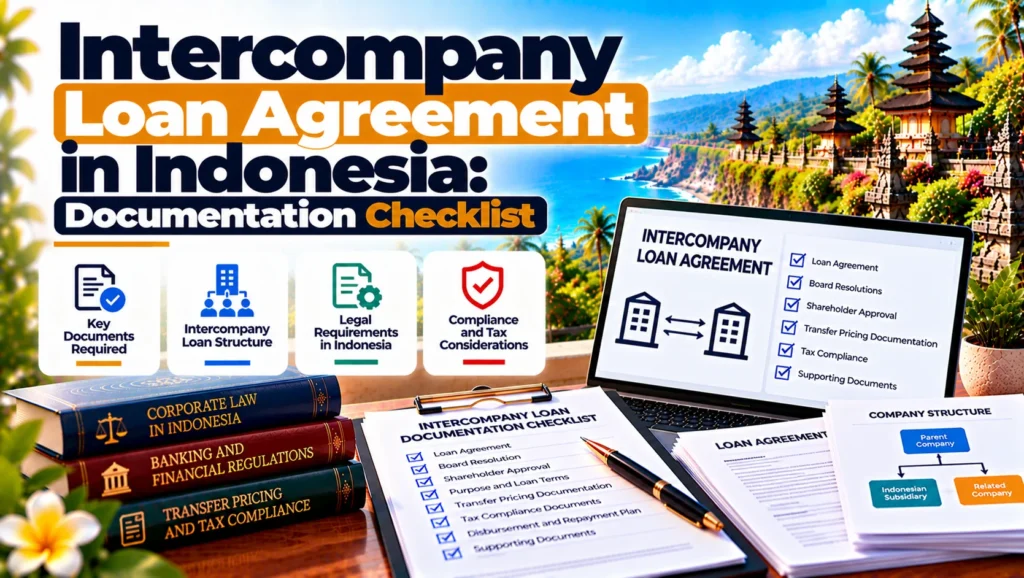
An intercompany loan agreement in Indonesia documents financing between two legally separate companies that are connected through ownership, control, or another relevant group relationship. It should establish the actual lender and borrower, the amount provided, repayment terms, and the commercial basis of the financing.
For business owners and investors, the main objective is to prevent an internal group transfer from becoming an undocumented or ambiguously classified transaction. A signed agreement can support that objective, but corporate approval, related-party tax treatment, and accounting evidence must also be assessed separately.
What Is an Intercompany Loan Agreement?
An intercompany loan is intended to be repayable financing from one company to another. The parties may belong to the same corporate group, but they remain distinct legal entities for purposes of identifying the parties to the transaction.
The agreement typically addresses the advance of funds, the borrower’s repayment obligation, the relevant financing terms, and circumstances in which those terms may change.
It should not be confused with an additional equity investment, a shareholder contribution, or a transaction undertaken directly between individuals merely because the individuals own both companies.
For example, a foreign holding company may provide funds to an Indonesian subsidiary. Alternatively, one Indonesian group company may provide temporary working capital to another. Both situations raise the same basic contractual question: Which company owes the debt, and under what agreed terms?
The answers should be consistent across the signed agreement, bank transfers, accounting records, and relevant company decisions.
Why Affiliated Companies Need Clear Loan Documentation
Related companies sometimes share management personnel, financial reporting systems, and commercial objectives. Those operational connections can make it tempting to treat transfers as informal internal movements of cash.
However, a group relationship does not remove the need to distinguish ownership funding from repayable debt or to identify each company’s contractual position.
A clear agreement can help demonstrate why the funds were provided, who authorized the transaction, how repayment is expected to occur, and how changes will be documented.
It also gives accountants and tax reviewers a starting point for comparing the legal description of the loan with the actual financial flows.
Where the arrangement is already underway, the parties should establish the history of advances and existing records before assuming that a newly drafted agreement accurately describes all previous transfers.
Intercompany Loan Agreement Indonesia: Key Documents
A useful documentation process begins with the companies and their intended transaction. It then identifies the financial terms, corporate approvals, and information needed for independent tax and accounting review.
Verify the Lender and Borrower
Record the full legal identity of each company and identify which entity is lending and which is borrowing.
Check the corporate registration information, the company’s current organizational documents, and the individuals acting on behalf of each entity. This helps prevent the agreement from incorrectly naming a parent, subsidiary, shareholder, or operating company.
The parties should also document the nature of their affiliation. Ownership and control information may be relevant to the related-party review, but the precise tax characterization should be determined under the applicable rules.
Do not assume that a person who is a director of both companies can automatically sign on behalf of both without considering each company’s governance arrangements and any potential conflicts.
Record the Commercial Loan Terms
The commercial terms should describe the actual financing rather than rely on a short statement that group funding has been approved.
Consider the principal amount, currency, disbursement mechanism, permitted use of funds, maturity, repayment arrangements, and treatment of interest or other financing charges.
Where the loan has multiple drawdowns, the agreement should explain how each advance is identified and how the outstanding balance is calculated.
The parties should also review payment delays, early repayment, modifications, and any conditions connected to additional advances.
No single clause list is universally suitable. The appropriate terms depend on the borrower, lender, commercial purpose, applicable law, and transaction structure.
Confirm Corporate Authority
The official record for Law Number 40 of 2007 on Limited Liability Companies identifies Indonesia’s statutory corporate governance framework and lists the law as applicable with subsequent amendments.
For an Indonesian company, review the latest articles of association, relevant internal decisions, and the proposed signatory’s authority before executing a financing agreement.
Different transactions may raise different approval questions. An ordinary unsecured operating loan should not automatically be treated as equivalent to a financing transaction involving significant company assets or complex security arrangements.
The appropriate corporate authorization should be determined under the amended statutory framework and the individual company’s governing documents, rather than assumed from the fact that both companies belong to the same group.
Related-Party Tax and Transfer-Pricing Questions
Intercompany lending should be reviewed for its tax implications because the commercial relationship between affiliated parties may affect how the transaction is evaluated.
The official record for Minister of Finance Regulation Number 172 of 2023 identifies the arm’s-length principle, related-party transactions, documentation, and compliance testing as subjects of the regulation.
The official regulatory status record confirms that the 2023 regulation revoked Minister of Finance Regulation Number 213/PMK.03/2016, so the earlier documentation framework should not be relied upon as current authority.
The historical requirements of the revoked regulation must not be substituted for current documentation obligations, calculations, or thresholds.
Because the current related-party transaction framework addresses arm’s-length analysis and documentation, affiliated companies should review the economic substance and commercial rationale of their financing rather than assume that group ownership removes tax questions.
Relevant questions may concern why the borrower needs the funding, how the amount and pricing were determined, whether the borrower can realistically repay, and whether the agreed arrangement is consistent with the parties’ actual conduct.
The applicable documentary obligations and tax treatment depend on the transaction facts and current rules. This article does not assign a universal interest rate, deduction outcome, or transfer-pricing documentation threshold to every group loan.
Intercompany Loan Documentation Matrix
The following matrix helps investors and finance teams organize a loan file. It is a practical review tool, not a government-prescribed list of mandatory attachments.
| Review area | Evidence to organize | Principal question |
|---|---|---|
| Lender identity | Corporate documents and signatory information | Which legal entity advances the funds? |
| Borrower identity | Current registration and organizational records | Which company legally owes repayment? |
| Affiliation | Ownership and group relationship records | How are the contracting companies connected? |
| Loan purpose | Funding request, budget, and business plan | What commercial need does the loan address? |
| Principal and drawdowns | Agreement terms and disbursement records | How much has been advanced and when? |
| Interest and pricing | Commercial rationale and calculation methodology | What related-party tax review is appropriate? |
| Repayment | Maturity and payment schedule | How will the debt be repaid and monitored? |
| Corporate authority | Governing documents and relevant decisions | Are the proposed signatories properly authorized? |
| Cross-border funding | Lender residency, currency, and payment arrangements | Do foreign-debt or other cross-border rules need review? |
| Accounting reconciliation | Ledger entries and balance confirmations | Do both companies record consistent outstanding balances? |
A complete file should tell the same transaction story from several perspectives. If the agreement describes a loan but bank records and accounting entries suggest different amounts or parties, the inconsistency should be examined before financial reporting or a major repayment.
Cross-Border Loans and Foreign-Debt Considerations
An intercompany loan between two Indonesian companies raises different regulatory questions from a loan advanced by an overseas company to an Indonesian borrower.
The official Bank Indonesia record for Regulation Number 16/21/PBI/2014 identifies prudential principles for managing foreign debt of nonbank corporations and lists the regulation as applicable.
Before an Indonesian company accepts a loan from an overseas affiliate, the Bank Indonesia foreign-debt framework should be considered alongside the applicable current reporting and transaction rules.
This does not mean every intercompany loan is subject to the same foreign-debt reporting process or prudential calculation. The relevant determination depends on the borrower’s circumstances, lender residency, currency, loan features, and the current applicable instruments.
The parties should also examine any applicable tax withholding, currency, accounting, or financing issues independently. A contract written in English or signed overseas does not, by itself, establish the correct Indonesian regulatory treatment.
Bali Investment Financing Example
Consider a hypothetical hospitality group with an overseas parent and an Indonesian company operating a business in Bali.
The Indonesian company requires additional working capital to prepare a new project and meet operating expenditure. The overseas group company proposes advancing funds on agreed repayment terms.
Management should first confirm whether the funding is intended as repayable debt, a capital contribution, or another form of group financing.
If it is a loan, the agreement should name the two companies correctly and define the principal, currency, permitted purpose, disbursement process, and repayment arrangements. The Indonesian company should review who can authorize borrowing and who will execute the document.
The group should then assess the related-party tax questions, including the commercial rationale and pricing, and separately determine whether cross-border borrowing rules apply.
Suppose the funds are used for premises preparation. That use of funds does not mean the lending company automatically acquires an interest in the premises. Loan repayment obligations, ownership or leasehold rights, and any proposed security should be documented and reviewed as distinct matters.
The lesson is that connected companies may share the same investment objective while remaining separate parties to a financing transaction.
After Signing: Recordkeeping and Reconciliation
An intercompany loan file should remain useful after the agreement has been signed.
Start by preserving the executed agreement, relevant corporate approvals, and evidence of each disbursement. The finance teams of both parties should be able to identify the same transfer by date, amount, currency, and transaction reference.
Next, reconcile the outstanding principal, interest calculations where applicable, repayments, and any changes agreed by the parties.
Where the terms are amended, document the change and assess whether additional corporate, tax, or accounting review is needed. Do not assume that an informal email or accounting entry necessarily replaces the original contractual arrangements.
For a cross-border loan, maintain a separate list of unresolved foreign-debt and tax questions, together with the basis on which each issue was reviewed.
A periodic reconciliation can help detect discrepancies before they affect financial statements, group reporting, or future funding decisions.
Conclusion
An intercompany loan agreement should establish the actual debt relationship between two affiliated companies, not merely record that money moved within a group.
A sound documentation review identifies the parties, verifies authority, records commercially meaningful terms, assesses related-party tax implications, and maintains evidence consistent with the accounting records.
For Indonesian borrowers receiving funds from an overseas affiliate, the same process should include a separate review of applicable cross-border financing requirements before the transaction is implemented.
Review Your Intercompany Financing Documents
If your Indonesian company is preparing a loan with an affiliated business or an overseas parent, contact Bali Legal ID to discuss corporate agreement documentation and the legal questions relevant to the proposed transaction.
A consultation can help identify the agreements, corporate records, tax considerations, and accounting information that should be reviewed before financing proceeds.
For help scoping the documents and next steps for your business or transaction, contact Bali Legal ID about our notary services in Bali.
Read More: Professional Notary Services in Bali for Property, Business & Legal Documentation
FAQ intercompany loan agreement
What is the purpose of an intercompany loan agreement in Indonesia?
It records a repayable financing arrangement between affiliated but legally distinct companies. The agreement identifies the lender, borrower, principal, repayment terms, and other relevant conditions so the transaction can be distinguished from equity funding or an informal cash transfer.
Is an intercompany loan the same as a shareholder capital contribution?
No. A genuine loan is intended to create a repayment obligation, while a capital contribution concerns equity funding. The documentation and treatment should reflect the actual economic and legal arrangement, not merely the ownership relationship between the parties.
Does every intercompany loan need an interest rate?
The appropriate terms, pricing, and tax treatment require transaction-specific review. An interest-free or otherwise unusual arrangement should not automatically be assumed to satisfy the applicable related-party tax rules. No universal rate can be determined solely from the companies being affiliates.
Do intercompany loans require transfer-pricing documentation?
Related-party financing should be evaluated under the applicable arm’s-length framework, but the exact documentation obligations depend on the current rules and the transaction facts. Companies should not assume every loan has identical documentation requirements or rely on revoked ministerial rules.
Does a loan from an overseas parent company raise additional requirements?
Potentially. A cross-border loan may require examination of applicable Bank Indonesia foreign-debt rules, reporting obligations, tax treatment, currency arrangements, and other transaction-specific requirements. The precise applicability must be established for the borrower and financing terms.
Can two companies use one director to sign the loan agreement?
Shared management does not automatically determine signing authority for both companies. Each company’s governing documents, applicable corporate law, and potential conflicts should be reviewed before the transaction is executed.
References & Sources
- Law Number 40 of 2007 on Limited Liability Companies — peraturan.bpk.go.id
- Minister of Finance Regulation Number 172 of 2023 on the Arm’s-Length Principle for Related-Party Transactions — peraturan.bpk.go.id
- Bank Indonesia Regulation Number 16/21/PBI/2014 on Prudential Principles in Foreign Debt Management by Nonbank Corporations — bi.go.id
Recommended Next Articles
- notary and commercial agreement documentation in Bali — balilegalid.com
- when business decisions need both legal and tax review — balilegalid.com
- PT PMA and corporate setup considerations in Bali — balilegalid.com