
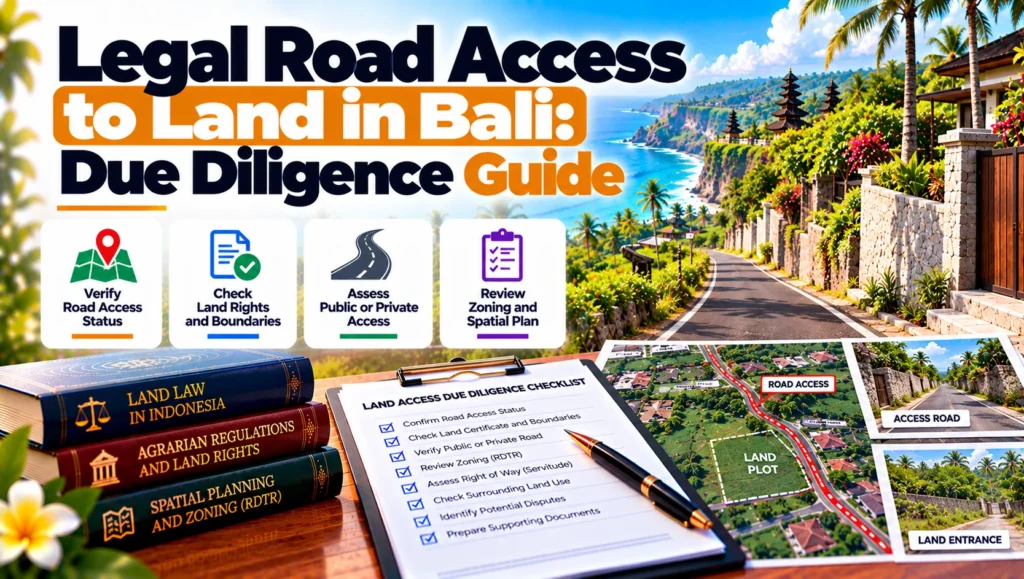
Legal road access to land in Bali should be verified before an investor purchases property, signs a long-term lease, or commits to a development project. A road may physically lead to a parcel, but that does not automatically establish an enforceable right to use every section of the route.
The central due-diligence question is whether the proposed access is adequately supported by the relevant land records, agreements, permissions, and transaction arrangements. Buyers and leaseholders should also consider whether the documented access is suitable for their intended use, including vehicles, deliveries, construction, and future operations.
Why Physical Road Access Is Not Enough
A property can appear accessible during an inspection even when important legal questions remain unanswered.
For example, a narrow lane may cross land belonging to a neighbor. The current owner may have used it for years, and local residents may be familiar with the route. Those observations establish how the road has been used, but they do not necessarily establish the rights available to a new buyer, tenant, or operating company.
An investor should distinguish between a road’s physical existence and the legal basis for using it.
The first question is where the route begins and ends. The second is which parcels it crosses. The third is whether the people granting permission have the necessary rights or authority to do so.
A further question is whether the arrangement covers the investor’s planned use. Permission to walk along a lane does not necessarily resolve access for delivery vehicles, construction equipment, guest traffic, or a substantially expanded development.
Indonesian Land Rights and Access Arrangements
The official record for Law Number 5 of 1960 on Basic Agrarian Principles identifies the national statutory framework for agrarian matters and lists the legislation as applicable.
The official ATR/BPN record for Government Regulation Number 18 of 2021 identifies land management rights, land rights, apartment units, and land registration as subjects of the regulation.
The ATR/BPN regulatory status page lists Government Regulation Number 18 of 2021 as applicable from 2 February 2021.
The official regulatory history records the revocation of Government Regulations Numbers 40 of 1996 and 103 of 2015.
These national rules provide the broader context for examining land rights and registration. They do not establish that a particular private access road may be used without further investigation.
Questions about passage across neighboring land may involve contractual arrangements, land registration, the history of the property’s use, and the interaction of different legal provisions. The legal basis for access should therefore be assessed for the particular parcels and parties involved, rather than inferred from a general historical legal reference.
For investment planning, an owner should not assume that a parcel’s lack of an obvious public-road connection automatically creates an unrestricted right to cross whichever neighboring land is most convenient.
Legal Road Access Land Bali: The Due Diligence Process
A practical road-access investigation begins with a map of the entire route from the property to an established public-road connection.
The objective is to identify each relevant parcel, its apparent controller, the documents supporting the route, and any restrictions affecting how the access may be used.
Trace Every Parcel Along the Access Route
Walk or inspect the proposed route and compare it with available parcel information, maps, and property documents.
A short lane may cross more than one parcel before reaching the land being acquired. Different segments may be controlled by different owners or may have different legal characteristics.
Record where the proposed access enters and exits each segment. Identify gates, barriers, changes in width, neighboring buildings, drainage channels, and other physical features relevant to the planned use.
Because the national land-rights framework distinguishes registered rights and land administration matters, an investor should identify the rights associated with every privately controlled parcel forming part of a proposed access route.
Where parcel boundaries or route ownership cannot be established from the available information, identify the uncertainty for appropriate land-record and technical review instead of treating a map image as conclusive evidence.
Check Written Access Agreements and Authority
If access depends on neighboring land, ask what documentation supports the arrangement.
Relevant evidence may include existing access agreements, contractual provisions, written permissions, property transaction documents, and other records indicating the rights of the parties involved.
The review should identify who granted the access, whether that person had appropriate authority, which land is affected, who may use the route, and the purpose for which access is allowed.
Particular attention is needed where the proposed agreement involves a company, representative, heir, agent, or individual who is not the recorded land-right holder.
A verbal assurance from the seller may be useful background information, but it should not replace an examination of the relevant rights and the proposed contractual arrangements.
Review Vehicle Access, Maintenance and Future Use
Legal documentation should be evaluated against the actual operational needs of the property.
A residential buyer may need occasional vehicle access. A hospitality operator may anticipate regular guest arrivals, staff vehicles, maintenance contractors, and deliveries. A construction project could require temporary access by larger vehicles.
These different uses may create practical and contractual questions even when a lane is already in use.
Consider the route’s width, condition, drainage, turning space, maintenance arrangements, and the ability to keep it accessible during the proposed transaction period.
Do not assume that permission for one type of access automatically extends to every future commercial or development use.
Legal Access vs Physical Access: Comparison Matrix
The following matrix is a practical due-diligence tool. It does not classify every arrangement as legally valid or invalid; instead, it identifies the evidence that should be examined.
| Access situation | Evidence to review | Main unresolved question |
|---|---|---|
| Direct connection to an apparent public road | Parcel boundaries and relevant road information | Is the connection and public-road status sufficiently established? |
| Private lane crossing one neighboring parcel | Neighboring land records and access documents | What supports the investor’s proposed use of the lane? |
| Route crossing several parcels | Parcel-by-parcel information and relevant agreements | Are all necessary segments covered? |
| Long-used road without clear written terms | Historical records, parties’ statements, and current documents | Can the legal basis for continued access be established? |
| Access controlled by a gate or barrier | Control arrangements and documented access terms | Who may regulate entry and under what circumstances? |
| Road requiring maintenance | Relevant agreements and maintenance arrangements | Who is expected to maintain the route and bear related costs? |
| Access for construction or business operations | Documented permissions and operational plans | Does the arrangement support the proposed intensity and type of use? |
| Uncertain boundaries | Land records and qualified technical review | Does the physical route correspond to the land identified in the documents? |
This comparison should be used alongside land certificate checking, contract review, and physical site inspection. A positive finding in one area does not automatically resolve the others.
Bali Villa Investment Scenario
Consider a hypothetical investor evaluating a parcel in Bali for a future villa project.
The land is reached by a paved lane approximately a short distance from a larger road. During the inspection, the route is open, vehicles pass through it, and the seller explains that the same access has been used for many years.
The investor later discovers that part of the lane crosses a neighboring parcel. The seller has no immediately available written document explaining the investor’s right to use that section after the proposed transaction.
The development plan also anticipates construction vehicles and future guest traffic. Neither use has been specifically addressed in the material initially provided.
The investor should separate the questions: Who controls the neighboring parcel? What is the present legal basis for access? What rights, if any, would continue after the purchase or lease? Does the proposed arrangement cover the intended traffic and operational use?
The investor should also examine whether the access route is compatible with other project considerations, including site planning and the practical needs of the proposed business.
The presence of a paved lane does not answer these questions. Resolving them before committing to the project is generally more useful than attempting to reconstruct the arrangement after a dispute arises.
What to Put in an Access Agreement Review
Where a documented private-access arrangement is being considered, an investor can prepare a review checklist covering the parties, affected parcels, route description, permitted activities, duration, and management responsibilities.
The checklist should examine whether the agreement identifies the land being crossed with sufficient clarity and whether it is consistent with the parties’ relevant rights.
It should also consider how the arrangement deals with gates, maintenance, repairs, changes in ownership or occupancy, and proposed changes to the type or intensity of access.
These are practical drafting considerations, not a universal statutory clause list. The legal form and effect of any proposed arrangement must be assessed under the applicable current law and the actual transaction circumstances.
For a substantial investment, unresolved questions should be recorded in writing and addressed through appropriate professional review before the parties rely on the agreement.
What If There Is No Documented Access?
An investor should treat the absence of reliable access documentation as a material due-diligence issue rather than assume it can always be corrected after signing.
Start by confirming whether a route exists and identifying the land it crosses. Obtain available registration and contractual information for the affected parcels.
Then ask the parties to explain the legal basis for using the route. Where the explanation depends on historical use, neighboring-property law, or disputed rights, seek transaction-specific legal advice instead of assuming an automatic entitlement.
Possible next steps may include obtaining additional evidence, negotiating an appropriate documented arrangement, revising transaction conditions, or reconsidering the proposed acquisition if an acceptable resolution cannot be established.
The correct response depends on the particular land rights, parties, and facts. No fixed compensation amount, compulsory route, or guaranteed enforcement outcome should be inferred without an applicable legal assessment.
Conclusion
Legal road access to land in Bali depends on more than whether a property can physically be reached.
Before buying or leasing, investors should trace the access route, identify the affected parcels and relevant parties, review the available permissions and agreements, and confirm that the proposed use is supported by appropriate evidence.
Separating physical access from documented legal rights helps investors recognize material property risks before making long-term contractual and financial commitments.
Check the access route alongside the land certificate records and the wider property due diligence file. This keeps the physical route, documented rights and proposed transaction connected in the review.
Review Road Access Before Your Bali Property Transaction
If you are planning to purchase land, enter a long-term lease, or evaluate property for investment in Bali, contact Bali Legal ID to discuss land documentation, access-related agreements, and the legal questions affecting your proposed transaction.
A consultation can help identify which parcel records, contractual provisions, and unresolved access arrangements should be reviewed before proceeding.
For help scoping the documents and next steps for your business or transaction, contact Bali Legal ID about our notary services in Bali.
Read More: Professional Notary Services in Bali for Property, Business & Legal Documentation
FAQ legal road access
Does a property with a visible road automatically have legal access?
No. Physical use of a road does not, by itself, establish the precise legal rights available to a buyer or leaseholder. The ownership or control of the route and any supporting access arrangements should be verified.
Can I use a road that crosses my neighbor’s land in Bali?
The answer depends on the relevant land rights, agreements, permissions, and applicable law. The route’s long-standing physical use does not automatically establish an unrestricted right of passage. Review the specific evidence before relying on the route.
What if land in Bali has no direct connection to a public road?
Identify the available physical routes and affected parcels, then investigate the legal basis for potential access. Historical civil-law questions concerning landlocked parcels require current legal interpretation and should not be treated as an automatic guarantee of a specific route.
Should road access be included in a land lease agreement?
Where the lease depends on access across other land, the parties should consider documenting the route, rights or permissions relied upon, permitted use, and relevant management arrangements. The appropriate legal documentation depends on the transaction.
Does land certificate checking prove a private access road is legally available?
Not necessarily. A land certificate review addresses registered land information. A private-access arrangement may require separate examination of neighboring parcels, contractual rights, physical boundaries, and other relevant evidence.
Can an existing access road be used for villa construction and guest traffic?
Do not assume that current access arrangements cover every future use. Verify the underlying access rights, any relevant contractual restrictions, and whether the route is practically suitable for the planned construction or commercial operation.
References & Sources
- Law Number 5 of 1960 on Basic Agrarian Principles — peraturan.bpk.go.id
- Government Regulation Number 18 of 2021 on Land Management Rights, Land Rights, Apartment Units, and Land Registration — jdih.atrbpn.go.id
Recommended Next Articles
- property documentation and land certificate checking services in Bali — balilegalid.com