
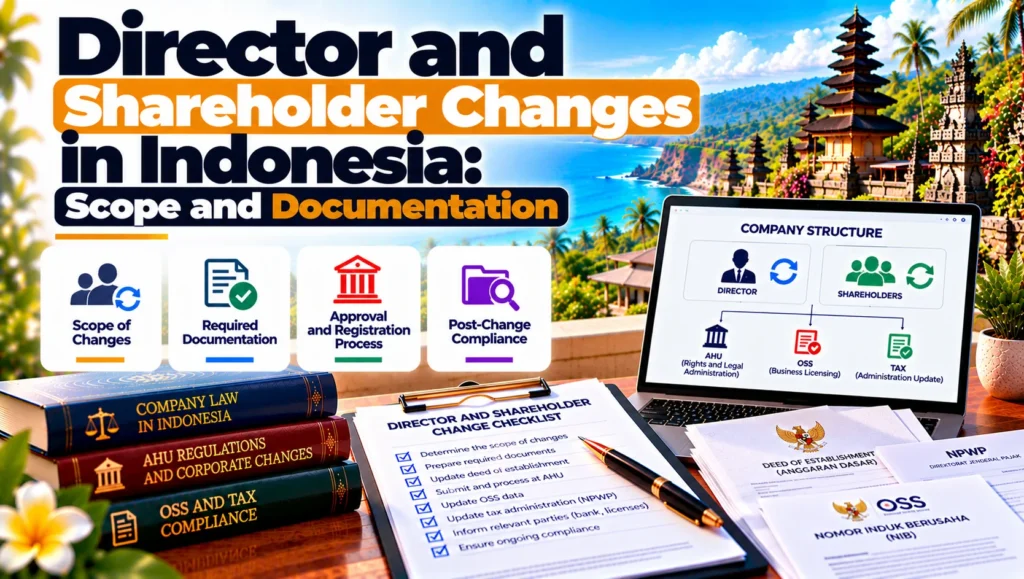
Director and shareholder changes in an Indonesian company may affect different legal records even when they happen at the same time. Replacing a director changes company management, while transferring shares changes ownership. Some transactions also involve capital amendments, changes to the articles of association, or subsequent updates to business administration records.
For an Indonesian PT operating in Bali, the first task is to identify precisely what is changing and which corporate decisions and documents support that change. This avoids treating every management or ownership event as a single generic filing.
What Do Director and Shareholder Changes Cover?
A director change typically concerns the appointment, replacement, resignation, or removal of a member of the company’s management. A commissioner change affects the company’s supervisory structure.
A shareholder change may involve a transfer of existing shares, a change in shareholder details, or a transaction that modifies the company’s capital structure. These situations should not be treated as interchangeable.
For example, replacing a director does not necessarily change the company’s ownership. Selling existing shares does not necessarily increase the amount of shares issued by the company. A capital increase introduces additional questions that may require a separate review.
The practical objective is to identify each event independently, then determine how the related company documents and records should be updated.
The Indonesian Corporate Amendment Framework
The official record for Law Number 40 of 2007 on Limited Liability Companies identifies company capital and shares, shareholders’ meetings, directors, and commissioners among the subjects governed by the statute.
The official legislative status record lists the law as applicable with subsequent amendments, including Law Number 6 of 2023.
The official record for Minister of Law Regulation Number 49 of 2025 identifies procedures for establishing, amending, and dissolving Indonesian limited liability companies.
The official regulatory status record confirms that the 2025 regulation took effect on 17 December 2025 and revoked Minister of Law and Human Rights Regulation Number 21 of 2021.
Consequently, earlier procedural explanations based only on the revoked ministerial regulation should not be treated as complete instructions for a current company amendment.
The official summary of Minister of Law Regulation Number 49 of 2025 describes applications to the Minister through the Directorate General of General Legal Administration.
The AHU Online company-amendment guide separately identifies changes to directors and commissioners, share transfers, and shareholder names within its company-data notification workflow.
The official AHU amendment instructions distinguish certain articles-of-association changes from notifications involving company data.
The appropriate route depends on what has actually changed. Historical system screenshots should also be checked against the current interface and applicable filing requirements.
Director and Shareholder Changes Scope: A Decision Matrix
The following table helps companies classify an event before preparing a deed, resolution, notification, or related record update. It is a planning tool rather than an exhaustive legal filing checklist.
| Corporate event | Main information to review | Key question |
|---|---|---|
| Director appointment or replacement | Existing management records, decision documents, and proposed appointment | Who will have management responsibilities after the change? |
| Director resignation or removal | Effective decision, existing records, and supporting documents | What event and date establish the proposed change? |
| Commissioner change | Supervisory appointments and company decision records | Does the change affect only the supervisory body? |
| Transfer of existing shares | Shareholder register, transaction documents, and relevant restrictions | Who transfers the shares, and who receives them? |
| Shareholder information correction | Identity records and existing company data | Is this an identity-data correction rather than a transfer of ownership? |
| Capital increase or decrease | Capital records, share structure, and corporate decisions | Does the transaction change company capital rather than only the holder of existing shares? |
| Combined ownership and management changes | All relevant decisions, deeds, and company records | Which separate corporate events must be documented? |
A single transaction may appear in several rows. The purpose of the matrix is to prevent an ownership change from being confused with a management appointment or a capital amendment.
What to Review Before Filing
Before proceeding with a change, compare the proposed transaction with the company’s latest governing documents and available corporate records.
The review should identify the company, its current directors and commissioners, existing shareholders, and any articles-of-association provisions relevant to the transaction. It should also establish who is authorized to make the relevant decisions and execute the documents.
Director and Commissioner Changes
Start by identifying the departing and incoming individuals and the corporate decision supporting the appointment, resignation, or replacement.
Check the current management composition, the relevant company decision records, and the information intended for the amendment filing.
A change should also prompt a practical review of who is authorized to represent the company, sign agreements, operate financial accounts, and access administrative systems. These operational matters may need attention even where they are not themselves part of the AHU filing.
Do not assume that every resignation, removal, and appointment has identical documentary requirements or dates of legal effect. The applicable corporate provisions and supporting decisions must be examined.
Share Transfers and Shareholder Information
Where existing shares move between parties, the review should establish which shares are involved, the identity of the transferor and transferee, and the terms and documentation of the transaction.
The company’s articles of association and applicable statutory provisions may affect the required process. The relevant rights, approvals, or restrictions should be reviewed before assuming a transfer can proceed without further steps.
A correction to a shareholder’s name or other identity information is a different problem from transferring shares to a new owner. The documentary explanation should correspond to the actual event.
For a company with foreign shareholders or a proposed new foreign investor, the ownership structure may also raise investment and sector-specific questions. These should be examined separately rather than treated as resolved by the amendment record alone.
Capital Changes and Related Amendments
A share transfer and a capital change are not necessarily the same transaction.
If a shareholder sells shares already issued, the company’s registered capital may remain unchanged. If the company issues additional shares or restructures its capital, the appropriate corporate amendment questions may be different.
Review the existing capital structure, the proposed transaction, and any accompanying articles-of-association changes before choosing the filing route.
Company capital records should remain consistent with the relevant decisions, transaction documents, and information eventually recorded through the appropriate administration process.
A Practical Change-Management Calendar
The following sequence can be used as an internal planning calendar. It is not a statement that every company amendment follows the same statutory timetable.
| Stage | Suggested internal action | Completion evidence |
|---|---|---|
| Initial review | Identify each intended management, ownership, or capital change | Written transaction summary |
| Corporate authority review | Examine the articles of association and decision-making arrangements | Decision and authority checklist |
| Document preparation | Prepare the relevant resolutions, deed information, and transaction evidence | Reviewed document package |
| Formal amendment process | Confirm the current applicable AHU procedure and submission requirements | Filing record or relevant official output |
| Corporate record reconciliation | Compare the new information with company registers and records | Updated corporate information register |
| Downstream administration | Review relevant licensing, tax, banking, and internal account information | Follow-up register with responsible persons |
| Final audit | Check unresolved discrepancies and retain supporting evidence | Completed change review file |
The company should identify any legally applicable deadline from the specific event and current rules before assigning dates to this calendar. An internal timetable does not replace an official submission requirement.
Bali Investment Example
Consider a hypothetical PT PMA operating a hospitality business in Bali. An existing shareholder proposes selling part of its holding to another investor, and the shareholders also plan to appoint a new director.
Although the parties negotiate both matters together, they should first distinguish the share transaction from the director appointment.
For the ownership change, the review concerns the shares involved, the parties, the supporting transfer documents, the company’s restrictions and decisions, and the resulting shareholder information.
For the management change, the review concerns the appointment decision, the previous and new management composition, and the related company records.
If the company also proposes issuing new shares to the investor, a separate capital assessment becomes relevant. The transfer of existing shares should not automatically be described as an increase in company capital.
After the appropriate formal procedures, the company should compare its updated corporate records with relevant operational information. The individuals authorized to manage banking, contracts, business systems, and regulatory correspondence may need to be reviewed.
The example illustrates a review method, not a universal filing procedure or a claim that a particular investor is eligible to hold shares in every business sector.
Post-Change Corporate Records Audit
A completed formal amendment is an important milestone, but the company’s internal and related administrative records should also be checked for consistency.
Use a post-change audit to compare the approved management composition, shareholder information, and corporate documents with the records the business actually uses.
Possible areas for review include the shareholder register, appointment records, company identification information, OSS records, applicable tax administration details, banking mandates, and authorized signatories.
Not every change requires an identical downstream update. A director replacement, a transfer of shares, and a capital amendment can affect different systems and supporting documents.
Where an update is appropriate, retain the official output or confirmation and record the completion status. If a discrepancy remains, identify its source before changing additional information.
A structured audit helps the company distinguish a completed legal amendment from operational records that still need attention.
Conclusion
Director and shareholder changes in Indonesia should be assessed according to the actual corporate events involved. Management appointments, share transfers, identity corrections, and capital amendments are related but legally and administratively distinct matters.
Business owners and investors should identify each change, examine the company’s governing documents, prepare the appropriate evidence, confirm the applicable current procedure, and reconcile the resulting records.
This approach provides a clearer basis for managing corporate changes without assuming that one filing or document automatically completes every connected administrative task.
Review Your Company Director and Shareholder Changes
If your company in Bali is planning a director replacement, commissioner appointment, share transfer, or related corporate amendment, contact Bali Legal ID to discuss the relevant corporate documentation and administrative review.
A consultation can help identify which company records, shareholder decisions, amendment documents, and subsequent administrative updates should be examined before proceeding.
For help scoping the documents and next steps for your business or transaction, contact Bali Legal ID about our business setup services in Bali.
Read More: Business Setup Bali for PT PMA, PT PMDN & OSS RBA Registration
FAQ director and shareholder changes
Is changing a director the same as changing a shareholder?
No. A director change concerns company management, while a shareholder change concerns ownership or shareholder information. The applicable decisions, documents, and filing classifications should be assessed separately.
Does a transfer of existing shares automatically change a company’s capital?
Not necessarily. Transferring existing shares changes who holds those shares, while a capital change concerns the company’s share capital structure. Review the actual transaction before treating it as a capital amendment.
Can director and shareholder changes be reviewed together?
Yes. The transactions may be coordinated, but each event should still be identified and supported by the appropriate corporate decisions, documents, and administrative process.
Do company director changes require updates outside AHU?
Depending on the circumstances, the company may need to review OSS information, tax administration records, banking authority, and internal systems. The required updates should be established for the specific event rather than assumed to be universal.
Does a change of foreign shareholder require additional review?
It may. A company should consider the proposed foreign ownership structure and any applicable investment or sector restrictions before assuming the transfer is permissible. A corporate filing alone does not establish eligibility for every business activity.
References & Sources
- Law Number 40 of 2007 on Limited Liability Companies — peraturan.bpk.go.id
- Minister of Law Regulation Number 49 of 2025 on Establishment, Amendment, and Dissolution Procedures for Limited Liability Companies — peraturan.bpk.go.id
- AHU Online Guide to Limited Liability Company Amendments — panduan.ahu.go.id
Recommended Next Articles
- corporate amendment and director appointment documentation in Bali — balilegalid.com
- company and shareholder information in OSS registration — balilegalid.com
- initial shareholder and management records for PT PMDN setup — balilegalid.com