
A commercial contract should not be reviewed as a collection of isolated legal phrases. The important question is what each clause does to the business deal: who must perform, when money moves, how risk is allocated, how either party can exit, and what happens if the relationship breaks down.
A focused review therefore starts with the clauses that can materially change the economics, control and downside of the transaction.
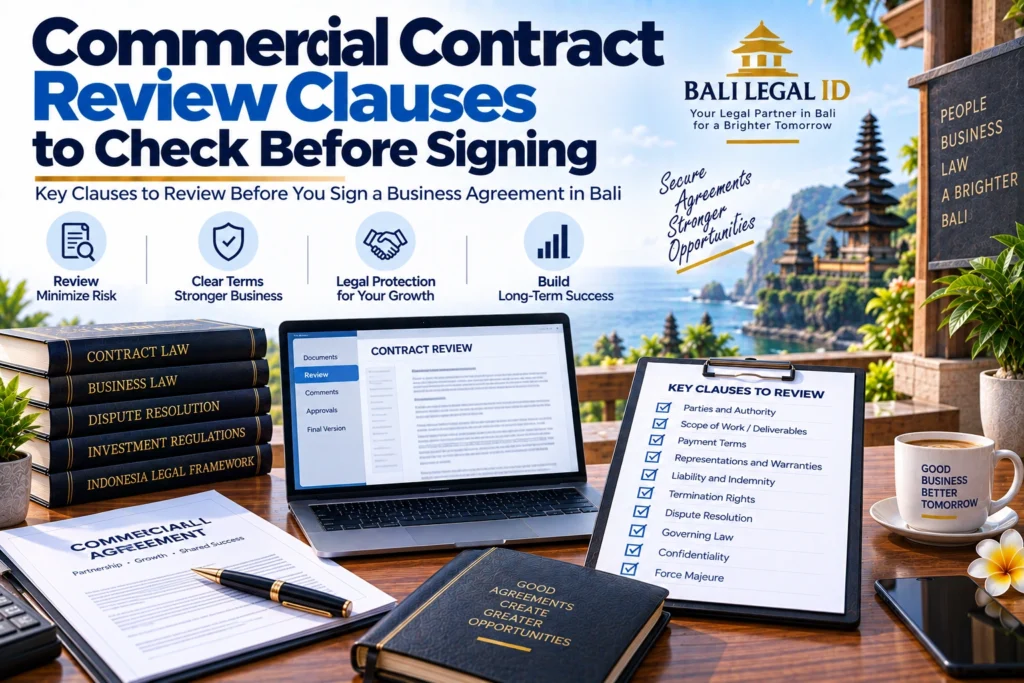
Commercial Contract Review Clauses: 12 Areas That Can Change the Deal
The table below provides a practical first-pass map.
| Clause area | Main commercial question |
|---|---|
| Scope and acceptance | What must be delivered, and when is it accepted? |
| Price and payment | How much is payable, when, and subject to what conditions? |
| Term and renewal | How long is the commitment? |
| Termination | How can either party exit and what happens afterward? |
| Liability | What financial exposure is capped or excluded? |
| Indemnity | Which events create reimbursement or defence obligations? |
| Warranties | What factual or performance promises are being made? |
| Intellectual property | Who owns or may use existing and newly created materials? |
| Confidentiality | What information is protected and for how long? |
| Change and assignment | How can scope or responsible parties change? |
| Disputes and notices | How are disputes and formal communications handled? |
| Language and execution | Which versions govern and is the signing copy complete? |
The clauses should then be read together because one provision can change the effect of another.
1. Scope, Deliverables and Acceptance
The scope clause is often the commercial centre of the agreement.
Check whether it defines:
- the service, product or asset being provided
- quantities or service levels
- deliverables and specifications
- milestones
- client dependencies
- acceptance criteria
- acceptance timing
- what happens if a deliverable is rejected
A payment clause tied to completion creates uncertainty if the contract never defines when completion occurs. Likewise, a detailed scope can still be weak if the counterparty can reject performance without objective acceptance criteria.
Where the detailed scope sits in a schedule, confirm that the schedule is attached and that the main agreement clearly incorporates it.
2. Price, Invoicing and Payment
The headline price is only part of the payment analysis.
Review:
- currency
- deposit or advance payment
- invoice timing
- milestone payments
- reimbursement of expenses
- taxes and withholding assumptions
- late-payment consequences
- retention or holdback
- disputed invoices
- price adjustments
- refund mechanics
Payment triggers should match the scope and acceptance provisions.
For example, if payment becomes due after acceptance, the contract should state how acceptance occurs and how long the customer has to reject the deliverable. Otherwise, an operational issue can become a payment dispute.
3. Term, Renewal and Minimum Commitment
Confirm when the agreement starts and how long it lasts.
Look for:
- effective date
- initial term
- automatic renewal
- renewal notice period
- minimum purchase or service commitment
- lock-in period
- extension options
- price changes at renewal
Automatic renewal deserves attention because a short notice deadline can extend the relationship before the business has decided whether it wants to continue.
4. Termination and Exit Consequences
Termination provisions determine how difficult and expensive it is to leave the relationship.
Review whether termination is allowed for:
- material breach
- failure to pay
- insolvency
- repeated service failures
- convenience
- regulatory or legal changes
- prolonged force majeure
- change of control where relevant
Then review the consequences.
Questions include:
- Are outstanding fees immediately payable?
- Must prepaid amounts be refunded?
- Is there a termination charge?
- Who returns property or confidential information?
- What happens to licences and intellectual property?
- Is transition assistance required?
- Which clauses survive termination?
A broad termination right may be commercially acceptable only if its financial consequences are also understood.
5. Liability Limits and Exclusions
A limitation-of-liability clause can materially change the value of other contractual protections.
Check:
- whether liability is capped
- how the cap is calculated
- whether different claims have different caps
- excluded categories of loss
- exceptions to the cap
- whether liability for certain conduct remains unlimited
- interaction with indemnity provisions
- whether the risk allocation is commercially proportionate to the transaction
Do not review the liability clause only from the provider’s perspective. A customer with a low payment obligation but high operational exposure may have a different risk profile from a supplier whose main exposure is the cost of re-performing services.
6. Indemnities
Indemnities allocate responsibility for specified events.
Identify:
- who gives the indemnity
- which events trigger it
- which losses or claims are covered
- whether third-party claims are included
- notice requirements
- who controls the defence
- settlement approval
- whether the indemnity is subject to the general liability cap
The key issue is not whether an indemnity appears in the contract. It is whether the trigger and financial exposure match the underlying risk.
7. Warranties and Representations
Warranties and representations can concern facts, authority, ownership, compliance or performance.
Review whether the parties are promising matters such as:
- authority to enter the agreement
- ownership or right to use assets
- accuracy of information
- compliance with agreed specifications
- professional or service standards
- absence of conflicting obligations
A representation that is easy to give during negotiation can become significant later if another clause attaches termination, indemnity or damages consequences to its breach.
8. Intellectual Property
For technology, creative, consulting, marketing and service agreements, intellectual-property provisions can be as important as payment.
Separate:
- pre-existing intellectual property
- materials created specifically for the project
- third-party materials
- licences granted to each party
- licence territory and duration
- sublicensing
- modification rights
- use after termination
- portfolio or publicity rights where relevant
Do not assume that paying for work automatically answers every ownership and usage question. The agreement should state the intended commercial allocation.
9. Confidentiality and Information Controls
A confidentiality clause should identify what information is protected and what each party may do with it.
Check:
- definition of confidential information
- permitted use
- employees or contractors who may receive it
- required safeguards
- legal or regulatory disclosure exceptions
- return or destruction obligations
- duration
- treatment of information already known or publicly available
If personal data or regulated information is involved, separate specialist compliance analysis may also be required rather than relying on a generic confidentiality clause.
10. Change Control, Assignment and Subcontracting
Longer-term commercial arrangements often change after signing.
A change-control clause should answer:
- Who can request a change?
- Must the change be documented?
- Who approves changes?
- How are price and timeline effects agreed?
- When does the change become binding?
Assignment and subcontracting provisions address a different issue: whether the party you selected can transfer rights, obligations or performance to someone else.
Review consent requirements, permitted group-company transfers and responsibility for subcontractors.
11. Governing Law, Disputes and Notices
Do not leave dispute clauses to the end merely because both parties expect the relationship to succeed.
Review the chosen:
- governing law
- dispute process
- court or arbitration mechanism where applicable
- location or seat where relevant
- escalation or negotiation stages
- notice addresses
- permitted notice methods
- deemed-receipt rules
These clauses can affect the cost and practicality of dealing with a dispute. They should be aligned with the parties, transaction and jurisdictions involved rather than copied automatically from another contract.
12. Language, Precedence and Execution
Language is a substantive review issue for agreements involving Indonesian parties.
For agreements involving an Indonesian party, Article 31 of Law No. 24 of 2009 requires Bahasa Indonesia in memoranda of understanding or agreements involving state institutions, Indonesian government institutions, Indonesian private institutions or Indonesian citizens.
The same provision states that where the agreement involves a foreign party, it is also written in that foreign party’s national language and/or English.
For an agreement involving a foreign party, Perpres No. 63 of 2019 provides that the foreign-language and/or English version is used as the counterpart or translation of the Indonesian version to create common understanding between the parties.
It further provides that if the parallel versions are interpreted differently, the language used is the language agreed by the parties in the agreement.
The review should therefore also check:
- which language versions will be signed
- how interpretation differences are handled
- document precedence between the main agreement and schedules
- whether amendments override earlier terms
- whether all annexes are attached
- whether defined terms and clause references are consistent
- whether signature blocks identify the correct parties and representatives
Bali Legal ID’s Notary Services in Bali page confirms that its active documentation services include contract review, clause customization, negotiation support and commercial agreements.
How the Clauses Interact
A commercial contract review is strongest when clauses are tested against each other.
Consider a service contract in which:
- payment is due after acceptance
- acceptance is undefined
- termination for convenience is allowed immediately
- prepaid fees are non-refundable
- liability is capped at one month’s fees
Each provision may appear understandable on its own. Together, however, they create a very different commercial result from a contract with objective acceptance, a notice period, prorated refunds and a higher liability cap.
The same interaction can arise between:
- intellectual property and termination
- confidentiality and subcontracting
- warranties and indemnities
- force majeure and termination
- scope and change control
- renewal and price adjustment
- liability and insurance
- dispute clauses and formal notices
The reviewer should therefore test the contract as a system rather than marking clauses independently.
Which Clauses Should Be Negotiated First?
Not every drafting issue deserves equal negotiation time.
A practical priority system is:
Deal-breaker: the clause changes whether the transaction remains commercially acceptable.
High economic impact: the clause materially affects payment, liability, ownership, termination or long-term commitment.
Operational risk: the clause may create recurring friction because responsibility, timing or procedure is unclear.
Clarification: the intended deal may be acceptable, but the drafting is ambiguous or inconsistent.
Drafting correction: the commercial result is understood, but wording, numbering, definitions or references require repair.
This approach helps business owners focus first on the clauses that can change the economic outcome of the deal.
A long list of minor drafting edits should not hide a termination clause, liability cap or intellectual-property provision that deserves an actual commercial decision.
Before the final version is signed, run one more consistency check across the definitions, schedules, payment terms, termination consequences, surviving obligations, notices, language versions and signature blocks.
Conclusion
Commercial contract review clauses should be evaluated by their business effect, not simply by whether the wording looks standard.
Start with scope, payment, term and termination because they define the commercial exchange. Then assess liability, indemnities, warranties, intellectual property and confidentiality because they allocate the consequences when performance or expectations break down. Finally, review change control, dispute provisions, language, precedence and execution controls so the final document operates consistently.
The purpose of review is not to eliminate every risk. It is to identify the material risks, understand how the clauses interact and decide which terms should be accepted, clarified or negotiated before the agreement is signed.
A clause-by-clause review should be followed by checks of signing authority and execution. If the form of the agreement is still undecided, compare notarial deeds and private agreements before arranging signatures.
Review the Clauses Before You Commit to the Contract
If your business is preparing to sign a commercial agreement in Bali, Bali Legal ID’s notary and document services can review the contract clauses, commercial obligations, risk allocation and documentation issues before execution.
For a focused review, provide the latest contract draft, transaction summary, key commercial terms, schedules, counterparty comments and the clauses you are most concerned about. Then use our pre-signing execution checklist to check the final version and signing process.
Bali Legal ID can help you review the applicable service scope.
For help coordinating the records and next steps discussed above, review our notary services in Bali.
For help scoping the documents and next steps for your business or transaction, contact Bali Legal ID about our notary services in Bali.
Read More: Professional Notary Services in Bali for Property, Business & Legal Documentation
FAQ commercial contract review clauses
Which commercial contract clauses should be reviewed first?
Start with scope, deliverables, payment, term, renewal and termination because they define the core commercial exchange. Then review liability, indemnities, warranties, intellectual property, confidentiality, dispute provisions and execution mechanics.
Why should liability and indemnity clauses be reviewed together?
Because an indemnity may create financial exposure that is treated differently from ordinary contractual liability. The contract should be checked to determine whether the general liability cap applies to indemnity claims and whether any exceptions create materially different exposure.
What should an intellectual-property clause clarify?
It should distinguish pre-existing materials from newly created work and state the intended ownership or licence rights, permitted use, duration, territory, modification rights and treatment after termination where relevant.
Does a commercial agreement involving an Indonesian party need Bahasa Indonesia?
Article 31 of Law No. 24 of 2009 requires Bahasa Indonesia in covered memoranda of understanding or agreements involving Indonesian state institutions, government institutions, private institutions or citizens. When a foreign party is involved, the agreement is also written in the foreign party’s national language and/or English.
Can a contract choose which language is used when bilingual versions differ?
Perpres No. 63 of 2019 provides that if the parallel versions are interpreted differently, the language used is the language agreed by the parties in the agreement.
Should standard-form clauses still be negotiated?
A clause should be reviewed according to its effect on the specific transaction. Standard wording may still deserve negotiation when it materially affects payment, termination, liability, ownership or operational responsibility.
References & Sources
- Law Number 24 of 2009 on the State Flag, Language, Emblem and National Anthem — Official Statutory Text — peraturan.bpk.go.id
- Official Status Record for Law Number 24 of 2009 — peraturan.bpk.go.id
- Presidential Regulation Number 63 of 2019 on the Use of Bahasa Indonesia — Official Text — peraturan.bpk.go.id
- Official Status Record for Presidential Regulation Number 63 of 2019 — peraturan.bpk.go.id