
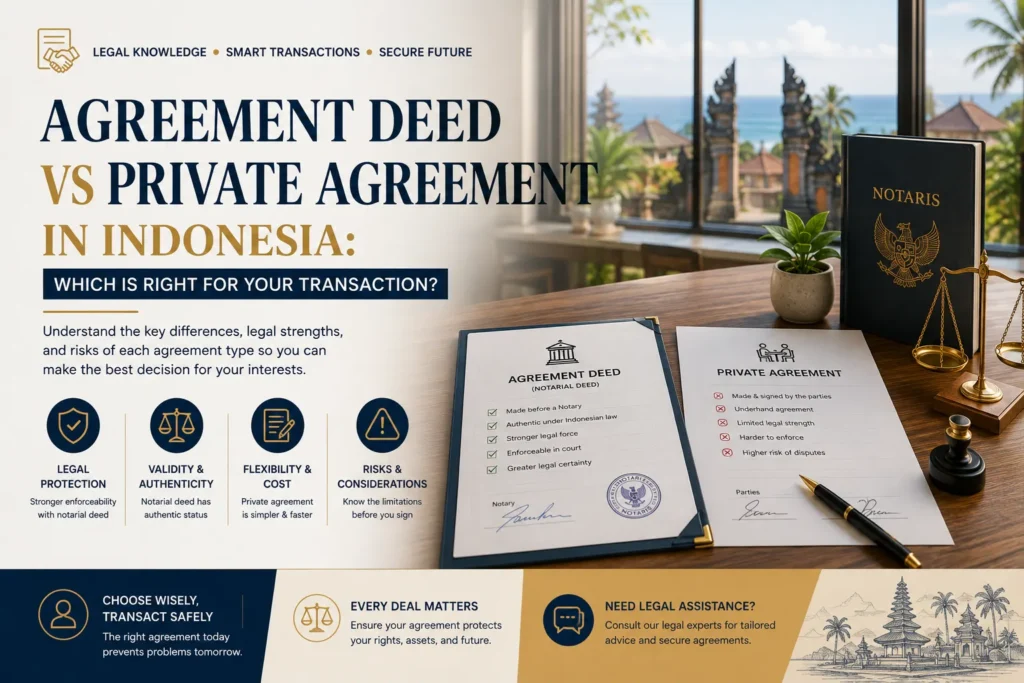
A private agreement can be legally binding in Indonesia, while an agreement made as an authentic notarial deed generally offers a different level of formality and evidentiary strength. The right choice depends on the transaction, the evidence risk, the parties involved, and whether a specific law requires a particular form.
For this comparison, agreement deed means an agreement stated in an authentic notarial deed made by or before an authorized notary. Private agreement means a written agreement made by the parties without being made as an authentic deed before an authorized public official. Bali Legal ID lists Agreement Deeds as a service for drafting, reviewing, and customizing agreements for business needs.
Agreement Deed vs Private Agreement Indonesia: Core Differences
The central distinction is not simply legal versus illegal. Indonesian contract law asks first whether the agreement itself satisfies the requirements for a valid contract, and then whether a particular transaction must use a prescribed form.
An official court decision applying Article 1320 of the Indonesian Civil Code states that the validity of an agreement depends on four conditions: consent, legal capacity, a specific subject matter, and a lawful cause. The same decision treated agreements satisfying those requirements as valid and binding between the parties. The decision can be reviewed through the Supreme Court JDIH.
| Decision factor | Authentic notarial agreement deed | Private agreement |
|---|---|---|
| How it is made | Made in the legally prescribed form by or before an authorized public official, such as a notary acting within authority | Prepared and signed by the parties without being made as an authentic deed before an authorized public official |
| Contract validity | Still depends on the underlying transaction satisfying applicable law; notarial form does not cure an unlawful object or other substantive defect | Can be valid where the general contract requirements are met and no special rule requires another form |
| Evidentiary position | Receives the statutory evidentiary treatment applicable to authentic instruments | Evidentiary weight can depend more heavily on acknowledgement of signatures and proof of the document |
| Process | More formal and requires execution through the notarial process | Usually more flexible for the parties to prepare and execute |
| Best fit | Higher-value, long-term, multi-party, governance-sensitive, or dispute-sensitive transactions, and transactions where law requires authentic form | Lower-complexity arrangements where the law does not require authentic form and the parties accept the evidentiary trade-off |
| Intermediate option | Not applicable | Certain private documents can have signatures and date legalized or can be registered by a notary, but that is different from making the whole agreement as an authentic deed |
The decision should therefore be based on the transaction rather than on a belief that every serious agreement must be notarized.
A Private Agreement Can Be Valid – But Form Still Matters
A private agreement is not automatically invalid merely because it was not made before a notary. The more important question is whether the agreement meets the substantive requirements of Indonesian contract law and whether a special law imposes an additional formality for that transaction.
The Four Contract-Validity Requirements
The Supreme Court JDIH decision applying Article 1320 of the Civil Code identifies four requirements for a valid agreement: agreement of the parties, capacity to enter into the obligation, a specific subject, and a lawful cause.
That means the choice between a private agreement and a notarial deed does not replace substantive contract analysis. The parties still need a clear object, lawful purpose, authority to sign, and terms that accurately record what they intend.
Special Rules Can Override the General Choice
Some legal acts have their own prescribed form. A clear example of a transaction with prescribed corporate form is standard PT establishment: the Directorate General of General Legal Administration states that establishing a PT is carried out through a notary.
The practical rule is simple: before choosing a private agreement for a transaction with corporate, land, security, registration, or other regulated consequences, check whether a specific statute or procedure requires an authentic deed, another official instrument, or another prescribed form. A general comparison page cannot replace that transaction-specific check.
Evidentiary Strength Is a Major Difference
For many commercial users, the most important difference is not whether both documents can exist, but how they operate if facts, signatures, dates, or agreed terms are later disputed.
Authentic Deeds Have a Stronger Statutory Evidentiary Position
An official court decision explains that an authentic deed is made in the form prescribed by law by or before an authorized public official, while a private deed is made by the interested parties without that official involvement, and the same decision applies Article 1870 of the Civil Code to the evidentiary position of authentic deeds.
The court describes an authentic deed as having perfect evidentiary value for the parties, their heirs, and persons deriving rights from them regarding what is contained in the deed. That does not mean a notarial deed can never be challenged. Authority, fraud, falsity, defects in execution, illegality, or other legal grounds can still become relevant. The advantage is the deed’s evidentiary position, not immunity from dispute.
Private Agreements Depend More on Acknowledgement and Proof
The same official decision states that a private deed can obtain strong evidentiary effect against the person who signed it and related successors when the signature is acknowledged, a distinction explained in the Supreme Court JDIH decision.
In practical terms, a private agreement may work effectively while the relationship remains cooperative. If a party later denies a signature, challenges the date, disputes authority, or contests the document’s contents, proof can become more contested.
A Third Option: Legalization or Registration of a Private Document
The choice is not always binary. Indonesian notary law gives notaries several powers relating to private documents in addition to the power to make authentic deeds.
Under Article 15 of the Notary Law as amended by Law No. 2 of 2014, a notary may make authentic deeds within the scope of the notary’s authority and may also legalize signatures and establish the date of a private document, as well as register private documents in a special book, as shown in the official amended Notary Law.
These services should not be confused with having the entire agreement made as an authentic notarial deed. They are separate statutory functions. If the real concern is certainty about signatures or date, ask whether legalization or registration is sufficient before automatically choosing a full authentic deed.
For broader context on available document services, Bali Legal ID also maintains a Notary Services page.
When an Authentic Agreement Deed Is Usually the Better Fit
There is no universal winner, but an authentic deed is often worth considering when the cost of ambiguity or a later evidence dispute would be material.
Higher-Value or Long-Term Commitments
A more formal deed may be appropriate for substantial investments, long-term cooperation, significant financing arrangements, complex asset arrangements, or agreements where performance continues for years. The reason is not that a private agreement is automatically invalid, but that stronger formal evidence may be commercially valuable if the relationship later changes.
Multi-Party or Governance-Sensitive Arrangements
Where several shareholders, investors, partners, or related entities have different rights and obligations, a formal execution process may help create a clearer evidentiary record around the agreement and the parties appearing before the notary.
Transactions With a Special Formal Requirement
If the relevant law requires an authentic deed or another prescribed instrument, a private agreement is not a substitute. This should be checked before comparing convenience, drafting speed, or other commercial considerations.
Cross-Border Transactions With Higher Dispute Risk
Foreign parties can add language, authority, governing-law, translation, and cross-border enforcement questions. A notarial deed may be part of the risk-management structure, but the document form alone does not resolve every international-contract issue.
When a Private Agreement May Be Reasonable
A private agreement may be suitable when the transaction is straightforward, the law does not require an authentic instrument, the parties understand the terms, and the consequences of an evidence dispute are manageable.
Examples may include routine service arrangements, ordinary commercial cooperation, limited-scope vendor terms, or other transactions where the parties deliberately choose a simpler written contract. Whether a private form is appropriate still depends on the subject matter and applicable law.
Before using a template, check at least:
- The legal names and authority of the signatories
- The exact obligations of each party
- Payment terms and performance milestones
- Duration, renewal, and termination
- Liability and default provisions
- Confidentiality or intellectual-property provisions where relevant
- Governing law and dispute-resolution mechanism
- Required language and translation
- Whether a special law requires a different form
Foreign Parties Must Also Consider the Language Rules
For agreements involving an Indonesian state institution, government agency, Indonesian private institution, or Indonesian citizen, Article 31 of Law No. 24 of 2009 requires the use of Bahasa Indonesia, and where a foreign party is involved the agreement is also written in that party’s national language and/or English.
Presidential Regulation No. 63 of 2019 further provides that the foreign language and/or English text is used as an equivalent or translation of the Indonesian text to align the parties’ understanding. Article 26 also provides that if interpretations differ between the equivalent texts, the language agreed by the parties in the agreement is used.
The litigation consequences of language disputes should not be oversimplified. The Supreme Court has discussed differing judicial approaches to foreign-language commercial contracts, including cases reaching different conclusions on the effect of non-compliance. For a transaction involving foreign parties, language planning should therefore happen before signing rather than after a dispute arises.
Practical Decision Checklist
Choose the document form only after answering these questions:
- Does a specific law require an authentic deed or another formal instrument?
- How significant is the transaction value or long-term exposure?
- Would a later dispute over signatures, date, authority, or wording create material risk?
- Are several parties, shareholders, investors, or complex approval rights involved?
- Will the document be relied on in a registration, corporate, financing, or regulated process?
- Are Indonesian and foreign parties involved, creating language or cross-border issues?
- Would legalization or registration of a private document meet the real objective?
- Are the signatories authorized and are the underlying documents complete?
If the first answer is yes, follow the required legal form. If no special form applies, the choice becomes primarily a question of transaction complexity, evidence, administration, and risk allocation.
Bali Legal ID’s broader Bali Legal Service can be used when the agreement is only one part of a wider business, property, licensing, or investment project.
Conclusion
For agreement deed vs private agreement Indonesia, neither option is automatically right for every transaction. A private agreement can be valid when the general requirements for a contract are satisfied and no special rule requires another form. An authentic notarial deed offers a more formal execution process and a stronger statutory evidentiary position.
Use a private agreement when the transaction is legally eligible for that form, relatively straightforward, and the parties accept the evidentiary trade-off. Consider an authentic agreement deed when the transaction is high-value, long-term, complex, dispute-sensitive, or subject to a formal legal requirement. If the concern is mainly proof of signatures or date, legalization or registration of a private document may be a third option worth assessing.
The final choice should follow the actual transaction, not a blanket rule that one format is always superior.
Once the document form has been selected, review documents commonly requiring notarization and execution checks before signing as separate questions in the transaction file.
Choose the Agreement Form Before You Sign
The wrong question is whether every agreement should be notarized. The more useful question is which form matches the transaction, evidence risk, parties, and any mandatory legal requirements.
For deed drafting or review, see the Agreement Deeds service. Before signing a commercial contract, use the contract clause checklist to identify obligations, payment terms, default and dispute provisions that need attention.
For help coordinating the records and next steps discussed above, review our notary services in Bali.
Read More: Professional Notary Services in Bali for Property, Business & Legal Documentation
FAQ agreement deed vs private agreement indonesia
Is a private agreement legally valid in Indonesia?
It can be. General contract validity is assessed using the requirements under Article 1320 of the Civil Code, while some transactions have additional mandatory form requirements. A private agreement should therefore not be treated as automatically invalid solely because it was not made before a notary.
Is a notarial deed always required for a business agreement?
No universal rule requires every business agreement to be an authentic notarial deed. The answer depends on the transaction and whether a specific law requires a prescribed form. Where no special form applies, parties may still choose a notarial deed for evidentiary or risk-management reasons.
Is a notarial agreement deed stronger evidence than a private agreement?
An authentic deed receives the evidentiary treatment assigned to authentic instruments under the Civil Code. Private documents can also have substantial evidentiary value, particularly where signatures are acknowledged, but disputes about signatures, date, or contents may create a different proof process.
Does legalizing a private agreement make it an authentic notarial deed?
Not simply by virtue of legalization. Indonesian notary law separately authorizes notaries to make authentic deeds, legalize signatures and dates on private documents, and register private documents. These are distinct functions and should be selected according to the objective.
Can an English-only agreement be used when an Indonesian party is involved?
Article 31 of Law No. 24 of 2009 requires Bahasa Indonesia for agreements involving specified Indonesian institutions or Indonesian citizens. When a foreign party is involved, the agreement is also written in the foreign party’s national language and/or English. Cross-border agreements should be structured with these language rules in mind before signing.
When should I prefer an authentic notarial agreement deed?
It is worth considering for high-value, long-term, complex, multi-party, governance-sensitive, or dispute-sensitive transactions, and it is required where a specific law prescribes authentic or other formal documentation.
References & Sources
- Bali Legal ID – Agreement Deeds
- Law No. 2 of 2014 amending Law No. 30 of 2004 on the Office of Notary – BPK
- Law No. 2 of 2014 on the Office of Notary – Supreme Court JDIH text
- Putusan Pengadilan Negeri Klaten Nomor 105/Pdt.G/2022/PN Kln
- Putusan Pengadilan Negeri Palu Nomor 146/Pdt.G/2022/PN Pal
- Directorate General of General Legal Administration – Limited Liability Company FAQ
- Law No. 24 of 2009 on the National Flag, Language, State Emblem, and National Anthem – Official Text
- Presidential Regulation No. 63 of 2019 on the Use of Bahasa Indonesia – Official Text
- Supreme Court of Indonesia – Private International Law Approach to Foreign-Language Commercial Contract Disputes