
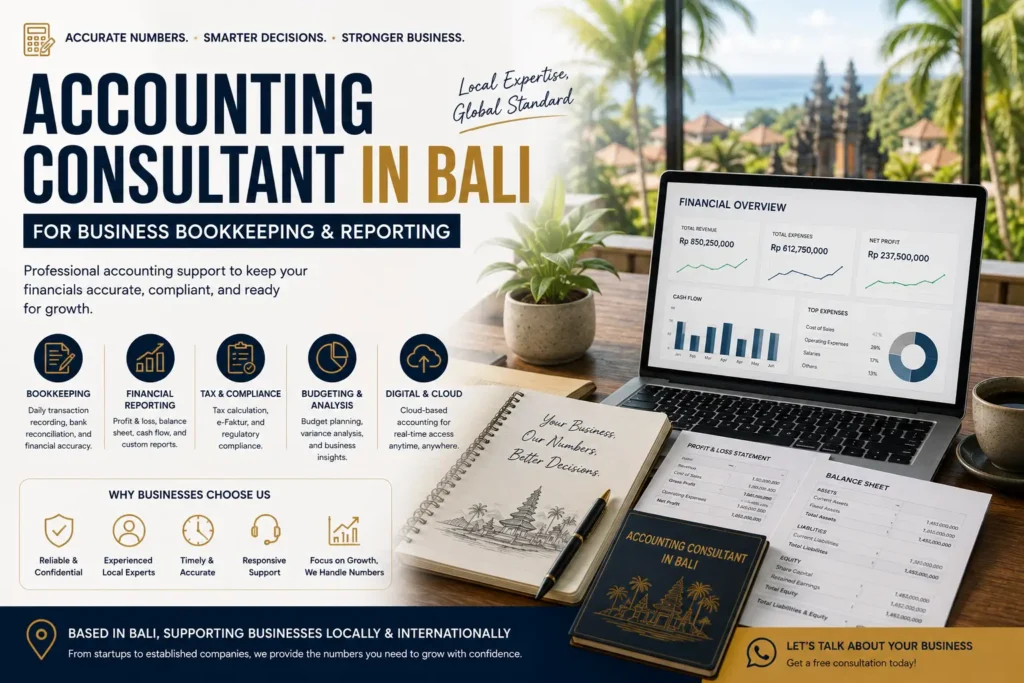
Incomplete bookkeeping, unreconciled bank activity, missing supporting documents and inconsistent financial records can make it difficult for an owner to understand what is happening inside a business. An accounting consultant can help organize that information into a repeatable accounting workflow and prepare cleaner financial data for management, financial reporting and related compliance work.
Bali Legal ID groups Accounting Services, Tax Consulting and Financial Report Preparation under its Financial Consultant service area, so these functions can be coordinated while remaining distinct workstreams.
The purpose of the accounting service is not to promise a particular financial result. It is to help the business establish, maintain or improve the underlying financial records used to understand transactions and prepare reliable accounting information.
Accounting Consultant Support: What This Service Covers
Bali Legal ID’s existing Business Accounting and Tax Services Bali guide describes accounting work including bookkeeping, bank reconciliation, expense tracking, revenue recording, financial documentation and ledger management.
Those activities provide a practical basis for defining an accounting engagement. The exact scope should still be agreed according to the company’s records, transaction volume, systems and reporting needs.
Use the table below as a scoping guide rather than a fixed service package. It connects common accounting needs with the workstream that should be confirmed during the initial review.
| Accounting need | Potential scope to confirm |
|---|---|
| Day-to-day records | Bookkeeping and transaction recording |
| Bank and ledger consistency | Bank reconciliation and review of recorded balances |
| Income and cost records | Revenue and expense recording |
| Supporting documents | Organization of financial documentation |
| Accounting structure | Ledger management and review of account classifications |
| Reporting output | Coordination with financial report preparation where required |
| Tax-related work | Separate coordination with Tax Consulting where included |
The main implication is that the core accounting scope centers on financial records, reconciliation and ledger organization. Financial-report preparation and tax work can be coordinated with that foundation, but they should be added only when the engagement specifically includes those separate workstreams.
Bookkeeping and Financial Record Organization
Good accounting begins with complete source information. Sales, expenses, bank activity, invoices, receipts and other supporting records need to be captured consistently so the accounting records represent the transactions that actually occurred.
An accounting consultant can help structure this workflow by identifying the records available, determining what information is missing and organizing transactions into an accounting record that can be reviewed over time.
For a company whose accounting is already current, the work may focus on recurring record maintenance and review. For a company with incomplete historical records, the first stage may instead require a clean-up or reconstruction exercise before normal recurring accounting can begin.
Reconciliation and Record Review
Recording transactions is only one part of an accounting process. Recorded balances should also be compared with external or supporting information where appropriate.
Bank reconciliation is one practical example. Differences between bank activity and the accounting ledger can indicate unrecorded transactions, duplicate entries, timing differences or items that require clarification. Resolving those differences improves the usefulness of the records before management or reporting decisions are based on them.
The same principle can be applied to selected receivable, payable, cash, revenue or expense records where the engagement requires it. The exact review should follow the company’s accounting system and available documentation rather than a generic checklist.
Financial Reporting Support
Accounting records are the input from which financial reports are prepared. Where the engagement requires structured reporting as a distinct output, Bali Legal ID also maintains a separate Financial Report Preparation service.
Keeping those services distinct is useful. Accounting work focuses on the underlying records and accounting process, while financial-report preparation focuses on presenting financial information in structured reports for the relevant business purpose.
The appropriate reporting format and frequency should be agreed according to the company and the intended use of the reports rather than assumed to be identical for every client.
Why Accounting Records Matter for Indonesian Companies
Accounting is not only a management tool. For corporate taxpayers in Indonesia, bookkeeping also has a regulatory role.
Current Directorate General of Taxes guidance on corporate financial statements explains that corporate taxpayers in Indonesia are required to maintain bookkeeping and prepare financial statements. The guidance states that the bookkeeping should reflect the company’s actual business condition or activities.
The same DJP guidance states that financial statements are attached to the annual corporate tax return for taxpayers that are required to maintain bookkeeping.
This is why accounting records and tax work should be coordinated but not treated as the same service. An accounting consultant helps establish the financial-data foundation. Tax calculations, tax-return preparation, filing and tax-specific advice require a separate tax scope where applicable.
The Directorate General of Taxes describes Coretax as the tax-administration system integrating core processes including taxpayer registration, tax-return filing, payment, examination and collection. Clean accounting records can support the information needed for tax work, but maintaining the books does not automatically mean that every tax-administration task is included in an accounting engagement.
Accounting Consultant vs Tax Consultant vs Financial Report Preparation
Accounting, tax and financial-report work use related information but solve different problems. Use the comparison below to identify which service should own the primary issue before deciding whether several workstreams need to be coordinated.
| Service | Primary focus | Typical reason to use it |
|---|---|---|
| Accounting consultant | Bookkeeping, transaction records, reconciliation and accounting organization | Records are incomplete, inconsistent or need recurring maintenance |
| Tax consultant | Tax planning, reporting and compliance questions | The company needs tax-specific review, calculations, reporting or advice |
| Financial report preparation | Structured financial reporting | The company needs organized financial statements or management reporting outputs |
The key implication is that these services can be coordinated but should not be assumed to be interchangeable. A company may need one, two or all three depending on the condition of its records, its reporting needs and the tax work that must be handled separately.
Tax planning, tax reporting and tax-compliance questions belong to a related but distinct workstream, which Bali Legal ID addresses through its separate Tax Consulting service.
For example, accounting records may first need to be reconciled before a financial report can be finalized or tax information can be prepared from the same records.
How an Accounting Engagement Can Be Structured
The exact workflow should be agreed for the company, but a practical accounting engagement can be structured in the following stages.
1. Define the Accounting Scope
Start by identifying what the business actually needs. Is the priority recurring bookkeeping, historical clean-up, bank reconciliation, management visibility, preparation for financial reporting or coordination with tax work?
The answer determines which records are required and whether the engagement is one-time, periodic or recurring.
2. Review the Existing Records
Collect the current accounting file, bank information, transaction records and available supporting documents. The objective is to understand the opening position before changing or rebuilding the records.
A company changing accounting providers should also identify the most recent completed period, outstanding reconciliations and any unresolved balances.
3. Organize and Record Transactions
Once the source information is available, transactions can be organized and recorded consistently. Missing documents or unclear items should be identified rather than silently assumed.
This stage is especially important where historical records have been maintained by several employees, spreadsheets or accounting systems.
4. Reconcile and Review Exceptions
Compare relevant accounting balances with supporting information such as bank activity and investigate material differences. The purpose is to distinguish genuine timing differences from missing, duplicated or incorrectly classified items.
5. Prepare the Agreed Outputs
The accounting output depends on scope. It may include updated books, reconciliation status, identified outstanding items or information ready for the company’s financial-reporting process.
Where formal financial reports are needed, the accounting work can be coordinated with Financial Report Preparation rather than assuming that every accounting engagement automatically contains the same reporting package.
6. Coordinate Related Tax Work Separately
Where the records are also being used for tax purposes, define whether Bali Legal ID’s Tax Consulting service is separately engaged. This avoids confusion over who is responsible for tax calculations, tax returns, submissions or tax-specific advice.
Who Is This Accounting Service Suitable For?
Accounting support can be useful when a business has one or more of the following conditions:
- Financial transactions are being recorded inconsistently
- Bank accounts have not been reconciled regularly
- Supporting invoices or receipts are difficult to trace to ledger entries
- Management cannot obtain a clear view of recorded income and expenses
- Historical records need to be reviewed before recurring bookkeeping begins
- The company is changing accountants or accounting systems
- Financial reports cannot be prepared efficiently because the underlying records are incomplete
- Accounting data needs to be organized before tax work is completed
- Owners want a more structured recurring accounting workflow
The service can be relevant to both domestic and foreign-owned businesses. The accounting method and engagement scope should follow the company’s actual operations and records rather than its ownership label alone.
What Is Outside the Core Accounting Scope?
Clear exclusions are as important as the service scope.
Statutory Audit
An accounting-consultant engagement should not be represented as an independent statutory audit unless the work is performed under the separate professional and regulatory requirements applicable to public accountants and audit services.
Current DJP material also distinguishes ordinary financial-statement preparation from circumstances in which separate legislation requires an audit by a public accountant. Agree on a separate audit engagement if an audit opinion or assurance conclusion is required.
Tax Advice and Tax Filing
Accounting records support tax work, but tax advice, tax calculations, tax-return preparation and filing should be confirmed separately. Bali Legal ID provides Tax Consulting as a separate service area.
Legal, Licensing and Corporate Work
Accounting services do not replace company-law, OSS licensing, notarial or property services. Where an accounting issue reveals a corporate, licensing or legal-document problem, that issue should be directed to the relevant service rather than treated as an accounting adjustment.
Guaranteed Financial Outcomes
Accounting work can improve the organization and visibility of financial information, but it cannot guarantee profitability, financing approval, investor acceptance, tax outcomes or business growth.
What to Prepare Before an Accounting Review
Preparing the records before consultation can make the initial scope easier to define. Depending on the business, useful information can include:
- Existing accounting ledger or accounting-system export
- Bank statements for the period under review
- Sales invoices and revenue records
- Supplier invoices and expense documents
- Cash transaction records
- Accounts receivable and accounts payable information
- Prior financial reports
- Fixed-asset information where relevant
- Existing chart of accounts
- Previous reconciliation files
- Tax returns or tax working papers where coordination with Tax Consulting is required
- A list of unresolved balances or transactions already known to management
Not every engagement requires every document. The first review should identify what is actually necessary for the agreed accounting scope.
How to Choose the Right Accounting Support
Before appointing an accounting consultant, define the problem the company needs to solve.
Choose recurring accounting support when transactions are ongoing and the company needs a repeatable process for recording and reviewing them. Consider a clean-up engagement when historical books are incomplete or unreliable. Use Financial Report Preparation when the underlying records are sufficiently organized but structured reports are the main requirement. Add Tax Consulting when the issue involves tax treatment, calculation, reporting or tax-administration questions.
Other practical decision factors include:
- Volume and complexity of transactions
- Number of bank accounts and payment channels
- Quality of existing supporting documents
- Whether historical records require reconstruction
- Frequency of management reporting needed
- Whether accounting and tax work must be coordinated
- Whether the company is changing providers or accounting systems
- Whether unresolved balances need investigation before the next reporting period
A useful engagement starts with a defined scope. This is more reliable than selecting a generic accounting package before the condition of the records is understood.
Conclusion
An accounting consultant can help a business turn fragmented transaction data into a more structured bookkeeping and accounting process. At Bali Legal ID, Accounting Services sits alongside Tax Consulting and Financial Report Preparation, allowing each workstream to be selected according to the company’s actual needs.
Start by identifying whether the problem is bookkeeping, reconciliation, historical clean-up, financial reporting or tax coordination. Then define the records, period, responsibilities and outputs required for that specific engagement.
For Indonesian corporate taxpayers, maintaining bookkeeping and preparing financial statements also connects accounting records with ongoing tax-administration requirements. Keeping the accounting scope clear from the beginning makes it easier to coordinate those related obligations without treating accounting, tax and audit as the same service.
Review Your Accounting Records and Define the Right Scope
If your books are incomplete, unreconciled or difficult to use for reporting, the first step is to identify what needs to be corrected and what should become part of the recurring accounting workflow.
Discuss your current records and reporting needs with Bali Legal ID to determine whether Accounting Services, Financial Report Preparation, Tax Consulting or a coordinated scope is appropriate for your business.
For help coordinating the records and next steps discussed above, review our accounting services in Bali.
Read More: Business Accounting and Tax Services Bali: Complete Guide for Companies and Foreign Investors
FAQ accounting consultant
What does an accounting consultant do for a business?
An accounting consultant can support bookkeeping, transaction recording, bank reconciliation, financial-document organization, ledger review and the preparation of accounting information used for management or financial reporting. The exact deliverables should be agreed according to the company’s records and needs.
Is an accounting consultant the same as a tax consultant?
No. Accounting work focuses on the company’s financial records and accounting process. Tax consulting focuses on tax treatment, planning, reporting and compliance. The two areas often use the same underlying data but should be scoped separately.
Do corporate taxpayers in Indonesia need bookkeeping?
Current Directorate General of Taxes material states that corporate taxpayers in Indonesia are required to maintain bookkeeping and prepare financial statements. The precise application should still be reviewed against the taxpayer’s circumstances and current rules.
Can Bali Legal ID also prepare financial reports?
Yes. Bali Legal ID currently lists Financial Report Preparation as a separate service under its Financial Consultant category. It can be considered when structured financial reporting is required in addition to the accounting-record work.
Does the accounting service automatically include tax filing?
It should not be assumed. Bali Legal ID lists Tax Consulting separately from Accounting Services. If tax calculations, tax-return preparation, filing or tax-specific advice are required, those responsibilities should be confirmed as a separate or coordinated scope.
Is accounting consulting the same as a statutory audit?
No. Bookkeeping, accounting and financial-report preparation are different from an independent statutory audit. Audit requirements and audit services are subject to separate professional and regulatory rules.