
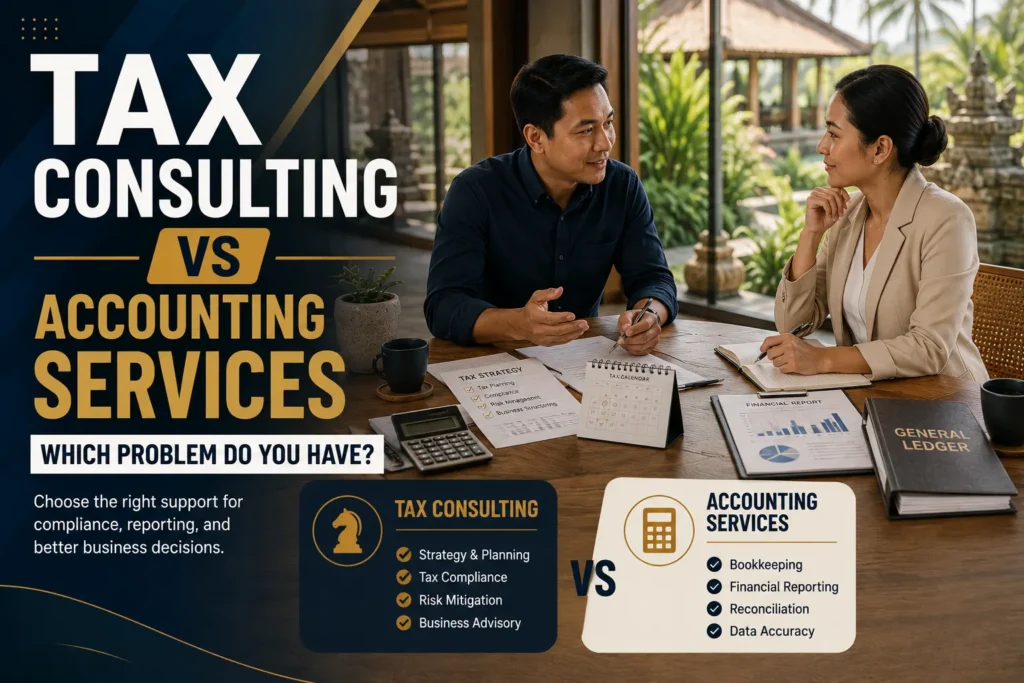
Tax consulting and accounting services solve different problems. If the question is about tax treatment, reporting or compliance, start with tax consulting. If the underlying problem is incomplete, inaccurate or poorly organized financial information, accounting should normally be reviewed first. Some companies need both, in sequence.
The question Tax Consulting vs Accounting Services is best answered by identifying where the information gap sits: in the tax position, in the underlying financial records or in the reporting output the business needs.
Bali Legal ID’s Financial Consultant service separately lists Tax Consulting, Accounting Services and Financial Report Preparation, which is a useful reminder that these functions are related but not identical.
Tax Consulting vs Accounting Services: Which Problem Do You Have?
The most useful comparison is not based on job titles. It is based on the decision the business needs to make.
Ask:
- Do we understand our financial information but need to determine the tax position?
- Are our records incomplete, inconsistent or unreconciled?
- Do we need a tax-specific compliance review?
- Do we first need reliable financial data?
- Is the required output actually a financial report rather than tax advice or accounting support?
The answer determines which workstream should lead.
What Tax Consulting Is Designed to Resolve
Tax consulting becomes relevant when the unresolved question is specifically about taxation.
Bali Legal ID’s dedicated Tax Consulting service describes its scope as supporting businesses with tax planning, reporting and compliance.
Typical tax-first questions include:
- What tax treatment applies to a transaction?
- Does a current tax position need review?
- What tax reporting issue needs to be addressed?
- Does the business need help understanding its ongoing tax compliance position?
For a deeper tax-specific overview, read our tax consultant guide for Bali businesses. Tax consulting therefore starts with a tax question and moves toward tax-specific analysis, reporting or compliance work. It can depend heavily on financial information, but improving the underlying accounting records is a different problem.
What Accounting Services Are Designed to Resolve
Accounting focuses on the financial information that describes what actually happened in the business.
Bali Legal ID also maintains a separate Accounting Services page focused on financial consultation and understanding the business’s financial condition. Our accounting consultant guide explains bookkeeping and reporting support in more detail.
For Indonesian corporate taxpayers, bookkeeping is also a regulatory issue. Under the current consolidated tax-law text published by JDIH Kementerian Keuangan, corporate taxpayers in Indonesia are required to maintain bookkeeping. The same current consolidated tax-law text states that bookkeeping or records must be maintained in good faith and reflect the taxpayer’s actual circumstances or business activities.
Accounting should therefore be considered first when the main problem is the reliability, organization or completeness of the underlying financial information.
Tax Consulting vs Accounting Services Decision Matrix
The table below compares the two workstreams by the question they answer, the information they usually depend on and the type of problem they are intended to resolve. Use it to identify the likely starting point rather than to treat either service as universally superior.
| Decision criterion | Tax Consulting | Accounting Services |
|---|---|---|
| Core question | What is the tax position or compliance issue? | What do the financial records show and are they reliable? |
| Starting evidence | Transaction facts, tax records and relevant financial data | Bank activity, invoices, expenses, revenue and accounting records |
| Typical problem | Tax treatment, reporting or compliance uncertainty | Incomplete, inconsistent or unreconciled records |
| Typical output | Tax-specific analysis, reporting or compliance direction | Organized accounting information and financial records |
| Dependency | Often depends on reliable underlying records | Creates or improves the record base used by other financial work |
The main implication is that the services address different layers of the same financial system. Tax Consulting generally becomes the stronger starting point when reliable records already exist and the unresolved issue is tax-specific, while Accounting Services becomes more relevant when the evidence needed for tax or reporting work is itself incomplete or unreliable.
The Records Before Tax Rule
A useful practical rule is Records Before Tax when unreliable accounting information prevents a sound tax review.
For example, suppose a company asks for help with its annual corporate tax position but its bank transactions have not been reconciled and revenue records are incomplete. The immediate problem is not only tax interpretation. The evidence needed for the tax work is not yet reliable.
In that situation, accounting may need to be addressed first so the tax review is based on records that reflect the business activity.
This principle is consistent with the current tax-law requirement that corporate taxpayers maintain bookkeeping reflecting actual circumstances. It does not mean accounting always comes first. Where records are already reliable and the unresolved issue is genuinely tax-specific, Tax Consulting can be the appropriate starting point.
Five Common Business Scenarios
1. The Books Are Incomplete
Start with Accounting Services.
If revenue, expenses, bank transactions or supporting records have not been organized properly, the first task is to understand and improve the financial record base.
A tax review based on incomplete records can leave the underlying evidence problem unresolved.
2. The Records Are Complete but the Tax Treatment Is Unclear
Start with Tax Consulting.
If the accounting information is available and the remaining question concerns tax treatment, reporting or compliance, the problem has already moved beyond bookkeeping.
3. The Company Is Preparing Its Annual Tax Position
Potentially both.
For taxpayers required to maintain bookkeeping, the consolidated tax-law text also requires financial statements as part of the information accompanying the Annual Income Tax Return.
The current DJP Annual Income Tax Return guidance also lists financial statements among the documents required as attachments.
If the records first need correction or completion, accounting becomes the dependency. Once the record base is ready, the company can address the tax-specific filing and compliance questions.
4. A New Business Has Started Operating
Start with the missing foundation.
If transactions are occurring but no structured accounting process exists, accounting is likely the immediate operational issue. If the financial information is already established but management needs to understand a specific tax consequence, Tax Consulting can lead.
5. Management Wants Better Financial Information
Accounting or Financial Report Preparation may be more relevant than tax consulting.
A management-information problem should not automatically be converted into a tax engagement. Determine whether the issue is the underlying accounting information, the accounting process or the need for a structured financial report.
When You May Need Both
Tax and accounting are often sequential rather than competing services.
A common sequence where the records themselves need work is:
- Organize and reconcile the underlying accounting records
- Confirm that the records reflect actual business transactions
- Prepare the relevant financial information
- Review tax-specific treatment and compliance questions
- Complete the relevant reporting work
The sequence can change when reliable records already exist. In that case, a tax-specific issue does not need to wait for unnecessary accounting work.
The decision rule is therefore simple: fix the dependency, not the job title.
Where Financial Report Preparation Fits
Accounting Services and Financial Report Preparation should also not be treated as identical.
Bali Legal ID’s Financial Consultant service lists Financial Report Preparation separately from both Tax Consulting and Accounting Services.
This matters when the underlying financial information is available but the business needs a defined reporting output. The problem may no longer be accounting maintenance, and it may not be tax advice. The relevant work can instead be preparation of the required financial report. See our financial report preparation guide for that distinct workstream.
Questions to Ask Before Choosing
Use these questions before deciding which service to review:
- Are the company’s financial records complete?
- Have bank and transaction records been reconciled?
- Is the problem a tax rule or a record-quality problem?
- Do we already have financial information that can support the tax question?
- Is the desired output tax advice, improved records or a financial report?
- Is there a filing or compliance issue that requires tax-specific review?
- Could incomplete accounting information materially change the tax analysis?
If you cannot yet tell whether the problem is tax or accounting, start by identifying which evidence is missing or unreliable. If the decision also involves company structure or legal documents, use our legal versus tax advice checklist to identify the separate questions.
Conclusion
Tax Consulting and Accounting Services do not have one universal winner. Choose Tax Consulting when reliable financial information exists and the unresolved problem is tax treatment, reporting or compliance. Choose Accounting Services when the underlying information itself needs organization, reconciliation or improvement.
When a tax question depends on incomplete financial information, address that accounting dependency first and then move to the tax work. When the records and tax position are already clear but a structured reporting output is needed, Financial Report Preparation may be the more relevant third workstream.
Identify Whether the Problem Is Tax, Accounting or Both
If you are unsure which workstream should come first, identify whether the current problem is the tax position, the reliability of the underlying financial information or the need for a defined financial report.
Discuss the situation with Bali Legal ID so the appropriate Tax Consulting, Accounting Services or Financial Report Preparation workstream can be identified before detailed work begins.
For help coordinating the records and next steps discussed above, review our accounting services in Bali.
Read More: Business Accounting and Tax Services Bali: Complete Guide for Companies and Foreign Investors
FAQ Tax Consulting vs Accounting Services
Do I need a tax consultant or accounting services?
Choose based on the problem. If your financial information is reliable but you need help with tax treatment, reporting or compliance, Tax Consulting is the more relevant starting point. If the records themselves are incomplete or unreliable, Accounting Services should normally be reviewed first.
Can accounting services and tax consulting be used together?
Yes. Accounting can establish or improve the underlying financial record base, while Tax Consulting addresses tax-specific questions that depend on that information. The two workstreams can therefore be sequential rather than alternatives.
Should accounting be completed before tax consulting?
Only when record quality is a material dependency. If incomplete or unreconciled records could materially affect the tax analysis, resolve the accounting problem first. If reliable information already exists, a tax-specific review can proceed without unnecessary accounting work.
Is Financial Report Preparation the same as Accounting Services?
Not necessarily. Bali Legal ID lists Accounting Services and Financial Report Preparation separately. Accounting concerns the underlying financial information and processes, while Financial Report Preparation concerns the required reporting output.
Why do accounting records matter for corporate tax reporting in Indonesia?
Current Indonesian tax rules require corporate taxpayers to maintain bookkeeping, and current DJP guidance lists financial statements among Annual Income Tax Return attachments. Reliable financial information can therefore be an important foundation for tax reporting.