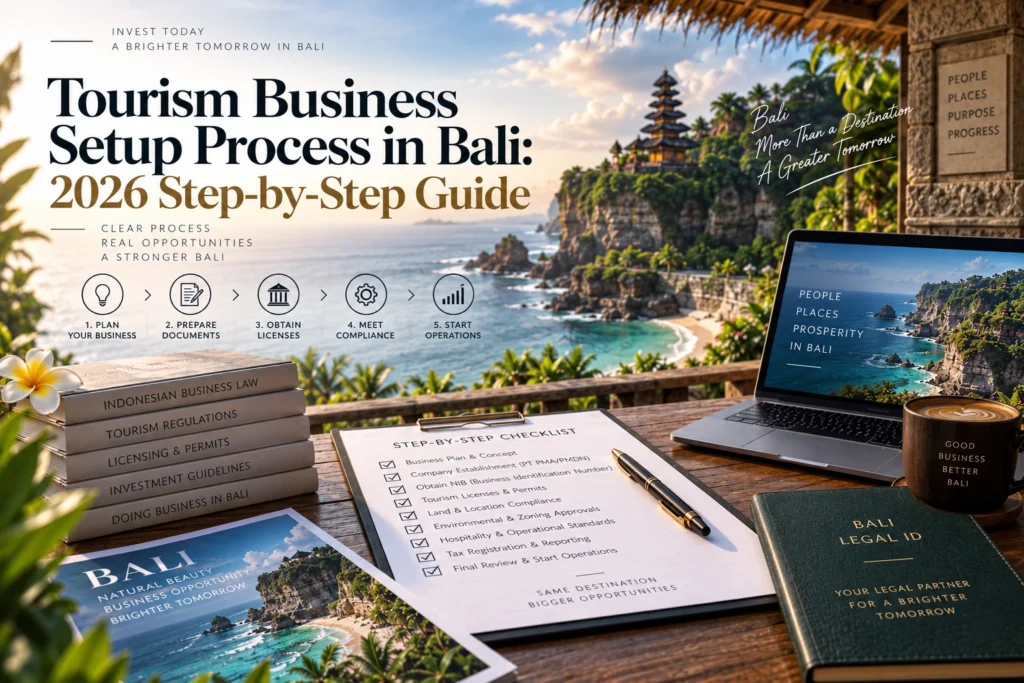
The tourism business setup process in Bali should not begin with an NIB application or a property lease. In 2026, the safer sequence is business model and ownership → KBLI → company → property checkpoint → OSS licensing → tourism standards → certification → ongoing supervision.
Each stage should confirm the assumptions needed for the next. If the ownership, activity, KBLI or premises change midway through the process, downstream corporate documents and licensing may also need to change.
Tourism Business Setup Process in Bali: The Correct Order
Step 1 — Define the business model and ownership
Start by writing down what the business will actually earn money from. Accommodation, restaurants, travel services, attractions, wellness activities, property management and tourism-area management are not interchangeable merely because they all serve tourists.
At the same time, establish who will legally own the operating company. Foreign equity participation can move the project into the PT PMA framework, while a genuinely domestic investment follows a different ownership structure. If that question is still open, Bali Legal ID’s PT PMA versus PT PMDN comparison is a more appropriate starting point than selecting licences first.
For foreign-invested projects, the company structure should also be reviewed before the articles of association and investment assumptions are treated as final. Bali Legal ID’s PT PMA formation guide covers that company-formation layer separately.
Step 2 — Map every material activity to the current KBLI
The next step is to translate the operating model into the Indonesian business classification used for licensing.
BPS Regulation No. 7 of 2025 established KBLI 2025 as Indonesia’s official classification of economic activities.
For projects being planned now, BPS Regulation No. 6 of 2026 amended KBLI 2025 effective 10 September 2026 and specifically changed the title or description of several codes, including KBLI 68122 concerning tourism-area management.
The official OSS conversion guide warns that a conversion result does not automatically mean every new code fits the business activity and instructs users to check the applicable description and scope.
That means the process should not be ‘find an old KBLI and copy it.’ Identify every material revenue activity, verify its current scope and then use those classifications consistently in the company and licensing stages.
Step 3 — Establish the correct company
Only after the ownership and activity map is clear should the corporate setup be treated as final. The company’s stated purposes should reflect the business that will later appear in OSS.
This sequencing reduces a common source of rework: incorporating a company around one business model and then discovering that the intended tourism operation, ownership or investment plan requires a different corporate or licensing configuration.
Treat legal-entity establishment as one milestone, not as proof that the tourism operation is already licensed to open.
Step 4 — Run the property and location checkpoint
For a physical tourism business, the premises should be reviewed before a long lease, major fit-out or opening date becomes difficult to reverse.
The same Tourism Minister Regulation No. 6 of 2025 shows that tourism supervision can include applicable basic requirements such as spatial-use conformity, environmental approval, Persetujuan Bangunan Gedung (PBG) and Sertifikat Laik Fungsi (SLF).
Not every project will follow the same premises path, but the key process rule is consistent: check whether the location and building can support the intended licensed activity before treating the property commitment as proof of business readiness.
This checkpoint is especially important when an existing villa, residence, commercial building or other premises is being converted to a different tourism use.
Step 5 — Complete OSS risk-based business licensing
The licensing stage now operates under Government Regulation No. 28 of 2025, which is currently in force and revoked Government Regulation No. 5 of 2021.
Once the company and activity data are ready, the business enters the OSS process for its NIB and the licensing requirements generated for the relevant activities and risk levels.
Do not use ‘NIB issued’ as a universal project-completion milestone. The more useful question is whether every material KBLI activity has reached the licensing status required for the planned operation.
Bali Legal ID’s NIB OSS RBA registration service is the more relevant same-domain resource for readers who need help specifically with this stage.
Step 6 — Match the business to the applicable Tourism Business Standard
Tourism licensing has an additional sector-specific layer. The Ministry of Tourism JDIH lists Tourism Minister Regulation No. 6 of 2025 as in force and confirms that it revoked the previous Tourism Minister Regulations No. 4 and No. 8 of 2021.
Under the official full text of Tourism Minister Regulation No. 6 of 2025, medium-low, medium-high and high-risk tourism activities must comply with the applicable Tourism Business Standards, while low-risk tourism activities remain subject to applicable health, safety and environmental standards.
The important process point is that the standard is identified from the activity, not from the marketing name of the business. Once the relevant activity and risk classification are known, review the corresponding standard and prepare the facilities, human resources, operational procedures and other evidence required for that activity.
Step 7 — Complete certification where required
Where certification is required, Tourism Minister Regulation No. 6 of 2025 generally requires the Tourism Business Standard Certificate no later than one year after the Business Licensing is verified, subject to the regulation’s exception for certain medium-low-risk activities.
Do not interpret that rule as a universal one-year permission to postpone all project requirements. Certification is one stage in the compliance sequence, while location, building, environmental and other applicable requirements should be handled according to their own rules and project dependencies.
A practical approach is to build the certification evidence while the premises and operating systems are being prepared rather than beginning from zero after launch.
Step 8 — Launch with a supervision-ready compliance file
The process does not end when the business opens. Maintain a file that connects the actual operation to its corporate data, KBLI activities, OSS status, premises documentation, tourism-standard evidence and certifications.
This matters when the business adds another revenue stream, changes premises, expands facilities or changes the underlying company structure. A new commercial idea can create a new licensing question even when the original business remains compliant.
Process Map: What Must Be Decided Before the Next Stage
The following table summarizes the main points to compare before choosing the next step.
| Stage | Decide before moving on | Avoid moving forward when |
|---|---|---|
| Business concept | Actual services and revenue streams | The project is still described only as a ‘tourism business’ |
| Ownership | Domestic or foreign investment structure | Shareholding is temporary or commercially inaccurate |
| KBLI | Current KBLI 2025 scope for each material activity | An old code is being copied without checking the latest scope |
| Company | Corporate purposes, ownership and management align with the project | The deed and intended operation describe different businesses |
| Property | Location and premises can support the intended activity | Lease or fit-out is being treated as proof of licensing feasibility |
| OSS | NIB and activity-specific licensing outputs are understood | NIB issuance is being treated as the finish line |
| Tourism standard | Correct activity-specific standard has been identified | A generic checklist is being used for every tourism activity |
| Certification | Required evidence and timing have been planned | Certification is considered only after operational launch |
| Supervision | Records remain aligned with the real operation | Later expansion is assumed to require no licensing review |
The process also helps with budgeting. Once the sequence is known, company costs, regulatory investment requirements, property expenditure, licensing work and operational preparation can be separated instead of being compressed into one misleading setup figure. Bali Legal ID’s tourism business setup cost and timeline guide addresses that financial-planning question separately.
Common Process Errors
A frequent mistake is starting with the property and trying to fit the company and licences around it afterward. The safer order is to understand the activity and likely licensing path before a major property commitment becomes irreversible.
Another is incorporating first and selecting the actual KBLI activities later. The activity map should inform the company scope, not be treated as an administrative afterthought.
A third mistake is using a pre-September 2026 KBLI reference without checking whether the classification has changed. The latest amendment is particularly relevant for projects involving tourism-area management.
Finally, avoid treating company formation, NIB issuance, tourism-standard compliance and certification as one event. They are connected stages with different legal and practical purposes.
Conclusion
The tourism business setup process in Bali is easiest to manage when each decision is made in the right order. Define the business and ownership first, verify the current KBLI, establish the appropriate company, review the property, complete OSS licensing, identify the applicable tourism standard, complete certification where required and maintain the project for ongoing supervision.
For a project being planned in 2026, the classification stage deserves particular attention because KBLI 2025 was amended on 10 September 2026. Rechecking that step before incorporation, property commitment or licensing submission can prevent later stages from being built on an outdated activity classification.
Review the Setup Sequence Before You Commit
If you are preparing a tourism business in Bali, Bali Legal ID lists PT PMA setup, PT PMDN setup and NIB OSS RBA registration among its business setup services.
Request a consultation to review the proposed ownership, KBLI activities, company structure, property assumptions and licensing sequence before the project moves into irreversible incorporation, lease or fit-out commitments.
For help coordinating the records and next steps discussed above, review our business setup services in Bali.
Read More: Business Setup Bali for PT PMA, PT PMDN & OSS RBA Registration
FAQ tourism business setup process
What is the first step in the tourism business setup process in Bali?
Start by defining the actual business activities and ownership structure. Those decisions affect the KBLI selection, company structure, investment assumptions and licensing path that follow.
Should I form the company before choosing the KBLI?
The activity and KBLI analysis should be substantially clear before the corporate scope is finalized. This reduces the risk that the company deed and later OSS licensing profile describe different business activities.
At what stage should I check the property?
Before treating a long lease, fit-out budget or launch date as final. Property and location questions should be reviewed after the intended activity is known but before commercial commitments become difficult to reverse.
Does obtaining an NIB complete the tourism setup process?
Not necessarily. The NIB is part of the OSS process, while additional activity-specific licensing, basic requirements, Tourism Business Standards and certification may apply depending on the project’s risk level and operating model.
Why should KBLI be rechecked in September 2026?
BPS Regulation No. 6 of 2026 amended KBLI 2025 effective 10 September 2026. The amendment includes changes affecting KBLI 68122 for tourism-area management, so a project should not rely automatically on an older classification reference.
References & Sources
- Government Regulation No. 28 of 2025 on Risk-Based Business Licensing — peraturan.go.id
- BPS Regulation No. 7 of 2025 on the Indonesian Standard Industrial Classification — jdih.bps.go.id
- BPS Regulation No. 6 of 2026 Amending KBLI 2025 — jdih.bps.go.id
- OSS Guide to Understanding KBLI Conversion — oss.go.id
- Tourism Minister Regulation No. 6 of 2025 — Ministry of Tourism JDIH Record — jdih.kemenpar.go.id
- Tourism Minister Regulation No. 6 of 2025 — Official Full Text — jdih.kemenpar.go.id