
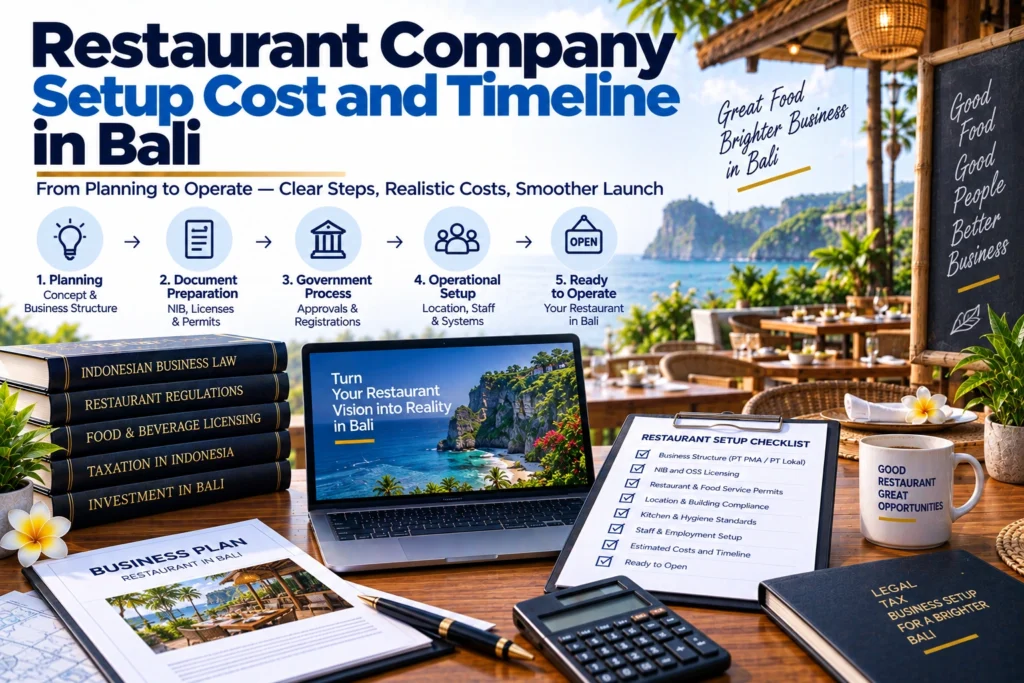
A restaurant company in Bali does not have one universal setup price or one guaranteed opening timeline. The amount required to establish the legal entity is only one part of the project. A realistic budget may also need to cover company capital, OSS licensing, restaurant-specific supporting approvals, lease or premises costs, fit-out, kitchen equipment, professional documentation, tax and accounting setup, and pre-opening operations.
Indonesia’s current licensing framework is governed by Government Regulation No. 28 of 2025, which uses risk-based business licensing and requires business operators to hold the applicable Business Licensing for their activities.
For a conventional restaurant operating from a permanent building, the official OSS classification page identifies KBLI 56101 for Restaurant activity and states that the code remains unchanged in the KBLI 2025 conversion.
The result is an important planning distinction: company established and restaurant ready to open are not necessarily the same milestone.
Restaurant Company Setup Cost Timeline: What the Budget Really Includes
Before comparing quotations, divide the restaurant project into separate cost layers. This prevents a low company-registration quote from being mistaken for the total cost of becoming operational.
| Cost layer | What it can include | Fixed for every restaurant? |
|---|---|---|
| Company formation | Corporate establishment, documentation and registrations within the agreed professional scope | No |
| PMA investment and capital | Regulatory investment value and paid-up capital where foreign investment rules apply | Regulatory thresholds apply, but they are not professional fees |
| Restaurant licensing | OSS, NIB and activity-dependent Business Licensing or supporting licensing | No |
| Premises and fit-out | Lease, renovation, kitchen, equipment, furniture and site preparation | No |
| Pre-opening operations | Accounting setup, staff preparation, suppliers and other operational expenditure | No |
The critical comparison is therefore not simply which provider offers the lowest company setup price? Ask what the quotation actually delivers and what remains outside it.
Company Formation and Professional Setup Scope
A restaurant may operate through different company structures depending on ownership and investment circumstances. Bali Legal ID’s current business-setup scope includes both PT PMDN establishment and PT PMA registration, together with NIB and OSS RBA licensing assistance.
When reviewing a proposal, confirm whether it covers only legal-entity establishment or also includes:
- business-activity and KBLI review
- corporate documentation
- NIB and OSS submission
- restaurant licensing work within the agreed scope
- tax registration or tax setup
- amendments if the business activities change
- assistance with additional supporting licensing
- post-establishment compliance support
A quotation that stops at company formation should not be compared directly with one that extends through restaurant licensing.
PT PMA Investment and Capital for a Foreign-Owned Restaurant
Foreign investment requires a separate financial analysis because regulatory investment value is different from the professional fee for establishing the company.
For a foreign-investment restaurant company, Regulation of the Minister of Investment and Downstreaming/Head of BKPM No. 5 of 2025 provides a specific rule for food and beverage services: the minimum investment value is more than IDR 10 billion, excluding land and buildings, per first two digits of KBLI per location point, with the location-point rule applying per regency or city.
This is particularly important for restaurant investors because it differs from the regulation’s general rule based on five-digit KBLI per project location. Do not automatically apply a generic PT PMA investment formula without checking the specific treatment for food and beverage services.
The regulation separately sets minimum placed and paid-up capital of IDR 2.5 billion per PMA limited liability company, unless another applicable regulation provides otherwise.
Neither figure should be presented as the consultant’s restaurant-setup fee. They are regulatory investment and capital concepts and should be budgeted separately from incorporation, licensing, lease, construction, equipment, and operational expenditure.
Restaurant Licensing and Supporting Approvals
Restaurant licensing should be scoped from the actual operating model rather than from the word “restaurant” alone.
The same OSS restaurant page lists supporting business licensing items, including hygiene-sanitation certification and direct-sale alcohol certificates, showing why the final licensing scope can depend on how the restaurant actually operates.
That does not mean every listed supporting license automatically applies to every restaurant. Instead, it is a reason to define the concept before the setup scope is priced.
Questions that can change the licensing analysis include:
- Will the restaurant serve alcoholic beverages?
- Is food prepared and served only at one permanent location?
- Does the operation include delivery, catering, packaged products or another separate activity?
- Is the restaurant an independent business or a separate unit within another hospitality operation?
- Does the premises require additional property, building, environmental or sanitation work before opening?
The correct answer depends on the actual activity and site.
Premises, Fit-Out and Operating Preparation
For many restaurants, the largest project expenditure is not company registration. It can be the premises itself.
A commercial restaurant budget may include:
- lease payments and deposits
- legal review of lease documentation
- renovation and fit-out
- kitchen and refrigeration equipment
- electrical, water and waste systems
- furniture and point-of-sale equipment
- signage
- professional drawings or technical work where required
- recruitment and staff preparation
- initial stock and supplier deposits
- accounting and financial administration
These items should remain separate from the company-formation quotation so the investor can see which costs are regulatory, which are professional, and which belong to the commercial restaurant project.
A Practical Restaurant Company Setup Timeline
No official source reviewed for this page establishes one universal number of days for every Bali restaurant setup. A more useful timeline is based on dependencies.
Stage 1 — Confirm Ownership, Concept, KBLI and Location
Before incorporating the company, define the actual restaurant model.
At minimum, confirm:
- whether the investment is Indonesian-owned or includes foreign investment
- the intended food and beverage activities
- the appropriate KBLI classification
- the proposed restaurant location
- whether alcohol will be sold
- whether other business activities will operate from the same company
- whether the site will be leased as an existing restaurant premises or substantially renovated
Changing these assumptions after the company or lease has been finalized can create additional documentation or licensing work. For the broader sequence of entity, activity, premises and sector approvals, see the tourism business setup process in Bali.
Stage 2 — Establish the Company
Once the ownership and business scope are clear, company establishment can proceed under the appropriate structure.
Foreign investors who need the broader incorporation framework can review Bali Legal ID’s complete PT PMA setup guide for Bali, while Indonesian-owned businesses may review the separate PT PMDN registration guide.
Company establishment should be treated as a project milestone, not as automatic permission to open the restaurant immediately.
Stage 3 — Complete OSS and Restaurant Licensing
The next phase is to align the registered company, business activity and location with the OSS licensing path.
The official restaurant classification should be checked against the actual concept. Any supporting licenses relevant to the operation should then be identified rather than assumed after the restaurant is already fitted out.
This is also the stage where quotation scope matters. A provider may offer company establishment but exclude supporting licensing, premises-related work or other approvals.
Stage 4 — Reach Operational Readiness
Operational readiness combines regulatory and commercial preparation.
A practical launch checklist can distinguish these milestones:
- company established
- business activities and location recorded correctly
- NIB and applicable OSS licensing handled
- relevant supporting licenses or approvals completed where applicable
- premises prepared for the intended operation
- accounting and operational systems prepared
- restaurant ready to commence the intended activities
An opening date should therefore be planned from the slowest unresolved dependency, not only from the expected company-incorporation date.
What Can Increase Restaurant Setup Cost or Delay Opening?
Several decisions can materially change the scope after work has already started.
Wrong or incomplete activity classification. A restaurant concept that later adds catering, packaged-product sales or another revenue activity may require a broader analysis than the original setup.
Changing ownership structure. Introducing foreign investment can change the company and investment framework.
Signing the premises too early. A commercially attractive property should still be evaluated against the intended restaurant activity and any relevant premises or licensing requirements before substantial capital is committed.
Adding alcohol sales later. The OSS restaurant page identifies direct-sale alcohol certificates among supporting licensing categories, so this should be considered during concept planning rather than treated as an afterthought.
Confusing capital with fees. The PMA investment value and paid-up capital are not the same as legal, notarial, licensing or consulting charges.
Setting the opening date from incorporation alone. Restaurant readiness can depend on licensing, premises, fit-out, equipment and other operational work after the company exists.
Before accepting a restaurant-company setup proposal, request a written scope showing what is included, what is excluded, what depends on the selected location, and which costs belong to the company versus the restaurant project.
For investors who want the company and licensing scope checked before committing to a restaurant launch budget, Bali Legal ID’s Business Setup Bali services include PT PMA registration, PT PMDN establishment, NIB registration, OSS RBA licensing, tax registration, and business permit assistance.
Conclusion
A realistic restaurant company setup cost timeline in Bali should be built from the restaurant concept rather than from a generic incorporation package.
First determine the ownership structure, activity, KBLI and location. Then separate company-formation expenditure from PMA investment and capital requirements where applicable, restaurant licensing, premises costs, fit-out and operating preparation. Finally, plan the opening date around the complete licensing and premises-readiness sequence rather than company registration alone.
That approach gives restaurant owners and investors a much clearer basis for comparing professional proposals, planning capital and avoiding preventable changes after a lease, fit-out or launch commitment has already been made.
For a foreign-owned restaurant group, read the restaurant investment and multi-location planning guide alongside this cost estimate so the regulatory investment assumptions are kept separate from professional setup and operating expenditure.
Plan Your Bali Restaurant Setup Before You Fix the Opening Budget
If you are preparing a restaurant, café or other food-service investment in Bali, Bali Legal ID can review the intended company structure, restaurant activity, KBLI scope, OSS licensing path and related business-setup requirements before you commit to the final setup budget.
For a more useful consultation, prepare your ownership structure, restaurant concept, proposed location, lease status, planned activities and whether the operation will include alcohol sales or additional food-service activities.
For help coordinating the records and next steps discussed above, review our business setup services in Bali.
Read More: Business Setup Bali for PT PMA, PT PMDN & OSS RBA Registration
FAQ restaurant company setup cost timeline
How much does it cost to set up a restaurant company in Bali?
There is no universal total setup price supported by the official sources reviewed. The budget can include company formation, professional services, regulatory investment and paid-up capital for a PT PMA where applicable, restaurant licensing, lease and premises expenditure, fit-out, equipment, tax and accounting setup, and operating preparation. These categories should be quoted separately.
What KBLI is used for a restaurant in Indonesia?
The official OSS database identifies KBLI 56101 for Restaurant activity in a permanent building and states that code 56101 remains unchanged in the KBLI 2025 conversion. The actual business model should still be checked because additional activities can require additional classifications.
What is the PT PMA investment requirement for a foreign-owned restaurant?
Under Regulation of the Minister of Investment and Downstreaming/Head of BKPM No. 5 of 2025, food and beverage service activities are subject to a specific minimum investment rule of more than IDR 10 billion excluding land and buildings per first two digits of KBLI per location point, with the location point applying per regency or city. The same regulation sets minimum placed and paid-up capital of IDR 2.5 billion per PMA limited liability company unless another rule provides otherwise.
Does a Bali restaurant need more than an NIB?
Potentially. The required scope depends on the activity, risk classification and operating model. The official OSS restaurant page lists supporting business licensing categories including hygiene-sanitation certification and direct-sale alcohol certificates. Their applicability should be checked against the specific restaurant operation.
How long does restaurant company setup in Bali take?
There is no single verified universal duration for every restaurant project. Company establishment is only one stage. The complete launch timeline can also depend on OSS licensing, supporting approvals, premises readiness, renovation, equipment, documentation and changes to the original business scope.
References & Sources
- Government Regulation Number 28 of 2025 on Risk-Based Business Licensing — peraturan.bpk.go.id
- Regulation of the Minister of Investment and Downstreaming/Head of BKPM Number 5 of 2025 — jdih.bkpm.go.id
- Official PDF of Regulation of the Minister of Investment and Downstreaming/Head of BKPM Number 5 of 2025 — jdih-storage.bkpm.go.id
- Official OSS Restaurant Business Classification — oss.go.id
- Bali Legal ID Business Setup Services for PT PMA, PT PMDN and OSS RBA — balilegalid.com