
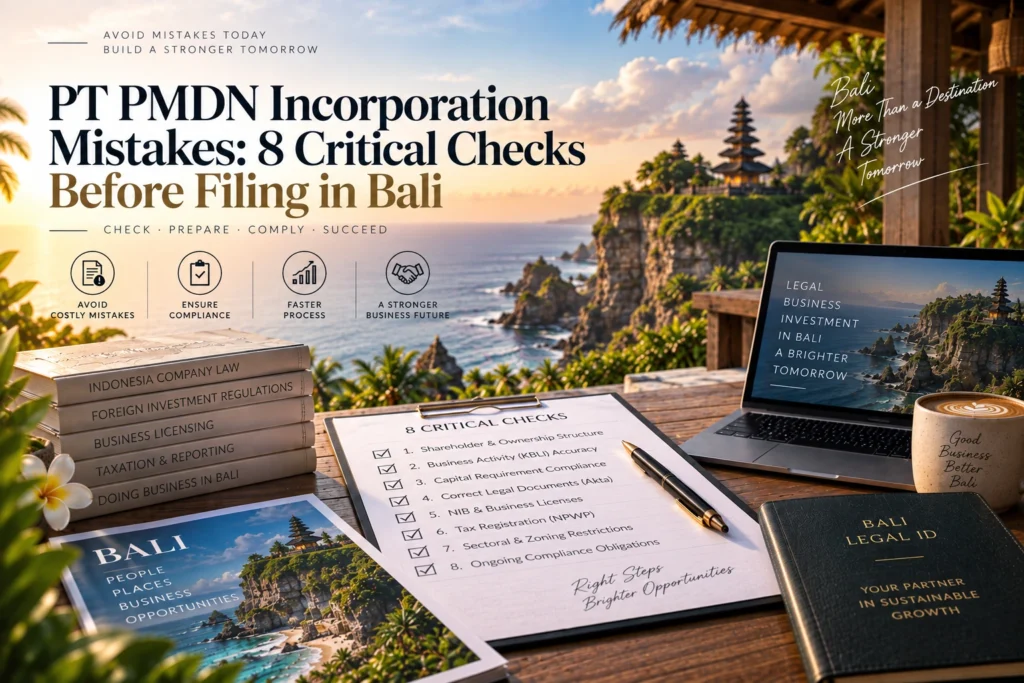
The most expensive PT PMDN incorporation mistakes are usually not typing errors. They are structural mistakes made before filing: choosing the wrong investment classification, using the wrong founder assumptions, copying an outdated capital figure, selecting the wrong KBLI, or allowing the deed and OSS profile to describe different businesses.
A useful 2026 pre-filing check is therefore simple: ownership → company form → capital → KBLI → deed → Ministry filing → OSS licensing. If one layer is wrong, later stages can inherit the same problem.
PT PMDN Incorporation Mistakes: What Usually Goes Wrong
Mistake 1 — Choosing PT PMDN before confirming the real ownership
PT PMDN should follow the actual investment structure, not the structure that appears administratively easier.
Under Law No. 25 of 2007 on Investment, domestic investment is investment conducted in Indonesia by a domestic investor using domestic capital, while foreign investment includes investment by a foreign investor either wholly with foreign capital or jointly with a domestic investor.
If foreign equity is genuinely intended, the project should be reviewed under the foreign-investment framework before incorporation documents are finalized. Trying to solve the ownership question after the domestic company has already been established can create unnecessary restructuring work.
Bali Legal ID’s existing PT PMDN registration guide is the more appropriate companion resource for the full setup process once the ownership structure is clear.
Mistake 2 — Assuming every PT needs the same founder structure
For an ordinary capital-partnership company, Law No. 40 of 2007 on Limited Liability Companies provides the general framework under which the company is established by two or more persons through a notarial deed made in Indonesian.
However, that is not the only PT route in Indonesian law. Government Regulation No. 8 of 2021 also provides a separate single-person-company route for businesses that meet the applicable micro and small business criteria, so treating the two-founder rule as universal is another avoidable incorporation mistake.
The practical lesson is to identify the correct company form before filling shareholder positions simply to satisfy an assumed checklist.
Mistake 3 — Copying a universal PT PMDN capital figure
Another common error is treating one online capital number as mandatory for every domestic company.
Under the official text of Government Regulation No. 8 of 2021, the founders determine the authorized capital, at least 25% of that amount must be placed and fully paid, and a business subject to a specific statutory capital requirement must follow that sector-specific rule.
That means three questions should be separated: the company’s authorized capital, the amount actually placed and paid, and any additional capital threshold imposed by the sector. Professional setup fees and operating budgets are separate again.
A copied number may therefore be both commercially unsuitable and legally incomplete as an analysis.
Mistake 4 — Reusing an old or approximate KBLI
The company should be built around what it will actually do, not around a KBLI copied from an older NIB or another business.
BPS Regulation No. 7 of 2025 established KBLI 2025 as Indonesia’s official classification of economic activities.
For filings being prepared now, BPS Regulation No. 6 of 2026 amended KBLI 2025 effective 10 September 2026, making reliance on an older activity list particularly risky.
The official OSS KBLI conversion guide warns that a conversion result does not automatically mean every new code fits the business and instructs users to check the description and scope.
Before incorporation, identify every material revenue activity and confirm that the current KBLI scope actually describes it.
Mistake 5 — Finalizing the deed before the real activities are settled
The deed should record a business structure that has already been thought through. If the founders are still deciding whether the company will trade, consult, manage property, operate hospitality activities, or combine several revenue streams, finalizing the corporate purposes too early creates avoidable amendment risk.
A better sequence is to map the real activities first, verify the current KBLI codes, and then make sure the corporate purposes support the activities that will later appear in OSS.
This is particularly important for companies with several lines of business. A broad commercial description is not a substitute for checking the licensing consequences of each actual activity.
Mistake 6 — Submitting inconsistent corporate data
The shareholder table, management, capital and corporate purposes should tell the same story across the notarial documents and government systems.
Inconsistencies often begin when one decision changes late in the process but the other records are not reviewed again. For example, a changed shareholder allocation should trigger a check of the deed data, capital allocation and the information that will subsequently be used for licensing.
The practical control is straightforward: before submission, compare the final shareholder structure, management appointments, capital figures and activity scope as one package instead of reviewing each document in isolation.
Mistake 7 — Using outdated company-registration rules
Company-registration guidance can become stale even when the basic PT concept has not changed.
For the legal-entity filing stage, Minister of Law Regulation No. 49 of 2025 is currently in force, governs establishment, amendment and dissolution procedures for limited liability companies, and replaced the previous 2021 procedural regulation.
A 2026 filing checklist should therefore not continue citing the revoked 2021 Ministry procedure as though it were still the current administrative framework.
This is also a reason to separate timeless concepts—such as shareholders, capital and management—from procedures that can change through newer regulations and government systems.
Mistake 8 — Treating NIB issuance as the end of licensing
Incorporating the company and completing its business licensing are connected but different tasks.
After incorporation, the licensing layer is governed by Government Regulation No. 28 of 2025, the current national risk-based business licensing framework that revoked Government Regulation No. 5 of 2021.
The current detailed OSS procedure is governed by Minister of Investment and Downstream Industry/Head of BKPM Regulation No. 5 of 2025, which is in force and replaced BKPM Regulations Nos. 3, 4 and 5 of 2021.
The mistake is assuming that one issued NIB necessarily means every activity is ready to operate. The selected KBLI and risk classification can produce additional licensing, standard or sector-specific requirements.
For the licensing stage itself, Bali Legal ID’s OSS RBA registration guide provides the deeper same-domain workflow.
Pre-Filing Error Check
The following table summarizes the main points to compare before choosing the next step.
| Check | Safer position before filing | Warning sign |
|---|---|---|
| Ownership | Real equity structure is confirmed as domestic | Foreign ownership is expected later but ignored now |
| Company form | Correct ordinary or qualifying single-person PT route is identified | Founders are added only to satisfy an assumed rule |
| Capital | Authorized, placed and paid-up amounts are clearly separated | One generic online number is copied |
| Activity | Actual revenue-generating activities are defined | Business purpose remains vague |
| KBLI | Current KBLI 2025 scope is verified | Old KBLI or conversion result is accepted automatically |
| Deed | Corporate purposes reflect the intended business | KBLI decisions are postponed until after signing |
| Corporate data | Shareholders, management and capital agree across records | One late change is not reflected everywhere |
| Legal procedure | Current 2025 Ministry filing rules are used | A revoked 2021 procedure is still being followed |
| OSS | Activity-specific licensing requirements are checked | NIB issuance is treated as complete operational approval |
Use this comparison as a starting point, then confirm how each point applies to the facts and documents in the specific case.
Conclusion
PT PMDN incorporation mistakes are easiest to prevent before the deed is signed and before OSS data is submitted. Confirm the true ownership structure, choose the correct company form, determine capital properly, verify the latest KBLI, align the deed with the real activities, check corporate data for consistency and use the current company-registration and licensing framework.
For a filing being prepared in September 2026, the KBLI stage deserves particular attention because KBLI 2025 was amended only days before this review. Early alignment is usually more practical than correcting the company and licensing records after incorporation.
Check the Structure Before Filing the PT PMDN
If you are preparing a domestically owned company in Bali, Bali Legal ID lists PT PMDN Setup and NIB OSS RBA Registration among its business setup services.
Request a consultation to review the proposed ownership, company form, capital, KBLI activities and licensing path before the deed and OSS submissions are finalized.
For help scoping the documents and next steps for your business or transaction, contact Bali Legal ID about our business setup services in Bali.
Read More: Business Setup Bali for PT PMA, PT PMDN & OSS RBA Registration
FAQ pt pmdn incorporation mistakes
What is the most important PT PMDN incorporation mistake to avoid?
Confirming the wrong ownership classification is one of the most consequential errors because it affects whether the project should be structured as domestic or foreign investment before the company documents are prepared.
Can I copy the KBLI from another PT PMDN?
It is risky to do so without checking the current description and scope. The correct KBLI depends on the company’s actual activities, and KBLI 2025 was amended again on 10 September 2026.
Is there one minimum capital figure for every PT PMDN?
No single figure should be applied mechanically to every business. The general company rule allows founders to determine authorized capital, requires at least 25% to be placed and fully paid, and sector-specific minimum requirements may still apply.
Can I choose the KBLI after the deed is completed?
The safer approach is to substantially resolve the intended activities and KBLI before finalizing the corporate purposes so the deed and later OSS profile describe the same business.
Does an NIB mean the company can immediately operate every selected activity?
Not necessarily. The risk classification and sector can generate additional licensing, standards or other requirements, so the NIB should not automatically be treated as the final operational approval.
References & Sources
- Law No. 25 of 2007 on Investment — peraturan.go.id
- Law No. 40 of 2007 on Limited Liability Companies — peraturan.go.id
- Government Regulation No. 8 of 2021 on Company Capital and Qualifying Micro and Small Companies — peraturan.go.id
- Government Regulation No. 8 of 2021 — Official Full Text — peraturan.go.id
- BPS Regulation No. 7 of 2025 on the Indonesian Standard Industrial Classification — jdih.bps.go.id
- BPS Regulation No. 6 of 2026 Amending KBLI 2025 — jdih.bps.go.id
- OSS Guide to Understanding KBLI Conversion — oss.go.id
- Minister of Law Regulation No. 49 of 2025 on Establishment, Amendment and Dissolution of Limited Liability Companies — peraturan.go.id
- Government Regulation No. 28 of 2025 on Risk-Based Business Licensing — peraturan.go.id
- Minister of Investment and Downstream Industry/Head of BKPM Regulation No. 5 of 2025 on OSS Risk-Based Business Licensing Procedures — jdih.bkpm.go.id
Recommended Next Articles
- complete PT PMDN registration guide for Bali — balilegalid.com
- OSS RBA registration process in Bali — balilegalid.com