
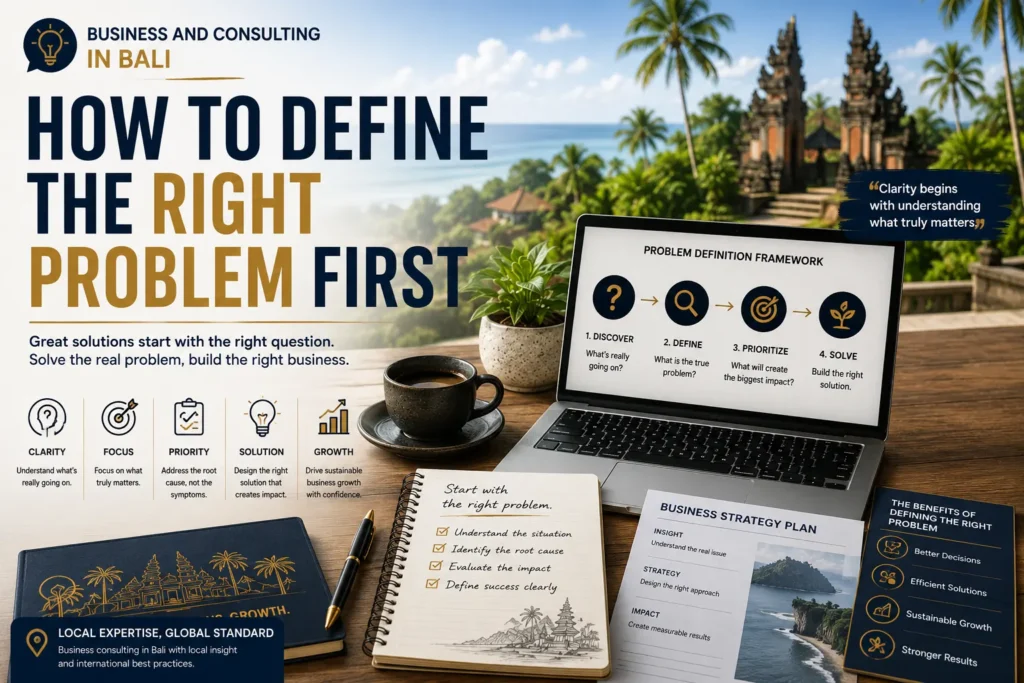
A business decision brief turns a broad concern into a question that can be reviewed. It records the next decision, the evidence already available, the uncertainty that matters and the person who must choose a course of action. The brief is for preparing the substance of advice, rather than requesting or comparing a provider quotation.
Prepare the Business Decision Brief Around One Decision
Write what management needs to decide next and why it matters now. Separate facts supported by records from assumptions and questions that require investigation. Identify constraints such as an intended location, a proposed transaction or a contract date, without treating the constraint as proof that the preferred option is legally or operationally ready.
The Business Decision Canvas
Use four fields to scope the problem before choosing a consultant or service.
| Field | Question | Example |
|---|---|---|
| Decision | What must be decided next? | Whether an existing PT can support a new activity |
| Evidence | What facts describe the current position? | Deed, NIB, OSS data, shareholders and activity description |
| Dependency | What issue can change the others? | Ownership structure may change company and licensing decisions |
| Output | What should happen after review? | Recommendation, amendment, OSS work, agreement or specialist handoff |
The purpose is not to create more paperwork. It is to prevent execution from starting before the actual problem is understood.
1. Decision: What Must Be Decided Next?
Replace a broad request such as “handle my business” with a decision statement.
For example:
- Weak scope: I need help with my company
- Better scope: I need to know whether the existing company structure should be used for a new business activity
- Weak scope: I need tax and accounting help
- Better scope: I need to know whether incomplete bookkeeping must be corrected before the company’s current tax position can be reviewed
A defined decision helps distinguish consultation from implementation.
2. Evidence: What Facts Define the Current Position?
The next step is to identify the minimum facts needed to understand the problem.
For a company or licensing issue, useful evidence can include the current company documents, shareholders, actual business activity and OSS information. For a property-related business decision, relevant evidence can instead include the proposed transaction, property documents and intended use. For a financial issue, the starting evidence may be accounting records, reports or the specific tax question.
Evidence used to diagnose a problem is not always the same as the full documentation later required to execute a filing or transaction.
3. Dependency: Which Issue Can Change the Others?
When several workstreams are connected, prioritize the one that can invalidate, block or materially change the others.
For example, signing a long property commitment before confirming the operating structure can create a harder-to-reverse decision than reviewing the company structure first. Similarly, preparing tax outputs from incomplete accounting records may be less useful than correcting the underlying records before completing the tax review.
A practical priority rule is:
Resolve the high-dependency or difficult-to-reverse decision before lower-dependency execution.
This is a decision-support principle, not a universal legal sequence. The correct order still depends on the facts.
4. Output: What Should the Consultation Produce?
A consultation should have a defined output. Common outputs include:
- A decision between available company or ownership paths
- Identification of the relevant OSS or licensing workstream
- A list of missing information before a filing can proceed
- A specialist tax review
- Accounting correction or reconciliation work
- A required agreement or property-document review
- A recommendation that another regulated or technical specialist is needed
Once the output becomes specific, broad consultation should usually transition into the specialist service responsible for execution.
When General Consultation Should Stop
Broad business consultation should normally transition into specialist execution once the question is defined.
A specialist handoff is appropriate when:
- The company structure has been selected and incorporation or amendment needs execution
- The activity is defined and the remaining task is OSS licensing
- The question has become specifically tax-related
- The underlying accounting records need correction or maintenance
- A financial report is the required output
- A lease, agreement or property document requires preparation or review
- A technical or regulated matter falls outside the verified service scope
This boundary prevents a general consultation from being treated as evidence that every legal, licensing, financial or technical issue has already been resolved.
Consultation Readiness Checklist
Before requesting consultation, prepare enough information to define the decision:
- The decision you need to make next
- Whether a company already exists
- Current or proposed shareholders
- The actual business activity
- Existing NIB or OSS information where relevant
- The proposed business location
- Any major lease, agreement or property commitment connected to the decision
- The specific tax question if tax is the issue
- The condition of the accounting records if financial work is required
- The output you expect after consultation
You do not need to know the answer before consultation. You should, however, be able to describe the decision, current facts and intended outcome.
A defined decision makes the consultant fit scorecard more useful because the provider can assess a concrete question and the evidence available.
Read More: Business Consultant in Bali for Company Setup & Licensing
Conclusion
Use the business decision brief to turn the issues described above into a controlled file with identifiable evidence, responsible people and clear next actions. Confirm what the review has established, keep unanswered questions visible and obtain the appropriate professional input before relying on an unresolved assumption.
Bali Legal ID can help scope the relevant business legal-support scoping. Share the company or transaction objective and the records already available so the required work, responsibilities and deliverables can be identified.
FAQ business decision brief
How long should a business decision brief be?
It should be concise enough to show the decision and material facts clearly, with supporting records indexed separately rather than copied into a long narrative.
What if the preferred option depends on an assumption?
Label the assumption, identify how it can be checked and explain which decision changes if the assumption proves incorrect.
How should the brief be updated after advice?
Record the advice received, remaining uncertainty, decision owner and next action. Retain the version on which the decision relied.
References and Sources
AHU information on limited liability companies provides official background for the relevant administrative or professional context. This checklist organizes the records and questions to discuss for the actual engagement.