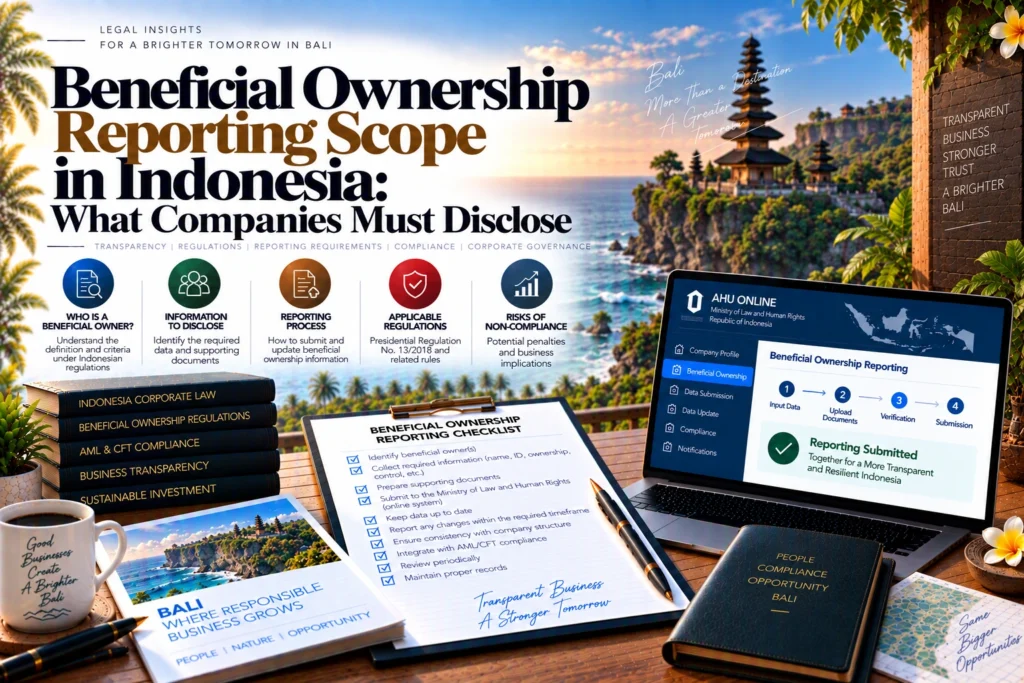
Beneficial ownership reporting asks a different question from a shareholder list: which natural person ultimately owns, benefits from or controls the corporation? Indonesian companies should identify that person, report the required information and keep it current as the ownership or control structure changes.
Indonesia’s current foundational rule is Presidential Regulation No. 13 of 2018, which remains in force and requires every covered corporation to determine its beneficial owner, with at least one qualifying individual identified.
Beneficial Ownership Reporting Scope: Which Corporations Are Covered?
The reporting regime is broader than PT companies alone.
For limited liability companies, that scope includes both capital-partnership companies and single-member companies under the current 2025 framework.
For a Bali investor, the first compliance question is therefore the corporate form. The second is who actually sits behind that structure as the natural person exercising ownership, control or economic benefit.
Who Counts as a Beneficial Owner?
A beneficial owner is ultimately an individual, not merely another company appearing in the ownership chain.
A company should therefore look through its registered ownership and control arrangements to identify the relevant natural person. The legal test is not limited to the name appearing on a share certificate or corporate registry.
The More-Than-25% Tests for a Limited Liability Company
For a limited liability company, Article 4 of Perpres 13/2018 includes individuals holding more than 25% of the shares, more than 25% of the voting rights, or entitlement to more than 25% of annual profit among the beneficial-owner criteria.
Those thresholds provide straightforward indicators where ownership or economic rights are concentrated in one individual.
They should not, however, be converted into a rule that anyone below 25% can automatically be ignored.
Control and Benefit Can Matter Without a 25% Holding
That matters in structures involving nominees, holding companies, indirect ownership, contractual control or economic arrangements that do not appear clearly from the immediate shareholder percentage.
The practical review should therefore ask both who owns the shares and who ultimately controls or benefits from the company.
What Beneficial Owner Information Must Be Collected?
The identification file is more detailed than a person’s name and ownership percentage.
Supporting documents should allow the corporation to verify that the reported person and the stated relationship are accurate.
For a foreign beneficial owner, identification should be reviewed carefully against the person’s passport, foreign address and applicable tax-identification information rather than copied from an outdated incorporation file.
When Must Beneficial Ownership Be Reported?
Beneficial ownership reporting is not a one-time filing.
The obligation begins around establishment or registration and continues when information changes and through periodic updating.
Reporting During Company Formation or Registration
For a new PT, the preferred compliance approach is to establish the ownership and control analysis early rather than rely on the seven-day fallback after licensing.
This is particularly useful where the immediate shareholder is another legal entity, because the corporation may need to trace the ownership chain before it can identify the natural person who satisfies the beneficial-owner criteria.
Changes and Annual Updating
Beneficial-owner information must remain current after incorporation.
If beneficial-owner information changes, Article 20 requires the corporation to report the change no later than three working days after the change occurs.
A share transfer is an obvious trigger for review, but it is not the only one. Changes in voting arrangements, control rights, economic entitlement or the person who ultimately owns the funds or shares can also change the beneficial-owner analysis.
How the 2025 Verification Framework Changes Compliance
The current framework goes beyond simple self-declaration.
The Ministry can also process and analyse submitted information, compare identification data and conduct clarification where the reported information differs from other data used in the verification process.
For owners and advisers, this means the BO file should be internally consistent with the deed, shareholder information, tax identification, control arrangements and current corporate records.
What Happens if the Company Does Not Report Correctly?
Beneficial ownership reporting now carries a more explicit administrative enforcement framework.
The regulation generally provides for sanctions to be imposed progressively, while allowing the Minister in certain circumstances to impose an administrative sanction without following the normal sequence.
Blocking AHU Online access can create an obvious corporate-administration problem because later company filings may depend on access to that system. Beneficial ownership compliance should therefore be reviewed before a transaction or amendment reaches the filing stage.
Beneficial Ownership Reporting Is Not LKPM Reporting
Beneficial ownership reporting and LKPM address different compliance subjects.
BO reporting is about the natural person who ultimately owns, controls or benefits from the corporation. LKPM, by contrast, concerns the company’s investment-activity reporting under the investment and OSS framework.
Completing one should not be treated as evidence that the other has been completed. A company can have accurate investment reporting while its beneficial-owner record is outdated, or it can have current BO information while another investment-reporting obligation remains outstanding.
The same distinction applies to the shareholder register. A registered shareholder can help explain the ownership chain, but the beneficial-owner analysis may need to look beyond that immediate shareholder to the natural person behind the structure.
Beneficial Ownership Checklist for Bali Companies
First, identify the corporate form and confirm that the entity falls within the beneficial-ownership framework.
Second, map the full ownership chain. Where a shareholder is another legal entity, continue the analysis until the relevant natural person is identified.
Third, test both percentage and control criteria. Review shares, voting rights, profit rights, appointment powers, practical control, receipt of benefits and true ownership of funds or shares.
Fourth, collect current identity and supporting information for every beneficial owner identified by the corporation.
Fifth, compare the BO analysis with the deed, shareholder records, agreements and actual control arrangements. Do not rely on an ownership chart that no longer reflects the transaction documents.
Sixth, complete the required reporting and verification steps through the applicable AHU process and retain evidence of the submission.
Seventh, establish an internal trigger for changes. Share transfers, restructurings, new voting agreements or changes in ultimate control should prompt an immediate BO review because reportable changes are subject to a short reporting window.
Eighth, complete the annual update even where the structure appears unchanged, and retain the supporting documents as part of the permanent corporate compliance file.
Finally, keep beneficial ownership, shareholder, company, tax and investment records conceptually separate but factually consistent. They serve different compliance purposes but should describe the same real ownership and control structure.
Conclusion
Beneficial ownership reporting in Indonesia is broader than declaring the largest shareholder. The current framework requires covered corporations to identify the natural persons who satisfy ownership, voting, profit, control, benefit or true-ownership criteria and to keep that information accurate over time.
For owners and investors, the practical compliance cycle is continuous: identify and verify the beneficial owner, report the information, update changes within the required period, complete annual updating and retain the supporting records. The 2025 verification and sanction framework makes accuracy and consistency increasingly important, particularly before corporate amendments, ownership transactions or due-diligence reviews.
When a filing follows an ownership change, distinguish the purpose of the share transfer deed from the corporate, OSS and tax records checked after the transfer. These guides address different parts of the same transaction file.
Check the Ownership Structure Before the Next Corporate Filing
If you are forming, acquiring or restructuring a company in Bali, Bali Legal ID can be consulted to review how the ownership structure, company documents and beneficial-owner information fit together before the next corporate filing.
Company setup, agreement drafting and corporate compliance support can also be coordinated where a share transfer, investment structure or control arrangement changes the beneficial-owner analysis; no separate verified service URL was supplied for this package.
For help scoping the documents and next steps for your business or transaction, contact Bali Legal ID about our business setup services in Bali.
Read More: Business Setup Bali for PT PMA, PT PMDN & OSS RBA Registration
FAQ beneficial ownership reporting scope
Which companies must report beneficial ownership in Indonesia?
The current framework covers limited liability companies, foundations, associations, cooperatives, limited partnerships, firms and civil partnerships.
Is someone automatically a beneficial owner if they own more than 25% of a PT?
More than 25% of shares, voting rights or annual profit entitlement are specific beneficial-owner criteria for a limited liability company, but they are not the only criteria.
Can someone with less than 25% still be a beneficial owner?
Yes. A natural person can also qualify through powers to appoint or remove management, control or influence over the company, receipt of benefits or true ownership of corporate funds or shares.
How quickly must a beneficial-owner change be reported?
Perpres 13/2018 requires changes in beneficial-owner information to be reported no later than three working days after the change occurs.
Does beneficial-owner information need to be updated every year?
Yes. The current framework requires periodic updating of beneficial-owner information once every year.
What are the sanctions for not reporting beneficial ownership?
Permenkum 2/2025 provides administrative sanctions for non-reporting or incorrect information, including warnings, blacklisting and blocking of AHU Online access.
Is beneficial ownership reporting the same as LKPM reporting?
No. Beneficial ownership reporting concerns the natural persons who ultimately own, control or benefit from the corporation, while LKPM concerns investment-activity reporting.
References & Sources
- Presidential Regulation No. 13 of 2018 — Corporate Beneficial Ownership — peraturan.bpk.go.id
- Minister of Law and Human Rights Regulation No. 15 of 2019 — Beneficial Ownership Implementation Procedure — peraturan.bpk.go.id
- Minister of Law Regulation No. 2 of 2025 — Beneficial Ownership Verification and Supervision — peraturan.bpk.go.id
- Former Minister of Law and Human Rights Regulation No. 21 of 2019 — Beneficial Ownership Supervision — peraturan.bpk.go.id
- Directorate General of General Legal Administration — Beneficial Ownership Service FAQ — portal.ahu.go.id