
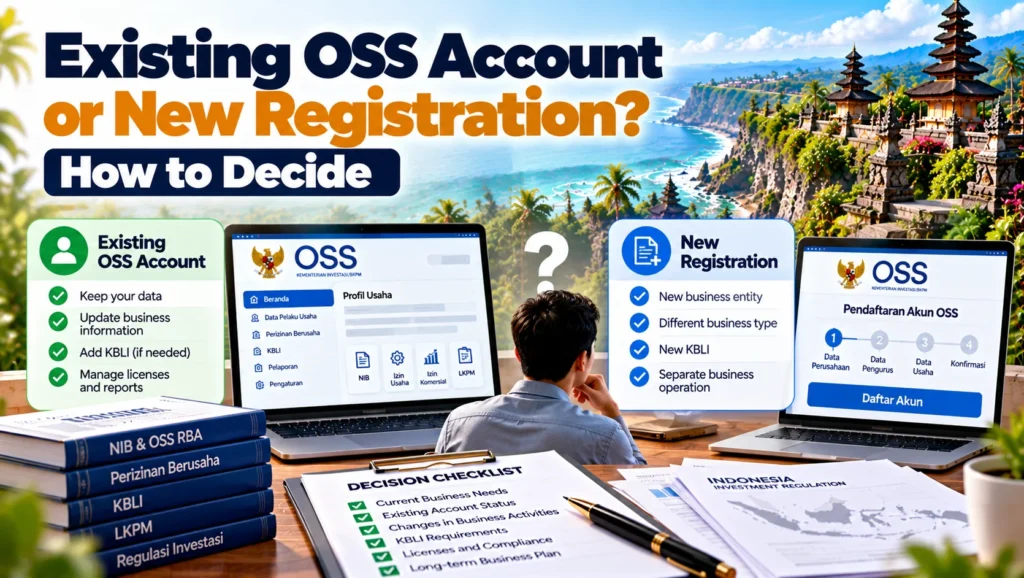
If your business already has an OSS account, do not assume that a new registration is necessary simply because the original login is unavailable or company details have changed. First establish whether the existing account belongs to the same legal entity, whether it contains an NIB or licensing history, and whether an official access recovery or information update procedure is available.
For the existing OSS account new registration decision, the most important distinction is between continuing the administration of an established business and registering a genuinely different business operator.
This guide explains how to assess that distinction, particularly for business owners and investors managing companies in Bali.
Should You Use an Existing OSS Account or Register Again?
An existing account should normally be investigated before initiating another registration for what may be the same business. A lost password, inaccessible email address, changed director, or outdated company profile does not, by itself, establish that a new account is the correct solution.
The official OSS portal publishes guidance on replacing access for existing non-micro and small businesses, confirming that established account access is a separate administrative subject from initial registration.
For micro and small businesses, OSS also publishes a dedicated existing-account access replacement guide.
These are official guidance references, not evidence that every account can automatically be recovered or that all users are eligible for the same replacement procedure. The appropriate route depends on the existing registration, the type of business operator, and the current OSS process.
The first decision is therefore not whether to click the registration button again. It is whether the business already has an identifiable registration that should be preserved or updated.
Existing OSS Account vs New Registration: Decision Matrix
Different account problems require different investigations. This decision matrix provides a practical starting point rather than a universal government determination of eligibility.
| Business situation | Recommended initial decision | What to verify |
|---|---|---|
| Existing company with a forgotten password | Investigate account recovery | Existing credentials, authorized identity, and recovery channel |
| Existing account with inaccessible email | Investigate official access replacement or recovery | Original account identity and available verification records |
| Company has appointed a new director | Review company information and access responsibility | Current corporate documents and authorized representative |
| Company has changed its business activities | Review existing profile and licensing information | Current business activities and relevant KBLI records |
| Old account contains an NIB | Investigate existing registration before considering another account | NIB identity, legal entity, and project records |
| New legal entity has been established | Examine the appropriate new registration route | New entity identity and existing registrations, if any |
| Earlier OSS registration status is uncertain | Reconstruct registration history first | Available NIB, correspondence, and prior account records |
The table highlights why a new registration should be treated as a decision following verification rather than an automatic response to an administrative problem. In particular, a company management change and the creation of a new legal entity are different events and may require different administrative actions.
What to Check Before Creating Another OSS Account
The most useful initial review connects three things: the legal identity of the business, the account used to manage it, and any existing business licensing results.
Establish the Existing Registration History
Begin by gathering information that may identify the earlier OSS registration. This can include the previously issued NIB, company name, registered contact information, historical OSS correspondence, and copies of available licensing documents.
The purpose is to establish whether the existing account and the proposed registration relate to the same business operator.
If an NIB exists, compare the identity recorded in that document with the current company records. Do not interpret an old NIB as automatically proving that every associated license remains valid or sufficient for current business activities.
If the original registration was handled by an employee or outside consultant, request an account handover record identifying the registered business, available contact channels, and documents previously issued.
Avoid transmitting passwords or sensitive identification documents through unsecured communication channels during this investigation.
Verify Whether the Legal Entity Has Changed
A business may experience substantial internal changes while remaining the same legal entity. Examples can include changes in directors, shareholders, business contact details, or operational plans.
Before considering new registration, identify which underlying corporate records have changed and whether the existing account or licensing information must be updated.
A different question arises when an entirely new company or separate business operator has been established. That situation may justify examining a distinct registration route, although the applicable procedure must still be verified.
For example, suppose a PT PMA operating in Bali appoints a new director. The appointment does not automatically demonstrate that the company itself has been replaced. The relevant review should distinguish the company’s continuing legal identity from the details of its representative and account administrator.
By contrast, an investor establishing a separate PT for an additional business venture should not assume that the new entity can simply use another company’s existing OSS account.
Recovering Access to an Existing OSS Account
When the main problem is account access, start with the official recovery or access replacement resources rather than attempting to recreate all business information from memory.
A useful recovery assessment should establish the original registration identity, determine which contact channels remain accessible, and identify the person authorized to act for the business.
The official OSS materials distinguish initial registration from procedures concerning existing business accounts. This supports investigating an established account before selecting another process, but it does not establish that any particular recovery request will be approved.
Where the business has no access to its original email or previous administrator, document that problem clearly. Preserve available evidence of the company identity and prior registration so that the appropriate official guidance or support channel can be consulted.
Do not create multiple registrations merely to test whether an application will succeed. An uncontrolled approach can make it harder to understand which account or set of records represents the intended business.
What About Older OSS Accounts and Migrated Data?
A business may have registered under an earlier version of OSS and retained historical licensing documents or account credentials.
The official OSS guidance directory also lists legacy migration guidance, making the original registration system an important consideration when investigating an older business account.
This means the review should determine whether the business has an older account, whether relevant records were migrated, and whether unfinished licensing applications remain associated with historical information.
The OSS guidance directory identifies a specific transitional pathway for certain older projects whose spatial-planning requirements were issued before implementation of the newer framework but whose business licensing remained incomplete.
This is not a universal instruction for every legacy account. Business owners should determine whether their own project matches the conditions described in the current official guidance before using a transitional procedure.
For regulatory context, Indonesia’s risk-based licensing framework is governed by Government Regulation No. 28 of 2025, which the official regulatory database identifies as effective from June 5, 2025.
The existence of a newer licensing framework does not mean every company must discard its earlier OSS account. Account access, existing project information, and the applicability of current licensing requirements should be assessed separately.
When Might New Registration Be Appropriate?
A new registration may be worth examining when a genuinely separate business operator is being established or when the applicable official process requires registration for a business that does not already have the relevant account.
The official OSS portal maintains account registration guidance for non-micro and small businesses, which should be reviewed when a genuinely new registration route is being considered.
A separate OSS account registration guide for micro and small businesses is also available.
The existence of separate guides demonstrates that registration information is organized by business-operator category. It does not establish an automatic entitlement to create another account for the same legal entity.
Before choosing a new registration, confirm that:
- The identity of the proposed business operator has been established.
- Existing accounts and NIB records have been investigated.
- The issue cannot be appropriately addressed through an existing-account procedure without further clarification.
- The current official OSS workflow supports the intended registration route.
This assessment avoids confusing a new business registration with an account recovery task.
Documents and Information to Prepare
A structured evidence file helps make the registration decision easier to review. The following items are recommended investigation materials, not a universal mandatory upload list.
| Information | Why it matters |
|---|---|
| Existing NIB, if available | Helps identify an earlier registered business |
| Current company establishment and amendment documents | Helps establish legal identity and subsequent corporate changes |
| Previous account email or correspondence | May help reconstruct account history |
| Available business licenses and OSS outputs | Helps identify existing licensing records |
| Current director or representative information | Helps establish the appropriate person responsible for the review |
| Historical project and activity information | Helps distinguish old records from current operations |
| Description of the access problem | Helps identify whether the issue is login, identity, profile, or licensing related |
These records should be reconciled before making a final decision. Any inconsistency should be documented rather than resolved by guessing or introducing conflicting data into a new application.
The business should also maintain a controlled record of any account recovery requests, administrative changes, or registration decisions so that subsequent personnel can understand what occurred.
Conclusion
An existing OSS account should not be abandoned merely because access has been lost or business information has changed. The first step is to identify the legal entity, examine existing NIB and licensing records, and determine whether an official recovery, replacement, migration, or update procedure is relevant.
A genuinely new business operator may require a separate registration assessment. However, account creation should follow verification of the business identity and current OSS process, not an assumption that earlier records can be ignored.
For business owners and investors in Bali, documenting this decision before taking action helps preserve continuity, reduce unnecessary administrative confusion, and identify the correct next licensing question.
Need Help Reviewing an Existing OSS Account?
If your business has an inaccessible OSS account, uncertain NIB history, or company information that no longer matches its records, Bali Legal ID can be contacted for a consultation about your registration situation.
Discuss your existing documents and the issue you are facing to determine whether OSS account recovery, an information review, or assistance with a new NIB OSS RBA registration should be explored.
For help scoping the documents and next steps for your business or transaction, contact Bali Legal ID about our business setup services in Bali.
Read More: Business Setup Bali for PT PMA, PT PMDN & OSS RBA Registration
FAQ existing oss account new registration
Can I create a new OSS account if I already have one?
Do not assume another account is necessary or permitted for the same business. First verify the existing registration, business identity, and available official recovery or replacement procedures. A genuinely separate legal entity may require a different assessment.
Does changing a company director require a new OSS account?
A director change does not, by itself, prove that a new legal entity has been created. Review the current corporate documents, existing account information, and applicable update procedures before determining what action is required.
What if my old OSS account uses an email address I cannot access?
Identify the original registration details and consult the current official OSS guidance for recovering or replacing access. Preserve company identity documents and available registration correspondence. The exact procedure depends on the relevant account category and current system requirements.
Can an old NIB be used with a newly created OSS account?
Do not assume an NIB can be transferred or associated with a new account through ordinary registration. Verify its existing business identity, account history, and the applicable official procedure before attempting changes.
Does a company need a new OSS registration when it starts another business activity?
An additional activity does not automatically establish that a new account is needed. Review the existing legal entity, relevant KBLI information, project records, and any licensing changes required for the new activity.
References & Sources
- Government Regulation No. 28 of 2025 on Risk-Based Business Licensing — peraturan.bpk.go.id
- Replacement of Existing OSS Access for Non-Micro and Small Businesses — oss.go.id
- Replacement of Existing OSS Access for Micro and Small Businesses — oss.go.id
- OSS RBA Account Registration for Non-Micro and Small Businesses — oss.go.id
- OSS RBA Account Registration for Micro and Small Businesses — oss.go.id
- Official OSS Business Licensing Guides — oss.go.id
Recommended Next Articles
- OSS RBA registration guide for Bali businesses and investors — balilegalid.com