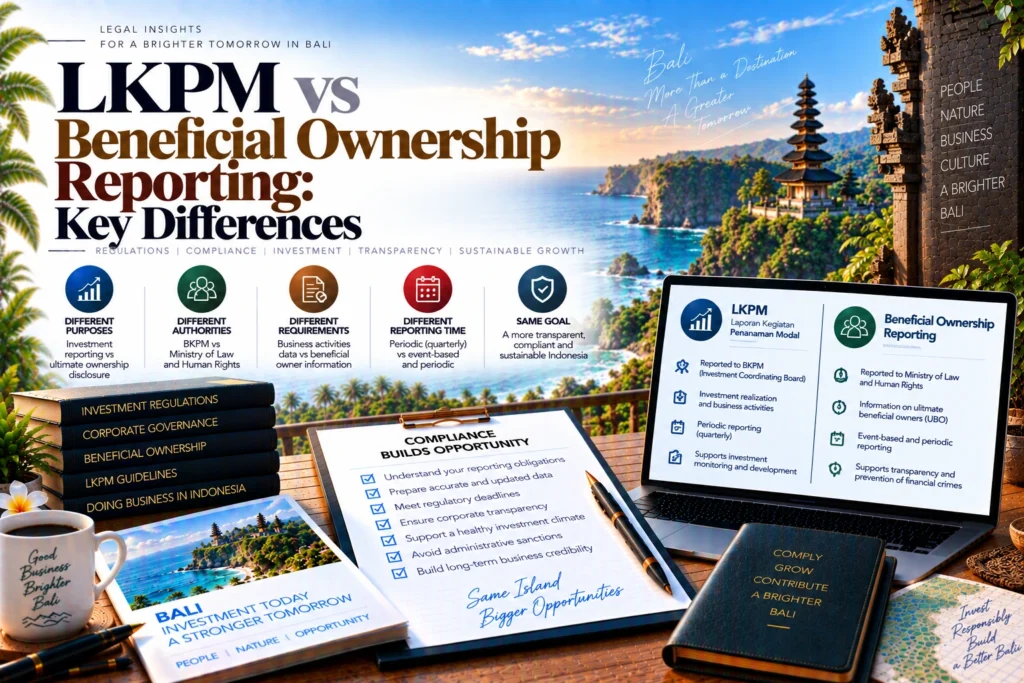
LKPM and beneficial-ownership reporting are not interchangeable filings. LKPM reports how an investment project and business activity are progressing. Beneficial-ownership reporting identifies the natural persons who ultimately own, benefit from or control the corporation.
The current LKPM framework used in this comparison is Minister of Investment and Downstream Industry/BKPM Regulation No. 5 of 2025, which the official legal database currently lists as in force.
Indonesia’s beneficial-ownership regime remains grounded in Presidential Regulation No. 13 of 2018, which the official legal database lists as in force and which requires corporations within its scope to determine their beneficial owners.
LKPM vs Beneficial Ownership Reporting: The Core Difference
For lkpm vs beneficial ownership reporting, use one question first: what information is the government asking the company to disclose?
If the subject is investment realization, workforce, production, project licensing, investment obligations or operational constraints, the relevant workstream is LKPM.
If the subject is who ultimately owns, controls or economically benefits from the corporation, the relevant workstream is beneficial-ownership reporting.
Completing one does not satisfy the other because the purpose, reporting data, government system and update trigger are different.
For investors still aligning ownership, KBLI, capital and OSS setup before these post-formation reporting obligations begin, Bali Legal ID’s PT PMA setup guide provides relevant same-domain formation context without replacing either LKPM or beneficial-ownership reporting.
Quick Comparison Matrix
The following table summarizes the main points to compare before choosing the next step.
| Comparison point | LKPM | Beneficial ownership reporting |
|---|---|---|
| Main purpose | Track investment realization and implementation | Identify the natural persons behind ownership, control or benefit |
| Reporting unit | Business activity and project location | Corporation and its beneficial owner or owners |
| Main system | OSS | Corporate beneficial-ownership/AHU administration |
| Typical data | Investment, workforce, production, licensing compliance and constraints | Identity, ownership, voting, control, benefit and ultimate-ownership information |
| Routine cycle | Semester for small businesses; quarterly for medium and large businesses | Annual update plus reporting when beneficial-owner information changes |
| Key trigger | Investment or project implementation | Change in ultimate ownership, control or beneficial interest |
| Can the other filing replace it? | No | No |
The matrix is useful because the same company can have both obligations at the same time.
What LKPM Actually Reports
This makes LKPM an implementation report. It tells the investment authorities what is happening with the business project, not simply who owns the company.
LKPM Is Activity- and Location-Based
For investment-realization LKPM, Article 285 requires reporting for each business activity and location after the business actor obtains an NIB.
That distinction matters for a company with several KBLI activities or several Bali project locations. A corporate-level investment figure should not automatically be treated as sufficient if the applicable LKPM reporting structure distinguishes activities and locations.
A company developing one accommodation project in Badung and another activity at a different project location should therefore review the reporting record by actual activity and location rather than treating the company as one undivided project.
LKPM Reporting Periods Depend on Business Scale
Article 286 currently sets small-business semester deadlines at 15 July and 15 January, and medium- and large-business quarterly deadlines at 15 April, 15 July, 15 October and 15 January.
The reporting calendar is therefore driven by business scale and reporting period, not by whether shareholders changed during the quarter.
What Beneficial Ownership Reporting Covers
Beneficial ownership looks in the opposite direction: from the corporate structure toward the natural person behind it.
The practical objective is not to measure how much the project spent during the quarter. It is to identify which natural person satisfies the legal ownership, control or benefit criteria.
Ownership Percentage Is Only Part of the Test
That means a shareholder register and beneficial-owner record answer related but different questions.
An individual with a straightforward majority shareholding may be easy to identify. A layered foreign holding structure, nominee arrangement, voting agreement or other control structure can require the company to look beyond the immediate registered shareholder.
Beneficial Ownership Is Event-Driven and Annually Updated
The beneficial-ownership framework requires changes in beneficial-owner information to be reported no later than three working days after the change and requires periodic updating once every year.
This creates a different compliance rhythm from LKPM.
A beneficial-owner change can arise in the middle of an LKPM quarter or semester. The company should not wait for the next LKPM filing to deal with an ownership-transparency change that has its own reporting timeline.
Which Filing Is Triggered by Common Business Changes?
If the company purchases machinery and increases investment realization, review LKPM.
If the company hires more workers or increases production, review LKPM.
If the company begins reporting a new project location or business activity, review the applicable OSS and LKPM structure for that activity and location.
If shares are transferred and the natural person satisfying the beneficial-owner criteria changes, review beneficial-ownership reporting.
If voting rights or contractual control change without a major change in nominal share percentage, beneficial ownership can still require review because control and benefit are part of the legal test.
If a restructuring changes both the company’s investment plan and the natural person behind the ownership chain, review both regimes independently.
Can One Event Trigger Both LKPM and BO Review?
Yes. The filings are different, but the underlying business event can affect both.
Consider an investor acquiring a Bali company and then funding a major expansion. The share acquisition may change the beneficial owner. The expansion may change the company’s investment realization, workforce, production or project-location information reported through LKPM.
The correct compliance response is not to choose one filing over the other. It is to identify every consequence of the transaction.
A useful internal workflow is:
- Map the corporate ownership change
- Recalculate who satisfies the beneficial-owner criteria
- Review the AHU beneficial-owner record
- Map changes in investment value and project implementation
- Review the relevant OSS activities and project locations
- Reflect the applicable investment realization in the proper LKPM period
This keeps ownership transparency and investment implementation aligned without combining them into one filing.
What Happens if the Company Misses the Filing?
The enforcement paths are also different.
For beneficial ownership, Permenkum 2/2025 provides administrative sanctions including a warning, blacklisting and blocking of the corporation’s AHU Online access for the non-reporting or incorrect-reporting situations covered by the regulation.
Those consequences illustrate why one compliance status should not be used as a proxy for the other. A company can be current with its LKPM while its beneficial-owner information is outdated, or current with beneficial ownership while investment reports remain overdue.
Combined Compliance Checklist for Bali Companies
Start by maintaining two separate compliance records: one for investment implementation and one for ownership transparency.
For LKPM, keep the NIB, activities, project locations, current business scale, investment realization, workforce, production and licensing information available for the relevant reporting period.
For beneficial ownership, keep the current ownership chart, shareholder information, voting arrangements, control rights and identity documents of the qualifying natural persons.
Before each LKPM deadline, reconcile the report against the real project rather than automatically copying the previous period.
After every share transfer, shareholder restructuring or material change in control, perform a beneficial-owner review immediately rather than waiting for the annual update.
When a corporate transaction changes both project funding and ownership, assign both workstreams. The corporate team should not assume the investment-reporting team has updated beneficial ownership, and the ownership team should not assume an AHU filing has updated LKPM.
Finally, retain evidence of both filings. During due diligence, the company should be able to demonstrate both how the investment is progressing and who ultimately controls or benefits from the corporation.
Conclusion
Neither LKPM nor beneficial-ownership reporting is the ‘better’ or more important filing; they serve different compliance purposes.
Use LKPM when the issue concerns investment realization, project progress, workforce, production, licensing implementation or business-location reporting. Use beneficial-ownership reporting when the issue concerns the natural person who ultimately owns, controls or benefits from the corporation.
When a transaction changes both the investment project and the ownership structure, review both. The safest compliance approach is to keep the two reporting systems separate in purpose but consistent with the same real company and transaction.
Use the LKPM reporting workflow for the investment-reporting file and the beneficial ownership reporting checklist for the ownership-and-control file. Keeping the two workstreams distinct makes the combined review easier to organise.
Review Both Reporting Tracks Before Closing a Corporate Change
If your Bali company is expanding, changing ownership or preparing for an investment transaction, Bali Legal ID can be consulted to review how the corporate structure, OSS investment position and reporting obligations fit together.
Company setup, agreement, tax, accounting and compliance support can be coordinated where one transaction affects both ownership transparency and investment reporting; no separate verified service URL was supplied for this package.
For help scoping the documents and next steps for your business or transaction, contact Bali Legal ID about our financial consultant services in Bali.
Read More: Financial Consultant in Bali for Tax, Accounting & Financial Reporting Services
FAQ lkpm vs beneficial ownership reporting
Is LKPM the same as beneficial ownership reporting?
No. LKPM reports investment realization and project implementation, while beneficial-ownership reporting identifies the natural persons who ultimately own, benefit from or control the corporation.
Does filing LKPM update beneficial ownership automatically?
No. LKPM is submitted through the investment and OSS reporting framework, while beneficial ownership is maintained through the corporate beneficial-ownership framework.
How often is LKPM submitted?
Under the current investment regulation, small businesses report every six months, while medium and large businesses report every three months; the regulation also provides specified exemptions.
How often must beneficial-owner information be updated?
Beneficial-owner information is subject to annual updating, and changes to beneficial-owner information are subject to a separate event-driven reporting deadline.
Can a share transfer trigger both reporting reviews?
Yes. The transfer may change the beneficial owner, while related investment restructuring or project funding may also affect the company’s LKPM information.
Does owning less than 25% mean a person can never be a beneficial owner?
No. For a PT, the beneficial-owner criteria also include control, management-appointment authority, benefit rights and true ownership, not only percentage ownership.
Which filing should an investor review during due diligence?
Both can be relevant. LKPM helps show investment and project-reporting compliance, while beneficial-ownership reporting helps show whether the corporation’s ultimate ownership and control information is current.
References & Sources
- Minister of Investment and Downstream Industry/BKPM Regulation No. 5 of 2025 — Current Legal Record — peraturan.bpk.go.id
- Minister of Investment and Downstream Industry/BKPM Regulation No. 5 of 2025 — Official Regulation PDF — jdih-storage.bkpm.go.id
- Presidential Regulation No. 13 of 2018 — Corporate Beneficial Ownership — peraturan.bpk.go.id
- Presidential Regulation No. 13 of 2018 — Official Beneficial Ownership PDF — portal.ahu.go.id
- Minister of Law Regulation No. 2 of 2025 — Beneficial Ownership Verification and Supervision — peraturan.bpk.go.id
- Minister of Law Regulation No. 2 of 2025 — Official Regulation PDF — portal.ahu.go.id
- Directorate General of General Legal Administration — Beneficial Ownership FAQ — portal.ahu.go.id
Recommended Next Articles
- PT PMA setup, investment and OSS structure in Bali — balilegalid.com