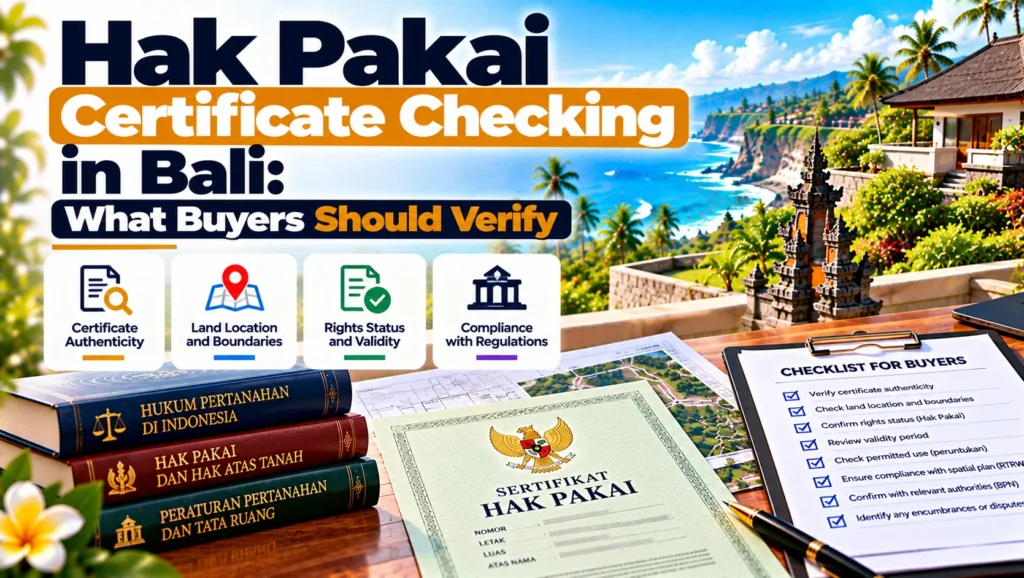
Hak Pakai certificate checking in Bali should establish four things: what land right is registered, who holds that right, whether the certificate corresponds to the actual property, and whether the available records reveal issues that require further investigation. Buyers should complete these checks before relying on the certificate when negotiating a purchase or making a substantial payment.
An official certificate check is an important part of due diligence, but it is not the same as a complete assessment of whether a buyer can legally acquire the right or use the property for a particular purpose.
What Hak Pakai Certificate Checking Should Establish
Hak Pakai, commonly described as a right to use land, is a recognized category of Indonesian land rights. It should not be treated as interchangeable with Hak Milik ownership, Hak Guna Bangunan, or an ordinary contractual lease.
Indonesia’s Government Regulation Number 18 of 2021 addresses Hak Pakai within the national framework for land rights and land registration.
For a potential buyer, the starting question is not simply whether a document looks authentic. It is whether the registered right, the proposed transaction, and the buyer’s intended use of the property are consistent.
A practical review should distinguish between information stated by the seller, evidence appearing on the certificate, information independently confirmed through land-registration records, and legal conclusions that still need professional assessment.
Confirm the Registered Right and Certificate Details
Begin with a complete, legible certificate rather than a cropped photograph or a typed summary prepared for marketing.
Review the stated type of right, identifying number, registered holder, administrative location, area, survey references, and any recorded term or conditions shown in the available documentation.
Because the national land-rights framework distinguishes the rights being registered, buyers should confirm that the certificate records the right actually contemplated by their proposed transaction.
The Ministerial Regulation Number 18 of 2021 provides a further regulatory framework for establishing land rights, making the underlying grant and registration history relevant to a certificate review.
A buyer should ask for clarification when the seller describes the property as freehold but the supplied document records Hak Pakai, or when a transaction summary refers to a different land-right category.
Verify the Holder and Their Authority
The registered holder should be identified directly from the current documentation, not inferred from possession of the land, management of a villa, or a person’s involvement in the negotiations.
Compare the registered name with the identity or corporate documentation provided by the proposed contracting party. If the parties differ, ask for documents explaining the relationship and authority to transact.
For a company, relevant questions may include whether the entity is still active, who can represent it, and whether additional corporate authorization is required for the contemplated transaction.
For an individual, verify whether the person signing is the registered holder or an authorized representative. If an intermediary is involved, examine the authority being relied upon rather than assuming that an agency relationship is sufficient.
A correct name on a certificate does not, by itself, resolve every question about signing authority, competing interests, or the suitability of a proposed transaction structure.
Match the Certificate to the Actual Parcel
A certificate must correspond to the land the buyer believes is being acquired or used.
Compare the certificate’s administrative location, recorded area, survey or measurement references, and available parcel identification with the seller’s site plan and transaction documents.
A physical inspection can help identify differences between the marketed property and its apparent boundaries. However, fences, walls, access paths, and visible occupation are not substitutes for registered survey information.
Consider a hypothetical villa offered with a stated land area of 600 square metres while the supplied certificate shows a smaller parcel. The difference may have an explanation, but the buyer should not assume that an adjacent area is included without further evidence.
If a property comprises multiple parcels, request documentation for each relevant parcel and confirm exactly which rights the agreement is intended to cover.
Hak Pakai Certificate Checking Bali: The Official Record Review
The central verification step is to reconcile the documentation supplied by the seller with relevant official land-registration information.
ATR/BPN’s 2022 technical guidance on electronic certificate checking and Land Registration Information Statements describes an official electronic checking framework.
The Ministerial Regulation Number 3 of 2023 governs electronic documents in land registration and replaced Ministerial Regulation Number 1 of 2021 on electronic certificates.
Buyers should therefore avoid assuming that only one paper format represents valid land-registration evidence. The appropriate verification method depends on the available records and current land-office procedures.
The official electronic certificate-checking framework provides a basis for requesting record verification, but buyers should treat the resulting information as one component of wider transaction due diligence.
Ask the responsible professional what was actually checked, when the check was completed, whether the result corresponded to the supplied certificate, and whether any issue remained unresolved.
Retain the verification result and a record of its date. An informal statement that a certificate was checked previously should not replace review of the evidence relevant to the current transaction.
Check Encumbrances and Outstanding Questions
A title review should also address whether restrictions or competing interests may affect the proposed transaction.
Questions worth investigating include possible registered security interests, blocking entries, seizure records, disputes, inconsistencies in ownership information, and other recorded matters relevant to the land.
The absence of an obvious warning on a copy supplied by the seller should not be interpreted as confirmation that no issue exists.
Equally, an apparent discrepancy should not automatically be described as fraud. Older documentation, administrative changes, incomplete information, or an unresolved registration process may require explanation.
The objective is to determine whether the available evidence adequately addresses the particular issue before the buyer takes the next step.
Confirm the Proposed Buyer’s Legal Position
Certificate verification and buyer eligibility are separate questions.
A certificate can accurately describe an existing right while the contemplated transfer or use still requires a separate assessment of the proposed acquirer, transaction structure, and applicable conditions.
This distinction is particularly important where a foreign individual or foreign-invested company is involved. The buyer should obtain specific advice rather than assuming that every Hak Pakai arrangement is available to every purchaser.
Buyers planning accommodation, rental, hospitality, or other commercial activity should also investigate applicable land-use and operational requirements separately. A certificate check alone is not evidence that a proposed business activity is permitted.
Documents Buyers Should Request
The following is a practical due diligence request list, not a representation that every item is a mandatory submission for every official certificate-checking service.
| Evidence to request | What to compare | Main question |
|---|---|---|
| Complete Hak Pakai certificate | Type of right, certificate details, holder | Does it identify the expected right and holder? |
| Holder identity or corporate documents | Names and legal identity | Is the contracting party correctly identified? |
| Survey and parcel information | Area, location, measurements | Does the registered parcel match the property offered? |
| Underlying grant or registration documents, where relevant | Right history and recorded conditions | Are there conditions affecting the proposed transaction? |
| Recent official checking result | Current registration information | What was independently confirmed? |
| Authority or representation documents | Signatory and registered holder | Who has authority to enter the agreement? |
| Draft transaction agreement | Parcel, parties, right and intended transfer | Does the contract match the verified evidence? |
Keep an organized record of the documents received, their dates, the person who supplied them, and any unanswered questions.
An especially useful approach is to maintain a short exception log. Instead of recording only that the certificate was reviewed, specify which details matched, which differed, and who is responsible for obtaining clarification.
What to Do When the Records Do Not Match
Not every discrepancy has the same significance. Classifying findings helps buyers avoid both unnecessary alarm and premature commitment.
Proceed to the next review stage: The essential certificate details and available official information correspond, the parties are identified, and no material unresolved question has emerged. This does not constitute final transaction approval.
Request clarification: A spelling difference, historical administrative reference, incomplete document, or unexplained measurement difference remains. Request supporting evidence and document the resolution.
Defer signing or payment: The proposed seller’s authority is unsubstantiated, the parcel cannot be reliably identified, relevant registration information conflicts, or a material restriction has not been adequately addressed.
Where a discrepancy concerns the actual land covered by an agreement, avoid relying solely on verbal explanations. Ask for documentary clarification and, where appropriate, a professional assessment of the relevant land-office information.
Before signing a binding agreement, confirm that the contract describes the same property, right, and parties established through the verification process. Payment arrangements should reflect the remaining legal and documentary risks.
Conclusion
Hak Pakai certificate checking in Bali should be treated as an evidence-based decision process rather than a visual inspection of a certificate.
The most useful outcome is a clear record of the registered right, the identified holder, the corresponding land parcel, the verification undertaken, and any unresolved issue requiring further action.
When those elements are reconciled with the intended transaction and the buyer’s legal position, the buyer is better equipped to decide whether to proceed, request further documents, or obtain additional legal advice.
Treat this title-specific review as part of land certificate checking, then use the wider property due diligence checklist to identify the access, zoning and transaction questions that the certificate alone does not resolve.
Need Help Reviewing a Hak Pakai Certificate in Bali?
Before committing to a property transaction, consider a consultation with Bali Legal ID about land certificate checking and the documents relevant to your proposed purchase or agreement.
You can discuss certificate details, holder identification, parcel discrepancies, and unresolved verification questions to determine what further review may be appropriate.
For help scoping the documents and next steps for your business or transaction, contact Bali Legal ID about our notary services in Bali.
Read More: Professional Notary Services in Bali for Property, Business & Legal Documentation
FAQ hak pakai certificate checking
Can a copy of a Hak Pakai certificate prove that a Bali property is safe to buy?
No. A copy is useful preliminary evidence, but buyers should arrange appropriate verification against official records and examine the proposed transaction, seller authority, and any material unresolved issues.
Does successful certificate checking confirm that a foreign buyer can acquire the land right?
No. The existence and registration of a land right are different from the legal eligibility of a particular buyer. Foreign individuals and foreign-invested companies should obtain a transaction-specific assessment of the applicable rules and conditions.
What if the certificate area differs from the marketed property area?
Request the relevant survey and parcel records and obtain a clear explanation of the difference. Do not assume that additional land, access areas, or adjacent parcels are included in the transaction without supporting documentation.
Can an electronic certificate be used for verification?
Indonesia has a regulatory framework for electronic land-registration documents. The appropriate verification method should follow current ATR/BPN procedures and the records available for the specific parcel. A screenshot or forwarded file alone should not be treated as independent confirmation.
Should certificate checking happen before paying a deposit?
As a practical risk-management measure, buyers should seek appropriate certificate verification and professional review before making substantial or non-refundable commitments. The timing and protections should be assessed in the context of the proposed agreement.
References & Sources
- Government Regulation Number 18 of 2021 on Land Management, Land Rights, Apartment Units, and Land Registration — peraturan.bpk.go.id
- Ministerial Regulation Number 18 of 2021 on Procedures for Establishing Land Management Rights and Land Rights — peraturan.bpk.go.id
- ATR/BPN Technical Guidance Number 3 of 2022 on Electronic Certificate Checking and Land Registration Information Statements — jdih.atrbpn.go.id
- Ministerial Regulation Number 3 of 2023 on Issuing Electronic Documents in Land Registration Activities — jdih.atrbpn.go.id