
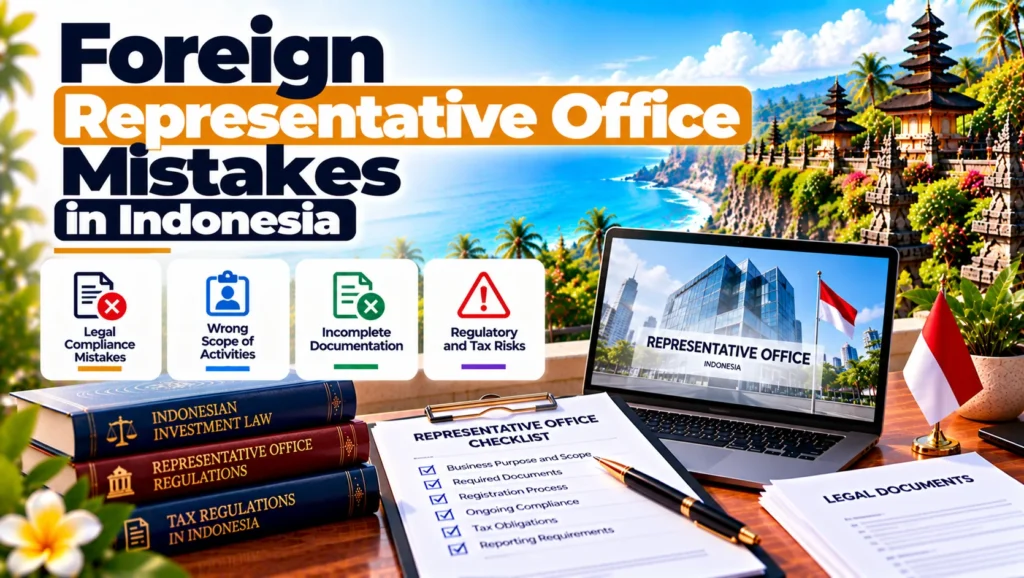
The most important foreign representative office mistakes in Indonesia usually begin with a mismatch between the investor’s intended activities and the type of presence being established. A representative office may be appropriate for specific liaison, coordination, or market-entry functions, but it should not automatically be treated as a substitute for a company authorized to operate a commercial business.
Before registration, foreign investors should identify exactly what the Indonesian office will do, who will act on behalf of the overseas company, whether local customers or commercial contracts are involved, and how the business model might change after market entry.
Why Representative Office Mistakes Begin Before Registration
A foreign company may initially want a local contact point to investigate market opportunities, communicate with potential partners, or prepare a future investment. These objectives differ from directly operating a restaurant, selling services, or managing a revenue-producing business in Indonesia.
The official record for Government Regulation Number 28 of 2025 identifies it as Indonesia’s risk-based business licensing framework that replaced Government Regulation Number 5 of 2021.
The Minister of Investment and Downstreaming/BKPM Regulation Number 5 of 2025 provides the applicable framework for risk-based business licensing procedures through the Online Single Submission system.
These sources provide the broader licensing context. They should not be interpreted as confirmation that every representative-office category can perform the same activities.
A sensible first step is to write an activity statement that describes planned work in ordinary business language. For example, assessing hotel investment opportunities is different from signing accommodation contracts or receiving payments from guests.
Choosing the Wrong Representative Office Category
Indonesia recognizes different forms of foreign representative presence, including arrangements commonly identified as KPPA and KP3A. Specialized sectors may involve other representative-office arrangements.
The correct category should follow the overseas company’s business, the proposed Indonesian activities, and the legal framework applicable to that particular office.
Mistaking KPPA for a Commercial Operating Company
A KPPA is generally considered for representation and preparatory functions rather than establishing an ordinary Indonesian commercial operating company.
Foreign investors should not assume that appointing a local representative authorizes unrestricted selling, invoicing, purchasing, or operating activity in Indonesia.
Before accepting a proposed KPPA structure, ask whether the Indonesian office will generate local revenue, enter into customer contracts, conduct trading activities, or manage a business already operating in Indonesia.
These questions help distinguish representation from proposed commercial operations. The exact permitted activities must be checked against the applicable current regulatory provisions and the intended registration category.
Where the planned activity requires an incorporated and appropriately licensed business, investors should separately assess PT PMA establishment and the relevant sector requirements.
Treating All Representative Office Categories as Equivalent
A second mistake is assuming that KPPA, KP3A, and sector-specific representative offices offer interchangeable functions.
A foreign trading company’s proposed representation may raise different questions from those of an overseas business establishing a general liaison office. Construction and certain other regulated sectors can involve additional category-specific considerations.
Because the current OSS regulatory framework governs business licensing administration, foreign companies should establish the applicable representative-office category before relying on an older registration checklist.
Indonesia’s official OSS portal provides a dedicated KPPA registration guide, which applicants can consult when checking the relevant representative-office registration route.
A guide for one office category should not be used as conclusive evidence of eligibility or authorization for another.
Common Foreign Representative Office Mistakes
Practical problems often arise when the original registration purpose is broader or narrower than the activities later performed by employees and representatives.
Commercial Activity and Contracting Assumptions
An overseas company may authorize local staff to develop relationships with prospective customers. However, the investor should examine whether that work remains representative in nature or extends into activities requiring a different legal and licensing structure.
The review should cover who negotiates agreements, which entity signs contracts, who invoices customers, where revenue is received, and who is responsible for delivering the service or goods.
Avoid assuming that routing invoices through an overseas parent automatically resolves questions about what the Indonesian office actually does.
The location of payment is only one element of the broader activity assessment.
Office Location, Representation and Staff Roles
A representative-office application should identify the intended premises, responsible representative, and actual functions performed at the location.
Before committing to an office lease, check whether the proposed premises satisfy the requirements applicable to the selected office category. Do not automatically assume that a residential villa, virtual address, coworking arrangement, or any commercial building is acceptable.
The responsible representative’s actual duties also need attention. A title such as country manager or representative does not determine the legal scope of the activities that person may perform.
Where foreign personnel are involved, assess employment and immigration questions separately. Representative-office registration should not be treated as automatic evidence that every proposed employment or immigration arrangement is authorized.
Written responsibility statements can help distinguish communication and coordination functions from operational management or sales activities.
Representative Office Mistake and Corrective Action Matrix
The following matrix provides a practical way to examine common planning errors before registration or during a subsequent compliance review.
| Potential mistake | Evidence to review | Recommended response |
|---|---|---|
| Wrong office category | Overseas company activities and proposed Indonesian functions | Compare the planned functions with the appropriate representative-office framework |
| Commercial activity mismatch | Contracts, invoices, customer communications and operational responsibilities | Review whether an appropriately licensed commercial structure is needed |
| Unclear representative authority | Appointment documents and job descriptions | Clarify who represents the overseas company and what decisions they may make |
| Unsuitable proposed premises | Address evidence, occupancy arrangements and applicable location rules | Confirm premises suitability before committing to the location |
| Unclear personnel responsibilities | Employment terms and actual duties | Assess labor and immigration implications independently |
| Outdated registration checklist | Regulatory references and OSS guidance | Replace superseded guidance with applicable current sources |
| Business expansion beyond the original purpose | Revised business plan and actual activity records | Reassess the legal structure before implementing new activities |
These issues do not all require the same corrective action. A documentary inconsistency may require clarification, while a substantive change in business operations may justify reviewing the company’s entire Indonesian presence.
A Bali Investment Scenario: Research Office or Operating Business?
Consider a hypothetical overseas hospitality group exploring investment opportunities in Bali.
Initially, the group wants staff to identify potential hotel sites, arrange meetings, gather market information, and communicate findings to the overseas management team.
Those proposed functions should be assessed against the activities permitted for the relevant representative-office category.
Now suppose the group changes its plan. It intends to manage accommodation operations, sign agreements with paying guests, collect booking revenue, and employ personnel to operate a property business.
The new activity statement is materially different from the original research-focused plan. The investor should not assume that the existing representative-office arrangement is sufficient merely because the overseas parent remains the same.
A separate assessment may be needed for an Indonesian operating company, appropriate licensing, premises, property rights, and sector-specific requirements.
Property leasehold arrangements should also be evaluated on their own terms. An agreement granting contractual use of premises does not establish that a representative office is permitted to conduct commercial hospitality activities there.
The useful lesson is that a business model must be reviewed as a whole, rather than assuming that one registration or property document authorizes every proposed activity.
How to Review Compliance After Registration
Representative-office compliance is not only a question to consider on the date of registration. Business plans, personnel responsibilities, and commercial relationships can change.
A practical review process can be organized around five actions:
- Confirm the registered purpose. Keep the initial business plan and current registration documents available for comparison.
- Record actual activities. Identify what local representatives do, which parties they contact, and whether commercial documents are being prepared or executed.
- Review changes in personnel and location. Examine whether new representatives, duties, or premises affect the applicable arrangements.
- Identify commercial expansion. Flag proposed selling, customer invoicing, business operations, or other activities that differ from the initial representative functions.
- Resolve open questions before implementation. Seek a category-specific review rather than assuming that the original registration covers the new activity.
The official regulatory summary for the 2025 OSS regulation identifies the newer licensing framework, while the issuing ministry’s regulatory history expressly confirms that BKPM Regulation Number 4 of 2021 was revoked by Minister of Investment and Downstreaming/BKPM Regulation Number 5 of 2025.
The revoked 2021 regulation must not be used as current authority for licensing procedures, application requirements, fees, or deadlines.
This distinction is particularly important when a company’s compliance documents rely on templates or legal summaries created under earlier licensing frameworks.
A useful monitoring register should record the business activity being reviewed, current evidence, responsible reviewer, unresolved issue, and proposed corrective action. The register need not be complicated, but its conclusions should be supported by actual documentation.
When to Consider a Different Business Structure
A representative office may no longer be the appropriate option when the investor’s business plan shifts from permitted representation to activities requiring direct commercial authorization.
The relevant decision is not simply whether the foreign company expects to stay in Indonesia permanently. It is whether its intended activities fit the permissions and restrictions of the selected legal structure.
When considering PT PMA incorporation, evaluate the proposed activities, ownership arrangements, applicable business classifications, regulatory conditions, and operational requirements independently.
An existing representative office should not be assumed to convert automatically into a commercial operating company. The appropriate sequence depends on the specific legal and licensing circumstances.
Conclusion
Avoiding foreign representative office mistakes begins with a clear description of what the Indonesian presence will actually do.
Choose the appropriate office category, verify the permitted scope of activities, examine representative authority and premises, and reassess the arrangement whenever commercial plans change.
The strongest compliance approach is to identify potential mismatches before contracts are signed or operations begin, then obtain the category-specific documentation and advice needed to support the next decision.
If the proposed activity calls for an operating company rather than a representative presence, review the PT PMA formation framework and the comparison of foreign and domestic company structures before choosing the entity.
Planning a Foreign Business Presence in Bali?
If you are considering a representative presence or a commercially operating company in Indonesia, contact Bali Legal ID to discuss your proposed business activities and the available company establishment options.
A consultation can help clarify whether your plans call for further representative-office regulatory review, PT PMA establishment, or separate business registration and licensing assessments.
For help scoping the documents and next steps for your business or transaction, contact Bali Legal ID about our business setup services in Bali.
Read More: Business Setup Bali for PT PMA, PT PMDN & OSS RBA Registration
FAQ foreign representative office mistakes
Can a foreign representative office operate a commercial business in Bali?
A representative-office registration should not be assumed to authorize unrestricted commercial operations. The permitted activities depend on the specific office category and applicable rules. Planned sales, invoicing, contracting, or direct business operations should be reviewed before implementation.
Are KPPA and KP3A the same type of representative office?
No. They are different representative-office categories associated with different purposes and regulatory considerations. The foreign parent’s activities and proposed Indonesian functions should guide the category assessment.
Can a representative office register using a villa or residential property?
The acceptability of a proposed address cannot be established from the property description alone. Applicants should verify the premises requirements relevant to the selected representative-office category and the property’s applicable use arrangements before signing a lease.
Does representative-office registration automatically authorize foreign staff to work in Indonesia?
No such automatic conclusion should be made. The employer or representative office should separately assess the work arrangement, foreign personnel’s duties, and applicable employment and immigration requirements.
When should a foreign investor consider PT PMA instead of a representative office?
An appropriately licensed PT PMA should be assessed when the intended activities require an Indonesian company to undertake commercial operations beyond the permitted representative functions. The decision depends on the business sector, ownership, activities, and applicable licensing requirements.
References & Sources
- Government Regulation Number 28 of 2025 on Risk-Based Business Licensing — peraturan.bpk.go.id
- Minister of Investment and Downstreaming/BKPM Regulation Number 5 of 2025 on OSS Business Licensing Procedures — peraturan.bpk.go.id
- OSS Guidance for Foreign Company Representative Offices — oss.go.id
- BKPM Regulation Number 4 of 2021 on Risk-Based Business Licensing Services: Revoked Regulation — jdih.bkpm.go.id