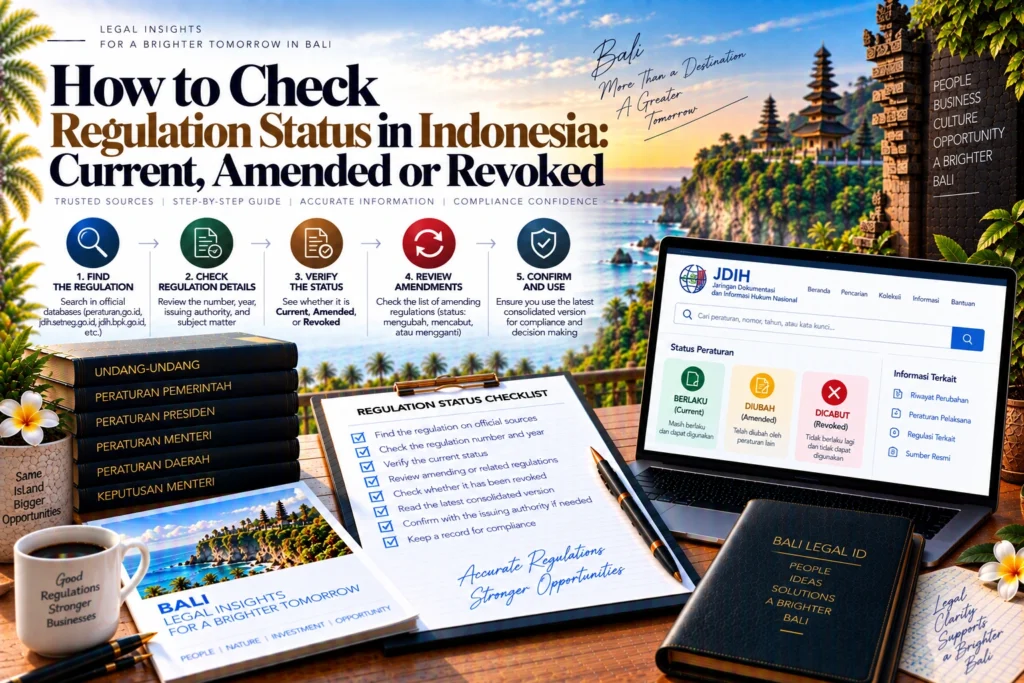
Before relying on an Indonesian regulation, verify more than its title and year. You need to know whether it is still in force, has been amended, has been revoked, or has been replaced by a later instrument.
Check Regulation Status Indonesia: What Should You Verify First?
To check regulation status Indonesia, start with four items: the exact regulation number and year, its official status, any amendment or revocation relationships, and the later instrument that changes or replaces it.
The Ministry of Law’s Directorate General of Legislation database publishes regulation status and relationships between regulations, making it useful for checking whether an instrument is still marked in force and whether it is linked to amendments or other legal instruments.
The BPK Regulation Database describes itself as part of BPK’s JDIH implementation for disseminating legislation and legal documents, and its individual regulation pages can show status, amendment and revocation relationships.
Do not rely on the age of a regulation to decide whether it is current. An older law can remain in force for decades, while a newer regulation can already have been revoked.
Use an Official Regulation Database
Start with an official government source such as peraturan.go.id, BPK’s Regulation Database, JDIHN or the JDIH of the responsible ministry or institution.
The objective is not merely to download the PDF. First inspect the metadata and status information surrounding the document.
Check the Status Label
Look for a status such as Berlaku or Tidak Berlaku.
A regulation marked Berlaku remains in force according to that official status record. But this does not necessarily mean the original text has never changed.
A regulation marked Tidak Berlaku should not be treated as the current governing rule without checking the revocation or replacement information shown on the same record.
Check Regulation Relationships
The relationship section is often more important than the status label alone.
Look for entries showing that the instrument amends another regulation, is amended by a later regulation, revokes an earlier regulation, or is itself revoked by another instrument.
These relationships tell you what else must be opened before you conclude that you have the current legal position.
What Does ‘Berlaku’ Mean?
Berlaku means the instrument is currently listed as in force. However, the instrument can still have later amendments.
The institutional basis for the national legal-document network, Perpres 33/2012 on Jaringan Dokumentasi dan Informasi Hukum Nasional, is currently listed by BPK as in force.
In a straightforward case like this, the status record can confirm that the regulation itself has not been revoked. You should still review its relationship section before relying on a specific provision.
What Does ‘Amended’ Mean?
An amended regulation remains part of the current legal framework, but its original text is no longer the complete source for every provision.
That means simply downloading the 2011 PDF is not enough for a current legal conclusion. You must identify whether the article relevant to your question was changed by any later amendment.
An amendment can modify only selected provisions. Do not assume the whole law was replaced unless the official status record says so.
What Does ‘Revoked’ Mean?
A revoked regulation should not be relied on as the current rule for conduct occurring after the revocation takes effect, unless a specific transitional provision or another legal rule makes part of it relevant.
A clear revocation example is Perpres 33/2010, which BPK marks as no longer in force and records as revoked by Perpres 8/2022.
The useful information is not only that the old regulation is no longer in force. The status record also tells you which later instrument revoked it, giving you the next document to open.
For research purposes, treat revoked by as a direction to the replacement or later framework rather than as the end of the search.
How to Trace an Amendment Chain
Use a simple sequence when the regulation is marked as amended.
First, open the base regulation and record its title, number and year. Second, review every entry under its amendment history. Third, open the latest amendment and determine which provisions it changes. Fourth, repeat the process if that amendment has itself been changed.
For Law No. 12/2011, the BPK page currently identifies three later amendments. A reader researching a provision affected by Law No. 1/2026 would therefore need the current 2026 amendment, not only the original 2011 text.
Do not assume that the latest amendment rewrites the entire law. Read the amendment clauses carefully to identify exactly which articles changed.
For a high-impact business decision, record the base law and each material amendment in the research file so another reviewer can reproduce the status check.
How to Verify a Replacement Regulation
When a regulation is marked revoked, identify the instrument listed under Dicabut dengan or the equivalent relationship field.
Open the later instrument and confirm three things: its title matches the subject you are researching, its own status is current, and its effective date covers the transaction or compliance period in question.
Do not assume that the revoking instrument reproduces the old framework exactly. A replacement regulation can change definitions, scope, responsibilities, procedures or transitional arrangements.
Also review whether there are implementing regulations below the replacement instrument. The status of the primary rule does not automatically tell you whether every older implementing rule remains applicable.
Why JDIHN Should Be Cross-Checked With Member Sources
JDIHN is useful for locating documents across Indonesian government institutions, but its own guidance supports an additional verification step.
For example, if you locate a Ministry of Finance regulation through an integrated search, confirm the relevant material with the ministry’s own JDIH when available. For corporate administration, check the relevant Ministry of Law or AHU source. For tax procedure, check official DGT material.
This is especially important where you are relying on a technical procedure, an effective date or a recently amended instrument.
Regulation Status Checklist for Bali Business Decisions
Before using a regulation in a Bali investment, property, corporate, licensing or tax decision, complete this check:
- Confirm the exact regulation number, year and title
- Open an official government status page
- Check whether the status is Berlaku or Tidak Berlaku
- Review all listed amendment relationships
- Review all listed revocation relationships
- Open the latest material amendment
- Confirm whether the article you need was changed
- If revoked, open the regulation that revoked or replaced it
- Check the effective date of the current instrument
- Confirm the relevant ministry or member JDIH source where appropriate
- Save the official URL and date checked
- Record the exact article or provision supporting the conclusion
- Note any transitional provisions or unresolved interpretation issues
- Obtain professional review where several instruments interact with the specific facts
A short status log is often enough: base instrument, current status, amendments, replacement rule, effective date, relevant article and source URL.
This makes later review more reliable than keeping only a downloaded PDF whose amendment history is unclear.
Conclusion
Checking whether an Indonesian regulation is still in force is a status-and-relationship exercise, not just a document search.
Confirm the official status, follow every amendment or revocation link, identify the current replacement instrument where necessary, and verify the specific provision you plan to rely on. A regulation can be authentic but outdated, current but amended, or completely revoked. The status record is what tells you which legal text should be read next.
After identifying the current regulation, use the legal-versus-tax advice checklist to decide which professional should review how the rule applies to your transaction.
Verify the Current Rule Before Applying It to the Transaction
If you have identified an Indonesian regulation but need help determining how the current text applies to a Bali company, property, licensing or tax matter, Bali Legal ID can be consulted after the relevant regulation and amendment history have been identified.
Legal documentation, company setup, land-document checks, tax consulting, accounting and financial-report preparation can then be reviewed against the current regulatory framework; the service scope should identify the specific legal issue and current provisions.
For help coordinating the records and next steps discussed above, review our business setup services in Bali.
For help scoping the documents and next steps for your business or transaction, contact Bali Legal ID about our business setup services for company and licensing matters.
Read More: Bali Legal Service for Business, Property, Tax & Investment Solutions
FAQ check regulation status indonesia
How do I know whether an Indonesian regulation is still in force?
Check an official government database for the regulation’s current status and its legal relationships. A status of Berlaku indicates that the instrument remains in force, but you should still check whether later amendments modify the provision you need.
Can a regulation be both current and amended?
Yes. Law No. 12 of 2011 is an example: BPK currently lists it as in force while also listing several later amendments. The original law therefore remains part of the current framework but must be read together with applicable amendments.
What should I do if a regulation is marked Tidak Berlaku?
Check the revocation relationship to identify which later regulation revoked it, then open the later instrument and confirm that its own status and effective date apply to your question.
Does the newest amendment replace the entire original regulation?
Not necessarily. An amendment may change only selected provisions. You need to read the amending clauses to determine which articles were modified.
Is JDIHN enough to confirm a regulation’s current status?
JDIHN is an official discovery portal, but its own disclaimer advises confirmation with the relevant member JDIH when there is doubt about document content. For important decisions, cross-check the responsible institution’s official source where available.
Why does the effective date matter when checking status?
A regulation may be issued on one date but apply from another date. The effective date helps determine which legal rule governed the transaction or compliance period you are reviewing.
References & Sources
- Directorate General of Legislation — Regulation Database — peraturan.go.id
- BPK Legal Database — Regulation Database — peraturan.bpk.go.id
- National Legal Documentation and Information Network — JDIHN Portal — jdihn.go.id
- BPK Legal Database — Presidential Regulation No. 33 of 2012 on JDIHN — peraturan.bpk.go.id
- BPK Legal Database — Law No. 12 of 2011 on the Formation of Laws and Regulations — peraturan.bpk.go.id
- BPK Legal Database — Presidential Regulation No. 33 of 2010 — peraturan.bpk.go.id