
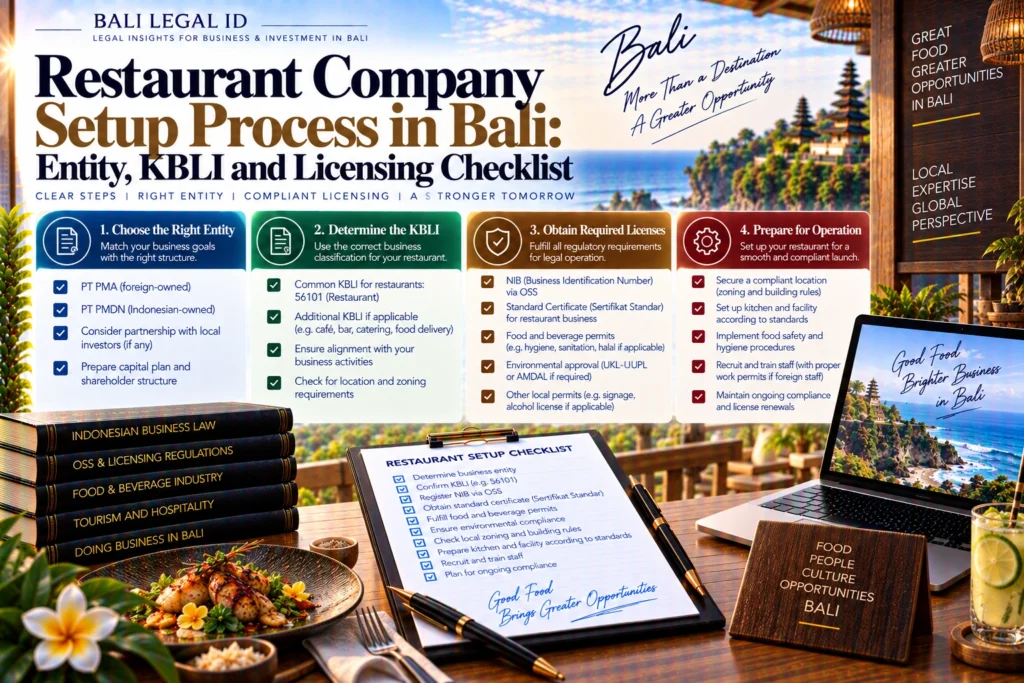
Opening a restaurant in Bali requires more than establishing a company and obtaining an NIB. The business model, current KBLI, ownership structure, premises, restaurant risk level, food-hygiene certification, and any additional activities such as alcohol sales should all describe the same operation before opening.
Restaurant Company Setup Process: The Short Answer
A practical restaurant company setup process follows this order:
- define the actual food-and-beverage model
- select the current KBLI for each material activity
- choose the domestic or foreign-investment company structure
- check the premises before major lease and fit-out commitments become irreversible
- establish the legal entity
- complete OSS risk-based licensing for the restaurant activity
- satisfy the applicable restaurant business standards
- obtain food-hygiene certification
- add conditional supporting licences only where the menu and operations require them
- align tax, accounting, employment, and operating records before launch
The most common planning mistake is to treat ‘restaurant setup’ as one government filing. In reality, incorporation and operational readiness are different milestones.
Step 1: Define the Restaurant Business Model
Start with what customers will actually buy and how the food will be served.
A fixed-building restaurant is not necessarily classified the same way as catering, a mobile food business, a café focused primarily on beverages, a takeaway-only model, or another food-service operation.
Under the current classification, OSS places restaurant and mobile-food activities in KBLI 2025 subclass 5610 and lists code 56101 for food-service activity in a fixed building.
That current code should be tested against the real operating model rather than selected simply because another restaurant uses it.
Use the Current KBLI, Not an Old Restaurant Code
Founders using older documents should also note that OSS records the former KBLI 2020 code 56102 for Rumah/Warung Makan as converting to KBLI 2025 code 56101.
This matters when an old NIB, lease due-diligence file, consultant checklist, or business plan still refers to the previous classification.
If the restaurant will also run material activities such as catering, packaged-product retail, a separate beverage concept, or another food-service model, review whether additional classifications are needed rather than forcing every revenue stream into one restaurant code.
Bali Legal ID’s OSS RBA registration guide provides broader context on how KBLI selection affects business licensing.
Step 2: Choose PT PMDN or PT PMA
Ownership determines the company pathway.
If the restaurant will operate through a PT, Permenkum No. 49 of 2025 is the current Ministry of Law framework for establishment, amendment, and dissolution of limited liability companies and JDIH BPK records that it revoked Permenkumham No. 21 of 2021.
A domestically owned restaurant can use the applicable domestic company structure. Where foreign equity will be introduced, do not register the business as a domestic company and assume the ownership issue can be ignored later.
For foreign investors, Article 5(2) of the Investment Law requires foreign investment generally to be carried out through an Indonesian limited liability company domiciled in Indonesia unless another law provides otherwise.
Bali Legal ID’s complete PT PMA setup guide is the more appropriate next reference for the general foreign-owned company formation process.
Foreign-Owned Restaurants Have a Specific PMA Investment Calculation
Restaurant investors should not apply the generic PMA investment calculation mechanically.
For food and beverage services specifically, Article 26 of Permeninves/BKPM No. 5 of 2025 sets the PMA minimum investment value above IDR 10 billion excluding land and buildings per first two digits of KBLI per one location, with the regulation applying that location rule per regency or city.
The same regulation separately provides that minimum placed and paid-up capital for a PMA limited liability company is IDR 2.5 billion per company unless another applicable regulation provides otherwise.
Those figures are regulatory investment and company-capital concepts, not professional setup fees. If a restaurant group plans several locations, the project structure should be reviewed before assumptions are made about the investment calculation.
Step 3: Check the Restaurant Premises Before Fit-Out
The lease and fit-out should follow the restaurant model, not precede it blindly.
Before committing significant capital, check whether the premises can support the intended kitchen, customer seating, storage, sanitation, waste handling, fire-safety measures, ventilation, utilities, deliveries, and other operational requirements.
The current restaurant standards illustrate why this matters. They include detailed facility and production requirements, including restaurant and kitchen conditions, drainage, grease-management equipment, ventilation, emergency arrangements, and documented operational systems.
The exact property and building documents should be checked for the specific location rather than assuming that every commercial-looking property can automatically support a restaurant.
Step 4: Establish the Company
Once ownership, company structure, activities, capital, and the proposed location are sufficiently clear, the corporate establishment stage can proceed.
Company formation creates the legal vehicle. It does not by itself complete the permits required to operate the restaurant.
The company deed, corporate data, and OSS application should use consistent business activities. Changing the KBLI or ownership model after incorporation can create additional amendment work and can alter the licensing result.
Step 5: Complete OSS Risk-Based Licensing
After the company exists, PP No. 28 of 2025 is the current national Risk-Based Business Licensing framework and JDIH BPK records that it revoked PP No. 5 of 2021.
Restaurant operators should use the current tourism standard because Permenpar No. 6 of 2025 is in force and replaced Permenpar No. 4 of 2021 and Permenpar No. 8 of 2021.
Do not stop the licensing review after NIB issuance. Review the actual restaurant risk classification, Standard Certificate requirements, supporting licences, and operational obligations shown for the project.
Restaurant Risk Level Depends on Business Scale
The current restaurant standard states that micro-scale restaurants fall into the medium-low risk restaurant category, while small, medium, and large restaurants fall into the medium-high risk restaurant category.
For medium-high restaurant businesses, the current standard sets an OSS Standard Certificate assessment process and states a maximum 14-working-day conformity-assessment period after complete and correct documents have been submitted through OSS.
That statutory assessment period should not be advertised as the total restaurant setup timeline. Company preparation, property issues, documents, fit-out, hygiene compliance, corrections, and other supporting requirements occur outside that single verification stage.
Step 6: Complete Food Hygiene Requirements
Food hygiene is a separate launch requirement, not merely an internal kitchen policy.
The health-side rule is also explicit: Permenkes No. 11 of 2025 places KBLI 56101 restaurants within the standard for Sertifikat Laik Higiene Sanitasi.
Its technical requirements state that food-management premises must hold the applicable SLHS or hygiene-sanitation label and specifically identify restaurants among the categories required to hold SLHS.
For both restaurant risk categories, the current restaurant standard includes SLHS among the operating obligations, while additional PB UMKU requirements vary with the restaurant’s actual activities.
This is one reason the kitchen layout, sanitation system, food-handler preparation, storage, cleaning procedures, and premises condition should be planned before opening rather than repaired after licensing review begins.
Step 7: Add Conditional Restaurant Licences
Not every restaurant needs the same supporting permits.
Where the business model includes those activities, OSS lists direct-sale alcohol certificates and veterinary control certification among the PB UMKU associated with restaurant activity.
The current tourism restaurant standard also treats these items conditionally. For example, alcohol-sale documentation is tied to the restaurant’s need to sell alcoholic beverages, while veterinary control requirements depend on the relevant animal-product operation and stated exceptions.
Do not add optional activities to the commercial plan and assume the original restaurant licence automatically covers them. Review each material revenue stream before launch.
Pre-Opening Restaurant Checklist
Use this matrix to identify what still needs to be resolved before opening.
| Area | Ready when | Stop and review when |
|---|---|---|
| Restaurant model | Food, beverage, takeaway, catering and other services are clearly defined | The concept is still being described only as F&B |
| KBLI | Current KBLI matches the actual operation | An old KBLI is being copied without checking conversion |
| Ownership | PT PMDN or PT PMA structure is settled | Foreign ownership may be introduced later without planning |
| PMA capital | Food-and-beverage investment calculation has been reviewed | Generic PMA figures are being copied without location analysis |
| Premises | Kitchen, sanitation, utilities and safety assumptions are workable | Long lease and fit-out are committed before operational review |
| OSS | Risk level and required licensing outputs are known | NIB is being treated as the only required approval |
| Restaurant standard | Applicable operational standard is mapped | Restaurant scale and risk category are unclear |
| Food hygiene | SLHS pathway is planned and evidence can be prepared | Hygiene certification is being postponed until after opening |
| Alcohol | Required direct-sale documentation is identified where applicable | Alcohol is planned without a separate permit review |
| Animal products | Veterinary-control requirements are checked where relevant | Meat or animal-product operations are assumed to have no separate requirements |
The table is a planning tool, not a substitute for the live OSS result or the requirements attached to the specific premises and activity.
Conclusion
A restaurant company in Bali should be built in the same order that it will operate.
First define the restaurant model and current KBLI. Then settle domestic or foreign ownership, check the premises, establish the company, complete OSS licensing, satisfy the applicable restaurant standards, obtain SLHS, and add alcohol, veterinary, or other supporting licences only where the business model requires them.
For foreign-owned restaurants, the investment plan also needs to use the current food-and-beverage-specific PMA calculation rather than a generic setup assumption.
The practical test before opening is straightforward: do the company documents, KBLI, premises, OSS profile, restaurant standard, hygiene certification, menu, and supporting permits all describe the same business?
Map the Restaurant Structure Before You Commit to the Fit-Out
If you are planning a restaurant in Bali, Bali Legal ID can assist with a consultation to review the proposed PT PMDN or PT PMA setup, company documents, current KBLI activities, NIB OSS RBA registration, restaurant licensing scope, tax requirements, accounting setup, and related issues before launch.
The useful starting point is the real restaurant model—ownership, location, menu, alcohol sales, kitchen operation, and additional revenue streams—so the entity and licensing structure can be built around the business you will actually operate.
For help scoping the documents and next steps for your business or transaction, contact Bali Legal ID about our business setup services in Bali.
Read More: Business Setup Bali for PT PMA, PT PMDN & OSS RBA Registration
FAQ restaurant company setup process
What is the current KBLI for a restaurant in a fixed building?
OSS KBLI 2025 places food-service activity in a fixed building under code 56101. The actual description should still be checked against the planned operation rather than selected from the word ‘restaurant’ alone.
What happened to the old Rumah/Warung Makan KBLI 56102?
OSS records that KBLI 2020 code 56102 converts to KBLI 2025 code 56101. Businesses using older documents should therefore check the current classification before filing or updating OSS data.
Can a foreign investor own a restaurant company in Bali?
Foreign investment generally uses an Indonesian limited liability company. The proposed ownership, restaurant activity, investment structure, and applicable investment rules should be checked before the company is established.
How is the PT PMA investment value calculated for restaurant activity?
Under Permeninves/BKPM No. 5 of 2025, food and beverage services use a specific calculation: more than IDR 10 billion excluding land and buildings per first two digits of KBLI per location, with the location treatment applied per regency or city.
How much paid-up capital does a restaurant PT PMA require?
The current investment regulation sets general minimum placed and paid-up capital for a PMA limited liability company at IDR 2.5 billion per company unless another applicable regulation provides otherwise.
Is an NIB enough to open a restaurant?
Do not assume so. The restaurant’s risk level, Standard Certificate requirements, food-hygiene certification, and any supporting PB UMKU should be checked from the actual OSS result and current sector standards.
Does a restaurant need an SLHS?
Yes for the restaurant category discussed here. Permenkes No. 11 of 2025 expressly includes KBLI 56101 restaurants within the Sertifikat Laik Higiene Sanitasi standards, and the current tourism restaurant standard also includes SLHS among restaurant obligations.
Does every restaurant have the same OSS risk level?
No. Under the current tourism restaurant standard, micro-scale restaurants are categorized as medium-low risk, while small, medium, and large restaurants are categorized as medium-high risk.
Can a restaurant sell alcohol automatically after obtaining its NIB?
No. OSS lists separate direct-sale alcohol certificates among the supporting permits associated with restaurant activity. The required certificate depends on the actual alcohol sales being planned.
Should I sign the Bali restaurant lease before licensing review?
Avoid making the commitment irreversible before checking whether the site can support the intended restaurant operation, kitchen, sanitation, safety, KBLI, and licensing requirements. Property and licensing review should happen early enough to influence the lease and fit-out plan.
References & Sources
- Current KBLI 2025 Classification for Restaurant and Mobile Food Activities — oss.go.id
- Official Conversion of Former Rumah/Warung Makan KBLI 56102 — oss.go.id
- Current Ministry of Law Regulation for Limited Liability Companies — peraturan.bpk.go.id
- Official Investment Law Provision on Foreign Investment Business Form — peraturan.bpk.go.id
- Current Investment and OSS Administration Regulation No. 5 of 2025 — peraturan.bpk.go.id
- Official PMA Food and Beverage Investment and Capital Provisions — peraturan.bpk.go.id
- Current Risk-Based Business Licensing Regulation — peraturan.bpk.go.id
- Current Tourism Business Standards Regulation — peraturan.bpk.go.id
- Official Current Restaurant Business Standards — peraturan.bpk.go.id
- Current Health-Subsector Risk-Based Business Licensing Standards — peraturan.bpk.go.id
- Official Current Restaurant Hygiene Certification Standards — peraturan.bpk.go.id
- Official OSS Restaurant Supporting Licence Record — oss.go.id
Recommended Next Articles
- complete PT PMA setup process for foreign restaurant investors — balilegalid.com
- OSS RBA registration and licensing process in Bali — balilegalid.com
- tourism business setup cost and timeline planning in Bali — balilegalid.com