
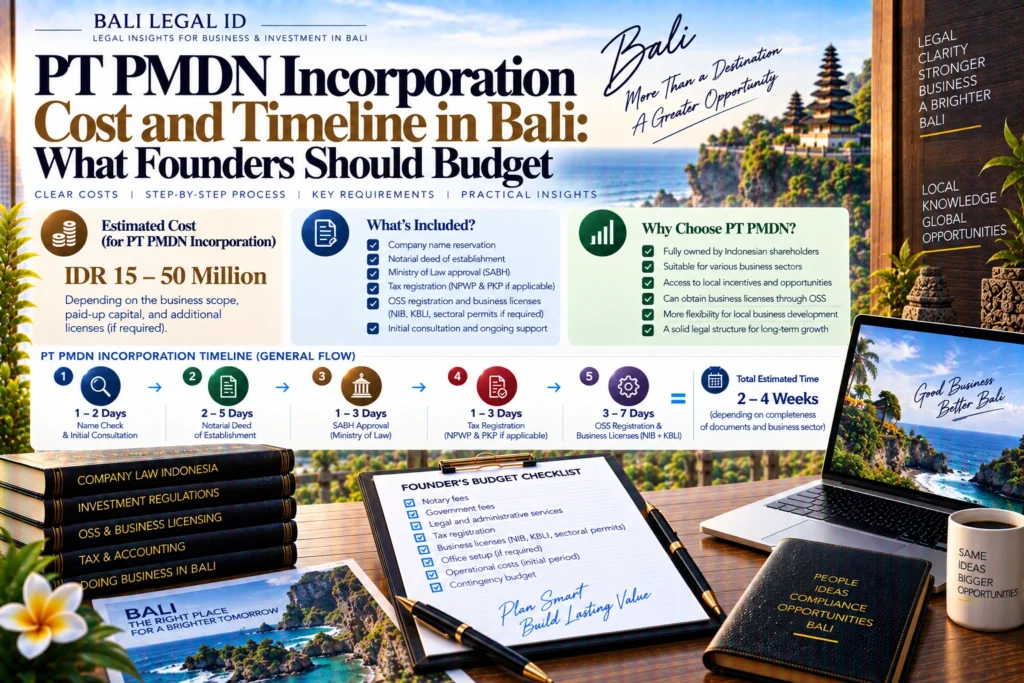
A PT PMDN incorporation budget in Bali should separate company capital from the actual cost of incorporation and licensing. The amount recorded as share capital belongs to the company structure; notarial work, government charges, professional services, OSS licensing, tax setup, accounting, and project-specific approvals are separate cost categories.
The domestic-investment framework is broader than a PT alone because Article 5(1) of the Investment Law allows domestic investment to be carried out through a legal-entity business, a non-legal-entity business, or a sole proprietorship, subject to applicable law.
This guide focuses specifically on domestic investment using an Indonesian limited liability company.
PT PMDN Incorporation Cost Timeline: The Short Answer
For a PT PMDN incorporation cost timeline, do not rely on one headline package number or one guaranteed number of days.
A useful budget separates authorized and paid-up capital, Ministry of Law PNBP, notarial and SABH work, OSS and NIB work, activity-specific Business Licensing, tax setup, accounting support, address or premises issues, and amendments caused by changes in the project.
A useful timeline separates pre-filing structuring, notarial and SABH establishment, OSS licensing, and operational readiness.
First Separate Company Capital From Formation Cost
For an ordinary Indonesian limited liability company, Article 3 of PP No. 8 of 2021 provides that the company must have authorized capital and that the amount is determined by the founders.
That means the authorized-capital figure should not be confused with the provider’s incorporation fee.
The founders still have a paid-capital obligation because Article 4 requires at least 25% of the authorized capital to be placed and fully paid, supported by valid evidence of payment.
For example, the commercial decision is not merely ‘what is the cheapest PT setup?’ It also includes how much authorized capital the founders select, how much must be placed and paid, and whether a particular regulated activity has its own capital rule.
There Is No One Universal PT PMDN Authorized-Capital Number
For an ordinary PT, PP No. 8 of 2021 does not impose one universal rupiah amount as the authorized capital for every company; the founders determine the amount.
A founder-determined amount is not universal across every regulated sector because Article 5 of PP No. 8 of 2021 states that companies carrying out certain business activities must follow any minimum authorized-capital amount imposed by the applicable sector regulation.
Before using a low capital figure merely to reduce apparent setup cost, check whether the selected industry has a separate capital requirement and whether the chosen amount is commercially suitable for contracts, financing, working capital, and the intended scale of the company.
The 60-Day Rule Is About Capital Evidence
The 60-day rule in PP No. 8 of 2021 is not a standard incorporation processing period.
The same provision states that valid evidence of the capital payment must be submitted electronically to the Minister within 60 calendar days from the date of the company’s establishment deed.
A provider should therefore not advertise ’60 days’ as though that is the normal government turnaround for creating the PT. It is a compliance deadline connected with evidence of capital payment.
What a PT PMDN Formation Budget Should Include
The following matrix helps founders compare two quotations using the same assumptions.
| Cost category | What to clarify |
|---|---|
| Company capital | Authorized capital, placed capital and paid-up capital stated in the corporate structure |
| Ministry of Law charges | Applicable PNBP for the establishment application |
| Notarial work | Deed preparation, revisions, execution and corporate filing coordination |
| SABH establishment | Electronic establishment submission and legal-entity decision |
| Beneficial-owner work | Required ownership information and supporting documents |
| Company address | Whether only address documentation or a broader premises review is included |
| OSS and NIB | Which business activities and project locations are included |
| Business Licensing | Additional risk-based licences, standards or sector requirements |
| Tax setup | Whether corporate tax-registration coordination is included |
| Accounting setup | Whether bookkeeping or financial-report preparation begins after incorporation |
| Amendments | Whether later changes to shareholders, activities, address or capital are separately charged |
| Third-party costs | Technical, property, translation, courier or other external expenses where relevant |
The table shows why a headline ‘PT PMDN setup fee’ is not enough for comparison: two proposals can have different totals simply because one stops at legal-entity establishment while another includes OSS, tax, accounting, or sector licensing.
Official government charges should be identified separately because Article 4 of Permenkum No. 49 of 2025 states that company establishment applications are subject to the applicable non-tax state revenue tariffs at the Ministry of Law.
A Practical PT PMDN Incorporation Timeline
The current corporate-registration procedure is Permenkum No. 49 of 2025, which JDIH BPK lists as in force from 17 December 2025 and as revoking Permenkumham No. 21 of 2021.
The practical timeline should be built around dependencies rather than a guaranteed total number of working days. Our PT PMDN registration process guide explains the decisions and filings behind these stages.
Stage 1: Set the Ownership, Activities and Capital
Before the deed is finalized, confirm the shareholders, share percentages, directors and commissioners, company address, proposed business activities, KBLI selections, authorized capital, placed and paid-up capital, and project locations.
Changing those assumptions after drafting or incorporation can require amendments and can change the OSS licensing result.
For businesses with several activities, it is also useful to review Bali Legal ID’s OSS registration and licensing guide before treating the NIB as the end of the licensing process.
Stage 2: Notary and SABH Establishment
The incorporation stage requires notarial involvement because Article 5 of Permenkum No. 49 of 2025 requires establishment of a capital-association limited liability company to be submitted through a notary using the electronic establishment form in SABH.
Preparation time depends on document readiness because Article 6 requires supporting materials that include the establishment deed, evidence of capital, company-address information, and beneficial-owner documents, together with other applicable records.
At the formal approval stage, Article 7 provides that the Minister through the Director General issues the legal-entity establishment decision when the application is received and sends it electronically to the notary through SABH.
That formal issuance rule should not be confused with the entire client timeline. Name and structure decisions, deed drafting, signatures, capital documentation, address records, beneficial-owner information, corrections, and other preparation take place around the formal submission stage.
Stage 3: OSS and Business Licensing
Company establishment is not the final licensing milestone because PP No. 28 of 2025 is the current Risk-Based Business Licensing regulation and JDIH BPK records that it revoked PP No. 5 of 2021.
A PT may already exist as a legal entity while the intended business activity still requires completion of its NIB, Business Licensing, supporting licences, standards, basic requirements, or sector-specific steps.
For budgeting purposes, ask the provider to identify separately when the PT is incorporated, when OSS and NIB work is complete, and when the intended activity is ready under the applicable licensing framework.
What Usually Changes Cost or Timing?
The main variables usually come from the project rather than from the label ‘PT PMDN.’
Cost or timing can change when:
- the shareholder or management structure changes during drafting
- several KBLI activities are included
- activities are located at several project locations
- the selected sector has special capital or licensing requirements
- address or premises issues need additional review
- beneficial-owner information is incomplete
- additional permits, standards or technical approvals are required
- tax or accounting setup is added to the incorporation scope
- amendments are needed after the company is established
- property, environmental, building or other project-level requirements must be resolved
A quotation should state which of these items are included, which are excluded, and which are priced only if triggered.
PT PMDN vs PT PMA: Ownership Changes the Framework
A PT PMDN cost comparison should not be used for a company that actually involves foreign investment.
The Investment Law distinguishes domestic and foreign investment forms, and the PT PMA framework has different investment and capital rules from the ordinary domestic PT framework discussed here.
If foreign ownership is planned now or may be introduced as part of the initial structure, compare the project with Bali Legal ID’s PT PMA setup cost guide before assuming the PT PMDN budget remains applicable.
This distinction matters because the cheapest domestic setup is not a valid substitute for the correct ownership structure.
Questions to Ask Before Accepting a PT PMDN Quote
Use the same project assumptions when comparing providers:
- Which shareholders, directors and commissioners does the quotation assume?
- What authorized, placed and paid-up capital will be stated?
- Does any selected business activity have a separate minimum-capital requirement?
- Does the fee include deed preparation and notarial coordination?
- Does it include Ministry of Law PNBP and SABH establishment?
- Which capital, address and beneficial-owner documents are included?
- Does the scope include OSS and NIB?
- Which KBLI activities and locations are included?
- Which activity-specific licences are included by name?
- Does the quote include tax-registration coordination?
- Does it include accounting or bookkeeping setup?
- Which government and third-party charges are excluded?
- How are client-requested changes or deed amendments priced?
- What final corporate documents and system access will be handed over?
- Which recurring compliance services begin after incorporation?
A detailed written scope is more useful than comparing two unexplained package totals.
Conclusion
A PT PMDN incorporation cost timeline in Bali should be built from the company’s actual ownership, capital, activities, locations, and licensing requirements.
For an ordinary PT, the founders determine the authorized-capital amount, at least 25% must be placed and fully paid, and sector-specific minimum capital may apply where another regulation requires it. Those capital amounts should be kept separate from notarial fees, government PNBP, professional services, licensing, tax and accounting expenditure.
The timeline should also be separated into stages: structure the company, prepare the deed and supporting records, complete SABH establishment, then complete the OSS and activity-specific licensing needed for the business.
The most useful question is therefore not simply ‘How cheap and fast is PT PMDN formation?’ It is what exact corporate, capital, licensing, tax, accounting, and post-incorporation work is included, and which dependencies remain outside the quoted price and timeline?
Build the PT PMDN Scope Before Comparing Formation Prices
If you are planning a domestically owned company in Bali, Bali Legal ID’s PT PMDN Setup service can assist with a consultation to map the proposed shareholders, capital structure, company documents, KBLI activities, NIB OSS RBA registration, tax requirements, accounting needs, and other incorporation issues before the formation scope is finalized.
A useful quotation should make the included work, assumptions, government and third-party charges, licensing scope, exclusions, and post-incorporation responsibilities clear before you commit.
For help scoping the documents and next steps for your business or transaction, contact Bali Legal ID about our business setup services in Bali.
Read More: Business Setup Bali for PT PMA, PT PMDN & OSS RBA Registration
FAQ pt pmdn incorporation cost timeline
How much does it cost to incorporate a PT PMDN in Bali?
There is no single statutory all-inclusive price. The total can include Ministry of Law PNBP, notarial work, professional services, OSS and NIB work, activity-specific licensing, tax setup, accounting, amendments, and external project costs. Company capital should be treated separately from these formation expenses.
Is there a fixed minimum authorized capital for every PT PMDN?
No single universal rupiah amount applies to every ordinary PT. PP No. 8 of 2021 provides that the founders determine the authorized capital, while certain regulated activities may be subject to separate minimum-capital rules.
How much PT PMDN capital must be paid up?
PP No. 8 of 2021 requires at least 25% of the authorized capital to be placed and fully paid, supported by valid evidence.
Does the 60-day capital rule mean incorporation takes 60 days?
No. The 60-calendar-day rule concerns electronic submission of valid evidence of capital payment after the establishment deed. It is not a standard government processing estimate for the entire incorporation.
Does PT PMDN incorporation automatically include an NIB?
Do not assume so from a generic formation package. Legal-entity establishment through SABH and risk-based business licensing through OSS are separate stages, so the provider should state explicitly whether NIB and activity-specific licensing are included.
What if a foreign shareholder will own part of the company?
The domestic-investment budget should be reviewed against the foreign-investment framework before proceeding. Foreign ownership can make the PT PMA rules relevant, so entity classification should be settled before comparing formation prices.
References & Sources
- Current Status of Indonesia’s Investment Law — peraturan.bpk.go.id
- Official Investment Law Provision on Domestic and Foreign Business Forms — peraturan.bpk.go.id
- Current Status of Government Regulation No. 8 of 2021 on Company Capital — peraturan.bpk.go.id
- Official Authorized and Paid-Up Capital Provisions in Government Regulation No. 8 of 2021 — peraturan.bpk.go.id
- Current Status of Ministry of Law Regulation No. 49 of 2025 — peraturan.bpk.go.id
- Official Limited Liability Company Establishment Procedure in Regulation No. 49 of 2025 — peraturan.bpk.go.id
- Current Risk-Based Business Licensing Regulation — peraturan.bpk.go.id
Recommended Next Articles
- PT PMA setup cost guide — balilegalid.com
- OSS registration and licensing guide — balilegalid.com
- PT PMA setup service scope — balilegalid.com