
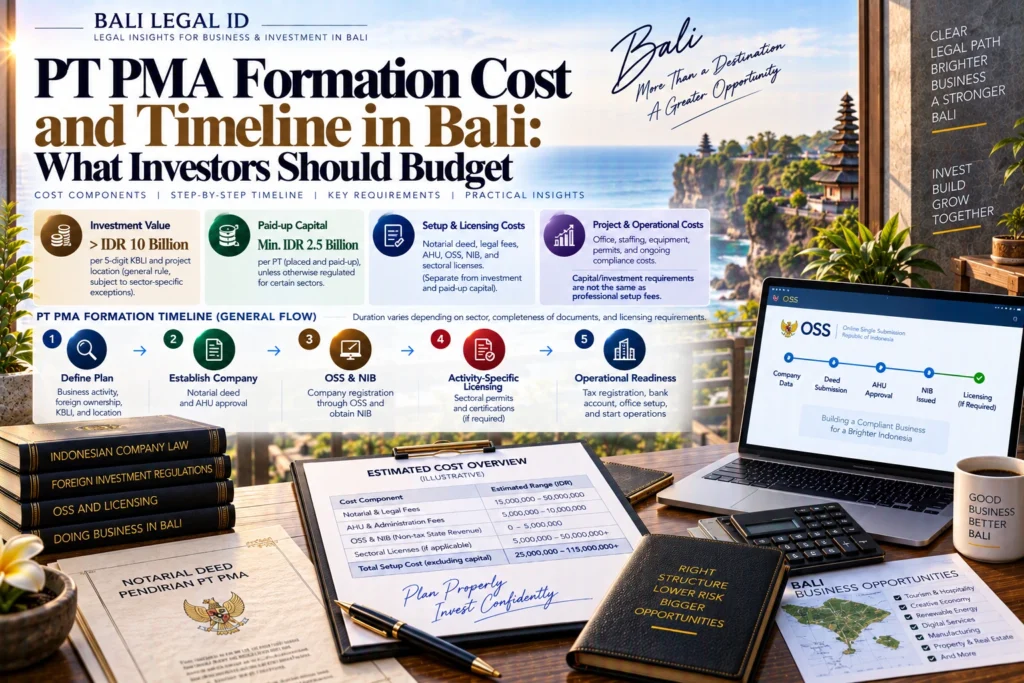
A PT PMA formation timeline should show the dependencies between company structuring, incorporation, OSS licensing, and operational readiness. This guide focuses on scheduling and delays; the separate cost guide explains the budget.
PT PMA Formation Timeline: Structuring, Filing and Licensing
There is no responsible universal end-to-end duration for every PT PMA. A better timeline separates stages and dependencies. See the PT PMA setup guide for the full establishment sequence.
Stage 1: Structure the Company Before Filing
Before the deed is finalized, settle the core project assumptions: shareholders, directors and commissioners, company address, proposed activities, KBLI classifications, investment values, capital, and project locations.
Changing these assumptions after drafting or incorporation can create amendments, additional filings, or a different OSS licensing result. Time spent resolving the structure before filing can therefore prevent more expensive corrections later.
Stage 2: Notarial Deed and SABH Establishment
For the incorporation stage, Article 5 of Permenkum No. 49 of 2025 requires establishment of a capital-association limited liability company to be submitted through a notary using the electronic formation form in SABH.
The filing is document-dependent because Article 6 requires supporting materials that include the establishment deed, capital evidence, company-address information, and beneficial-owner documents, together with other applicable supporting records.
Once the complete corporate application reaches the decision stage, Article 7 provides that the Minister through the Director General issues the legal-entity establishment decision when the application is received and sends it electronically to the notary through SABH.
That formal decision stage should not be mistaken for the entire client timeline. Drafting, shareholder documents, foreign documents, signatures, translations, address evidence, capital evidence, corrections, and other preparation happen before a complete application reaches that point.
Stage 3: OSS and Business Licensing
A company can exist legally before every intended business activity is operationally ready.
After incorporation, licensing must be planned under PP No. 28 of 2025, which JDIH BPK lists as the current Risk-Based Business Licensing regulation and as replacing PP No. 5 of 2021.
The required licensing path depends on the actual activities, risk classification, project location, basic requirements, and sector rules. A quotation and timeline should therefore distinguish company established, NIB and OSS registration completed, and the intended activity ready under its applicable licensing requirements.
What Usually Creates Delay?
Most avoidable delays come from unresolved project assumptions rather than from the name of the company itself.
Before committing to a launch date, clarify:
- whether the intended business activity is open to the proposed foreign ownership structure
- which KBLI codes are actually needed
- whether several activities or locations change the investment calculation
- whether the business address is suitable for the intended activity
- whether foreign shareholder documents need additional authentication or translation
- whether shareholder, director, commissioner, or beneficial-owner information is complete
- whether the project needs sector licences or technical requirements after NIB
- whether a property commitment has been made before the activity and location were checked
- whether the quotation covers amendments if project assumptions change
A provider can quote its own professional turnaround, but no provider can responsibly guarantee the timing of every third-party document, authority review, technical approval, banking step, premises issue, or sector-specific licence.
References & Sources
- Current Status of Investment and OSS Regulation No. 5 of 2025 — peraturan.bpk.go.id
- Official PT PMA Investment Value and Capital Provisions in Regulation No. 5 of 2025 — peraturan.bpk.go.id
- Current Status of Ministry of Law Regulation No. 49 of 2025 on Limited Liability Companies — peraturan.bpk.go.id
- Official Limited Liability Company Establishment Procedure in Regulation No. 49 of 2025 — peraturan.bpk.go.id
- Current Risk-Based Business Licensing Regulation — peraturan.bpk.go.id
Timeline Review Before Filing
Record the input required for each stage, who supplies it, the completion evidence, and the next dependent task. Resolve missing company information before treating a target date as a reliable commitment. Agree how delays and changes will be communicated.
Read More: Business Setup Bali for PT PMA, PT PMDN & OSS RBA Registration
Discuss the scope and supporting records with Bali Legal ID through our business setup services before deciding the next step for your Bali business or transaction.
FAQ PT PMA formation timeline
Is there one reliable completion time for every company?
No. The sequence depends on the proposed company, completeness of its information, activity-specific licensing, and the progress of dependent tasks. Ask for a schedule built around the actual scope.
Should licensing and operating readiness appear in the same calendar?
Record them as separate milestones so that company establishment is not mistaken for completion of every later licensing or operating task.
What should be recorded when a stage is delayed?
Identify the missing input or unresolved question, its owner, the next review date, and which later milestones are affected.
Plan the budget alongside the schedule using the PT PMA setup cost guide. Before committing to target dates, work through the PT PMA formation mistake checklist to identify unresolved inputs that could affect later milestones.