
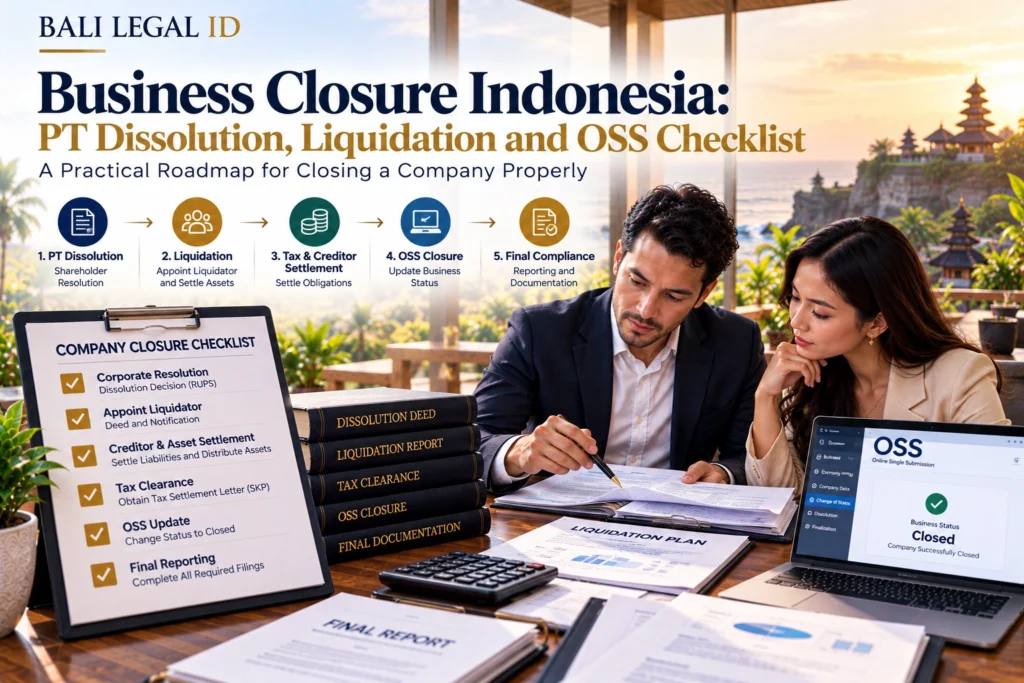
Business Closure Indonesia: Closing a PT in Indonesia is not completed simply by stopping operations, leaving an OSS account unused or allowing contracts to expire. A formal closure can involve corporate dissolution, liquidation, creditor and asset settlement, OSS licensing actions, tax deregistration and final documentation.
This checklist is designed for owners and investors considering closure of a PT PMA or PT PMDN. Before starting, first confirm whether the company genuinely needs to be dissolved or whether another route better matches the business decision.
Business Closure Indonesia: Choose the Correct Route First
Different business decisions require different legal and administrative actions:
- Pause operations: the PT remains in existence and may continue to have corporate, licensing, tax and contractual obligations
- Sell the shares: ownership changes, but the legal entity may continue
- Remove or change a business activity: corporate or OSS data may need amendment without dissolving the company
- Close one project or location: this does not necessarily mean the entire PT should be dissolved
- Dissolve the PT: the company enters the formal dissolution and liquidation process applicable to its circumstances
If the company will continue but its activities or licensing need to change, review Bali Legal ID’s Business Setup Bali guidance and OSS RBA Registration Bali guide before choosing dissolution.
What Indonesian Company Law Says About PT Dissolution
Indonesia’s Limited Liability Company Law remains in force but has been amended by later legislation. The current status can be checked on the official BPK regulatory database for Law No. 40 of 2007.
The dissolution provisions remain set out in Articles 142–152 of the PT Law. The official statutory text published by OJK shows that Article 142 identifies the legal grounds for dissolution and requires liquidation when dissolution occurs under those grounds.
Article 143 is particularly important for business owners: dissolution does not immediately remove the company’s legal-entity status. The company remains a legal entity until liquidation has been completed and the liquidator’s accountability has been accepted by the shareholders’ meeting or the court, as applicable.
This is why a shareholder decision to dissolve the PT should be treated as the beginning of a formal closure process rather than proof that every liability, license and tax record has already been closed.
Practical PT Dissolution Checklist
1. Map the Company Before Filing Anything
Start by building a complete picture of the company and its open obligations.
Gather and review:
- deed of establishment and amendments
- Ministry of Law or AHU records
- shareholder and management information
- NIB and OSS project data
- sector-specific permits and approvals
- NPWP and, where applicable, PKP status
- financial statements and bookkeeping records
- bank accounts
- receivables and payables
- employee obligations
- leases and commercial contracts
- guarantees
- assets and inventories
- disputes, claims or court matters
This step determines the real closure scope. A PT with no employees, liabilities or active permits is a very different closure project from a company with creditors, leased property, tax issues and multiple OSS activities.
2. Confirm the Legal Basis and Corporate Decision
The company’s circumstances determine the proper legal route for dissolution. Where dissolution proceeds through a shareholder decision, the corporate approvals and notarial documentation should be prepared consistently with the PT Law and the company’s constitutional documents.
The Ministry of Law’s official AHU FAQ on PT dissolution describes a staged process involving notarial submission, liquidation work and final liquidation reporting.
Do not assume that the first AHU submission completes the entire closure. The corporate dissolution stage and the completion of liquidation are separate milestones.
For companies that need broader corporate-document support before deciding whether to close or restructure, Bali Legal ID’s Notary Services in Bali page provides relevant context on corporate legal documentation and amendments.
3. Identify the Liquidator, Assets, Liabilities and Creditors
Once the dissolution route is confirmed, identify who will perform the liquidation work and prepare a reliable statement of the company’s position.
The review should cover:
- cash and bank balances
- property and other assets
- customer receivables
- supplier balances
- shareholder or related-party balances
- taxes payable
- employee obligations
- guarantees and security interests
- unresolved contractual commitments
- creditor claims
- litigation or disputes
The purpose is to settle the company’s affairs before any residual assets are treated as available for distribution.
A closure plan should therefore not begin with the assumption that remaining cash can immediately be returned to shareholders.
4. Reconcile OSS and Business Licensing
Corporate dissolution and OSS licensing are connected but are not the same administrative process.
Before taking action in OSS, review every NIB-linked activity, project and permit. The OSS system publishes separate official procedures for non-liquidation business-license revocation and liquidation-related business-license revocation for Non-UMK businesses.
The correct OSS route therefore depends on what is actually happening to the company. Removing one activity, discontinuing a project and liquidating the entire legal entity should not automatically be treated as identical events.
Sector-specific or local approvals may also require separate review. Do not assume that an OSS action automatically closes every permit held by the business.
5. Reconcile Tax and Accounting Records
Tax closure should be planned alongside the corporate process rather than left until the end.
Before applying for deregistration, reconcile:
- tax filings
- tax payments
- bookkeeping and supporting documents
- outstanding assessments or correspondence
- withholding obligations
- invoices and VAT records where applicable
- assets and liabilities shown in the accounts
The Directorate General of Taxes states in its official NPWP removal guidance that a corporate taxpayer that has been liquidated or dissolved may apply for NPWP removal using a copy of the dissolution deed or equivalent document authorized by the competent authority.
The same DJP guidance also states that NPWP removal is an administrative tax action and does not eliminate tax rights or obligations that still need to be fulfilled.
If the company is registered as a taxable entrepreneur, review the separate DJP procedure for PKP revocation rather than assuming it disappears automatically with corporate dissolution.
This is one reason the accounting records should be reconciled before the closure process reaches its final stage.
6. Complete the Liquidation and Final Corporate Reporting
Maintain a clear file of the entire closure process, including:
- shareholder or court decision, where applicable
- notarial documents
- creditor notices and supporting evidence
- asset-disposal records
- settlement of liabilities
- liquidation calculations
- tax correspondence
- OSS actions
- final liquidation reports
- AHU acknowledgments or other official records
The AHU process includes final liquidation reporting rather than ending with the initial notification of dissolution.
After completing the required stages, verify the company’s resulting status in the relevant official systems. Do not rely solely on one filing receipt as evidence that every corporate, licensing and tax workstream has been completed.
Documents to Gather Before Requesting a Business Closure Quote
A provider cannot accurately scope a closure project from the company name alone.
Prepare at least the available versions of:
- latest deed and all amendments
- Ministry of Law or AHU documents
- shareholder and management details
- NIB and OSS project list
- sector permits
- NPWP and PKP information where applicable
- recent financial statements
- tax filing status
- list of bank accounts
- asset and liability schedule
- creditor and debtor list
- employee information
- contracts and leases
- guarantees
- pending claims or disputes
- any existing liquidation or court documents
This is a scoping checklist, not a universal statutory filing list. The final document requirements depend on the company’s facts and the authority handling each part of the closure.
What Changes the Cost and Timeline of PT Closure?
There is no responsible single cost or timeline that applies to every PT closure.
The workload may change according to:
- condition of the corporate records
- number of shareholders or corporate changes still outstanding
- number of OSS activities and sector permits
- whether the company has employees
- number and type of creditors
- unpaid liabilities
- property or lease interests
- tax and accounting status
- incomplete filings
- active contracts or disputes
- liquidation complexity
- need for additional professional or notarial work
When requesting a quotation, ask the provider to separate professional work, government or third-party charges, exclusions, responsibilities and completion milestones.
A quotation for one notarial or AHU filing should not automatically be treated as a quotation for complete corporate liquidation, OSS reconciliation and tax closure.
For help scoping the documents and next steps for your business or transaction, contact Bali Legal ID about our business setup services in Bali.
Read More: Business Setup Bali for PT PMA, PT PMDN & OSS RBA Registration
FAQ business closure indonesia
Can we simply stop using the PT without dissolving it?
The company may stop operating while remaining registered, but stopping operations does not itself complete formal dissolution. Continuing corporate, licensing, tax and contractual obligations should be reviewed before treating the entity as closed.
Does cancelling the NIB dissolve the PT?
No. OSS licensing and the company’s corporate legal status are different workstreams. The formal corporate dissolution and liquidation process must be considered separately.
Does a shareholder decision immediately terminate the PT’s legal status?
No. Article 143 of the PT Law provides that the company’s legal-entity status continues until liquidation has been completed and the liquidator’s accountability has been accepted by the shareholders’ meeting or court, as applicable.
Can PT PMA and PT PMDN use exactly the same closure process?
Both operate within the Indonesian PT framework, but their shareholders, business activities, permits, investment records and other compliance matters can differ. The closure plan should therefore be based on the actual company records.
Is NPWP removed automatically when a company is dissolved?
No automatic removal should be assumed. DJP provides a specific NPWP-removal process for corporate taxpayers that have been dissolved or liquidated and requires supporting dissolution documentation.
Should PKP status also be checked?
Yes, where the company is a PKP. DJP maintains a separate process for revoking PKP status, so it should be reviewed as part of the tax-closure workstream.
Plan the Closure Scope Before Starting the Process
A clean business closure Indonesia begins with accurate records and a clear separation of the corporate, liquidation, OSS and tax workstreams.
Before requesting assistance, prepare the company’s AHU records, OSS profile, tax status, accounting records and list of assets and obligations. Bali Legal ID provides business legal, licensing and compliance support in Bali, while its Business Setup Bali guide provides additional context on corporate and licensing records that may need review before closure.
Request a written scope that clearly states which stages are included, which documents you must provide, which third-party steps are excluded and what evidence will be delivered when each workstream is completed.