When you search OSS requirements by KBLI, the most important point is that the five-digit KBLI code is only the starting point. The licensing result must be read together with the activity scope, business scale, risk parameters, requirements, obligations and the authority assigned to the activity.
The current legal framework is Government Regulation No. 28 of 2025, which BKPM JDIH lists as in force.
For classification, BPS Regulation No. 7 of 2025 establishes KBLI 2025 and BPS JDIH lists the regulation as currently in force.
Readers who need the broader registration sequence before interpreting individual fields can also use Bali Legal ID’s OSS RBA Registration Bali guide for the overall OSS registration context.
How to Read OSS Requirements by KBLI
Do not read the OSS result as a generic list attached permanently to one code. Read it as the licensing outcome for a particular business activity after the system has considered the information and parameters attached to that activity.
PP 28/2025 states that Annex I specifies the KBLI, activity scope, business scale, risk level, business licensing, requirements, issuance period, obligations, PB-UMKU, parameters and authority for each sector.
That structure explains why copying a licensing checklist from another company can be unreliable even when the businesses appear similar. The controlling question is what OSS generates for the actual activity and data entered by your company.
Start With the Current KBLI 2025 Code
Before interpreting the result, confirm that you are working with the current activity classification. The current OSS conversion guide states that new applications, amendments, expansions, updates, extensions and PB-UMKU processes use KBLI 2025 as the primary reference.
This matters when an older business document, spreadsheet or licensing tutorial still refers to a KBLI 2020 code. Some codes continue directly, while others may have been converted, split or merged. Verify the current activity description instead of assuming an old number has the same scope in 2026.
For a business owner, the practical test is simple: does the selected KBLI description accurately describe the revenue-generating activity that will actually be carried out? If the description is too broad, too narrow or represents a different activity, interpreting the later licensing fields will not solve the classification problem.
Check the Activity Scope and Business Parameters
After the KBLI, read the selected activity scope. A KBLI can contain a defined scope or more than one relevant activity context. The result should be checked against what the company will actually do, not merely against the title of the code.
Then review the business parameters requested by OSS. PP 28/2025 makes the activity scope, scale, risk and parameters part of the regulatory mapping rather than treating the KBLI number as the only variable.
That guide is specifically a PP 28/2025 transition workflow, so it should not be treated as a universal screenshot-by-screenshot manual for every current application. Its risk-validation explanation is useful because it shows the relationship between the business data and the regulatory fields produced by the system.
What the Main OSS Result Fields Mean
The licensing result becomes easier to use when each field is treated as a separate decision question.
Risk Level and Licensing Type
The risk field answers: what level of regulatory control applies to this activity?
Under PP 28/2025, risk is classified as low, medium-low, medium-high or high, and the risk level determines the form of business licensing.
The regulation provides that low-risk activities use an NIB, medium-low activities use an NIB and Standard Certificate, medium-high activities require an NIB and a verified Standard Certificate for operational or commercial activity, and high-risk activities use an NIB and permit.
Do not therefore read an NIB as proof that every additional licensing step for the activity has been completed. The next question is what type of licensing output the risk result requires and whether any required Standard Certificate, permit or supporting business license is already effective for the intended stage of activity.
Requirements and Obligations
The requirements field should be read as the items connected to obtaining, fulfilling or validating the relevant licensing output. Depending on the sector, this can lead to technical documents, declarations, evidence or other conditions that must be handled in the applicable workflow.
The obligations field serves a different purpose. It identifies duties attached to carrying out the activity, which may continue after a licensing output has been issued. A useful internal compliance file should therefore keep requirements and obligations in separate sections instead of marking everything complete once the initial licensing process finishes.
When reviewing either field, copy the wording exactly into your working checklist. Do not reduce a technical requirement to a vague label such as “supporting document,” because the precise wording may determine what evidence the competent authority expects.
Verifier and Licensing Authority
The verifier and the licensing authority answer related but different questions.
For medium-high risk activities, verification is carried out by the competent central government, regional government, KEK administrator or KPBPB authority according to their respective authority.
In practical terms, the verifier is relevant when the application requires an assessment of whether a standard or submitted evidence has been fulfilled. The authority field tells you which level or body has the licensing responsibility assigned under the regulatory mapping.
This distinction is useful when following up a medium-high or high-risk application. A delay should not automatically be treated as an OSS technical issue when the application is waiting for substantive review by the authority responsible for that sector or jurisdiction.
A Practical Sequence for Reading an OSS Result
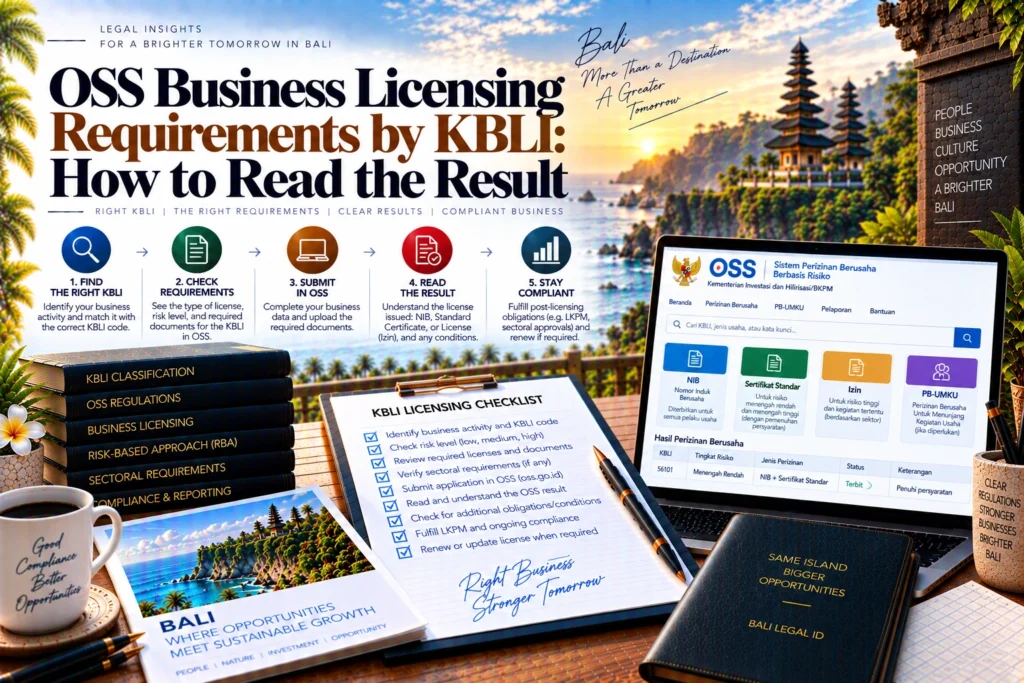
Use the following sequence before preparing a licensing file:
- Confirm that the KBLI is the current KBLI 2025 code
- Read the full KBLI activity description, not only the code title
- Confirm the activity scope selected in OSS
- Check the business scale recorded for the activity
- Review every parameter used to determine the result
- Read the risk level and resulting licensing type
- Separate the displayed requirements from ongoing obligations
- Identify any Standard Certificate, permit or PB-UMKU that must still be fulfilled
- Note the verifier where verification is required
- Note the government authority assigned to the licensing process
- Build the document checklist from the generated result rather than from another company’s application
- Save the result and submitted evidence together for future changes and compliance review
The current OSS procedural framework also includes Minister of Investment and Downstreaming/Head of BKPM Regulation No. 5 of 2025, which BKPM JDIH lists as in force and as revoking the former 2021 BKPM Regulations Nos. 3, 4 and 5.
That is an important reason to check older OSS tutorials before relying on them for a current application.
If the review shows that the business still needs its registration or NIB licensing work completed, Bali Legal ID’s verified NIB OSS RBA Registration service is the relevant same-domain next step rather than a generic service destination.
Why Similar Businesses Can Receive Different Results
Two businesses using similar commercial descriptions can still produce different licensing outcomes if the underlying classification, scope, scale or relevant parameters differ.
Location can also matter where the applicable framework assigns different authority or where project-specific basic requirements must be completed. For a Bali business, the correct approach is therefore not to ask whether another villa, restaurant, consultancy or trading company received a particular output. Ask whether your own KBLI, scope and project data produce the same regulatory result.
A useful warning sign is a mismatch between the company’s actual activity and the wording shown in the selected KBLI. Another is an OSS result that appears inconsistent with the business model because an activity parameter, scale or scope was selected incorrectly. Resolve the underlying data issue before building the compliance file around the result.
Checklist for Bali Business Owners and Investors
Before relying on an OSS licensing result, confirm that:
- The selected KBLI is the current code for the actual business activity
- The activity description matches what the company will sell or provide
- The selected activity scope is correct
- Business scale and project data are current
- Every risk-validation parameter has been checked
- The licensing type matches the displayed risk level
- Requirements have been copied into a document checklist
- Ongoing obligations have been assigned to a compliance owner or calendar
- Any required verification has a clear supporting-evidence file
- The responsible licensing authority has been identified
- Older KBLI 2020 documents have been checked against the current classification
- The final OSS output and evidence are retained together
The objective is not simply to obtain a screen showing a licensing result. It is to understand what that result requires before the business treats the activity as ready for operation.
Conclusion
OSS business licensing should be read from the activity outward: current KBLI first, then scope and parameters, followed by risk, licensing type, requirements, obligations, verification and authority.
For business owners and investors in Bali, this approach reduces the risk of using a checklist prepared for a different activity or relying on an old KBLI reference. The result generated for the actual business data should remain the starting point for the licensing and compliance file.
Review the OSS Result Before Preparing the Licensing File
If your Bali business needs help reconciling its KBLI, risk result, requirements or licensing status, Bali Legal ID can be consulted before the submission or compliance file is finalized.
NIB OSS RBA registration, PT PMA setup and PT PMDN setup support can then be scoped around the actual business activity and licensing result.
For help scoping the documents and next steps for your business or transaction, contact Bali Legal ID about our business setup services in Bali.
Read More: Business Setup Bali for PT PMA, PT PMDN & OSS RBA Registration
FAQ oss requirements by kbli
Does one KBLI always produce the same OSS requirements?
Not necessarily. The KBLI is the starting classification, while the applicable activity scope, business scale, risk parameters and other regulatory fields must also be read from the generated result.
What is the difference between OSS requirements and obligations?
Requirements are items connected to obtaining, fulfilling or validating a licensing output. Obligations are duties attached to carrying out the activity and may continue after the initial licensing step has been completed.
What should I do if my old documents use KBLI 2020?
Check the code against the current KBLI 2025 classification and OSS conversion mechanism before relying on the old code or description. Some codes convert directly, while others may have changed, split or merged.
Why does the OSS result show a verifier?
For licensing processes that require substantive verification, the competent government authority or other authorized verifier assesses whether the applicable standards or requirements have been fulfilled.
Is an NIB enough to start every business activity?
No. Under the current risk-based framework, the required licensing output depends on the risk level. Medium-low, medium-high and high-risk activities involve additional licensing treatment beyond the NIB.
References & Sources
- BKPM JDIH — Government Regulation No. 28 of 2025 — jdih.bkpm.go.id
- Government Regulation No. 28 of 2025 — Official Text — jdih.bp2mi.go.id
- BKPM JDIH — Minister of Investment and Downstreaming/Head of BKPM Regulation No. 5 of 2025 — jdih.bkpm.go.id
- BPS JDIH — BPS Regulation No. 7 of 2025 on KBLI — jdih.bps.go.id
- OSS — Guide to Converting KBLI 2020 and Earlier Codes to KBLI 2025 — s3.oss.go.id
- OSS — PP 28/2025 Transitional Business Licensing Guide — s3.oss.go.id
Recommended Next Articles
- complete OSS RBA registration guide for Bali businesses — balilegalid.com