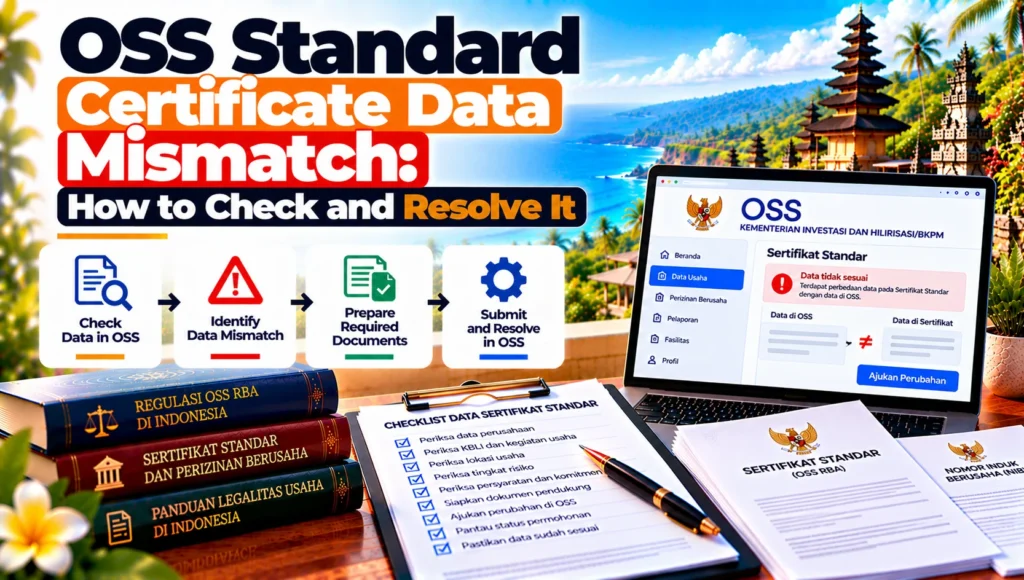
An OSS Standard Certificate data mismatch occurs when information associated with a Sertifikat Standar appears inconsistent with the company’s registration, business activity, project details, or current licensing record. The discrepancy may involve the business identity, KBLI code, activity description, project location, or document status.
The appropriate response is to identify the exact difference before changing anything in OSS. An apparent mismatch does not automatically mean that the certificate is invalid or that the business has been assigned the wrong risk category. It may instead reflect outdated information, an incomplete process, different project records, or an issue requiring official clarification.
For companies and investors in Bali, the objective is to establish which record is inconsistent, what evidence supports the correct information, and whether a formal correction or further verification is actually necessary.
What Does a Standard Certificate Data Mismatch Mean?
A mismatch is a difference between information that the business expects to see and information actually recorded in a licensing document or associated OSS data.
For example, the Standard Certificate may refer to a business activity that no longer matches the company’s intended operations. A project location may be different from the location described in current business documents. Alternatively, the certificate may exist, but the applicable verification process may not have reached the status the owner expected.
These situations require different investigations. A wrong company identity is not the same problem as an incomplete verification process, and a KBLI change is not necessarily the correct response to a discrepancy involving the project address.
The first question should therefore be: Which exact field or status appears inconsistent, and what current record should it be compared with?
Check the Regulatory and OSS Context First
The official record for Government Regulation Number 28 of 2025 identifies basic requirements, business licensing, supporting business licenses, OSS services, supervision, and the handling of licensing obstacles as subjects of the regulation.
The official regulatory status and history identifies 5 June 2025 as the effective date and records the revocation of Government Regulation Number 5 of 2021.
The official BKPM record for Ministerial Regulation Number 5 of 2025 identifies procedural guidance for risk-based business licensing and investment facilities through the OSS system.
The BKPM regulatory status page lists the regulation as applicable and records its promulgation on 2 October 2025.
The official BKPM regulatory history records the revocation of BKPM ministerial regulations Numbers 3, 4, and 5 of 2021.
These records establish the general regulatory context. They do not independently determine which correction procedure applies to an individual company’s certificate.
The official OSS guidance portal provides guidance categories and materials for business licensing applications, changes, cancellations, and revocations.
Business owners should check the guidance relevant to their current activity and licensing status rather than assume that an older tutorial or another company’s experience describes the correct process.
OSS Standard Certificate Data Mismatch: Field-by-Field Checks
A reliable investigation begins by comparing the certificate with the current OSS information and supporting business records.
Company Identity and NIB
Compare the business name, identification information, and NIB shown in the relevant records.
Determine whether the difference concerns the same registered entity, an earlier company record, a separate business, or an administrative detail that requires clarification.
Do not assume that a certificate belonging to another entity can be relied upon merely because the two businesses operate at the same property or have common shareholders.
KBLI and Actual Business Activity
Check the KBLI code and activity description against what the business actually intends to do.
A company may undertake more than one activity, but one activity’s documents should not automatically be assumed to cover every other registered activity.
If the KBLI appears incorrect, describe the actual products or services first. Then review the classification and determine which official correction process may apply.
Changing a code solely to obtain a more convenient risk classification is not a reliable way to resolve a documentary mismatch.
Project Location and Business Scale
Compare the project location and scale information with the actual operation and the relevant business documents.
The same company may have different activities or projects, so the presence of its name on a certificate does not necessarily establish that the document concerns the location currently being evaluated.
Where location details differ, identify whether the issue is an address description, a genuinely different project location, or another change requiring assessment.
Certificate Status and Outstanding Verification
Review the certificate’s recorded status separately from its data fields.
A certificate that has been generated does not necessarily answer whether all applicable verification or fulfillment steps have been completed.
If the certificate information appears correct but a process remains outstanding, investigate the relevant requirement rather than automatically amending unrelated business details.
Conversely, a completed status should not be treated as conclusive evidence that every company, building, land, or operational requirement outside the certificate’s scope has been satisfied.
Standard Certificate Mismatch Diagnosis Matrix
The following matrix helps identify the likely category of an apparent discrepancy and the evidence to examine first. It is a practical review tool, not an official determination of the correct amendment procedure.
| Apparent problem | Initial evidence to compare | Main question |
|---|---|---|
| Business name or NIB differs | Certificate, current OSS profile, company records | Does the document concern the correct entity? |
| KBLI differs from actual activities | KBLI description, operational plan, current project data | Is the registered activity consistent with the real business? |
| Business activity description is incomplete | Current activity information and intended operations | Is the difference material to the licensing record? |
| Project address differs | OSS project information and available location documents | Are the records referring to the same project? |
| Project scale is inconsistent | Registered scale information and current business plan | Has the project information changed? |
| Certificate exists but verification appears incomplete | Certificate status and applicable OSS requirements | Is this an outstanding process rather than a data error? |
| An older document differs from current records | Document versions, change history, current OSS information | Which version reflects the relevant licensing status? |
| The system prevents a proposed change | Error messages, affected fields, application status | Which official procedure or assistance channel is appropriate? |
A single business may have more than one discrepancy. Review each difference independently before deciding whether they arise from the same underlying problem.
What to Do Before Changing OSS Data
Start by preserving the existing information. Record the certificate details, current project data, relevant status messages, and the date of the review.
Step 1: Identify the discrepancy. State exactly what differs and which records are being compared.
Step 2: Establish the correct underlying facts. Use available company documents, business activity descriptions, project information, and relevant supporting records.
Step 3: Separate data errors from incomplete requirements. A document awaiting verification should not automatically be treated as having incorrect company or KBLI information.
Step 4: Check the appropriate current procedure. Different amendment, cancellation, or other administrative processes may apply depending on the affected information and licensing status.
Step 5: Avoid speculative changes. Do not repeatedly change KBLI or project information simply to remove a warning without understanding its cause.
Step 6: Document the outcome. Preserve the resulting official records and compare them with the intended correction.
Where the available guidance does not clearly address the case, an official clarification may be more appropriate than proceeding through an assumed menu sequence.
Example: Standard Certificate Discrepancy in a Bali Business
Consider a hypothetical company operating a hospitality-related business in Bali.
The company has an NIB and a Standard Certificate, but its management notices that the business activity description on an older document differs from the operations currently planned.
The project information also contains a location description that needs clarification. Management initially assumes that the Standard Certificate must be replaced immediately.
A more useful investigation starts by comparing the currently registered business activities with the planned operations. The company then reviews the project information and certificate status to determine whether the issue concerns activity classification, location information, a previous document version, or an outstanding administrative requirement.
If several issues are present, the company should not assume that changing the KBLI will resolve the project-location question or any separate verification condition.
The review should also distinguish OSS licensing from property documentation. The existence of a Standard Certificate does not independently establish ownership, lease validity, or the completion of every building-related requirement.
This example is hypothetical. It does not assign a particular risk level or certificate requirement to any specific villa, restaurant, hotel, or other hospitality KBLI.
When to Request Official Assistance
Official assistance is appropriate when a business cannot determine why information differs, when a required field cannot be updated through the available process, or when the document status remains unclear after the relevant records have been reviewed.
Prepare a concise explanation identifying the affected business activity, the difference observed, the current document status, and the actions already attempted.
Retain relevant screenshots and supporting documents, but avoid sharing passwords or unnecessary confidential information.
If the question concerns the interpretation of an activity classification or a licensing decision, seek clarification from the competent authority rather than assuming that an apparent display error proves the classification is incorrect.
Verify the Result After Correction
A successful correction should be evaluated against the original discrepancy rather than simply the disappearance of an error message.
Compare the current company identity, NIB, KBLI, activity description, project location, and certificate status with the records that should support them.
Confirm whether any related licensing documents or additional processes require review. A correction to one field does not automatically establish that every connected requirement has been completed.
Keep an organized record of the original issue, supporting evidence, official action taken, resulting documents, and any unresolved questions.
This final comparison helps distinguish an issue that has actually been resolved from one that has merely changed how it appears in the system.
Conclusion
An OSS Standard Certificate data mismatch should be investigated by identifying the exact inconsistent information and comparing it with the current business, project, and licensing records.
The correct response depends on whether the problem involves company identity, KBLI, activity description, project details, certificate status, or an outstanding process.
For business owners and investors in Bali, documenting the discrepancy, checking the relevant official guidance, and verifying the resulting records provides a more reliable approach than making repeated changes without establishing the cause.
Review Your OSS Standard Certificate Discrepancy
If your OSS Standard Certificate, NIB, KBLI, or project information appears inconsistent, contact Bali Legal ID to discuss the business registration and documentation questions involved.
A consultation can help clarify the scope of an OSS licensing review, identify the records that need attention, and determine which outstanding issues require further official or professional verification.
For help scoping the documents and next steps for your business or transaction, contact Bali Legal ID about our business setup services in Bali.
Read More: Business Setup Bali for PT PMA, PT PMDN & OSS RBA Registration
FAQ oss standard certificate data mismatch
What causes an OSS Standard Certificate data mismatch?
An apparent mismatch may involve different business identity information, KBLI, activity descriptions, project locations, document versions, or licensing statuses. The cause should be established by comparing the certificate with current OSS and supporting business records.
Does an incorrect Standard Certificate automatically invalidate my NIB?
Not necessarily. A mismatch should be assessed according to the specific information affected and the applicable licensing status. Do not infer the legal status of one document solely from an apparent difference in another.
Can I change the KBLI to correct a Standard Certificate?
A KBLI change should be considered only when the registered classification does not accurately describe the business activity and the relevant official procedure allows the proposed action. A mismatch involving another field may require a different response.
What if the project address on my Standard Certificate is different?
Compare the certificate with the current OSS project information and available location documents. Determine whether the difference is an administrative detail, a different project record, or a substantive change requiring official review.
Is a Standard Certificate issued through OSS always fully verified?
Do not assume that document issuance and applicable verification requirements are the same in every case. Review the recorded status and the requirements relevant to the particular business activity.
What should I do if OSS will not accept a correction?
Document the error message, affected information, current licensing status, and actions attempted. Check the appropriate official guidance and seek assistance through OSS or the competent authority rather than repeatedly making speculative changes.
References & Sources
- Government Regulation Number 28 of 2025 on Risk-Based Business Licensing — peraturan.bpk.go.id
- Ministerial Regulation Number 5 of 2025 on Risk-Based Business Licensing Procedures and Investment Facilities Through OSS — jdih.bkpm.go.id
- OSS RBA Official Guidance Portal — oss.go.id
Recommended Next Articles
- understanding OSS registration and Standard Certificates in Bali — balilegalid.com
- reviewing business activity and licensing decisions in Bali — balilegalid.com