
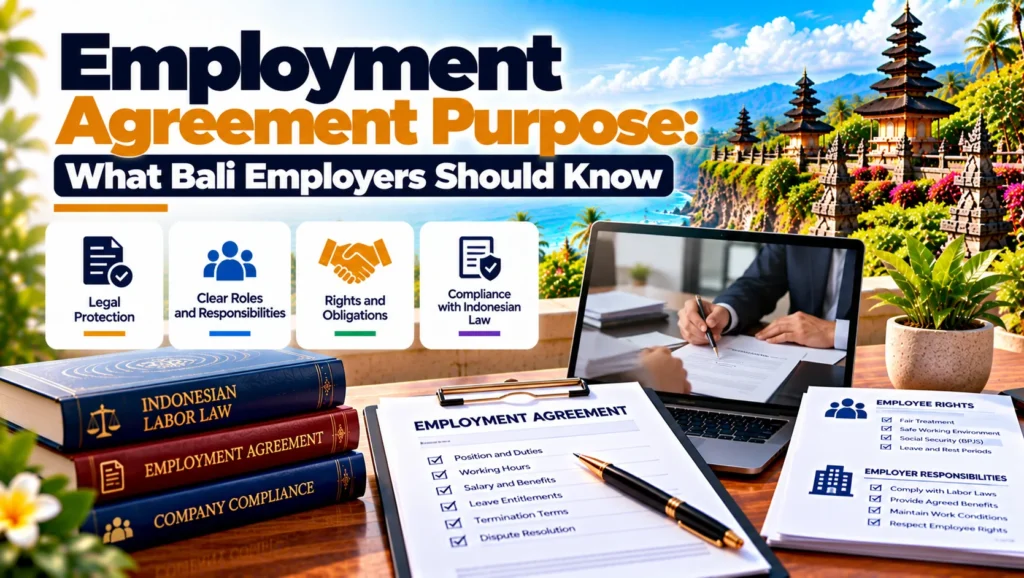
The purpose of an employment agreement is to define the working relationship between an employer and an employee. It records what work will be performed, the agreed employment conditions, and the rights and responsibilities of both parties.
For businesses operating in Bali, understanding employment agreement purpose is useful when hiring administrative staff, hospitality workers, accountants, operational managers or other employees. A clear agreement helps employers explain expectations and gives workers a written reference for understanding the terms of their employment.
However, an employment agreement is not simply a commercial document that a company can draft without regard to employment law. Its terms need to be considered against the legal framework applicable to the working relationship.
What Is the Purpose of an Employment Agreement?
An employment agreement provides a documented basis for an employment relationship. Its primary function is to clarify the work, employment conditions, and respective rights and obligations of the employer and employee.
Indonesia’s Manpower Law, Law No. 13 of 2003, establishes the employment agreement as the basis for defining employment conditions and the rights and obligations of workers and employers.
In practical terms, the agreement helps answer questions that might otherwise lead to misunderstanding:
- What job has the employee been hired to perform?
- Where will the work ordinarily take place?
- What remuneration arrangements have been agreed?
- How will working schedules and responsibilities be communicated?
- Which employment relationship and contract type is intended?
- How will changes to employment terms be reviewed and documented?
A well-organized contract does not eliminate every workplace disagreement. It does, however, provide a reference point for checking what the parties agreed and where additional legal or organizational rules must be considered.
For employers, this can support consistent hiring and record management. For employees, it provides clarity about the position and employment conditions they have accepted.
The Legal Framework for Employment Agreements in Indonesia
Employment agreements in Indonesia are governed by a legislative framework that has changed over time. Businesses should therefore avoid relying solely on an old contract template or an outdated explanation of employment rules.
The official BPK legislative history confirms that the 2003 Manpower Law has been amended, including through Law No. 6 of 2023.
The official record for Law No. 6 of 2023 confirms that it established the Job Creation emergency regulation as law and is listed as applicable, with subsequent amendments affecting parts of its wider legislative framework.
The Ministry of Manpower’s official record for Government Regulation No. 35 of 2021 identifies PKWT, PKWTT, outsourcing, working time, rest periods and employment termination among the subjects governed by the regulation.
The Ministry of Manpower legal database records Government Regulation No. 35 of 2021 as applicable, with an effective date of February 2, 2021.
These references establish the general regulatory context. They do not mean that every employee, job category, industry or termination situation is governed by identical conditions.
PKWT and PKWTT Are Different Employment Arrangements
A key drafting question is whether the intended employment relationship should be structured as a Perjanjian Kerja Waktu Tertentu (PKWT), a fixed-term employment agreement, or a Perjanjian Kerja Waktu Tidak Tertentu (PKWTT), an indefinite-term employment agreement.
The distinction matters because the legal suitability and consequences of each arrangement are not necessarily the same.
An employer should not choose a fixed-term agreement merely because it prefers a shorter commitment or wants the contract to appear more flexible. The actual characteristics of the job and the applicable employment rules require review.
For example, a company hiring someone to perform ongoing operational duties may need a different assessment from a company engaging workers for a genuinely temporary project.
The appropriate agreement type should be decided before drafting clauses about duration, changes or the conclusion of employment.
Employment Rights Cannot Be Evaluated from the Contract Alone
An employment agreement should be reviewed alongside applicable employment legislation, company regulations, collective arrangements where relevant, and the real working conditions.
A clause appearing in a signed contract does not automatically settle whether the arrangement complies with the applicable legal requirements.
Likewise, leaving a topic out of the agreement does not necessarily mean that the topic has no legal significance.
For this reason, a company should avoid assuming that general statements such as employment follows company policy are sufficient to explain every important aspect of the working relationship.
Where a question concerns statutory entitlements, working time, leave, social protection or termination, the company should verify the currently applicable rules rather than rely on a general-purpose contract template.
What Should an Employment Agreement Clarify?
A practical agreement should be understandable to the parties signing it and specific enough to describe the intended employment relationship.
The following matrix identifies useful topics for an internal drafting review. It is not presented as an exhaustive statutory list of mandatory clauses for every employment agreement.
| Agreement topic | Question to clarify | Practical drafting objective |
|---|---|---|
| Parties | Who is the employer and who is the employee? | Avoid uncertainty over the contracting parties |
| Job role | What position and duties are intended? | Define the principal work expectations |
| Employment type | Is PKWT or PKWTT appropriate? | Identify the arrangement requiring legal assessment |
| Work location | Where is the employee expected to work? | Clarify normal workplace arrangements |
| Remuneration | What compensation terms are agreed? | Establish a reference for payroll administration |
| Working arrangements | How are schedules and reporting lines managed? | Reduce operational ambiguity |
| Confidentiality | What business information needs protection? | Explain reasonable information-handling expectations |
| Company policies | Which workplace rules apply? | Connect the agreement with relevant internal procedures |
| Contract changes | How will changes be considered? | Create a documented review process |
| Employment conclusion | What framework applies when employment ends? | Direct the parties to the relevant legal and contractual review |
The value of this matrix is in identifying unclear terms before the contract is finalized. Every proposed clause must still be assessed under the legal framework applicable to that employment relationship.
A contract should not be made unnecessarily complicated. Clear descriptions of duties and responsibilities are generally more useful than lengthy statements that do not explain how the role actually operates.
Employment Agreement vs Shareholder Agreement
An employment agreement and a shareholder agreement address different relationships, even when the same individual is both a shareholder and an employee of a company.
An employment agreement concerns the person’s work for the business and the relevant employment terms. A shareholder agreement concerns rights and arrangements associated with company ownership, governance and relationships among shareholders.
For example, a foreign investor may own shares in a PT PMA while a locally employed manager runs daily operations. The manager’s employment agreement should not be treated as a substitute for agreements dealing with shareholder voting rights or ownership arrangements.
If an investor also performs an operational role in the company, the ownership relationship and any proposed employment relationship should be evaluated separately.
This distinction is especially useful when companies prepare multiple agreements during establishment or restructuring. Documents should be selected according to their actual legal purpose, not simply because every document is described as an agreement.
Employment Agreement vs Independent Service Agreement
An employment agreement is also different from a commercial arrangement for independent services.
For example, a hospitality company may employ a full-time reservations administrator or contract with another business to provide a specified reservation-management service. Both arrangements involve work, but the underlying relationship may be different.
A company should consider how the work is performed, how instructions are given, the remuneration arrangement and the actual relationship between the parties.
A title such as consultant, freelancer or independent contractor should not be assumed to determine the legal classification of the relationship by itself.
Where the proposed working relationship could reasonably be interpreted in more than one way, a specific employment-law assessment is preferable to choosing a commercial agreement solely for administrative convenience.
Practical Examples for Bali Businesses
The following hypothetical examples illustrate how the purpose of an employment agreement changes the questions a business needs to consider.
An Ongoing Hospitality Operations Role
A villa management company hires an operations coordinator to supervise daily guest arrangements, communicate with staff and maintain internal records.
The employment documentation should clearly identify the intended duties, work location, reporting structure and employment conditions.
The business should separately review the appropriate employment classification and ensure that the agreement is consistent with applicable working arrangements.
A Temporary Business Project
A business hires workers for a limited project associated with preparing a new operating site.
The employer should first assess whether the nature of the work is suitable for the proposed fixed-term arrangement. It should not assume that every project assignment can be handled through the same employment contract wording.
The agreement’s description of the work should accurately reflect the project rather than use generic temporary worker language without reviewing the actual job.
A Specialist External Service Provider
A PT PMA needs a provider to perform a defined accounting systems project.
Before selecting an employment agreement, the company should assess whether the arrangement represents employment or an independent service relationship.
The appropriate documentation depends on the substance of the arrangement, including the parties’ respective responsibilities and the way the work will be performed.
These examples are decision-support illustrations, not binding classifications of particular jobs or services.
How to Review the Agreement Before Signing
A useful review begins with the actual role, not with the first contract template available.
Employers can organize the process into the following stages:
- Describe the role. Write down the real responsibilities, operating location and reporting relationships.
- Assess the relationship. Determine whether the proposed work is intended to be employment or a separate commercial service.
- Review the employment type. Consider the applicable PKWT or PKWTT framework based on the actual work.
- Check the conditions. Review the proposed remuneration, work arrangements and relevant workplace policies.
- Verify legal consistency. Compare the draft with the employment rules currently applicable to the company and worker.
- Discuss unclear terms. Resolve important differences in understanding before execution.
- Retain a consistent record. Keep the executed agreement and relevant approved changes in the company’s employment records.
The sequence is a recommended internal process, not an assertion that every company follows an identical government filing workflow.
Connect the Agreement to Workplace Administration
Employment documentation is only one part of managing the employment relationship.
An employer may also maintain onboarding records, payroll information, relevant workplace policies, training records and approved changes to working arrangements.
These materials help explain how the agreement operates in practice and whether the company’s records are consistent.
An agreement that promises one set of working arrangements while actual practice follows another should be reviewed rather than left unresolved.
Review Changes During Employment
A job may evolve as a company grows. Duties, reporting lines, work locations or other conditions can change over time.
When an important term changes, the business should assess the appropriate legal and administrative process and document the resulting arrangement clearly.
Do not assume that an informal email or an unapproved replacement contract automatically resolves every employment-law question.
For a company with multiple workers, consistent document control also makes it easier to identify which version of an agreement is currently relevant.
Conclusion
The central purpose of an employment agreement is to define an employment relationship in understandable terms, including the work to be performed and the rights and responsibilities of both parties.
For Bali businesses, the agreement can support clearer hiring, consistent administration and better records, provided it is based on the actual working relationship and reviewed against applicable employment law.
Employers should distinguish PKWT from PKWTT, avoid confusing employment with shareholder or independent service arrangements, and make sure the agreement’s terms reflect how the job will operate in practice.
Keep the agreement review separate from the company’s tax compliance work and use the pre-signing contract review checklist to agree which employment-law questions require specialist review.
Review the Purpose of Your Business Agreements
If your Bali business is preparing company documents or deciding which type of agreement is appropriate for a planned arrangement, Bali Legal ID provides a starting point for a consultation about agreement documentation and related business administration needs.
For employment-specific rights, contract classification or statutory obligations, ensure the proposed agreement is reviewed by a suitably qualified Indonesian employment-law professional before it is used.
For help scoping the documents and next steps for your business or transaction, contact Bali Legal ID about our notary services in Bali.
Read More: Professional Notary Services in Bali for Property, Business & Legal Documentation
FAQ employment agreement purpose
What is the main purpose of an employment agreement?
Its main purpose is to define the relationship between employer and employee, including the work, employment conditions, and the rights and responsibilities of the parties. It helps document expectations but must be considered alongside applicable employment law.
What is the difference between PKWT and PKWTT?
PKWT is a fixed-term or specified-work employment arrangement, while PKWTT concerns indefinite-term employment. The appropriate choice depends on the nature of the work and the currently applicable employment framework; employers should not select an arrangement solely for administrative convenience.
Can a shareholder agreement replace an employment agreement?
No. A shareholder agreement concerns ownership and shareholder relationships, whereas an employment agreement concerns the working relationship between employer and employee. A person who is both a shareholder and an employee may have distinct legal relationships requiring separate assessment.
Is a freelancer contract automatically different from an employment agreement?
Not necessarily. The name of a document alone does not determine the underlying relationship. The actual work, instructions, remuneration and other characteristics should be reviewed before deciding whether employment or independent service documentation is appropriate.
Does signing an employment agreement guarantee legal compliance?
No. A signed agreement is an important record, but its terms and the actual working arrangements still need to be considered against the applicable legal requirements. Company policies and payroll or employment administration may also require separate review.
References & Sources
- Law No. 13 of 2003 on Manpower — peraturan.bpk.go.id
- Law No. 6 of 2023 Establishing the Job Creation Regulation as Law — peraturan.bpk.go.id
- Government Regulation No. 35 of 2021 on Employment Agreements, Working Time and Termination — jdih.kemnaker.go.id