
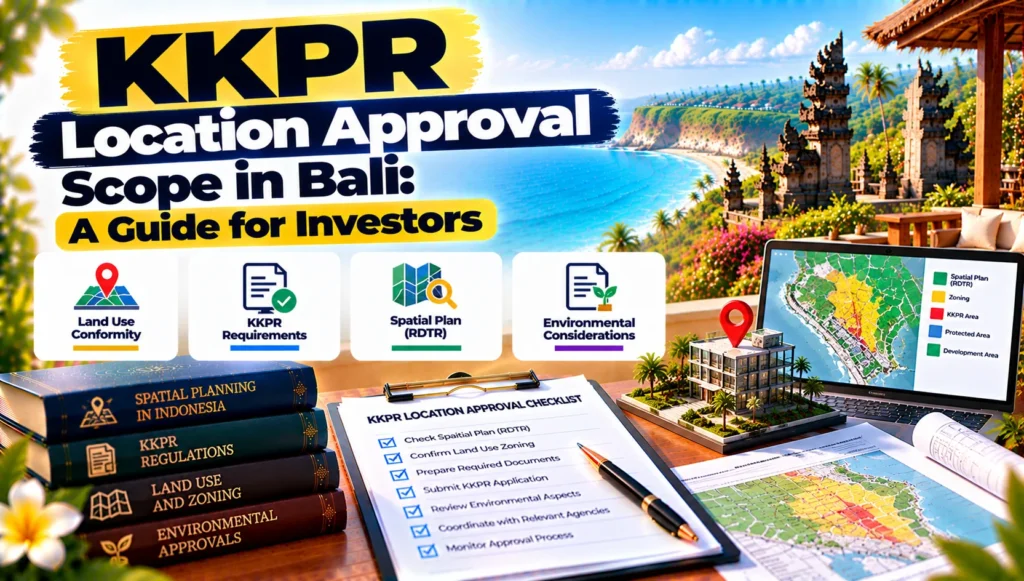
KKPR location approval scope should be compared with the intended activity, project location, and supporting spatial-planning information before relying on it for an investment decision.
KKPR location approval scope concerns whether a proposed activity at a particular site is consistent with the applicable spatial planning framework in Indonesia. For businesses and property investors in Bali, KKPR is an important location-related consideration, but it should not be confused with ownership rights, an environmental assessment, or the complete set of business operating permissions.
A proposed villa, restaurant, office, or other commercial project should be evaluated according to its actual activities, precise location, relevant spatial planning information, and supporting property documentation. A promising property description or an existing lease does not independently establish that the intended business use has received the necessary location-related clearance.
What Does KKPR Location Approval Cover?
Kesesuaian Kegiatan Pemanfaatan Ruang (KKPR) concerns the relationship between planned spatial utilization and the relevant spatial plan.
The official legal record for Government Regulation Number 28 of 2025 identifies basic requirements as part of Indonesia’s risk-based business licensing framework and confirms that the regulation replaced Government Regulation Number 5 of 2021.
The official OSS basic requirements portal presents spatial conformity, environmental approval, and building-related requirements as distinct administrative subjects.
For an investor, the practical question is whether the location is suitable for the planned activity under the applicable spatial planning framework, rather than merely whether the property is available for purchase or lease.
A location review may involve the type of activity, the land area, site position, project boundaries, and the spatial plan that applies to the location. The precise assessment depends on the project and the applicable official requirements.
Why KKPR Matters Before Committing to Property
Business plans frequently begin with an attractive site rather than a completed regulatory assessment. In Bali, a property may appeal to an investor because of its accessibility, building condition, or commercial potential.
However, those commercial characteristics do not answer whether the proposed use aligns with the relevant spatial planning rules.
Consider an investor evaluating land for a hospitality project. Before signing an unconditional long-term lease, the investor should understand whether the intended activity, proposed development area, and site description are suitable subjects for a positive spatial conformity assessment.
This is a practical due diligence recommendation, not a claim that the same review procedure applies to every transaction.
It is also important to separate the property’s contractual availability from any approval needed for the planned business. A landlord’s willingness to lease land does not itself determine the result of a government location review.
KKPR Location Approval Scope and RDTR
Rencana Detail Tata Ruang (RDTR), or a detailed spatial plan, is an important concept in location conformity review.
OSS provides an official guide concerning land-based KKPR confirmation and Rencana Detail Tata Ruang (RDTR), establishing a relevant reference category for reviewing spatial conformity.
The existence of a guidance page does not establish the status of an individual property’s spatial approval. That decision requires the relevant location and project information.
RDTR-Based Location Review
A practical RDTR review starts with identifying the proposed project location and the intended activities. The reviewer should then establish which officially available spatial planning information applies to that site.
For example, a location proposed for an office should be assessed against the activity actually planned rather than automatically evaluated as if it were a hotel, restaurant, or unrelated commercial development.
The relevant plan and classification should be checked through current official channels. An online map or an informal zoning description should not be treated as definitive proof of project approval without appropriate confirmation.
When Further Spatial Review May Be Needed
Not every project presents the same review circumstances. Detailed spatial planning information, location characteristics, and the proposed activity may affect the relevant KKPR pathway.
The ATR/BPN legal information portal publishes Technical Guidance Number 3/Juknis-HK.02.02/VII/2025 concerning regional spatial planning forums for KKPR issuance.
This official listing establishes the existence of the guidance, but it does not mean every application requires the same forum process.
Where the appropriate pathway is uncertain, the investor should seek confirmation of the currently applicable procedure and responsible authority before committing to an expected result or processing schedule.
KKPR and Environmental Approval: Different Questions
Spatial conformity and environmental approval are related to business development, but they address different issues.
A spatial conformity review examines the proposed utilization of a particular location against spatial planning considerations. An environmental review concerns the environmental implications and relevant environmental requirements for a proposed business or activity.
The OSS environmental approval page identifies environmental approval as a separate basic-requirements category from spatial conformity.
For a Bali development project, the environmental approval scope should therefore be reviewed separately from the spatial conformity question.
Depending on the proposed activities and applicable environmental screening, investors may need to examine whether an Amdal, UKL-UPL, SPPL, or another relevant environmental administrative pathway applies. The correct document and process should be verified for the actual project rather than selected solely from its commercial description.
A favorable spatial conformity outcome should not be interpreted as automatic environmental clearance. Conversely, preparing environmental documentation should not be treated as proof that the project location complies with the relevant spatial plan.
KKPR and Land Rights: Why Both Need Review
A land certificate, lease agreement, or other document establishing rights over property addresses a different question from spatial conformity.
For example, a business may have contractual permission to use land under a lease. That contractual arrangement does not by itself establish that every proposed commercial activity at the property is spatially suitable.
Likewise, a spatial conformity document should not automatically be treated as proof of ownership, an unrestricted right to occupy the land, or the authority of the person offering the property.
Property investors should review land rights, contracting-party authority, boundaries, lease terms, and location-related approvals as separate but connected elements of due diligence.
This distinction is particularly important where a hospitality project involves several adjoining parcels, a proposed change in use, or development outside an existing building footprint.
Location and Project Data to Prepare
A clear information file can make a location review more reliable before an investor enters into major commitments.
Consider preparing the following materials for preliminary assessment:
- Proposed business activity. Describe what the business will actually do at the location.
- Site address and coordinates. Record the location as precisely as available evidence permits.
- Land area and project boundaries. Distinguish the property area from the specific area proposed for business use.
- Property documentation. Collect available certificates, lease documents, and relevant supporting records.
- Site plan or layout. Explain the intended use of buildings, open areas, access points, and other relevant facilities.
- Existing project records. Review any available OSS project information or prior location-related documents.
- Environmental screening information. Describe activities and project characteristics that may be relevant to a separate environmental review.
- Questions requiring confirmation. Record inconsistencies between the site description, proposed activities, and applicable planning information.
This is a practical due diligence checklist, not a verified universal list of mandatory KKPR application documents. The official filing requirements should be determined according to the applicable pathway and current administrative instructions.
Bali KKPR Location Review Decision Matrix
The following matrix helps identify the most useful next question for common property investment and business-location scenarios.
| Project situation | Main concern | Practical next review |
|---|---|---|
| Investor considers leasing land for a villa project | Proposed hospitality use and spatial conformity | Compare site location, planned activities, and applicable spatial planning information |
| Existing building will be used for a different commercial activity | Change in intended business use | Review the proposed activity against location and existing approval information |
| Project extends across adjoining parcels | Site boundaries and location consistency | Reconcile project area, parcel information, and relevant location records |
| Business has a property lease but no verified KKPR information | Contractual rights versus location conformity | Review lease evidence and applicable spatial requirements separately |
| Location conformity appears acceptable but environmental review remains unresolved | Different basic-requirement categories | Examine environmental approval scope independently |
| OSS project location differs from the actual site | Possible data inconsistency | Compare coordinates, registered area, and supporting project documents |
The table is intended for early issue identification rather than predicting an approval outcome. The appropriate procedure and supporting evidence must be determined from the actual site and business activity.
Example: Evaluating a Hospitality Project in Bali
Consider a hypothetical investor who is evaluating a long-term lease of land in Bali for a small hospitality development.
The investor receives a draft lease, a copy of a land certificate, and a general description of the property. These materials help begin contractual and land-document due diligence, but they do not independently resolve spatial conformity.
The investor first clarifies the intended business activities and the area to be developed. Next, the proposed site coordinates and boundaries are compared with the available property records and applicable official spatial planning information.
If the location review identifies uncertainty about the intended use, the investor should obtain the appropriate clarification rather than assuming that the commercial lease permits the planned operation.
Separately, the environmental implications of the project should be screened under the relevant current rules. Any existing building or proposed construction may also require its own assessment.
The investor can then use the findings to evaluate contractual conditions, project feasibility, and any necessary revisions to the development plan.
This scenario illustrates a review sequence, not an assertion that a particular property would qualify for approval.
How to Verify KKPR and Related Records
Once the relevant spatial conformity information is available, it should be checked against the actual project rather than retained as an isolated document.
Review the recorded location, business activity, area, and applicable conditions. Compare those details with the proposed development, the available land documents, and the corresponding OSS project records.
Where inconsistencies appear, identify their cause before assuming that an existing document covers a revised activity or expanded site.
Keep a project review log identifying the evidence examined, unresolved issues, responsible reviewer, and required next action. This helps distinguish confirmed information from assumptions that still require official verification.
Environmental documents, building-related requirements, and land rights should also be reviewed within their own applicable frameworks. A single favorable location document is not a substitute for completing every other relevant project assessment.
After defining the location question, examine the separate environmental approval scope for the proposed project. Keep both reviews connected to the property due diligence review, with clear records of the parcel and intended use being assessed.
Conclusion
KKPR location approval scope is fundamentally about the relationship between a proposed activity, its location, and the applicable spatial planning framework. For Bali property investors and business owners, understanding that scope before relying on a property’s commercial potential can support better-informed development decisions.
A sound review separates spatial conformity from land rights, environmental approval, and other business licensing questions. The practical next step is to identify the precise site, document the intended use, compare the available records, and confirm the applicable requirements through the relevant official channels before making commitments that depend on the project’s regulatory feasibility.
Review Your Bali Property and Business Location Before Committing
If you are assessing land for a lease, property transaction, or business development in Bali, Bali Legal ID provides land-document checking, property agreement, company establishment, and business licensing services that may be relevant to your project.
Request a consultation to discuss the proposed business use, property documents, OSS location information, and outstanding spatial or environmental questions. The appropriate review scope can be established before proceeding with major property or development commitments.
Read More: Business Setup Bali for PT PMA, PT PMDN & OSS RBA Registration
Discuss the scope and supporting records with Bali Legal ID through our business setup services before deciding the next step for your Bali business or transaction.
FAQ KKPR location approval scope
Is KKPR the same as permission to build on land in Bali?
No. KKPR concerns spatial conformity of the proposed activity and location. Building-related requirements, land rights, and other relevant approvals should be assessed separately.
Does a valid land certificate automatically establish KKPR compliance?
No. A land certificate concerns land rights and associated property information, while spatial conformity concerns the relationship between proposed land utilization and the applicable spatial plan. Both matters should be reviewed independently.
What is the difference between KKPR and environmental approval?
KKPR addresses spatial conformity. Environmental approval concerns the environmental requirements associated with the proposed business or activity. The specific environmental document and approval process depend on the applicable screening and current requirements.
Can an investor check RDTR before signing a property lease?
Reviewing available official spatial planning information before making a major commitment is a sensible due diligence step. However, an online map or general zoning description should not be treated as a definitive project approval without the appropriate official confirmation.
What documents are useful for an initial KKPR location review?
Useful preliminary materials include the proposed activity description, site address and coordinates, available land documents, project boundaries, proposed site layout, and existing OSS or location-related records. The legally required application documents must be confirmed for the actual project and applicable procedure.
Does obtaining KKPR guarantee that a hospitality project can operate?
No. Spatial conformity is only one relevant part of project compliance. Environmental, building, land-rights, business licensing, and other applicable requirements may need separate review.
References & Sources
- Government Regulation Number 28 of 2025 on Risk-Based Business Licensing — peraturan.bpk.go.id
- OSS Basic Requirements: Spatial Conformity — oss.go.id
- OSS Guide to Land-Based KKPR Confirmation and RDTR — oss.go.id
- ATR/BPN Technical Guidance on Regional Spatial Planning Forums for KKPR — jdih.atrbpn.go.id
- OSS Environmental Approval Requirements — oss.go.id