
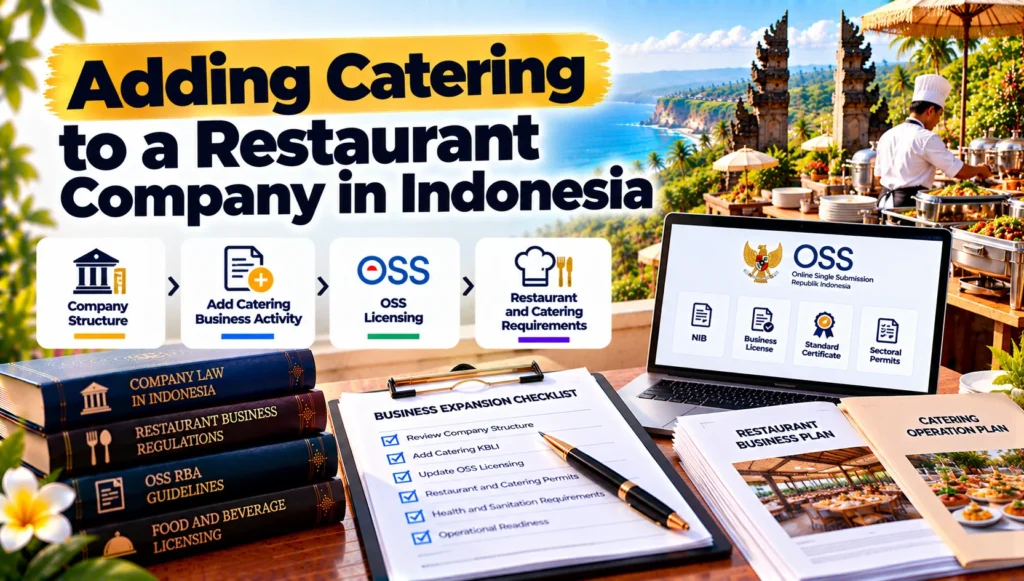
Adding catering to an existing restaurant company starts with defining the new service, comparing it with the registered activity, and reviewing the relevant company and OSS records.
An existing restaurant in Indonesia may be able to expand into catering, but the first question is whether the new service remains within the restaurant activity already recorded or represents a separately classified food-service business. Ordinary takeaway and delivery, catering for individual events, and ongoing food supply under contracts can describe different business models.
Before offering the new service, a restaurant operator should define the planned activities, compare them with current OSS classifications, and review the company’s existing corporate and licensing records. The answer depends on what the business will actually do, not simply whether customers call the service catering.
Does Adding Catering Require a Separate Business Activity?
A restaurant does not necessarily need a separate company merely because it plans to serve customers outside its dining premises. However, that does not mean its existing business classification automatically covers every catering arrangement.
The distinction begins with the nature of the service. A customer ordering prepared meals for takeaway or home delivery is different from a business contracting to provide food and staff for a wedding, conference, office canteen, or ongoing institutional meal service.
The official OSS KBLI 2025 classification for restaurant and mobile food-service activities identifies group 5610 and expressly distinguishes restaurant operations from catering activities classified under groups 5621 and 5629.
This is why a restaurant’s existing KBLI should be checked against the actual proposed catering service. A new activity classification may be relevant even where the operator intends to use the same company, commercial kitchen, staff, or brand.
Restaurant and Catering Activities Under KBLI 2025
The official OSS KBLI 2025 food and beverage service hierarchy distinguishes restaurant activities, catering and other food-service activities, beverage services, and food-service intermediation.
The classification structure helps establish the subject of the business activity. It does not, by itself, establish that a specific company’s existing license automatically authorizes the proposed operation.
Existing Restaurant Operations
Restaurant activities can involve serving meals on the premises, takeaway orders, and food delivery to customers.
For example, a restaurant may prepare an ordinary customer order in its existing kitchen and arrange delivery to the customer’s home. The fact that food is transported outside the restaurant does not, by itself, prove that the operator has entered a separate catering business category.
Consider how the business receives orders, who the customers are, where meals are prepared, and whether it is supplying ordinary restaurant meals or undertaking a separate contractual food-service obligation.
Event Catering
Event catering is generally concerned with food preparation and provision for particular occasions arranged with clients.
The official OSS KBLI 2025 entry for event catering, code 56210 describes contractual food preparation and provision for particular events at locations determined by customers.
A restaurant considering wedding catering, corporate events, conferences, or private celebrations should examine this classification when the proposed service matches that operating pattern.
Important details include whether the restaurant supplies only prepared meals, provides serving personnel and equipment, prepares food at the event, or undertakes an integrated event food-service contract.
These facts may help establish the appropriate classification and supporting review, but no single service feature should be treated as a complete licensing determination without checking the current official activity description.
Ongoing Contract-Based Food Services
Some catering operations involve recurring contractual arrangements rather than individual events.
The official OSS KBLI 2025 entry for other food-service provision, code 56290 describes contract-based services that can include longer-term catering, certain workplace canteens, food-service concessions, and catering at client facilities.
A restaurant proposing to operate a contracted staff canteen, supply meals to an institution over an extended period, or provide other continuing food services should investigate whether this classification is more relevant than event catering.
The contractual relationship, duration, location of preparation, and nature of the service can affect how the activity should be described.
Add Catering Business Activity Restaurant Indonesia: Decision Matrix
For an operator researching how to add catering business activity restaurant Indonesia, the following matrix provides an initial distinction among common service models. It is a planning aid, not an official classification decision for a particular company.
| Proposed operation | Classification to examine | Key question |
|---|---|---|
| Standard restaurant takeaway | Existing restaurant activity under 5610 | Is the service ordinary restaurant food provision? |
| Restaurant meal delivery | Existing restaurant activity under 5610 | Is delivery part of the current restaurant model? |
| Catering for a wedding | Event catering under 56210 | Is food supplied under a contract for a particular event? |
| Catering for a company seminar | Event catering under 56210 | Is the arrangement tied to a specific occasion and client? |
| Ongoing meals for an office | Other food-service provision under 56290 | Is the service provided under a continuing contractual arrangement? |
| Contracted canteen operation | Other food-service provision under 56290 | Is the operator providing food services under a concession or contract? |
| Packaged food for resale | Another relevant food production or trading classification may need review | Is the activity different from ready-to-consume food service? |
The correct classification should be determined by reviewing the actual service and current OSS descriptions. A restaurant may have more than one genuine activity, but adding a code should not be used to describe work the company does not undertake.
Review the Existing Company’s Documents
Before updating OSS, examine the company’s current corporate records and describe the new business activity in ordinary language.
Start with the articles of association and the latest relevant notarial deed. Identify the business purpose and activity descriptions already documented. Check whether the proposed catering service is consistent with those records or whether a corporate change requires professional consideration.
Next, examine the company’s existing NIB and OSS activity information. Record which KBLI activities and business locations are already associated with the company.
Compare those records with the new service. A company may use one legal entity for multiple activities where permitted, but the corporate scope and licensing scope still require separate assessment.
If the articles of association need amendment, the appropriate corporate procedure should be established from the actual documents and applicable AHU requirements. Do not assume that every additional KBLI automatically requires a deed amendment, or that changing OSS data alone is always sufficient.
Check OSS Licensing Under the Current Framework
Indonesia’s current national risk-based business licensing framework should be considered when assessing additional catering activity.
The official legal documentation record for Government Regulation Number 28 of 2025 identifies the regulation as applicable and records its revocation of Government Regulation Number 5 of 2021.
The official Ministry of Finance regulatory history for Government Regulation Number 5 of 2021 confirms that it was revoked on 5 June 2025 and replaced by Government Regulation Number 28 of 2025, which became effective on that date.
Accordingly, Government Regulation Number 28 of 2025 is the identified successor for the national risk-based business licensing framework. Government Regulation Number 5 of 2021 is historical legislation and must not be cited as the currently governing regulation for a new catering licensing assessment.
Older guides that rely on the superseded 2021 regulation should therefore not be used as the sole basis for current licensing decisions. Any transitional circumstances affecting the restaurant’s existing project should be checked independently.
When evaluating the catering expansion, identify the correct activity classification, actual scale, relevant project location, and information required by the applicable OSS process.
Review the risk-based licensing result and any supporting requirements presented for the specific activity. Do not assume that an existing restaurant NIB independently demonstrates that a new catering operation has completed every applicable condition.
Likewise, avoid assuming that every catering business requires an identical supporting certification, fee, or procedure. The applicable requirements must be determined from the selected activity and actual project circumstances.
Production Locations and Supporting Requirements
A restaurant may plan to prepare catering orders in its existing kitchen, at a separate production facility, or partly at a customer’s premises.
Each model raises different practical questions. Review where food will be prepared and stored, how it will be transported, whether serving personnel or equipment will be provided, and whether the intended work matches the selected business activity.
If the company will use another kitchen or facility, examine the relevant occupancy rights, location information, and any project-specific premises or operational requirements. Do not automatically treat the original restaurant’s premises documentation as sufficient for a new facility.
Food handling, sanitation, storage, transportation, and site-specific conditions should be assessed where relevant. This article does not assign a universal hygiene or sanitation certificate to every catering model.
For substantial contracts, review the proposed service agreement separately. It may need to address menu scope, service location, delivery, staffing, payment, cancellation, and responsibility for equipment or site arrangements.
The contract determines the commercial obligations, while the applicable licensing and supporting requirements need independent confirmation.
Example: A Bali Restaurant Expanding Into Catering
Consider a hypothetical company already operating a restaurant in Bali. It has a recorded restaurant business activity and now receives three opportunities.
The first is delivering ordinary restaurant orders to nearby customers. The second is preparing food and providing service for a wedding at a client-selected venue. The third is supplying meals to a corporate office under a continuing service contract.
The company should not assume these three opportunities represent the same activity simply because food is prepared in one kitchen.
The ordinary delivery model may fall within the restaurant activity already being operated. Wedding services should be assessed against the event-catering classification. The continuing office meal contract should be compared with the other contract-based food-service classification.
The company then reviews its articles of association and existing OSS data. Where a separate activity is appropriate, it identifies the relevant corporate and licensing questions before treating the expansion as ready to operate.
It also examines whether the existing kitchen, intended service locations, staffing, and supporting arrangements match the proposed activity.
This example illustrates a classification process. It does not establish that any particular Bali restaurant has completed the required registrations or approvals.
Records to Verify After the Change
After any relevant corporate or OSS action, compare the updated records with the actual business operation.
Confirm that the company’s stated activities, business classification, registered project information, and current licensing results are consistent with the catering service it intends to provide.
Retain the available corporate decision and amendment documents where applicable, together with the corresponding AHU or OSS records. Make clear which documents are current and which have been superseded.
Review any applicable supporting business licensing or operational evidence separately rather than treating an updated activity listing as proof that all other requirements have been completed.
If the company later changes from occasional event catering to recurring institutional food provision, revisit the activity classification. Business descriptions should follow the work actually performed rather than remain unchanged merely for administrative convenience.
Compare the catering proposal with the company records organized in the restaurant setup process and pre-opening checklist. If an additional activity is needed, use the process for adding a new KBLI as the reference for planning that update.
Conclusion
Adding catering to an existing restaurant company in Indonesia is primarily an activity-scope question before it becomes a documentation or licensing task.
The official KBLI 2025 classifications distinguish ordinary restaurant services, event catering, and other contract-based food provision. The correct category depends on the actual catering model.
Restaurant owners should then compare the proposed activity with their existing corporate documents, NIB, OSS data, locations, and applicable licensing conditions. This provides a sounder basis for deciding what to update without assuming that a new company is always necessary or that the original restaurant registration automatically covers every catering contract.
Review Catering Expansion for Your Existing Restaurant
If your restaurant company in Bali is considering event catering or continuing food-service contracts, contact Bali Legal ID to discuss the proposed activities and existing company records.
A PT PMDN or PT PMA business activity and NIB OSS RBA consultation can help identify which KBLI classifications, company documents, business locations, and licensing questions require further review before expansion.
Read More: Business Setup Bali for PT PMA, PT PMDN & OSS RBA Registration
Discuss the scope and supporting records with Bali Legal ID through our business setup services before deciding the next step for your Bali business or transaction.
FAQ adding catering
Can an existing restaurant company add catering in Indonesia?
Potentially, yes. The company should compare the proposed catering service with its current business activity, corporate documents, OSS information, and applicable licensing requirements. A separate company is not automatically necessary solely because another service is proposed.
Is restaurant food delivery the same as catering?
Not necessarily. The official OSS restaurant classification includes restaurant takeaway and delivery activities, while event catering and longer-term contract-based food services appear in separate categories. The actual business model determines which classification requires consideration.
Which KBLI is relevant for event catering?
OSS KBLI 2025 identifies code 56210 for event catering. The description concerns food preparation and provision under contracts for particular events at customer-selected locations.
What KBLI covers ongoing contracted food services?
OSS KBLI 2025 identifies code 56290 for other food-service provision activities, including certain continuing contractual catering and concession arrangements. The operator should verify whether its specific services fit that description.
Must the restaurant change its company deed before adding catering?
Not in every situation automatically. The existing articles of association, stated business activities, and nature of the proposed expansion must first be reviewed to establish whether a corporate amendment is appropriate.
Does adding catering to OSS automatically authorize operations?
No. The applicable OSS licensing result and any supporting conditions must be checked for the actual activity and project. An updated activity record should not be treated as universal proof that every requirement has been met.
Can the same restaurant kitchen be used for catering?
The proposed use should be reviewed against the premises arrangements, actual production process, business location information, and applicable operational requirements. Existing kitchen use does not independently resolve every licensing or sanitation question.
References & Sources
- OSS KBLI 2025: Restaurant and Mobile Food-Service Activities — oss.go.id
- OSS KBLI 2025: Event Catering Activities — oss.go.id
- OSS KBLI 2025: Other Food-Service Provision Activities — oss.go.id
- Government Regulation Number 28 of 2025 on Risk-Based Business Licensing — jdih.komdigi.go.id
- OSS KBLI 2025: Food and Beverage Service Activities — oss.go.id
- Official Status History of Government Regulation Number 5 of 2021 — jdih.kemenkeu.go.id
Recommended Next Articles
- restaurant company establishment costs and planning in Bali — balilegalid.com