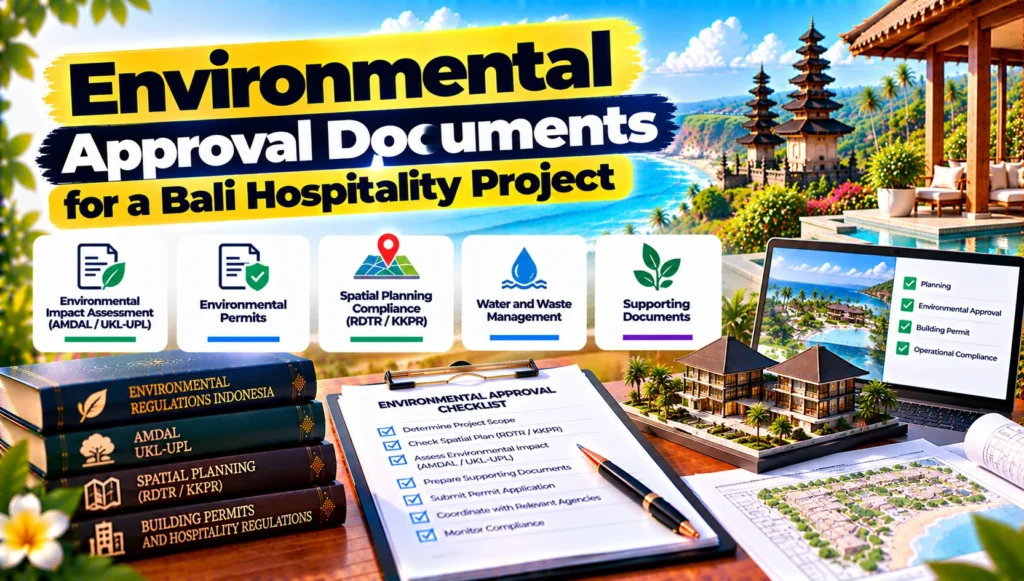
Environmental approval documents should be organized around the actual hospitality project, its activities, location, capacity, and changes. This guide focuses on the information and evidence file needed for screening and review.
Environmental approval documents for a Bali hospitality project depend on the actual business activity, project characteristics, location and the environmental screening requirements applicable to the proposed development. A hotel, villa accommodation business or restaurant should not automatically be assigned the same document category solely because each operates in hospitality.
The main environmental document categories to investigate are Amdal, UKL-UPL and SPPL. The appropriate category must be established through the applicable regulatory criteria and project-specific information, not selected from a generic checklist.
For investors, the first task is to describe the project accurately. Only then can the relevant environmental approval scope and supporting documentation be assessed.
Which Environmental Documents Might a Hospitality Project Need?
Indonesia’s environmental regulatory framework distinguishes activities according to the environmental assessment and management obligations applicable to their characteristics.
The official legal record for Government Regulation Number 22 of 2021 identifies environmental approval as one of the subjects governed by Indonesia’s environmental protection and management framework.
The official record for Peraturan Menteri Lingkungan Hidup dan Kehutanan Nomor 4 Tahun 2021 identifies the categories of businesses and activities subject to Amdal, UKL-UPL or SPPL screening.
These are relevant legal references, but they do not establish a particular hospitality project’s document category without applying the relevant provisions and criteria to its actual circumstances.
How Environmental Document Screening Works
Environmental screening begins by establishing what the project will involve. The business activity, development scale, site characteristics, operational impacts and other applicable criteria must be considered before deciding which environmental pathway requires further preparation.
Amdal
Analisis Mengenai Dampak Lingkungan Hidup (Amdal) is the environmental impact assessment category associated with activities meeting the applicable significance and screening criteria.
For a hospitality project, an assessment may need to consider the proposed development and operations rather than merely the marketing description of the property.
A hotel with substantial facilities and infrastructure may raise different environmental questions from a smaller existing accommodation property. This comparison does not independently determine whether either project requires Amdal.
If the screening identifies Amdal as applicable, the preparation of the required assessment and associated review should follow the current official requirements and involve appropriately qualified parties where required.
UKL-UPL and SPPL
UKL-UPL refers to Upaya Pengelolaan Lingkungan Hidup dan Upaya Pemantauan Lingkungan Hidup, addressing environmental management and monitoring measures for activities falling within the applicable category.
SPPL refers to Surat Pernyataan Kesanggupan Pengelolaan dan Pemantauan Lingkungan Hidup, a statement of commitment concerning environmental management and monitoring for activities within its applicable scope.
Neither category should be selected solely because a project appears small, operates from an existing building or has a limited number of employees.
The correct outcome depends on the criteria applicable to the proposed activity and its actual circumstances. A general online reference may help identify the subject, but it does not replace project-specific screening.
Information to Prepare Before Screening
A reliable assessment begins with a consistent project description. Hospitality investors can prepare an initial information file before arranging a detailed environmental review.
- Business activity: Describe whether the project involves accommodation, food service, leisure facilities or a combination of activities.
- Location and boundaries: Identify the actual site, coordinates, development area and any separate adjoining parcels.
- Project scale: Record the proposed facilities, operating capacity and physical development characteristics.
- Buildings and infrastructure: Identify existing structures, planned construction, supporting facilities and changes to the site.
- Water use: Describe the expected sources of water and major operational uses requiring assessment.
- Wastewater arrangements: Document the proposed collection, treatment and discharge arrangements for further technical review.
- Waste management: Identify likely waste streams and planned handling arrangements.
- Access and activities: Explain relevant operational access, deliveries, visitor activities and other site operations.
- Existing approvals: Collect any previously issued environmental documents and related project information.
- Project changes: Identify expansion, refurbishment or operational changes that may affect the original environmental scope.
This is a preparation checklist, not a legally verified universal application form. The information required for an actual submission should be confirmed through the applicable screening and current official instructions.
Environmental Approval Documents for Bali Hospitality: Decision Matrix
The following matrix compares common hospitality development situations and the principal information that should be reviewed before assigning an environmental document category.
| Proposed project | Main screening question | Useful preparation evidence |
|---|---|---|
| New hotel development | What activities, facilities and development scale are proposed? | Site plan, capacity information, facility descriptions and environmental design information |
| Villa accommodation business | What is the actual accommodation activity and project scope? | Operational description, site details, water and wastewater information |
| Restaurant with kitchen operations | What are the relevant operating characteristics and environmental implications? | Kitchen layout, wastewater arrangements, waste information and business activity description |
| Resort with multiple facilities | Does the proposed assessment cover the full integrated project? | Consolidated project description, supporting facilities and site boundaries |
| Existing hospitality property undergoing expansion | Does the proposed change remain within the scope of existing environmental records? | Previous environmental documents and description of proposed changes |
| Mixed-use accommodation and food service | How should the connected activities be assessed together? | Activity list, site layout and facility-specific operating information |
The matrix identifies information gaps rather than giving an Amdal, UKL-UPL or SPPL verdict. The correct document category must be determined from the applicable official criteria, including any relevant technical and sectoral conditions.
How Environmental Approval Fits With OSS
Environmental approval is connected to Indonesia’s business licensing system, but it is not interchangeable with company incorporation or an NIB.
The official record for Government Regulation Number 28 of 2025 establishes the current general risk-based business licensing framework and confirms that it replaced Government Regulation Number 5 of 2021.
The official OSS environmental approval page presents environmental approval as a separate basic-requirements category from spatial conformity and building-related administration.
A project owner should therefore review the environmental position alongside the relevant OSS project details and business activity information.
A document created for an earlier business model or smaller project should not be assumed to cover all later changes without checking its scope and the requirements applicable to the revised activity.
How the Responsible Approval Authority Is Determined
The agency responsible for an environmental approval should not be assumed solely from the property’s Bali address.
The official record for Peraturan Menteri Lingkungan Hidup/Badan Pengendalian Lingkungan Hidup Nomor 22 Tahun 2025 addresses authority for environmental approval issuance and partially repeals Articles 56, 57 and 58 of Peraturan Menteri Lingkungan Hidup dan Kehutanan Nomor 18 Tahun 2021.
The applicable authority should be identified from the current rules and the characteristics of the project concerned.
A hotel in one Bali regency should not automatically be assumed to follow the same administrative handling as every other hospitality development. Before submitting documentation, confirm the relevant reviewing or issuing authority through official channels.
Environmental Approval vs KKPR and Building Requirements
Environmental documentation addresses different questions from spatial conformity and building administration.
KKPR concerns whether a proposed activity at a location is consistent with the relevant spatial planning framework. Environmental review addresses the environmental assessment and management requirements associated with a project. Building-related administration addresses its own applicable construction and building conditions.
For example, a prospective villa investor may have a lease agreement and preliminary location information but still lack adequate evidence about environmental screening.
The lease establishes contractual matters; it does not independently establish that environmental requirements have been fulfilled. Equally, reviewing environmental documentation does not replace the separate assessment of land rights, spatial conformity or building requirements.
Maintaining these distinctions helps investors identify which matters remain unresolved before development commitments.
Reviewing Existing and Changed Hospitality Projects
An existing environmental document deserves careful review, particularly when an investor is acquiring or leasing an established hospitality operation.
Compare its described business activities, site boundaries, development characteristics and operational scope with the project as it exists today and with any proposed changes.
An investor considering additional accommodation units, a new restaurant or expanded supporting facilities should document those changes before relying on earlier project assessments.
This does not mean that every renovation or operational change automatically requires a new environmental approval. The applicable consequences must be determined by evaluating the actual modification against the current rules and existing documents.
Example: Preparing a Villa Accommodation Project in Bali
Consider a hypothetical investor planning to establish a villa accommodation business on leased land in Bali.
The investor has a draft lease, a preliminary site layout and an initial description of the accommodation facilities. However, the project has not yet established the appropriate environmental documentation pathway.
The first step is to clarify the actual business activities and physical development proposal. The investor then compiles the site boundaries, proposed capacity, water-use arrangements, wastewater management concept and available existing environmental records.
These details provide a better basis for professional environmental screening than a statement that the project will operate as a villa.
Once the appropriate category and authority have been established, the project team can identify which documents require preparation and whether specialist technical work is necessary.
Separately, the investor should review property rights, KKPR, building matters and the business licensing position. None of those topics should be treated as automatically resolved by the environmental screening decision.
This example describes a preparation sequence, not an assessment of a real property or a prediction of regulatory approval.
How to Review Documentation Before Submission
Before relying on an environmental document or preparing a new submission, conduct a consistency review.
Check whether the project name, responsible business entity, activity description, site location and development information agree with the underlying records.
Confirm that the documentation considers the actual activities and relevant facilities rather than only the original commercial concept. Where the project has changed, identify whether the existing environmental record still describes the planned operation accurately.
Finally, record any unresolved screening questions, the official source used to evaluate them, and the professional or authority responsible for confirmation.
A document checklist is useful only when it reflects the actual project. Collecting generic forms without establishing the correct environmental category may create unnecessary work while leaving the central regulatory question unanswered.
Use the environmental approval scope to frame the questions the supporting documents need to address. Place the resulting evidence and unresolved items in the hospitality project due diligence checklist alongside the other project records.
Conclusion
Environmental approval documents for Bali hospitality projects cannot be selected reliably from the terms hotel, villa or restaurant alone. The correct starting point is to define the proposed activity, identify the relevant environmental screening criteria and establish the applicable Amdal, UKL-UPL or SPPL pathway.
Owners and investors should prepare accurate project information, assess existing records, confirm the responsible authority and keep environmental requirements separate from spatial conformity, land rights and building administration. This approach provides a clearer foundation for informed project decisions and appropriately scoped professional assistance.
Review Your Bali Hospitality Project Documentation
If you are evaluating a hotel, villa or restaurant investment, Bali Legal ID offers property document checking, land agreement, company establishment and OSS business registration services that may be relevant to your project preparation.
Request a consultation to discuss the property records, intended business activities and outstanding licensing questions. Any specialist environmental assessment or document preparation requirements should be confirmed separately with an appropriately qualified environmental professional.
Read More: Business Setup Bali for PT PMA, PT PMDN & OSS RBA Registration
Discuss the scope and supporting records with Bali Legal ID through our business setup services before deciding the next step for your Bali business or transaction.
FAQ environmental approval documents
Does every villa project in Bali require Amdal?
Not automatically. The applicable environmental category must be determined from the actual activity and relevant screening criteria, including the project’s characteristics and applicable regulatory provisions. The label villa alone is not sufficient to establish an Amdal requirement.
What is the difference between Amdal, UKL-UPL and SPPL?
They are different environmental assessment or management categories within Indonesia’s environmental framework. The appropriate category depends on the relevant activity and screening criteria rather than a universal rule based solely on the commercial type of hospitality property.
What environmental information should a hotel investor prepare first?
Useful preliminary information includes the proposed activities, project location, site boundaries, development scale, facilities, water requirements, wastewater arrangements, waste handling and any previous environmental records. The final required documents should be confirmed after project-specific screening.
Is environmental approval the same as KKPR?
No. Environmental approval addresses relevant environmental assessment and management matters, whereas KKPR concerns spatial conformity. Both should be evaluated according to their respective requirements.
Can an existing hotel’s environmental documents cover a new restaurant or additional rooms?
That cannot be assumed. Compare the proposed changes with the activities, facilities and scope described in the existing environmental documents, then determine whether further screening or administrative action is required under the applicable rules.
Does an NIB prove that a hospitality project has completed its environmental requirements?
An NIB should not be treated as conclusive evidence that every applicable environmental requirement has been satisfied. Review the project’s environmental approval status and supporting records separately.
References & Sources
- Government Regulation Number 22 of 2021 on Environmental Protection and Management — peraturan.bpk.go.id
- Minister of Environment and Forestry Regulation Number 4 of 2021 on Environmental Document Categories — peraturan.bpk.go.id
- Government Regulation Number 28 of 2025 on Risk-Based Business Licensing — peraturan.bpk.go.id
- OSS Environmental Approval Basic Requirements — oss.go.id
- Minister of Environment Regulation Number 22 of 2025 on Environmental Approval Issuing Authority — peraturan.bpk.go.id