
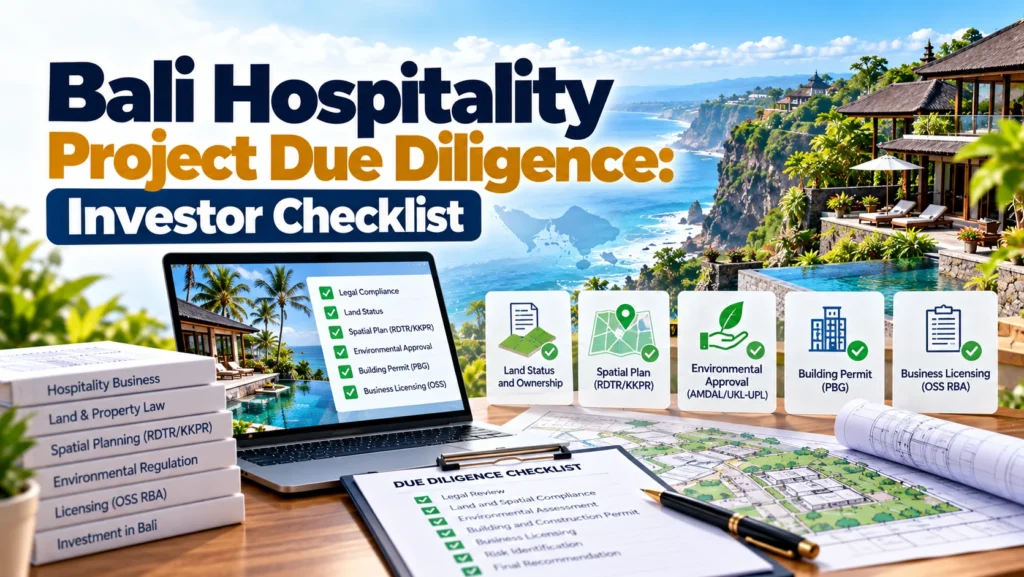
Bali hospitality project due diligence helps investors determine whether a proposed hotel, villa, restaurant, or mixed-use hospitality development is supported by the relevant property, spatial planning, environmental, building, and business licensing documentation.
The objective is not simply to collect documents. It is to establish whether those documents are authentic, applicable, consistent with one another, and appropriate for the business the investor actually intends to operate.
A property may have an existing building, a land certificate, and a business registration record while still presenting unresolved questions about commercial use, development scope, or the party authorized to operate it.
For investors planning a lease, acquisition, partnership, or development commitment in Bali, these differences should be investigated before accepting financial and contractual exposure.
Why Hospitality Project Due Diligence Matters
Hospitality investments typically involve several connected decisions: who controls the property, what activities are proposed, whether those activities fit the location, what buildings can be used, and which business entity will conduct operations.
These questions belong to different areas of review.
A land certificate helps establish relevant registered land information, but it does not independently prove that a particular hospitality operation meets every applicable licensing or building requirement.
A lease agreement can explain contractual rights without resolving the project’s spatial planning or environmental position.
Likewise, a business registration document should not be treated as proof that every property-related requirement has been satisfied.
Effective due diligence considers the complete investment arrangement and identifies gaps before they become contractual disputes, redesign costs, operational limitations, or other unexpected commitments.
What Bali Hospitality Project Due Diligence Should Cover
An integrated review should connect five areas: land rights, spatial compatibility, environmental documentation, building compliance, and business licensing.
Property Ownership and Lease Rights
Start by identifying the land parcel and the party offering the investment opportunity.
Request available land certificates, supporting ownership records, cadastral information, and documents establishing the proposed contracting party’s authority.
For a leasehold investment, review the proposed agreement alongside the intended business model.
Important questions include:
- Who has authority to grant the proposed lease or contractual rights?
- Do the recorded boundaries match the land being offered?
- What is the proposed lease term, and are any extension rights clearly defined?
- Does the agreement address construction, renovation, and commercial operation?
- Who bears responsibility if a property or licensing issue prevents the intended use?
- What happens to improvements, fixtures, and buildings when the agreement ends?
These questions are particularly important where substantial construction or renovation expenditure is contemplated.
Contractual rights, land registration, and the proposed operational use should be reviewed as related but separate matters. Any uncertainty about title or authority warrants appropriate land and legal verification.
Spatial Planning and KKPR
A hospitality project’s location must be evaluated against the intended activity rather than judged only by the presence of nearby hotels or restaurants.
According to the Ministry of Agrarian Affairs and Spatial Planning, KKPR concerns the compatibility of a proposed spatial use with the applicable land-use designation.
For investors, the practical questions are whether the intended use has been correctly described, whether the location information is accurate, and whether the appropriate planning review has been completed.
An existing residential or commercial building does not, by itself, establish that a different proposed hospitality activity is compatible with the relevant planning framework.
Where a project involves several activities, the investor should ensure the location review is based on the actual development and operational proposal.
Environmental Documentation
Environmental due diligence considers how the planned activity relates to the applicable environmental documentation framework.
Environmental approval and management are addressed by Government Regulation No. 22 of 2021, which establishes a national framework for environmental protection and management.
The categories of activities requiring AMDAL, UKL-UPL, or SPPL are identified in Minister of Environment and Forestry Regulation No. 4 of 2021.
A preliminary environmental review should examine the proposed activity, development scale, supporting facilities, wastewater arrangements, waste management, and available environmental documents.
If documentation was prepared for a previous operation, compare its described activity and boundaries with the investor’s current plan.
A document associated with an earlier business configuration should not automatically be assumed to cover significant expansion, changed facilities, or a new operating model.
The correct pathway and any necessary follow-up should be confirmed against the applicable classification and project details.
Building Approvals and Functional Suitability
A property’s physical condition and its regulatory building documentation should be assessed separately.
Building administration is governed by Government Regulation No. 16 of 2021, with additional implementing and technical requirements potentially relevant to individual buildings.
Within the building administration framework, Persetujuan Bangunan Gedung (PBG) and Sertifikat Laik Fungsi (SLF) concern different building compliance functions and should therefore be reviewed separately.
For due diligence purposes, request available building approval records, functional certification documentation, relevant plans, and information about modifications made after the original approval.
Compare these records with the actual building configuration and planned hospitality use.
For example, converting a building into a hospitality facility may involve questions that were not relevant to its previous use. Any proposed change should be examined by an appropriately qualified professional rather than assumed to be covered by existing paperwork.
Building quality inspections, structural assessment, fire safety review, and technical certification may require specialists beyond the scope of general property document review.
OSS Licensing and the Operating Entity
Investors also need to establish which business entity will conduct the proposed hospitality activities and whether its business licensing position matches the intended operation.
Indonesia’s current risk-based business licensing framework is established by Government Regulation No. 28 of 2025, which replaced Government Regulation No. 5 of 2021.
The risk-based licensing regulation addresses basic requirements, business licensing, supporting business licenses, OSS services, and supervision.
An investor should identify the proposed operating entity, relevant business activities, applicable KBLI classifications, and the actual licensing records available for inspection.
A foreign-invested project may also require consideration of the proposed investment structure and the rules applicable to the selected business activities.
Do not assume a single existing NIB or a general company description establishes the complete licensing position for a planned hotel, villa business, restaurant, or mixed-use operation.
Hospitality Due Diligence Risk Matrix
A risk matrix helps investors connect each finding to an appropriate next step.
| Review area | Example concern | Recommended response |
|---|---|---|
| Land rights | Contracting authority or boundaries are unclear | Obtain title and authority verification |
| Lease terms | Development rights or renewal provisions are ambiguous | Review and negotiate contractual wording |
| Spatial planning | Intended hospitality use has not been assessed | Confirm the applicable location review |
| Environment | Existing documentation describes a different operation | Assess document scope and applicable requirements |
| Buildings | Actual modifications do not clearly match available records | Request technical and documentation review |
| OSS licensing | Business activities or operator details are inconsistent | Review the entity’s applicable licensing position |
This matrix is an investment planning tool, not an official regulatory classification.
For decision-making, separate findings into three practical categories:
Documented and consistent: The available evidence supports the proposed use, subject to normal verification and contractual protections.
Unclear but potentially resolvable: Missing records, incomplete explanations, or correctable inconsistencies require clarification before commitment.
Material unresolved risk: Significant uncertainty concerning authority, intended use, regulatory compatibility, or building suitability warrants deferring the relevant commitment until appropriately assessed.
Documents to Request Before Investing
A useful initial document request covers the property, the development, and the operating business.
Property and transaction records:
- Available land certificates and relevant parcel information.
- Identity and authority documents for the contracting parties.
- Draft lease, acquisition, or investment agreements.
- Relevant boundary plans and property descriptions.
Planning and development records:
- Available spatial planning or KKPR documentation.
- Environmental documents associated with the activity.
- Existing building approval and functional certification records.
- Building plans and available information about alterations.
Business and operational records:
- Operating entity registration information.
- Available NIB and relevant OSS licensing records.
- Description of actual and proposed business activities.
- Records explaining which facilities and services form part of the operating model.
Document requests should be adapted to the transaction. A lease of undeveloped land presents different questions from acquiring an existing hospitality business or converting an older building into accommodation.
The existence of a document is only the starting point. Authenticity, validity, scope, and consistency must still be assessed.
How to Evaluate Due Diligence Findings
After collecting available records, prepare a summary of findings and their implications for the investment.
A practical evaluation can follow four steps.
Step 1: Confirm the proposed investment model. Describe the intended hospitality activity, ownership or contractual structure, development plans, and operating entity.
Step 2: Compare documents against the proposal. Identify inconsistencies between land information, the agreed use, location documentation, environmental scope, building records, and business activities.
Step 3: Assign responsibility for unresolved items. Determine which matters require legal review, land verification, regulatory clarification, or technical inspection. Record the responsible party and required evidence.
Step 4: Connect findings to the transaction terms. Consider whether the agreement should include appropriate conditions before completion, document-delivery obligations, warranties, or other protections proportionate to the identified risks.
An investor may choose to proceed when material questions have been resolved and the transaction terms appropriately reflect the remaining exposure.
Where evidence is incomplete, requesting further verification may be more valuable than negotiating a lower price without understanding the underlying problem.
When Professional Review Is Appropriate
Professional support is particularly relevant when a proposed hospitality investment involves multiple land parcels, substantial construction, unclear ownership authority, an existing operation with incomplete documents, or a change in intended property use.
Different specialists may be needed for different questions.
Land and contractual matters may require legal and land-record verification. Spatial and environmental questions may require input from the relevant authority or qualified consultant. Building condition and functional suitability may require architectural, engineering, or other authorized technical expertise.
The purpose of coordinated due diligence is not to replace these specialists with one general checklist. It is to identify which questions matter, which evidence is missing, and which decisions should wait for reliable answers.
Investors comparing an operating hotel in Lombok can use Lombok Legal ID’s hotel licensing due diligence checklist to identify questions for that separate project. Review each property’s location, operator and supporting records against the actual transaction.
Conclusion
Bali hospitality project due diligence is most useful when it examines the investment as a complete transaction rather than a collection of unrelated permits.
Land rights, spatial compatibility, environmental documentation, building records, and business licensing should support the same proposed business activity. Inconsistencies should be identified early, evaluated according to their consequences, and addressed before substantial financial or contractual commitments.
For investors, the central decision is straightforward: establish what can be verified, identify what remains uncertain, and avoid treating missing evidence as proof that a project is compliant.
For the property side of the project, use the Bali property due diligence guide alongside the hospitality KBLI selection guide to connect the site review with the activities the business intends to conduct.
Plan Your Bali Hospitality Investment With Greater Clarity
Considering a hospitality property lease, acquisition, or business establishment in Bali? Bali Legal ID provides a consultation point for discussing property documentation, land lease arrangements, company establishment, and relevant business licensing matters.
Share your proposed project location, intended business activity, transaction structure, and available documents to discuss appropriate verification steps and whether specialist legal, environmental, or building assessments should form part of your investment planning.
Read More: Complete Guide to Setting Up PT PMA in Bali
For help scoping the documents and next steps for your business or transaction, contact Bali Legal ID about our business setup services for company and licensing matters.
Read More: Bali Legal Service for Business, Property, Tax & Investment Solutions
FAQ bali hospitality project due diligence
What is included in Bali hospitality project due diligence?
A practical review typically considers land and contractual rights, proposed land use, available environmental documentation, building approval records, the intended operating entity, and relevant business licensing records. Additional legal or technical checks depend on the particular transaction.
Does a land certificate prove that a property can operate as a hotel or villa business?
No. A land certificate concerns registered land information and should not be treated as proof that the proposed hospitality use satisfies every applicable spatial, environmental, building, and business licensing requirement.
Are KKPR and environmental approval the same?
No. KKPR concerns compatibility with the applicable spatial planning framework, while environmental approval relates to environmental assessment and management. They address different regulatory questions and should be considered separately.
Why should investors check both PBG and SLF?
PBG and SLF concern different aspects of building administration. Reviewing both helps investors understand the available building documentation and identify questions about the actual configuration and intended use. Applicable requirements should be confirmed for the specific building.
Can a hospitality property be leased before all documentation questions are resolved?
The legal and commercial implications depend on the transaction and the unresolved issues. Investors should seek appropriate professional advice and consider contractual conditions or other protections rather than assuming incomplete documentation will be corrected automatically.
Can an existing NIB cover a different hospitality business activity?
Not automatically. The operator’s registered and licensed activities should be compared with the proposed operation. Any necessary changes or additional licensing steps must be confirmed against the applicable rules and actual business classification.
References & Sources
- Government Regulation No. 28 of 2025 on Risk-Based Business Licensing — peraturan.bpk.go.id
- Government Regulation No. 22 of 2021 on Environmental Protection and Management — peraturan.bpk.go.id
- Minister of Environment and Forestry Regulation No. 4 of 2021 on Activities Requiring AMDAL, UKL-UPL, or SPPL — peraturan.bpk.go.id
- Government Regulation No. 16 of 2021 on Building Administration — peraturan.bpk.go.id
- Understanding KKPR: Spatial Utilization Compatibility — atrbpn.go.id