
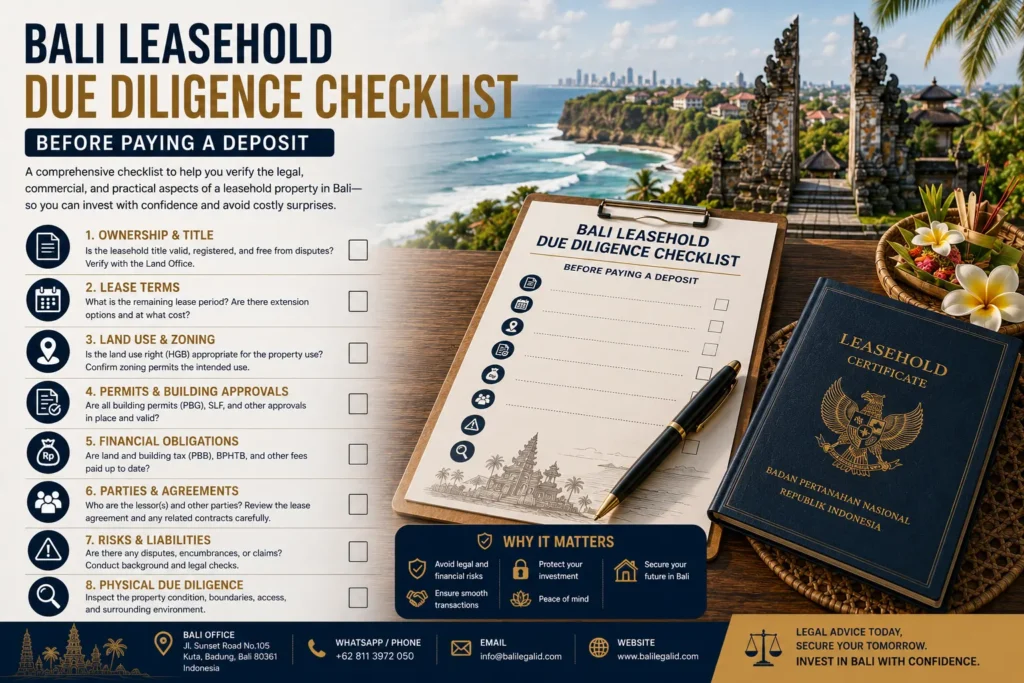
Do not treat a deposit as the start of due diligence. For a material Bali leasehold transaction, first establish what land is involved, who has authority to lease it, whether the intended use is compatible, what rights the lease actually gives you and what happens to the deposit if the transaction cannot proceed.
A practical Bali Leasehold Due Diligence Checklist Before Paying a Deposit can be reduced to five questions: Land–Owner–Use–Lease–Payment.
Bali Leasehold Due Diligence Checklist Before Paying a Deposit
Before money moves, review:
- Land: Is the property and land documentation sufficiently verified?
- Owner: Is the person offering the lease legally connected to the land and authorized to contract?
- Use: Can the property support what you actually intend to do there?
- Lease: Are the term, payment, renewal, transfer, improvements and exit provisions clear?
- Payment: What exactly does the deposit secure, and what happens if a condition fails?
A deposit can be commercially useful, but there is no safe universal deposit percentage or structure for every Bali lease. The amount and conditions should follow the transaction facts.
1. Verify the Land Before Reviewing the Price
Start with the property, not the sales presentation.
Bali Legal ID’s Land Certificate Checking service is one part of a wider review before purchasing, leasing or investing. Confirm separately which checks cover the land-office record, zoning, disputes, encumbrances and other transaction risks.
Indonesia’s official legislation database lists Government Regulation No. 18 of 2021, which governs management rights, land rights, apartment units and land registration, as currently in force.
Before paying a material deposit, ask for the available land and property documentation and verify that the property being marketed matches the legal transaction object.
Red flags include unclear ownership information, inconsistencies between documents and the property being offered, or explanations that important land documents will only be shown after payment.
2. Confirm Who Has Authority to Lease the Property
Knowing the landowner’s name is not enough if somebody else is negotiating or signing.
Identify:
- The registered or legally relevant landholder
- The proposed lessor
- The person who will sign
- Any power, company authority or supporting document relied on
- Whether another family member, co-holder, company or third party has a material role
Article 44 of Indonesia’s Basic Agrarian Law, Law No. 5 of 1960 describes Hak Sewa untuk Bangunan as the right to use another person’s land for building purposes in return for payment of rent.
Article 45 of the same Basic Agrarian Law lists Indonesian citizens, foreigners domiciled in Indonesia, Indonesian legal entities domiciled in Indonesia and foreign legal entities with representatives in Indonesia among parties that may hold the lease right described there.
Those provisions should not be expanded into the claim that every foreign investor can lease every property for every purpose. Party eligibility, property use and the actual transaction structure still require separate review.
3. Check Whether Your Intended Use Is Actually Compatible
A landlord can agree contractually that you may use a property for a villa, office, restaurant or another activity, but that private permission does not by itself establish public-law approval for that use.
Spatial compatibility is a separate issue from the lease contract itself: Indonesia’s official database lists Government Regulation No. 21 of 2021 on Spatial Planning as in force.
For planned business use, the current OSS KKPR/RDTR guide shows that business-location data forms part of the spatial-planning process in OSS, reinforcing why intended use should be checked separately from the private lease agreement.
Before paying, define your actual project. A lease suitable for private occupation may not answer the same regulatory questions as a site intended for hospitality or another licensed business.
4. Review the Lease Terms That Affect Your Investment
Once the land, parties and intended use are sufficiently clear, review the economic and legal structure of the lease.
Focus on:
- Exact property covered by the agreement
- Lease commencement and expiry
- Rent and payment schedule
- Renewal or extension mechanism
- How future extension pricing is determined
- Permitted use
- Construction and improvements
- Sublease or assignment rights
- Sale of the underlying land during the term
- Default and cure provisions
- Early termination
- End-of-term treatment of buildings and improvements
- Dispute process
Once the underlying land and transaction are sufficiently clear, Bali Legal ID’s Land Lease Agreements service describes support including land ownership certificate review, lease drafting and legal documentation.
Do not assume that a vague extension clause creates a guaranteed future term. The wording should explain the mechanism rather than rely on informal assurances about what will happen years later.
5. Define What the Deposit Actually Does
Before transferring a deposit, require a clear answer to four questions:
- Purpose: Is it a reservation payment, part of the rent, security or another payment?
- Conditions: What must happen before the transaction proceeds?
- Refund: When is the deposit refundable or non-refundable?
- Deadline: What happens if due diligence or documentation is not completed by the agreed date?
If the transaction still depends on certificate verification, landlord authority, spatial compatibility or another material condition, the deposit arrangement should address what happens if that condition fails.
A practical principle is: the greater the unresolved dependency, the stronger the reason not to make the payment unconditional.
Deposit Readiness: Go, Conditional or Stop?
Use this matrix before committing funds.
| Status | Situation | Practical response |
|---|---|---|
| Go | Land, authority, intended use and material lease terms are sufficiently verified | Proceed to final payment/document planning |
| Conditional | A limited issue remains but is clearly documented as a condition before completion | Consider payment only with clearly defined conditions and consequences |
| Stop | Ownership, authority, property identity, intended use or a major lease term remains materially unclear | Resolve the issue before making an irreversible payment |
The purpose of the matrix is not to eliminate all investment risk. It is to prevent a deposit from becoming the reason you stop asking questions.
Documents to Request Before Paying
Depending on the transaction, request and review the available:
- Land certificate or relevant land-right documentation
- Identity of the landholder or lessor
- Authority documents where another person signs
- Existing lease or master lease, if relevant
- Draft lease agreement
- Property plans or description showing the leased area
- Documents relating to buildings already on the site
- Available spatial-planning or intended-use information
- Company documents if a company is a party
- Written deposit or reservation terms
- Any document on which a promised extension, sublease or transfer right depends
Not every transaction requires the same evidence. The list should be adapted to the property and intended use.
What Due Diligence Does Not Guarantee
Due diligence reduces uncertainty; it does not make every future risk disappear.
It does not guarantee:
- Future property value
- Rental occupancy or investment returns
- Automatic lease extension
- Future agreement by the landowner
- Approval of a business license not yet applied for
- Approval of construction not yet reviewed
- Absence of every future dispute
It should instead help you identify what is verified, what remains conditional and what is serious enough to stop the transaction.
Conclusion
The safest sequence for a Bali leasehold is not deposit first, documents later. Review the Land–Owner–Use–Lease–Payment chain before making a material commitment.
Verify what land you are leasing, who has authority, whether the property fits the intended use, what the lease actually gives you and what happens to the deposit if an important condition fails.
The practical rule is simple: when a material fact is still unclear, treat it as a condition to resolve—not as something the deposit will somehow fix later.
Check the Leasehold Before You Pay
If you are considering a deposit on a Bali leasehold, gather the available land documents, proposed lease, payment terms and intended use before making a material commitment.
For the contract stage, review the Land Lease Agreements service. If the land record is not yet checked, begin with land certificate checking. The scope should identify who checks the title, lessor authority, intended use, draft clauses and deposit conditions before signing.
Bali Legal ID can help you review the applicable service scope.
For help coordinating the records and next steps discussed above, review our land certificate checking services in Bali.
Read More: Property Due Diligence Bali: Legal Checks Before You Buy or Lease
FAQ Bali Leasehold Due Diligence
Should I pay a deposit before Bali leasehold due diligence is complete?
There is no universal rule for every transaction, but a material deposit should not be used as a substitute for verifying the land, lessor authority, intended use and important lease terms. If due diligence is still incomplete, the payment terms should clearly address the outstanding conditions and what happens if they fail.
What is the first document to check for a Bali leasehold?
Start with the documents identifying the land and the legally relevant landholder. The exact evidence depends on the property, but you should understand what land is being leased and who has authority before focusing on commercial lease clauses.
Does a leasehold mean I own the land?
No. Article 44 of the Basic Agrarian Law describes Hak Sewa as the use of another person’s land in return for rent. A lease should not be described as ownership of the underlying land.
Is zoning important for a Bali leasehold?
Yes when the proposed use depends on spatial compatibility. Contractual permission from the landlord and public-law permission to use a location for a particular activity are separate questions.
What lease clauses should be checked before paying a deposit?
Review the property identity, term, payment schedule, renewal mechanism, permitted use, improvements, assignment or sublease rights, default, termination, end-of-term treatment and any conditions linked to the deposit.
Is there a standard Bali leasehold deposit percentage?
This guide does not rely on a universal percentage because deposit size and structure are commercial terms that vary between transactions. The important point is to define what the deposit secures, whether it is refundable and what conditions must be satisfied.
References & Sources
- Bali Legal ID – Land Certificate Checking
- Bali Legal ID – Land Lease Agreements
- Law No. 5 of 1960 on Basic Agrarian Principles
- Government Regulation No. 18 of 2021 on Management Rights, Land Rights, Apartment Units and Land Registration
- Government Regulation No. 21 of 2021 on Spatial Planning
- OSS Guide – KKPR RDTR Spatial Planning Requirements
- The Bali Lawyer – Bali Property Due Diligence Checklist for Foreign Buyers
- Bali Business Consulting – Land and Property Due Diligence