
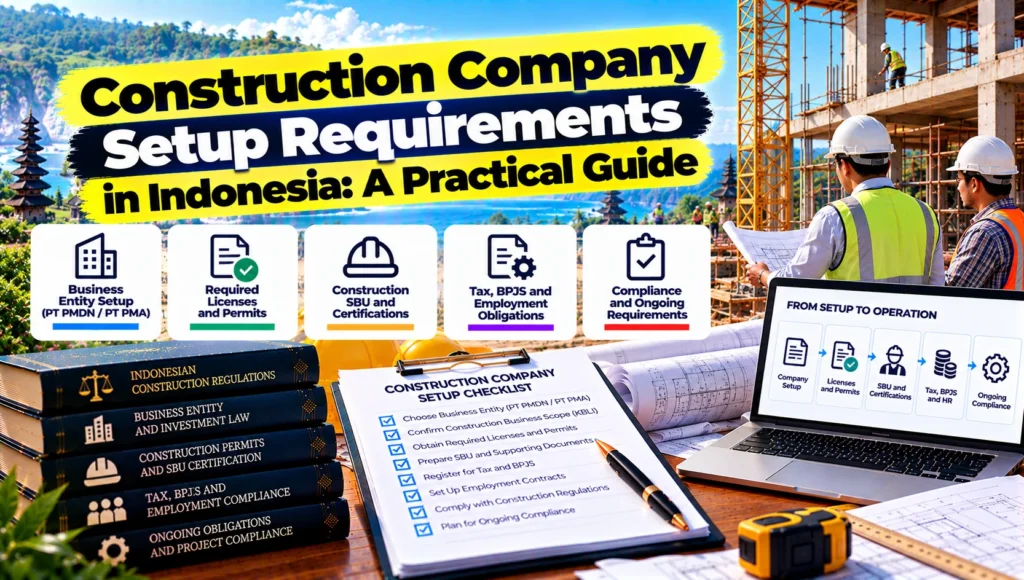
Construction company setup requirements should be organized as a preparation file covering the proposed services, ownership, company documents, premises, and construction licensing questions.
Establishing a construction company in Indonesia requires more than preparing company incorporation documents. The business owner must identify the actual construction activities, select an appropriate legal and investment structure, examine the applicable KBLI classifications, and review business licensing and construction-sector qualification requirements before undertaking the proposed work.
For Indonesian entrepreneurs and foreign investors planning construction operations in Bali, the most important distinction is between establishing a legal entity and confirming that the entity can lawfully perform its intended construction services. Completing one administrative step should not be assumed to complete every other requirement.
This guide explains the main construction company setup requirements, the questions to resolve, and the documents worth preparing. It does not assume that all construction contractors, project owners, consultants, and specialized service providers follow identical licensing requirements.
What Are the Main Construction Company Setup Requirements?
A construction company setup review should address four connected questions: what the business will do, which company structure is appropriate, what business licensing applies, and whether the planned activity requires additional sector-specific qualifications or certifications.
The first question determines much of the later analysis. A business proposing to perform building construction may need a different review from an investor developing a property and appointing independent contractors to carry out the physical work.
Treat company incorporation, OSS business licensing, and construction-sector qualification as separate review workstreams, even when they concern the same proposed company.
The purpose is to establish a coherent sequence of decisions rather than complete registration based on a broad company name that does not accurately describe its activities.
Define the Construction Business Activity First
The company’s planned services should be described before selecting an activity classification or finalizing the licensing plan.
Define the actual construction services the company intends to provide before selecting a business activity classification or preparing a licensing application.
A clear description may include the type of work, the company’s role in delivering that work, the likely clients, and whether the business will directly undertake site operations or engage other providers.
The KBLI review should follow the activity actually proposed. Selecting a broad or familiar classification without checking its description can create inconsistencies between the business plan, corporate documents, and licensing records.
Construction Contracting Versus Project Ownership
A company that contracts to provide construction services is not necessarily performing the same business activity as an investor that owns a development project and engages another company to build it.
For a proposed Bali hospitality development, for example, the investor may need advice about property rights, land-use questions, project approvals, and the engagement of construction contractors. That does not automatically establish that the project-owning company itself operates as a construction services provider.
The company should identify whether it intends to earn revenue by providing construction services to customers, develop its own property, or undertake several distinct activities.
Construction Consulting and Specialized Work
Construction-related consulting, technical planning, supervision, building work, and specialized contracting should not automatically be treated as one activity.
Where the company proposes several services, each should be reviewed for its proper classification, applicable business qualifications, and any technical conditions. The specific outcome depends on the current rules and the precise scope of work.
A practical starting document is a short activity statement describing what the company will actually offer, who will perform the services, and which activities may require specialist personnel or additional verification.
Choose the Appropriate Company Structure
The company’s ownership and investment model should be considered alongside its operational activities.
For a domestic investment proposal, an Indonesian company structure may be evaluated according to the proposed owners and business scope. Where foreign investment is involved, the investor should assess whether a PT PMA structure is appropriate for the intended construction activity and which investment conditions apply.
Before selecting a foreign-investment structure, verify the specific construction activity, applicable investment conditions, and the qualifications relevant to the proposed business model.
Do not assume that a construction business automatically permits a particular foreign ownership percentage or that one minimum capital figure applies to every type of contractor. Those questions require an up-to-date assessment of the actual business classification and investment framework.
A foreign representative office should also not be treated as a substitute for a construction operating company without verifying the intended activities and the applicable rules.
The structure selected should be consistent with the business plan, ownership information, company documents, and intended licensing route.
Understand the Current OSS Licensing Framework
Indonesia’s business licensing framework must be considered using current regulations rather than relying on older registration guides.
The official JDIH record for Peraturan Pemerintah Nomor 28 Tahun 2025 identifies it as the current regulation governing risk-based business licensing, effective from 5 June 2025.
The official JDIH record for Peraturan Pemerintah Nomor 5 Tahun 2021 confirms that the 2021 regulation was revoked on 5 June 2025 by Peraturan Pemerintah Nomor 28 Tahun 2025 tentang Penyelenggaraan Perizinan Berusaha Berbasis Risiko.
The replacement is also identified in Article 550(b) of PP 28/2025, which expressly revokes PP 5/2021. Article 550(a) addresses the continued application of other provisions concerning basic requirements, business licensing, and supporting business licensing to the extent they do not conflict with PP 28/2025.
Consequently, construction businesses should not use PP 5/2021 as an independent statement of currently applicable licensing requirements. Historical instructions based on that regulation may be useful for understanding earlier records, but they should not substitute for the current framework.
The business should examine the applicable KBLI activity, resulting risk classification, basic business licensing position, and any additional construction-sector requirements using the current OSS information and competent official sources.
The official OSS supporting-licensing portal also refers to transitional project data associated with implementation of the 2025 risk-based licensing framework.
A business that already has earlier OSS records should therefore assess its existing registration history rather than assuming it must always begin from the same point as a newly established company.
Review Construction Business Certification
A construction services company should investigate whether the intended business activity involves a construction business certification or other sector-specific qualification process.
The official OSS listing for Sertifikat Badan Usaha (SBU) konstruksi identifies construction SBU as an available supporting business licensing category associated with the public works and housing sector.
That listing establishes the existence of the category, but its public detail page does not provide a complete technical checklist establishing every applicant’s eligibility or documentation requirements.
The correct construction qualification review should therefore identify the particular service classification, applicable business category, personnel or technical requirements where relevant, and the competent certification or licensing process under the currently applicable rules.
A company should not interpret the presence of an SBU category in OSS as proof that it already holds a valid certificate or that every planned activity is automatically authorized.
Likewise, obtaining company incorporation documents should not be represented as equivalent to satisfying construction-sector qualifications.
Construction Company Setup Requirements Checklist
The following matrix is a practical preparation tool for investors and business owners. It identifies the main questions and supporting information to review before concluding that a construction services business is ready to operate.
| Review area | Information to prepare | Main verification question |
|---|---|---|
| Planned activities | Description of actual construction services | Does the business plan distinguish contracting, consulting, and project ownership? |
| Ownership and investment | Proposed owners and investment structure | Is the selected company structure suitable for the actual activities? |
| Company documents | Relevant incorporation and corporate records | Do the legal documents reflect the intended business scope? |
| KBLI classification | Proposed activity codes and descriptions | Do the selected classifications match the services to be provided? |
| OSS registration | Business identity and proposed licensed activities | What licensing position applies under the current framework? |
| Construction qualifications | Relevant business classification and supporting evidence | Is SBU or another sector-specific qualification applicable to this activity? |
| Technical personnel | Planned personnel and professional responsibilities | Which qualifications must be checked for the specific business category? |
| Office or business location | Location and operational information | Are there location-specific requirements relevant to the actual premises or activities? |
| Existing permits or registrations | Previous OSS and certification records, if any | Are earlier records still appropriate, or is a transition or update review needed? |
| Outstanding issues | Missing evidence and unresolved questions | Who will verify each matter before operations begin? |
The matrix does not represent a government-prescribed application form. Its value is in preventing a business from assuming that a complete company registration file also proves completion of all construction licensing and certification requirements.
A Staged Preparation Process
A practical preparation sequence can reduce avoidable inconsistencies between the business plan and subsequent records.
Stage 1: Define the business. Describe the construction services, intended customers, operating model, and activities that will generate revenue.
Stage 2: Review investment eligibility and structure. Determine the appropriate company form and verify any conditions relevant to foreign or domestic ownership.
Stage 3: Review classifications. Match planned services with suitable current KBLI descriptions and identify activities that may require separate assessment.
Stage 4: Prepare company information. Organize the ownership, management, and supporting corporate documents relevant to incorporation.
Stage 5: Assess OSS licensing. Review the current risk-based licensing requirements and the business’s registration or transition position.
Stage 6: Assess construction qualifications. Identify relevant SBU and other potential technical or professional requirements, obtaining current official guidance for the specific activity.
Stage 7: Resolve outstanding issues. Confirm which records are complete, which require corrections, and which depend on further professional or authority review.
Record missing documents, unresolved classifications, responsible personnel, and the next verification action rather than treating the application as complete simply because incorporation documents have been prepared.
This sequence is a recommended internal preparation workflow. It does not claim that every applicant must follow an identical mandatory submission order or that completing each stage guarantees an approval.
Example: Preparing a Construction Company in Bali
Consider a hypothetical investor interested in establishing a company that will undertake construction work for several commercial projects in Bali.
The investor initially plans to register a company using a broad construction-related business description. During preparation, the proposed business model is clarified: the company intends to provide construction services to external clients, rather than merely own buildings developed by other contractors.
That distinction affects the questions the investor must examine. The activity description is reviewed against relevant KBLI classifications, the planned ownership structure is assessed, and the company identifies the licensing and qualification issues associated with its proposed services.
The investor also gathers information about the planned management team, technical personnel, operational premises, and any earlier business records that could affect the application.
Where an exact certification requirement remains unclear, the issue is documented for verification with the appropriate official or competent specialist source. The investor does not assume that incorporation, OSS registration, and construction certification are interchangeable outcomes.
This is a hypothetical planning example, not an actual client case or a representation that a particular business would qualify for a license.
Place the construction preparation file within the entity and ownership questions covered by the business setup guide. Use the OSS RBA registration guide to organize the licensing workflow while retaining the construction-specific qualification questions for review.
Conclusion
Construction company setup requirements in Indonesia are best approached as related but distinct decisions covering the business activity, legal entity, investment structure, KBLI classification, OSS licensing, and construction-sector qualifications.
For a business preparing to operate in Bali, defining the intended services before registration is especially useful. A reliable setup process records the questions already resolved, verifies current official requirements, and identifies what remains to be completed before the company undertakes construction activities.
Discuss Construction Company Establishment in Bali
Planning to establish an Indonesian construction business or assess a PT PMA or PT PMDN structure for operations in Bali? Contact Bali Legal ID to discuss company setup, NIB OSS RBA registration, and related business legal documentation needs.
Before proceeding, confirm the applicable construction business classifications, required sector qualifications, and which technical certification matters may need review by an appropriately qualified specialist or competent authority.
Read More: Business Setup Bali for PT PMA, PT PMDN & OSS RBA Registration
Discuss the scope and supporting records with Bali Legal ID through our business setup services before deciding the next step for your Bali business or transaction.
FAQ construction company setup requirements
Is forming a PT enough to operate a construction company in Indonesia?
Not necessarily. Incorporation establishes a company structure, but the proposed construction services must also be assessed for applicable business licensing and sector-specific qualification requirements. Completion of incorporation alone should not be treated as proof that every construction activity is authorized.
Does a construction company need a construction SBU?
The official OSS portal lists Sertifikat Badan Usaha (SBU) konstruksi as an available construction-related supporting business licensing category. Whether it applies to a particular applicant, and the required certification pathway, should be verified against the company’s exact activities and current sector rules.
Can foreign investors establish a construction company in Indonesia?
Foreign investors can assess potential Indonesian investment structures, including a PT PMA where applicable. The actual eligibility, ownership conditions, and qualifications for a specific construction activity require current legal and investment review. This guide does not assume one universal rule for every construction business.
How should a construction business choose its KBLI?
Begin with a precise description of the services the company will provide. Review the relevant current KBLI descriptions and identify whether different services require separate classifications or additional licensing assessment.
Is the older 2021 OSS risk-based licensing regulation still applicable?
The official Indonesian regulation database records Peraturan Pemerintah Nomor 5 Tahun 2021 as revoked by Peraturan Pemerintah Nomor 28 Tahun 2025. A business should use the applicable current framework and confirm whether any transition provisions affect its existing records.
Is developing a property the same as operating a construction services company?
No automatic equivalence should be assumed. A project owner that appoints independent contractors may have a different business activity from a company providing construction services to clients. The actual operational role should determine the relevant classification and licensing review.
What should be prepared before seeking construction business registration?
Useful preparation includes a clear activity description, proposed ownership and corporate information, relevant KBLI classifications, operational details, and a list of construction-sector qualification questions. The final required documentation must be verified for the particular licensing and certification process.
References & Sources
- Government Regulation Number 28 of 2025 on Risk-Based Business Licensing — jdih.kemenkeu.go.id
- Government Regulation Number 5 of 2021: Official Revocation and Replacement Record — jdih.kemenkeu.go.id
- OSS Construction Business Certificate (SBU) Listing — oss.go.id
- OSS Supporting Business Licensing Portal — oss.go.id