
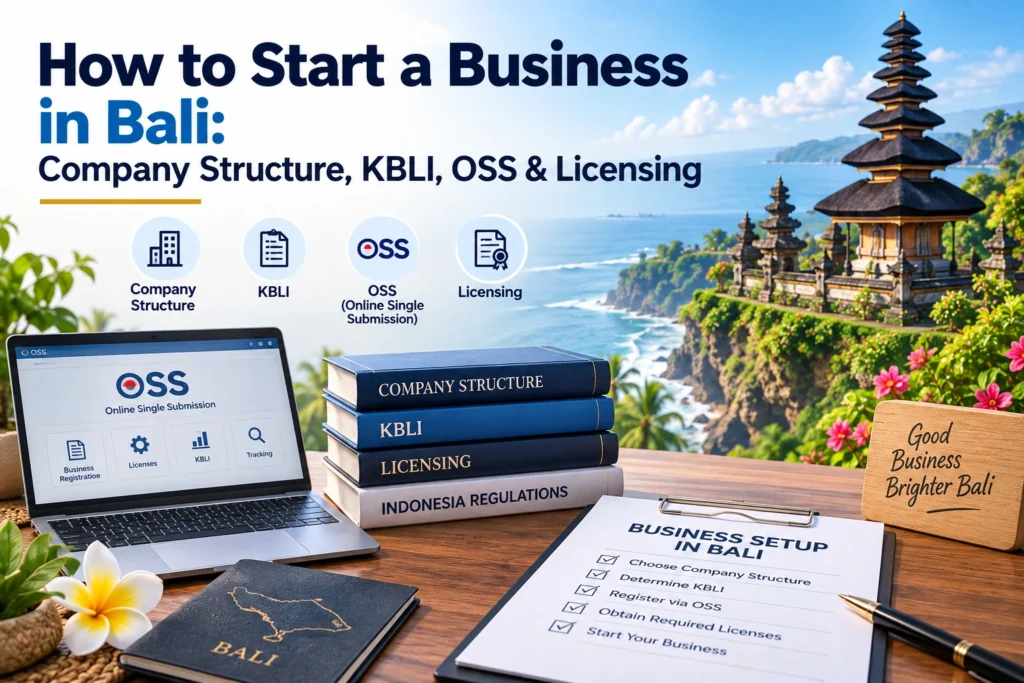
Starting a business in Bali should follow the right sequence: decide the ownership structure, identify the actual business activities, select the correct KBLI 2025, establish the company with matching corporate purposes, obtain an NIB through OSS, and then complete the licensing requirements triggered by the activity and risk level.
For readers researching How to Start a Business in Bali: Company Structure, KBLI, OSS & Licensing, the core principle is to define the ownership and real operating activities before locking the corporate structure or submitting licensing data.
The order matters. Registering a company before confirming the ownership model or KBLI can create avoidable amendments later, while obtaining an NIB does not necessarily mean every activity-specific licensing requirement has been completed.
How to Start a Business in Bali: Company Structure, KBLI, OSS & Licensing
Use this six-step sequence:
- Decide who will own the company
- Map the real business activities to KBLI 2025
- Establish the PT with aligned corporate purposes
- Register through OSS and obtain the NIB
- Complete the applicable risk-based and sector-specific licensing
- Confirm the business is operationally ready before launching
The licensing framework is national, but the actual setup should be assessed against the proposed shareholders, activities, location and operating model.
Step 1: Decide the Ownership Structure
The first question is not which OSS button to click. It is who will own the business.
The Ministry of Law’s AHU Limited Liability Company FAQ states that PT establishment involves preparing the company name, domicile, purposes and objectives, capital structure and management, followed by establishment through a notary.
Foreign Ownership: PT PMA
The same AHU guidance states that where a foreign individual or foreign legal entity becomes a shareholder of a PT, the company becomes a foreign investment company, or PT PMA.
That makes ownership a pre-incorporation decision. Do not create a domestic ownership structure first and assume foreign shareholders can later be added without reviewing the resulting corporate and investment consequences.
Bali Legal ID maintains a separate PT PMA Setup service for foreign-owned company establishment.
Domestic Ownership: PT PMDN
Where the intended ownership remains Indonesian, Bali Legal ID maintains a separate PT PMDN Setup service for the domestic-company setup workstream.
The practical decision is therefore simple: resolve the real ownership structure before incorporating the company. Our PT PMA vs PT PMDN comparison explains how the two paths differ.
Step 2: Select the Correct KBLI 2025 Before Finalizing the Company
KBLI is the official classification used to identify business activities and connect them to regulatory requirements.
The current OSS KBLI directory displays KBLI 2025, so proposed activities should be checked against the current classification rather than copied automatically from an older company profile.
KBLI 2025 is established by BPS Regulation No. 7 of 2025, which the BPS legal database currently lists as in force.
AHU also states that business fields must refer to KBLI, and its FAQ explains that changes to a PT’s purposes and objectives require a shareholder resolution and deed-based amendment process.
That is why activity and KBLI review belongs before the corporate structure is treated as final.
Ask:
- What will the company actually sell or provide?
- Will it operate one activity or several distinct activities?
- Does each activity match the current KBLI description?
- Is the proposed activity compatible with the intended ownership structure?
- What licensing consequences follow from the activity and risk classification?
- Is the proposed location appropriate for the intended operation?
Do not select a code merely because it appears broad or convenient. The classification should reflect the real commercial activity. For the resulting licence obligations, read how to interpret OSS requirements by KBLI.
Step 3: Establish the PT and Align the Corporate Deed
Once ownership and activities are clear, the PT can be established with purposes and objectives that align with the intended business.
The AHU PT guidance connects PT establishment with the company name, domicile, purposes and objectives, capital structure and management.
Before the establishment deed is finalized, ask:
Does the corporate document describe the same business that will later be registered through OSS?
If the answer is uncertain, resolve the activity first. Corporate documents and OSS licensing data should not describe materially different businesses.
Step 4: Register Through OSS and Obtain the NIB
After the relevant company information is available, the business proceeds through Indonesia’s Online Single Submission system.
The OSS portal describes the Business Identification Number, or NIB, as the official identity for starting or running a business in Indonesia.
The NIB is therefore a fundamental business identifier, but it should not be interpreted as proof that every additional licensing obligation has been completed.
The same OSS portal states that the Risk-Based Business Licensing System groups businesses into four risk levels that determine the permits and business obligations that must be fulfilled.
Bali Legal ID’s verified NIB OSS RBA Registration service describes assistance with business classification, OSS registration, NIB issuance and supporting licensing.
Step 5: Complete Risk-Based and Sector-Specific Licensing
Indonesia’s current national risk-based licensing framework is Government Regulation No. 28 of 2025, which BKPM’s legal database currently lists as in force.
The current procedural framework is further governed by Minister of Investment and Downstream Industry/Head of BKPM Regulation No. 5 of 2025, which BKPM’s legal database currently lists as in force.
The practical implication is that licensing depends on the actual business activity and its regulatory profile. Depending on the activity, the NIB may need to be accompanied by additional standards, approvals, permits or other business-licensing requirements.
Do not rely on an older article stating that a particular activity automatically requires only an NIB. Check the current OSS result for the actual KBLI and project data. For a service-business example, see our digital agency setup process in Bali.
Step 6: Check Operational Readiness Before Starting the Business
Before operations begin, compare the planned business with the registrations and licensing already obtained.
Use this checklist:
| Area | Question before operation |
|---|---|
| Ownership | Does the company structure match the actual shareholders? |
| KBLI | Do the registered activities match what the business will actually do? |
| Corporate deed | Do the purposes and activities align with the OSS profile? |
| NIB | Has the correct company and activity data been registered? |
| Licensing | Are the obligations triggered by the current risk classification completed? |
| Location | Is the operating location appropriate for the intended activity? |
| Sector rules | Are any activity-specific approvals still outstanding? |
A business should not begin a regulated activity merely because incorporation is complete. Company establishment and operational licensing are connected, but they are not the same step. Our business compliance checklist for Bali covers the controls to keep after launch.
Common Setup Mistakes to Avoid
For examples across ownership, location and launch decisions, see five common Bali business setup mistakes.
Choosing the Company First and the Activity Later
This can create a mismatch between corporate purposes and the business the company actually intends to conduct.
Reusing an Old KBLI Without Checking KBLI 2025
The current OSS classification uses KBLI 2025. Verify the current activity description before filing.
Treating NIB as the Final License for Every Business
OSS expressly connects permits and obligations to risk level. Some activities therefore require more than business identification alone.
Choosing PT PMDN While Planning Foreign Shareholding
AHU states that foreign shareholding causes a PT to become PT PMA status. Structure the intended ownership before incorporation rather than treating it as an afterthought.
Ignoring the Operating Location
A legal entity can exist while the proposed activity still has unresolved location or sector requirements. Review the actual project, not only the company documents.
Conclusion
Starting a business in Bali is easier to manage when the process is treated as a sequence rather than a collection of registrations.
Start with ownership, confirm the KBLI 2025 activities, establish the company, obtain the NIB through OSS, and complete the licensing obligations attached to the actual activity and risk classification before operating.
Bali Legal ID’s verified Business Setup service separates PT PMDN Setup, PT PMA Setup, Business Closure and NIB OSS RBA Registration into distinct workstreams.
The practical rule is: do not register first and define the business later. Define the ownership, activity and licensing path first, then build the company around that plan.
Build the initial budget using the company setup cost guide. Once the business is established, keep the AHU and OSS change checklist available for later changes to the company or its operations.
Check the Structure and KBLI Before You Register
If you are planning a business in Bali, prepare the proposed shareholders, actual business activities, location and operating model before starting incorporation or OSS registration.
Discuss the setup with Bali Legal ID to determine whether the next step should involve PT PMA Setup, PT PMDN Setup, KBLI review, NIB OSS RBA Registration or another relevant licensing workstream.
For help coordinating the records and next steps discussed above, review our business setup services in Bali.
Read More: Business Setup Bali for PT PMA, PT PMDN & OSS RBA Registration
FAQ How to Start a Business in Bali
What is the correct first step when starting a business in Bali?
Start by defining the intended ownership structure and actual business activities. Those decisions affect company status, KBLI selection, corporate purposes and later OSS licensing.
Does a foreign shareholder make the company a PT PMA?
AHU states that where a foreign individual or foreign legal entity becomes a shareholder of a PT, the company becomes a PT PMA and falls within the foreign-investment framework.
Which KBLI version should a new business use in 2026?
Current OSS KBLI pages display KBLI 2025, which is established under BPS Regulation No. 7 of 2025. Proposed activities should therefore be checked against the current classification.
Is obtaining an NIB enough to start operating?
Not necessarily. OSS states that risk-based licensing uses four risk levels that determine permits and business obligations. Whether additional requirements apply depends on the actual business activity and project data.
What regulation currently governs OSS risk-based business licensing?
Government Regulation No. 28 of 2025 is currently listed by BKPM JDIH as the national risk-based business licensing framework. Current procedures are further governed by Minister of Investment and Downstream Industry/Head of BKPM Regulation No. 5 of 2025.
Can a company change its business activities later?
Changes are possible, but AHU guidance shows that changing a PT’s purposes and objectives can require a shareholder resolution and deed-based corporate amendment. This is one reason to review the intended activities and KBLI carefully before incorporation.
References & Sources
- Bali Legal ID – Business Setup Bali Guide
- Bali Legal ID – NIB OSS RBA Registration
- Directorate General of General Legal Administration – Limited Liability Company FAQ
- OSS Risk-Based Business Licensing System
- OSS – Indonesian Standard Classification of Business Fields
- Government Regulation No. 28 of 2025 on Risk-Based Business Licensing
- Minister of Investment and Downstream Industry/Head of BKPM Regulation No. 5 of 2025
- BPS Regulation No. 7 of 2025 on the Indonesian Standard Industrial Classification