
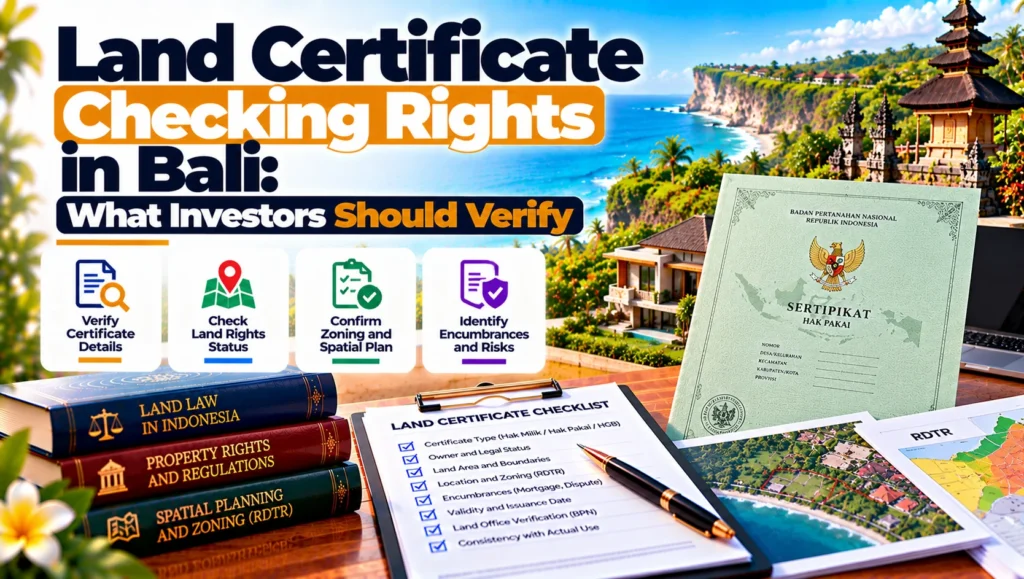
Land certificate discrepancies should be recorded as specific questions before a buyer or leaseholder relies on the documents. A difference in the holder’s name, parcel reference, stated area or supporting transaction file needs clarification. It does not, by itself, establish fraud or tell you which legal correction procedure applies.
This guide focuses on organizing and resolving a discrepancy file after an inconsistency has been found. The broader title-checking guide explains the initial review, while a property due diligence file also covers authority, access, intended use and the proposed contract.
Land Certificate Discrepancies: Describe the Exact Difference
Identify the two records that do not agree. Note their dates, sources and the field in question. A seller’s marketing description, a certificate copy and a measured site plan may describe different things; copying them into one comparison sheet does not make them equivalent evidence.
Preserve the documents in their original form. Record whether you have an original, a copy, a scan or an unverified summary. If the discrepancy appears only in a translation or transcription, retain the underlying Indonesian record for review.
Build a Discrepancy Register
| Issue | Evidence to collect | Question for the reviewer |
|---|---|---|
| Holder name | Certificate and relevant identity or corporate records | Are these records about the same person or entity? |
| Parcel reference | Certificate, survey or mapping records and the proposed agreement | Do all documents identify the same parcel? |
| Area or boundary | Available land records, site information and any survey evidence | Is the difference documentary, measurement-related or unresolved? |
| Document version | Dates, amendment history and source of each copy | Which record is current and how can it be verified? |
| Authority | Ownership evidence and representative documents | Who can provide clarification and authorize the proposed transaction? |
Distinguish a Document Question From a Rights Dispute
A spelling difference, an outdated copy and competing ownership claims should not be handled as the same issue. Start by asking what the available evidence actually establishes. Where the parties disagree about rights or an official record is in question, obtain appropriate professional guidance on the route for verification or correction.
The official ATR/BPN land-rights and registration framework is relevant background. It does not mean that every discrepancy can be corrected privately by changing a contract, or that a professional can promise the same result for every parcel.
Ask for Clarification Supported by Records
Send a focused question identifying the inconsistent field and the records being compared. Ask for the relevant current evidence rather than accepting an explanation that simply repeats the original claim. Record who supplied the answer and whether any independent or official verification is still required.
If a representative responds for the landholder, identify the capacity in which that person acts. A broker’s familiarity with a property does not establish authority to change official land records or commit the registered holder.
Keep the Finding Visible in the Transaction File
Connect each discrepancy to the proposed transaction decision. Explain whether it affects identification of the parcel, the counterparty, the claimed right or a condition being negotiated. Record the evidence still needed and who is responsible for obtaining it.
Where the parties discuss a condition, payment milestone or further document, obtain advice on suitable wording for the actual agreement. Do not treat an informal promise to correct a record later as proof that the correction is possible or complete.
Example: Different Parcel Details in a Proposed Lease
In a hypothetical lease review, the parcel reference in a draft agreement differs from the reference on the certificate copy supplied by the agent. The prospective tenant records both references and asks the landholder’s authorized representative to identify the parcel the lease is intended to cover.
The review file retains the original draft, the certificate copy and the response. It separately records any mapping or official verification needed. The agreement is not silently amended to the reference preferred by one party before the underlying difference is understood.
When Can the Discrepancy Be Closed?
Define the completion evidence at the start of the review. Depending on the issue, that may involve a reliable explanation supported by current records, an updated draft referring to verified information, or the outcome of an appropriate official procedure.
Mark a finding unresolved if the necessary evidence is unavailable. A reviewer should be able to see what remains uncertain, the practical implication and the decision the client made with that uncertainty. A neat document folder is not a substitute for a verified answer.
Conclusion
Resolving land certificate discrepancies starts with a clear comparison of records and ends with evidence appropriate to the issue. Preserve the originals, identify the authorized parties and keep the finding visible until the relevant clarification or procedure is complete.
FAQ land certificate discrepancies
Does a discrepancy prove that a certificate is false?
No. An inconsistency is a reason for investigation. Its cause and significance depend on the records and verification available.
Can changing the lease wording resolve an official record problem?
Changing a private draft does not itself change an official land record. Obtain advice on the underlying discrepancy and the appropriate verification or correction route.
Should an explanation from an agent be retained?
Yes, as part of the review history. Identify its source and distinguish it from the evidence or official confirmation needed to close the finding.
What if the parties cannot obtain the missing evidence?
Keep the issue open, record the uncertainty and discuss its effect on the proposed commitment with the appropriate professional before deciding how to proceed.
References & Sources
Record the discrepancy against the checks in the land certificate guide, then consider its meaning for the wider property due diligence review. If a preliminary or final sale deed is proposed, the PPJB and AJB comparison helps keep the contractual steps separate from registered-title evidence.
Discuss the Scope With Bali Legal ID
Contact Bali Legal ID about our notary and property documentation services to discuss the documents, unresolved questions and work required for your actual project. Ask for a defined scope and deliverables before accepting a proposal.
Read More: Professional Notary Services in Bali for Property, Business & Legal Documentation