
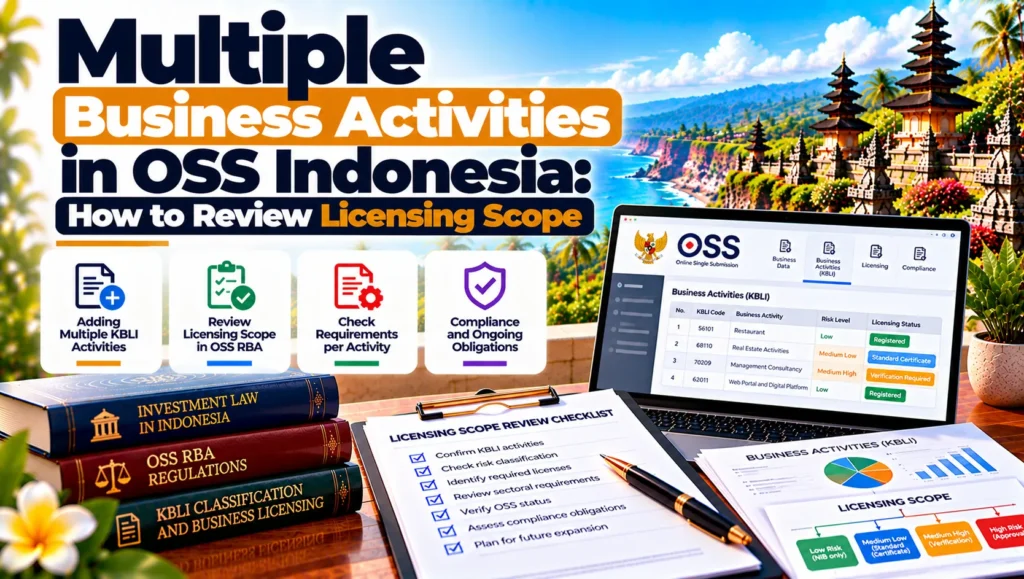
A company may plan multiple business activities under one legal entity, but it should not assume that a single OSS registration automatically establishes complete licensing coverage for every operation. Each distinct activity needs to be reviewed against the company’s registered information, applicable business classification, project details, and licensing outputs.
For businesses operating in Bali, the central question is not simply how many activities the company wants to list. It is whether the activities actually performed are accurately represented in the relevant corporate and OSS records, and whether any separate licensing conditions remain unresolved.
Can One Company Register Multiple Business Activities?
An Indonesian business may have more than one area of commercial activity, provided its proposed activities and legal structure satisfy the applicable requirements.
For planning purposes, owners should distinguish between the company’s legal identity, the economic activities it conducts, and the licensing status of those activities.
Consider a business that operates accommodation, provides property management services, and sells goods to customers. These functions may be related commercially, but their regulatory classification should not automatically be assumed identical.
A company name, general corporate purpose, or NIB cannot by itself answer every licensing question about these operations. The owner should establish what each activity actually involves before checking the applicable OSS record.
What the Current OSS Framework Covers
The official record for Government Regulation Number 28 of 2025 identifies business licensing, supporting business licensing, OSS services, and supervision as subjects within Indonesia’s risk-based licensing framework.
The government’s regulatory summary describes risk-based business licensing as an approach based on analyzing the risks of each business activity.
The official status record confirms that Government Regulation Number 28 of 2025 revoked Government Regulation Number 5 of 2021.
The official record for Minister of Investment and Downstreaming/BKPM Regulation Number 5 of 2025 describes procedures for risk-based business licensing and investment facilities through the Online Single Submission system.
The official regulatory summary confirms that the 2025 ministerial regulation revoked BKPM Regulations Numbers 3, 4, and 5 of 2021.
The earlier regulations should not be used to establish current administrative requirements without checking the applicable replacement framework.
These sources provide the national context for examining business activities. They do not establish that every KBLI, project scale or location has the same risk designation, supporting documents, or operating conditions.
Multiple Business Activities OSS Indonesia: The Scope Review
Start with the activities the company actually performs or intends to perform, rather than treating its existing list of KBLI codes as proof of licensing completeness.
The most useful output is an activity register showing the commercial work being performed, who performs it, where it occurs, and which licensing records appear relevant.
Identify Each Revenue-Producing Activity
Describe each product or service in ordinary language before assigning or checking its business classification.
For example, operating accommodation for guests differs from managing properties for third-party owners. Selling merchandise may represent another activity even where the sales are connected to the same hospitality business.
Ask how each activity generates revenue, who contracts with the customer, and who carries out the work. This can help distinguish a genuinely separate business line from an internal function supporting another business activity.
Do not assume that every ancillary task needs a separate KBLI. Equally, do not assume that commercially distinct services are covered by the classification of the principal activity. The applicable classification should follow the official description and the actual operating model.
Match Activities to KBLI and Operating Locations
Once the activities are described, compare them against the relevant current KBLI descriptions and existing OSS records.
For each activity, document the responsible legal entity, proposed or existing location, selected code, and available licensing output.
A company operating several sites should also distinguish an additional location from a completely new business activity. The correct administrative treatment depends on the recorded project information and the nature of the expansion.
Because the national framework evaluates the risks of business activities, owners should review the licensing position of each distinct activity rather than assume that a single general risk assessment covers every operation.
An owner should not substitute a code used by a competitor for a review of the company’s own actual activity and project details.
Review Principal and Supporting Licensing
The scope of Government Regulation Number 28 of 2025 separately identifies Perizinan Berusaha and Perizinan Berusaha untuk Menunjang Kegiatan Usaha, meaning principal business licensing and supporting business licensing are distinct subjects for review.
A multi-activity company should therefore consider both the licensing position of each principal activity and any supporting requirements associated with the relevant project.
Supporting requirements should not be inferred solely from the activity’s name. They may depend on sector rules, premises, location, operational arrangements, or other project characteristics.
The review should distinguish what has already been issued from what remains subject to verification or completion.
Activity-to-License Reconciliation Matrix
The following table can be used to compare a company’s actual business activities with its existing records before requesting any amendment or additional licensing review.
| Review element | Information to record | Review question |
|---|---|---|
| Business activity | Actual product or service | Is it a separate activity or part of an existing operation? |
| Operator | Legal entity conducting the activity | Does the relevant record identify the correct business operator? |
| KBLI | Current or proposed business classification | Does the code match the real economic activity? |
| Location | Business premises or project site | Is the relevant location reflected in the project records? |
| OSS evidence | Existing NIB and associated licensing outputs | What coverage and status do the records actually show? |
| Supporting requirements | Applicable additional permits or conditions | Which matters are completed or still require review? |
| Change category | Existing, additional, replaced or discontinued activity | What administrative question needs resolution? |
| Discrepancy status | Matched, incomplete, inconsistent or pending review | What evidence is needed to resolve the issue? |
The table is an internal reconciliation instrument rather than a government application form. Its value comes from identifying specific gaps instead of treating a valid NIB as a universal confirmation of all operating permissions.
Adding, Replacing or Discontinuing an Activity
Not every change to a company’s business activities involves the same administrative problem.
An existing activity is one already conducted or recorded by the company. The review should determine whether its description, project details, and available licensing evidence remain accurate.
An additional activity is a new commercial line proposed alongside existing activities. The company should assess whether it is supported by its corporate purposes and determine the applicable classification and licensing requirements.
A replacement activity occurs when the company intends to substitute a different activity for one already recorded. It should not be treated automatically as a routine correction of the company’s profile.
A discontinued activity is one the company no longer intends to conduct. The appropriate treatment of its existing licensing records should be assessed according to their status and the current official procedure.
For a more detailed explanation of how corporate and licensing changes interact, Bali Legal ID’s published guide to business setup changes and AHU versus OSS updates examines these administrative distinctions.
Before proceeding, document which of these four situations applies. That decision helps prevent an owner from applying instructions intended for a different type of change.
Bali Hospitality Example: Several Business Lines
Consider a hypothetical Bali company operating guest accommodation. It later proposes to manage villas owned by other investors, operate an independent restaurant, and sell merchandise.
The activities may share management personnel, premises, branding, or customer relationships. However, those commercial connections do not establish that the same activity classification or licensing result covers each line of business.
The company should first describe how each service is delivered. It should then determine who enters customer contracts, where the activity takes place, and which current business classification corresponds to its actual operations.
A restaurant open to external customers may raise different classification questions from food services that form part of an accommodation operation. Similarly, third-party property management needs to be distinguished from operating accommodation directly.
The published villa business licensing guide for Bali provides sector-specific context for reviewing accommodation operations and related regulatory questions.
The wider lesson is that the business model, rather than the number of brands or outlets, should determine the scope of the activity review.
How to Close Licensing Scope Gaps
Once the activity register is complete, classify the results into four practical categories.
A matched activity has a description and licensing record that appear consistent with the documented operation, subject to the applicable current requirements.
An incomplete activity has missing documentation or an unfinished administrative step. An inconsistent activity has information that does not clearly correspond to the actual operation. A pending review activity requires an interpretation or additional evidence before a conclusion can be reached.
For each unresolved item, record the proposed correction, supporting information, person responsible, and evidence of completion.
Where a change is needed, confirm the appropriate current OSS procedure rather than assuming that adding a code, replacing an activity, and removing an activity use identical functions.
After the relevant update or licensing step, compare the resulting official record with the original activity register. Confirm that the business operator, activity description, project information, and any identified supporting requirements have been reviewed.
Keep the completed register with the company’s administrative records. It can provide a useful baseline for subsequent expansion or regulatory review.
Conclusion
Reviewing multiple business activities in OSS requires more than counting KBLI codes or checking whether a company holds an NIB.
Owners should inventory the real activities, compare each activity with the applicable classification, examine its project and licensing records, and document any gaps before choosing an administrative procedure.
A structured activity-to-license review helps companies in Bali make better-informed decisions when operating several business lines, introducing additional services, or expanding to new locations.
Review Your Company’s Multiple OSS Business Activities
If your company conducts several business activities or plans to expand its operations in Bali, contact Bali Legal ID to discuss your existing business records, KBLI classifications, and OSS licensing scope.
A consultation can help identify which activity descriptions, licensing records, and proposed changes require further assessment before proceeding.
For help scoping the documents and next steps for your business or transaction, contact Bali Legal ID about our business setup services in Bali.
Read More: Business Setup Bali for PT PMA, PT PMDN & OSS RBA Registration
FAQ multiple business activities
Can one Indonesian company have several KBLI activities in OSS?
A company may undertake multiple business activities when its legal structure and the applicable conditions support those activities. Each proposed activity should be checked against the relevant classification and licensing requirements rather than assuming that one registration covers everything.
Does one NIB mean that all company activities are licensed?
Not automatically. The owner should review the activities and project information represented in the company’s OSS records, together with any associated licensing outputs or supporting requirements.
Does every additional service require another KBLI?
Not necessarily. The question depends on whether the service constitutes a separate economic activity under the applicable classification. Distinguish genuine new business lines from functions already included within another classified activity.
Is adding a KBLI the same as replacing an existing KBLI?
No. Adding an activity and replacing an existing activity are different situations. The applicable administrative procedure should be determined using current OSS guidance and the company’s existing licensing status.
Should a business review OSS records after opening another location?
Yes, a scope review is advisable. The company should compare the additional location, activities conducted there, and the relevant project information with its existing records before assuming the earlier licensing coverage applies.
References & Sources
- Government Regulation Number 28 of 2025 on Risk-Based Business Licensing — peraturan.bpk.go.id
- Minister of Investment and Downstreaming/BKPM Regulation Number 5 of 2025 on OSS Licensing Procedures — peraturan.bpk.go.id
Recommended Next Articles
- OSS RBA registration for Bali businesses — balilegalid.com
- understanding business changes involving AHU and OSS — balilegalid.com
- villa business licensing scope in Bali — balilegalid.com