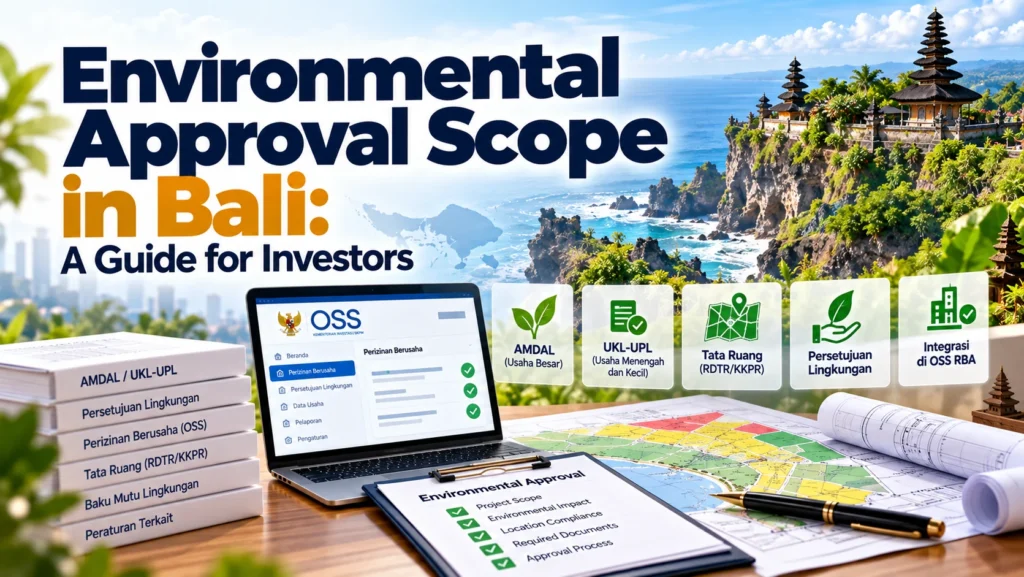
Environmental approval scope describes the activities, facilities, project boundaries, and potential environmental impacts that need to be considered when assessing a proposed business or development. For investors in Bali, the key question is not simply whether a property has an environmental document, but whether that document addresses the project actually being planned.
A villa development, restaurant, hospitality facility, or other commercial property may involve different activities and operating conditions. The appropriate documentation must be evaluated against the proposed project rather than assumed from its commercial description alone.
Indonesia’s environmental approval framework is addressed in Government Regulation No. 22 of 2021, which covers environmental approval and wider environmental protection and management requirements.
What Does Environmental Approval Scope Cover?
Environmental approval scope concerns the activities and environmental effects considered within the relevant assessment or documentation process.
For practical planning, an investor should identify:
- The exact location and boundaries of the proposed activity.
- The type of business or development being planned.
- The physical scale and facilities involved.
- Construction activities and their potential impacts.
- Operational requirements, including water, wastewater, waste, and other environmental considerations.
- Activities or supporting facilities that may fall outside an existing document.
A property’s physical boundary and the boundary of a proposed business activity are not necessarily the same. For example, a leased parcel might include a main building, parking area, access arrangements, and additional operational facilities.
A scope review should clarify which parts are actually included in the proposed activity and which require further assessment.
Understanding Environmental Documentation Pathways
Indonesia distinguishes environmental documentation according to the characteristics of the planned activity and the applicable regulatory classification.
The classification of activities requiring AMDAL, UKL-UPL, or SPPL is addressed by Minister of Environment and Forestry Regulation No. 4 of 2021, including its relevant activity lists.
| Documentation pathway | General function | Initial planning question |
|---|---|---|
| AMDAL | Assessment of activities with potentially significant environmental impacts | Does the proposed activity fall within an applicable AMDAL classification? |
| UKL-UPL | Environmental management and monitoring documentation for activities within its applicable category | What management and monitoring measures should the activity address? |
| SPPL | Statement of commitment to environmental management and monitoring for activities in its applicable category | Is the activity eligible for the SPPL pathway? |
The official activity-classification regulation distinguishes AMDAL, UKL-UPL, and SPPL pathways rather than applying one identical environmental document to every project.
The table explains the general distinction. It does not establish which category applies to a particular property.
AMDAL for Activities With Significant Environmental Impacts
AMDAL, or Analisis Mengenai Dampak Lingkungan Hidup, is the environmental impact assessment pathway associated with activities that may have significant environmental impacts under the applicable criteria.
Its function is broader than identifying individual pollution concerns. An assessment may need to consider the planned activity, affected environmental conditions, potential impacts, and proposed management and monitoring measures.
For investors, the practical issue is whether the assessed activities correspond to the actual development proposal.
A document describing one development configuration should not automatically be assumed to cover a materially different configuration.
UKL-UPL and SPPL for Other Activities
UKL-UPL refers to environmental management and monitoring efforts. SPPL is a statement of commitment to environmental management and monitoring.
These categories serve different regulatory functions and should not be treated as interchangeable documents.
For a reliable initial classification, compare the actual business activity, planned development scale, and site characteristics against the relevant environmental activity lists before assuming which documentation pathway applies.
Investors should avoid selecting a pathway solely because another business nearby uses that document type. Even apparently similar businesses may differ in activity, physical facilities, or environmental context.
Environmental Approval Scope vs. KKPR and Property Rights
Environmental approval, spatial planning compatibility, and land-use rights address different questions.
A project may require separate reviews of where an activity can take place, how the land may legally be used, and how the proposed activity’s environmental impacts should be assessed.
| Review area | Main question | Practical concern |
|---|---|---|
| Spatial planning and KKPR | Is the planned activity compatible with the relevant spatial planning framework? | Location suitability |
| Land rights or leasehold arrangements | What land-use rights and contractual permissions does the investor hold? | Legal and contractual authority |
| Environmental scope | What activities and environmental effects are covered by the environmental documentation? | Environmental assessment and management |
| Building documentation | What building-related requirements apply to the proposed development? | Building compliance |
These reviews interact, but they are not substitutes for one another.
A lease agreement may establish contractual rights between parties without determining the environmental documentation applicable to a commercial operation.
Similarly, a favorable preliminary location review should not be interpreted as proof that every environmental question has been resolved.
For Bali investors, checking these matters together can reveal inconsistencies before major construction or business commitments are made.
How to Define Your Project’s Environmental Scope
A useful scope review begins with the actual project rather than with an assumed document category.
1. Describe the intended activity. Identify what the business will do, which facilities it will operate, and whether construction is part of the proposal.
2. Establish the project boundary. Clarify the land parcels, buildings, access arrangements, utilities, and supporting facilities associated with the activity.
3. Confirm the scale. Prepare reliable information about the land area, buildings, proposed capacity, and other measurements relevant to the applicable activity classification.
4. Examine the environmental setting. Consider nearby land uses, drainage, wastewater arrangements, waste handling, and environmentally sensitive features that may affect project planning.
5. Review existing environmental documents. Where documents already exist, compare their described activities and locations with the new proposal. Check whether they relate to the same operator and development configuration.
6. Identify any differences. Record extensions, additional facilities, altered operations, or other changes that may warrant professional review.
7. Confirm the applicable documentation pathway. Use the relevant official activity classification and competent authority’s guidance rather than relying on general assumptions.
A written scope matrix can be helpful. List each facility or activity, its location, its intended function, and whether the existing documentation clearly addresses it.
Environmental Scope for Common Bali Property Projects
Different investment models raise different practical questions. The examples below illustrate assessment issues, not automatic legal classifications.
Villa or accommodation development. Review the proposed buildings, supporting facilities, wastewater arrangements, and operating model. A property intended for private occupation may need to be considered differently from a proposed commercial accommodation activity.
Restaurant development. Consider kitchen operations, wastewater, waste handling, ventilation, and additional facilities forming part of the business activity.
Hospitality or mixed-use property. Identify whether several activities share the same site, including accommodation, food service, events, or other commercial operations. Their combined project boundary may need particular attention.
Development on an existing leased property. Check whether the proposed operation differs from the activity described in existing documentation and whether the landlord’s documents are relevant to the tenant’s actual project.
These examples show why property descriptions alone provide an incomplete basis for environmental classification.
When Should Environmental Scope Be Reviewed Again?
A previously prepared environmental document should be reviewed whenever the proposed project changes in a way that may affect its assessed activities or impacts.
Practical review triggers include an increase in development scale, new facilities, a changed business activity, significant alterations to operating arrangements, or changes to environmental management infrastructure.
The environmental management framework also addresses supervision and enforcement of environmental obligations established during project planning.
This does not mean every minor operational adjustment automatically requires a replacement approval. The appropriate response depends on the nature of the change and the applicable provisions.
A sensible approach is to document the proposed change, compare it against the existing scope, and confirm whether an amendment or other regulatory step is necessary before implementation.
Environmental Due Diligence Before Signing a Lease
Environmental issues can create practical complications when investors commit to land before confirming the intended business use.
Before entering a substantial leasehold or development commitment, ask for the relevant property and project records available from the landowner or existing operator.
Then consider these questions:
- Is the proposed business activity clearly identified?
- Does the intended use align with the location and property documentation?
- Are existing environmental documents available, and what project do they describe?
- Are additional buildings or operational facilities planned?
- Who will be responsible under the proposed contract for preparing documents, managing environmental obligations, and addressing potential changes?
- What should happen contractually if the intended activity cannot proceed on the expected terms?
These questions provide a basis for legal and technical due diligence. They do not establish that an existing approval is transferable, sufficient, or applicable to a new operator.
For material investments, the lease and business planning process should allow environmental and location questions to be evaluated before irreversible commitments are made.
Conclusion
Environmental approval scope is fundamentally about matching environmental documentation to the real activities, facilities, scale, and impacts of a proposed project.
For Bali investors, the strongest starting point is a clear project description, a review of existing documents, and a careful distinction between environmental requirements, location compatibility, property rights, and building matters.
Because the national environmental framework includes environmental management, monitoring, supervision, and enforcement, investors should treat environmental documentation as part of continuing project governance rather than a one-time administrative exercise.
Review Your Bali Property and Business Licensing Plan
Uncertain whether your proposed development or business activity is consistent with the available property and licensing documentation? Bali Legal ID can be contacted for consultation about relevant property documentation and business licensing matters in Bali.
Describe your intended activity, location, and available documents when requesting a consultation so the appropriate next steps and any specialist environmental assessment needs can be discussed.
Read more: Agreement Deed vs Private Agreement
For help scoping the documents and next steps for your business or transaction, contact Bali Legal ID about our business setup services for company and licensing matters.
Read More: Bali Legal Service for Business, Property, Tax & Investment Solutions
FAQ environmental approval scope
Does every business in Bali need an AMDAL?
No. AMDAL is one environmental assessment pathway. Depending on the activity and applicable classification, another documentation pathway such as UKL-UPL or SPPL may apply. The particular requirement must be checked against the relevant regulations and project details.
Is environmental approval the same as KKPR?
No. Environmental approval concerns environmental assessment and management, while KKPR concerns the compatibility of an activity with the applicable spatial planning framework. One should not be assumed to replace the other.
Can a tenant rely on a landlord’s existing environmental document?
Not automatically. The document’s covered activities, location, responsible party, and current applicability should be examined. A proposed tenant’s business may differ from the activity originally documented.
Does expanding a villa or hospitality business require another environmental review?
An expansion can justify reassessing the existing environmental scope. Whether a formal amendment or different document is required depends on the proposed changes and applicable rules. An automatic requirement should not be assumed without checking those details.
What should investors prepare before requesting an environmental scope assessment?
Prepare a project description, site location and boundaries, planned facilities, development scale, proposed business activities, available property documents, and any existing environmental records. These materials help identify the questions that require technical or regulatory confirmation.