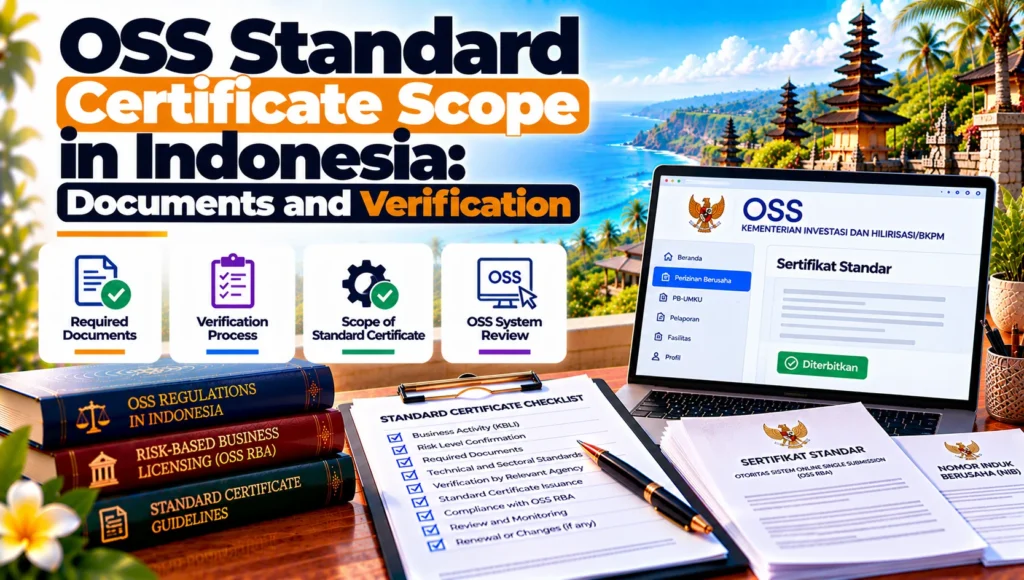
Standard certificate scope is a coverage question: compare the certificate with the actual activity, location, and operating conditions. The separate document-preparation guide explains how to assemble an OSS submission file.
An OSS Standard Certificate, officially known as Sertifikat Standar, is a business licensing document associated with activities covered by Indonesia’s risk-based licensing framework. Its practical significance depends on the registered business activity, the applicable risk classification, the certificate’s status, and the requirements relevant to that activity.
For business owners and investors in Bali, the essential question is not simply whether a Standard Certificate exists. It is whether the document corresponds to the business and project being evaluated and whether other required documents or verification steps remain outstanding.
A Standard Certificate should therefore be examined alongside the NIB, business activity information, project records, and any separate location, building, or sector-specific requirements.
What Is an OSS Standard Certificate?
A Sertifikat Standar is part of Indonesia’s risk-based business licensing system. It should be interpreted in connection with the business activity and licensing outcome shown through OSS, not as a general certificate proving that every part of a company or property is compliant.
An NIB identifies the registered business, while a Standard Certificate relates to applicable standards within the business licensing framework. Their exact roles and required combinations depend on the activity’s regulatory classification.
For this reason, an investor reviewing a business should distinguish the existence of an NIB, the presence of a Standard Certificate, the certificate’s documented status, and any other licensing or basic requirements associated with the proposed operation.
The certificate is particularly relevant when investigating whether the records relate to the activity that will actually be conducted rather than an earlier or different business plan.
Indonesia’s Current Risk-Based Licensing Framework
The official record for Government Regulation Number 28 of 2025 identifies basic requirements, business licensing, supporting business licenses, OSS services, supervision, and the handling of licensing obstacles within the risk-based licensing framework.
The official government summary of Government Regulation Number 28 of 2025 describes risk-based business licensing as an approach based on analysis of the risks associated with each business activity.
The BPK regulatory status record lists Government Regulation Number 28 of 2025 as applicable from 5 June 2025.
The same official regulatory history confirms that Government Regulation Number 28 of 2025 revoked Government Regulation Number 5 of 2021.
The official BKPM record for Ministerial Regulation Number 5 of 2025 identifies procedural guidance for risk-based business licensing and investment facilities through the Online Single Submission system.
The BKPM regulatory status page lists this ministerial regulation as applicable and records its promulgation on 2 October 2025.
The official BKPM regulatory history records the revocation of BKPM Regulations Numbers 3, 4, and 5 of 2021.
These sources provide the current general framework for reviewing OSS documents. A business should not rely exclusively on an older explanation that treats a revoked regulation as the operative authority for today’s licensing decisions.
Standard Certificate Scope: What Should Be Checked?
The most useful way to assess standard certificate scope is to examine the specific business activity and the documentary status rather than assume that one certificate covers all operations at a location.
Business Activities, KBLI, and Project Data
Start by identifying the registered company or individual, the relevant NIB, the KBLI business classification, the project location, and the activities the business intends to conduct.
Compare this information with the actual operation. A company may have several business activities, and their licensing outcomes should not automatically be treated as identical.
If the project has changed in scale, location, or activity, record that difference for review. A certificate issued for an earlier project description should not be assumed to describe a later business arrangement without checking the corresponding OSS information.
Where the activity is unclear, the first step is to establish the intended products or services and then investigate the classification and applicable licensing result.
Certificate Status and Verification
Next, review the certificate’s status and any associated conditions in the applicable OSS record.
A document may require the reader to distinguish its issuance from any verification or fulfillment process associated with the business activity. Do not infer completion merely because a downloadable document or registration number exists.
Where verification is relevant, identify the competent authority, the outstanding matter, and the evidence required under the rules applicable to the particular activity.
Likewise, do not assume that every Standard Certificate follows the same verification process. The correct interpretation depends on the business activity, applicable risk category, and current licensing requirements.
Supporting Requirements and Other Documents
A Standard Certificate is only one component of a broader business compliance review.
Depending on the project, additional questions may concern basic requirements, business-supporting licenses, location information, building documentation, or sector-specific operating conditions.
These matters should be distinguished rather than collapsed into a single certificate-status question.
For example, the fact that a company has an OSS licensing document does not, by itself, establish that its land lease is enforceable, that the proposed building use is appropriate, or that every separate project approval is complete.
The relevant evidence must be checked according to the issue it is intended to establish.
OSS Standard Certificate Review Matrix
The following matrix is a practical document-audit tool for determining which questions should be investigated when a Standard Certificate appears in a business licensing file. It is not an official licensing application form.
| Review item | What to examine | Question to resolve |
|---|---|---|
| Business identity | Registered business name and NIB | Does the document concern the business being reviewed? |
| Business activity | KBLI code and activity description | Does the registered activity match the actual operation? |
| Project location | Address and project information | Does the document relate to the intended location? |
| Risk classification | Risk level associated with the activity | Is the classification consistent with the current OSS result? |
| Standard Certificate | Document identity and recorded status | What does the certificate establish for this activity? |
| Verification | Applicable verification information | Is further verification relevant or outstanding? |
| Associated requirements | Document conditions and applicable standards | What evidence of fulfillment requires review? |
| Basic requirements | Relevant location and project documents | Are there separate requirements outside the certificate’s scope? |
| Supporting licenses | Any activity-specific additional licensing | Does the proposed business need other licensing records? |
| Changes in operations | Actual activities compared with registered data | Should changes be evaluated through the appropriate official process? |
A satisfactory answer to one row does not automatically resolve the others. The objective is to understand what the certificate covers and to identify which additional records should be examined before a decision is made.
What Does a Standard Certificate Not Prove?
A Standard Certificate should not be used as a substitute for evidence addressing a different legal or administrative question.
Land rights: A certificate concerning business licensing does not independently establish ownership of land, the validity of a lease, or authority to enter into a property transaction.
Property boundaries and access: It does not conclusively establish the boundaries of a parcel or the legal basis for using a road across neighboring property.
Building documentation: It should not be treated as automatic confirmation that every building-related document has been issued or that all conditions for the intended physical use have been satisfied.
Every business activity: An enterprise may conduct activities with different licensing characteristics. A document associated with one registered activity should not automatically be applied to another.
Continuing compliance: An issued document is not a substitute for examining applicable conditions, subsequent changes, or any relevant continuing obligations.
These distinctions matter for property investors because the right to use a property, the suitability of a building, and authorization to operate a business involve different evidence.
Bali Hospitality Investment Example
Consider a hypothetical investor evaluating an existing hospitality business in Bali.
The seller provides an NIB and a Standard Certificate, explaining that the documents show the business is ready to operate.
The investor should begin by comparing the documents with the business currently being offered. Is the operating company the same entity shown in the records? Does the registered activity correspond to the services actually provided? Is the project location consistent with the proposed investment?
Next, the investor should review the Standard Certificate status and investigate whether any relevant verification, conditions, or other documentary requirements remain outstanding.
A separate property assessment may also be necessary. If the operation uses leased land, the lease and landholder authority require their own review. If the project involves a commercial building, the relevant building and project documentation should be examined independently.
The appropriate conclusion is not automatically that the business is compliant or noncompliant. It is that each material question requires evidence corresponding to the issue under examination.
This illustration does not assign a particular risk category to a villa, hotel, restaurant, or other hospitality activity. The relevant classification must be established from the actual business activity and applicable current rules.
How to Prepare a Standard Certificate Document Audit
A structured review can begin with a copy of the certificate and the corresponding current OSS information.
First, identify the business and activity. Record the NIB, company identity, KBLI, project location, and business description.
Second, establish the intended operation. Write down what the business will actually do and note any differences from the registered information.
Third, examine the certificate status. Review the document’s recorded condition and identify any outstanding verification or compliance questions that apply to the activity.
Fourth, separate other legal documents. Organize land, building, business-supporting licensing, and company records into distinct categories rather than treating the Standard Certificate as a universal approval.
Fifth, identify unresolved issues. List the missing evidence, the question it should answer, and the appropriate official or professional review channel.
Finally, review the result. Any correction or additional documentation should be assessed against the current licensing record rather than assuming that a single change resolves every outstanding requirement.
This method helps the business maintain a clearer record of what has been established and what remains subject to review.
For each activity under review, compare the available evidence with the Standard Certificate document checklist. Check the separate sector business licensing scope when deciding which activity-specific licensing questions still need an answer.
Conclusion
Standard Certificate scope under Indonesia’s OSS system must be understood in connection with the actual business activity, risk classification, project information, document status, and applicable requirements.
For Bali business owners and investors, the central task is to confirm that the certificate corresponds to the intended operation and to distinguish its licensing function from land, building, contractual, and other compliance questions.
A careful document audit supports more informed decisions without assuming that possession of one certificate establishes complete legal readiness for an entire project.
Read the Standard Certificate document checklist alongside the guide to interpreting OSS licensing results by KBLI to connect the certificate scope with the evidence and licensing output for the actual activity.
Review Your OSS Standard Certificate and Business Documents
If you are reviewing an OSS Standard Certificate, preparing an NIB registration, or examining business licensing documents for an investment in Bali, contact Bali Legal ID to discuss the business activities, project information, and outstanding documentation questions.
A consultation can help clarify the scope of an OSS registration review and identify which records require further examination before proceeding.
For help scoping the documents and next steps for your business or transaction, contact Bali Legal ID about our business setup services in Bali.
Read More: Business Setup Bali for PT PMA, PT PMDN & OSS RBA Registration
FAQ standard certificate scope
What is the purpose of a Standard Certificate in OSS?
A Sertifikat Standar relates to standards applicable to a business activity under Indonesia’s risk-based business licensing framework. Its practical effect should be assessed against the registered activity, its risk classification, recorded status, and current requirements.
Is an NIB the same as a Standard Certificate?
No. An NIB and a Sertifikat Standar serve different functions in business licensing. A business should examine the applicable OSS licensing outcome to determine which documents are relevant to its particular activity.
Does every Standard Certificate require the same verification process?
No universal verification process should be assumed. The relevant requirements depend on the business activity, risk classification, and current licensing rules. Review the status recorded through OSS and any applicable conditions.
Which documents should be checked together with a Standard Certificate?
Start with the NIB, KBLI activity information, project details, certificate status, and relevant supporting requirements. Depending on the transaction, separate land, building, company, and additional licensing documents may also require review.
Does a Standard Certificate prove that a villa or commercial property in Bali is legally ready for operation?
Not by itself. The certificate should be examined in relation to the actual business activity, while land rights, building documentation, location requirements, and any other relevant licensing questions require separate evidence.
What should I do if the Standard Certificate information does not match the actual business?
Document the discrepancy, compare the business activity and project information with the applicable OSS records, and investigate the correct official procedure before making changes. Avoid choosing a different KBLI or risk level simply to obtain a more convenient licensing outcome.