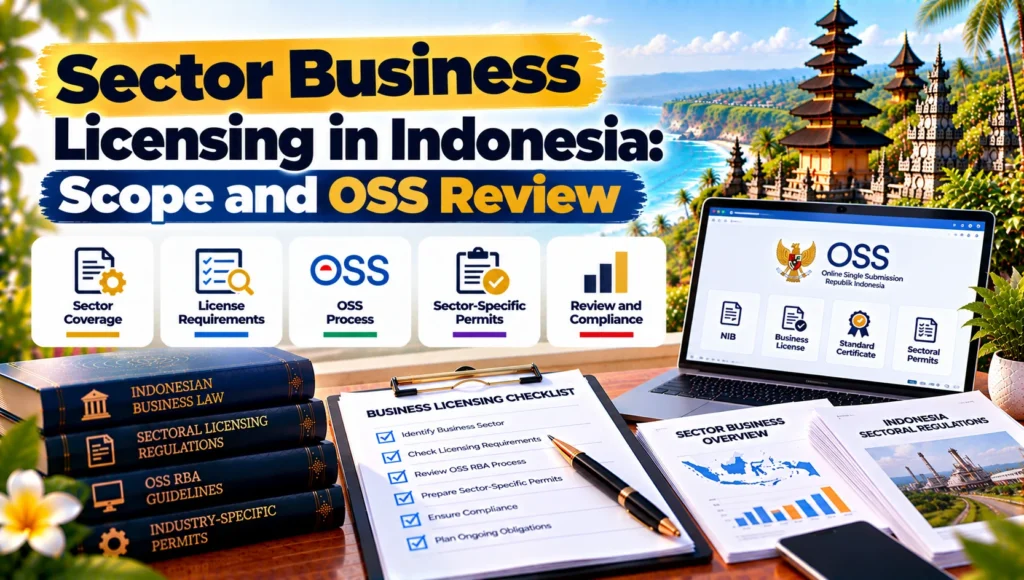
Sector business licensing should be reviewed against the specific activity, location, project characteristics, and supporting requirements rather than assumed from an NIB alone.
A sector business license scope review asks which activities a company intends to perform, what its existing OSS records actually cover, and whether sector-specific authorization needs further examination. The answer cannot be established from the company name or NIB alone.
For business owners and investors in Indonesia, including Bali, the practical objective is to connect the real activity with its KBLI classification, risk-based licensing result, relevant sector, business location, and any supporting permissions. These are related questions, but each requires its own evidence.
What Does Sector Business License Scope Mean?
A business may be incorporated to pursue several commercial activities. That corporate purpose is not necessarily identical to the scope established by its licensing records.
Sector business licensing refers to the regulatory treatment of activities associated with a particular field, such as tourism, health, food-related operations, transportation, trade, or industry.
The key distinction is between the activity the business performs, the licensing outcome that applies to it, and any additional authorization relevant to particular operations.
For example, a hospitality operator might provide accommodation, food services, or another separately identifiable service. A single commercial brand does not establish that every component has the same KBLI, risk classification, or supporting requirements.
The appropriate assessment begins with the activities themselves, not with an assumption that one registration document covers every future expansion.
The Current Indonesian Licensing Framework
The official legal documentation record for Government Regulation Number 28 of 2025 identifies it as applicable and records its revocation of Government Regulation Number 5 of 2021.
The Ministry of Finance regulatory history independently records that Government Regulation Number 28 of 2025 took effect on 5 June 2025 and revoked Government Regulation Number 5 of 2021.
The official Ministry of Finance record for Government Regulation Number 5 of 2021 confirms that the earlier regulation ceased to apply on 5 June 2025 and identifies Government Regulation Number 28 of 2025 as its replacement.
Government Regulation Number 28 of 2025 is therefore the identified successor in Indonesia’s national risk-based business licensing framework. Government Regulation Number 5 of 2021 is historical legislation, and its former requirements or procedures should not be treated as current authority for a new licensing assessment.
These official records establish the national regulatory framework. They do not, by themselves, determine the exact risk level, supporting permit, technical standard, or application procedure for an unidentified project.
A project-specific decision requires the applicable current activity and sector information together with the actual OSS record.
Sector Business License Scope: Five Layers to Review
A practical sector business license scope review can be organized into five layers: the actual activity, the KBLI classification, the OSS licensing outcome, sector-specific supporting authorization, and relevant business location information.
Business Activity and KBLI
Begin by describing the goods or services that the company actually provides or plans to provide.
Include how the activity operates, who receives the product or service, whether production or service delivery occurs at a fixed location, and whether additional independently identifiable activities exist.
Compare that description with the current official KBLI categories. Selecting a code merely because its title resembles the brand or business name can obscure differences in the underlying activity.
Where a business has several activities, each genuine activity should be assessed on its own scope. This does not mean that every service variation automatically requires a different company or a separate permit.
OSS Licensing Outcome
Next, examine the actual NIB and any associated business licensing documents or statuses available for the project.
Identify the company, activity classification, project location, and details reflected in the relevant records. Determine whether the document is a registration record, a licensing output, or another form of administrative evidence.
Do not assume that an NIB proves that every supporting operational requirement has been satisfied. Equally, do not assume an additional license is required simply because the business operates in a regulated sector.
The relevant question is what the current licensing information establishes for that activity and project.
Sector-Specific Supporting Authorizations
Some business activities involve additional sector-specific authorization questions beyond the initial company or activity registration.
The official OSS PB UMKU directory is a government portal for supporting business authorizations. Its sector listings may help readers investigate authorization categories relating to health, food and drugs, tourism, trade, industry, transportation, agriculture, and other regulated areas, although the live directory details were not fully accessible during this review.
PB UMKU is the OSS label for Perizinan Berusaha Untuk Menunjang Kegiatan Usaha, or business licensing to support business activities.
The OSS supporting-license directory may provide related KBLI information and service availability, but the current entries and their applicability must be checked directly for the particular activity.
A directory listing is a starting point for determining relevance. It should not be treated as proof that every company in a displayed sector must obtain every listed authorization, or that a particular permit has already been granted.
For a real project, identify which listed activity or supporting authorization applies and confirm its present requirements through the relevant official authority and actual OSS process.
Business Location and Operating Conditions
The fourth practical consideration is where and how the business will operate.
A business may have a valid agreement to occupy premises while its intended commercial activity still raises licensing or technical questions. Conversely, a recorded business activity does not prove that the company has an enforceable right to use a particular property.
Review the relevant site information, contractual use, intended operating arrangements, and any location-specific conditions that may affect the project.
Record Consistency
Finally, compare the corporate purpose, recorded business activities, project details, and licensing outputs with the work that will actually take place.
Inconsistencies do not automatically establish a violation. They identify questions requiring closer examination before the company relies on its existing documents for a new service or project.
Licensing Scope and Evidence Matrix
The following matrix helps a business owner distinguish the main records from the question each record can answer. It is an editorial review aid rather than a mandatory official document checklist.
| Review area | Evidence to examine | Main question |
|---|---|---|
| Company identity | Current corporate records and available AHU information | Which legal entity is operating? |
| Actual activity | Operational description, products and services | What does the business really do? |
| KBLI classification | Current official activity description and recorded KBLI | Does the classification match the activity? |
| NIB and OSS licensing | Actual registration and licensing outputs | What has been recorded or authorized? |
| Sector-specific licensing | Relevant OSS PB UMKU entries and applicable sector guidance | Is another supporting authorization relevant? |
| Project location | Site information, lease or occupancy records | Does the intended operation fit the available location evidence? |
| Operational conditions | Available technical and supporting documents | What unresolved conditions require verification? |
| Business expansion | Existing and proposed activity records | What has changed, and which records may need review? |
The matrix is most useful when the result of each review is recorded as confirmed, incomplete, conflicting, or requiring official clarification. It should not be used to declare a project compliant solely because a particular document is present.
Does an Existing NIB Cover a New Activity?
An existing NIB should not automatically be treated as covering a business expansion that changes what the company actually does.
Consider a company that initially operates one type of commercial service and later adds a separate activity. The company should compare its new operating model with its current corporate purpose, KBLI entries, project details, and relevant licensing records.
A change may involve a new activity classification, updated project data, further supporting authorization, or another form of review. The applicable treatment depends on the exact activity and current rules.
A business should therefore avoid two opposite assumptions: that every expansion requires establishing a new legal entity, or that an existing NIB authorizes every additional service under the same commercial brand.
Where the classification or applicable authorization remains uncertain, seek confirmation using the official activity description and the company’s actual OSS information before making an irreversible commitment.
Location and Sector Licensing Are Different Questions
Businesses operating from leased premises may need to distinguish their property arrangements from their licensing status.
A lease agreement can document the parties’ contractual arrangements concerning the use of a site. It does not, by itself, establish that a proposed regulated activity is approved at that location.
Similarly, an OSS record or sector authorization should not be treated as evidence that the company owns the land or possesses every contractual right needed to operate there.
For a Bali investor, these questions may arise when reviewing hospitality premises, a restaurant site, business facilities, or another proposed commercial location.
The practical method is to compare the specific business activity, site arrangement, relevant project information, and any required official checks separately.
This is particularly important when the operation changes: a new production facility, additional service location, or materially different use can raise questions not resolved by documents prepared for the original business.
Example: A Bali Hospitality Business
Consider a hypothetical PT planning to operate a hospitality business in Bali.
The company has corporate registration documents and an NIB. It intends to use leased premises and later considers adding a food-service activity and another service involving a different sector.
The first step is to identify the activities separately. The company describes its existing accommodation business and the additional proposed services rather than assuming that every service is included in one classification.
The second step is to compare the activities with current official KBLI descriptions and the company’s recorded OSS details.
The third step is to examine the relevant licensing outputs. If a proposed service involves sector-specific supporting authorization, the company identifies the applicable official category and checks whether further evidence or action is necessary.
The fourth step is to review the premises. The lease and project location information should be checked against the intended use and any relevant official conditions.
Only after these reviews can the company form a more reliable view of what additional work may be needed.
This example is hypothetical. It does not mean that a specific Bali hospitality business must obtain an unidentified certificate or that any actual site or business activity has already been approved.
How to Organize a Licensing Scope Review
Start with a concise description of the existing business and every proposed additional activity.
Record the company’s current KBLI information, relevant NIB details, project locations, and available business licensing outputs. Distinguish records that are final from applications, drafts, or data still requiring confirmation.
For each activity, determine which official classification and sector information should be examined. Where relevant, check the OSS PB UMKU directory and the responsible sector authority for current supporting authorization information.
Identify inconsistencies between the company’s intended operations and recorded information. Prioritize material gaps that may affect signing a contract, making a substantial investment, starting a new service, or relying on an existing authorization.
Finally, prepare a short review outcome describing what is established, what has not been verified, which additional documents may be relevant, and which questions need professional or official confirmation.
The result should be an evidence-based plan rather than an unsupported statement that the company either needs every sector permit or needs none.
Place the sector review within the workflow described in the OSS RBA registration guide. Then compare the activity-level result using the guide to OSS licensing requirements by KBLI, retaining questions that require confirmation for the actual project.
Conclusion
Sector business licensing in Indonesia should be reviewed according to the actual business activity, its KBLI classification, the relevant OSS licensing result, and any supporting sector-specific authorization that applies.
Government Regulation Number 28 of 2025 provides the current national risk-based business licensing framework, while the OSS PB UMKU directory helps identify categories of supporting business authorization for further examination.
For a business owner or investor in Bali, the appropriate next step is to reconcile the company’s recorded activities, operational plans, location information, and available licensing evidence. A sector authorization should be treated as relevant only when its applicability to the specific activity and project has been established.
Review the Licensing Scope of Your Business in Bali
If you are establishing or expanding a business in Bali and need to review KBLI activities, NIB OSS RBA information, or possible sector-specific licensing questions, contact Bali Legal ID to discuss the proposed activities and available company records.
A business setup and licensing consultation can help identify which existing documents, classifications, sector requirements, and unresolved project questions deserve further review.
Read More: Business Setup Bali for PT PMA, PT PMDN & OSS RBA Registration
Discuss the scope and supporting records with Bali Legal ID through our business setup services before deciding the next step for your Bali business or transaction.
FAQ sector business licensing
What does sector business license scope mean in Indonesia?
It concerns the actual business activity, the relevant classification and licensing result, and any additional authorization applicable to that activity or sector. The company’s name or NIB alone may not answer every question about operating scope.
Does every sector require an additional permit?
No universal conclusion should be drawn for every business. Whether a supporting authorization is relevant depends on the actual activity, its applicable classification, sector requirements, and project circumstances.
What is PB UMKU?
PB UMKU stands for Perizinan Berusaha Untuk Menunjang Kegiatan Usaha, referring to business licensing that supports business activities. The official OSS portal provides a sector-based directory of such authorization categories.
Does an NIB prove that all sector licenses are complete?
Not automatically. The NIB should be considered alongside the actual project licensing outputs and any supporting requirements relevant to the activity. The current documents must be reviewed to determine what has been completed.
Can one company carry out activities in several sectors?
That depends on its corporate documents, the actual activities, relevant investment conditions, and licensing requirements. Multiple business activities should be assessed individually rather than assumed to have identical regulatory treatment.
Does a valid land lease prove that a business activity is licensed?
No. A lease concerns contractual rights to use premises, while licensing concerns the administrative status of a particular business activity or project. Both may need separate examination.
Which regulation replaced Government Regulation Number 5 of 2021?
Government Regulation Number 28 of 2025 replaced Government Regulation Number 5 of 2021 in the national risk-based business licensing framework. The successor regulation took effect on 5 June 2025, according to the official government legal documentation records.
References & Sources
- Government Regulation Number 28 of 2025 on Risk-Based Business Licensing — jdih.komdigi.go.id
- Ministry of Finance Regulatory Status of Government Regulation Number 28 of 2025 — jdih.kemenkeu.go.id
- OSS: Business Licensing to Support Business Activities — oss.go.id
- Official Status History of Government Regulation Number 5 of 2021 — jdih.kemenkeu.go.id