
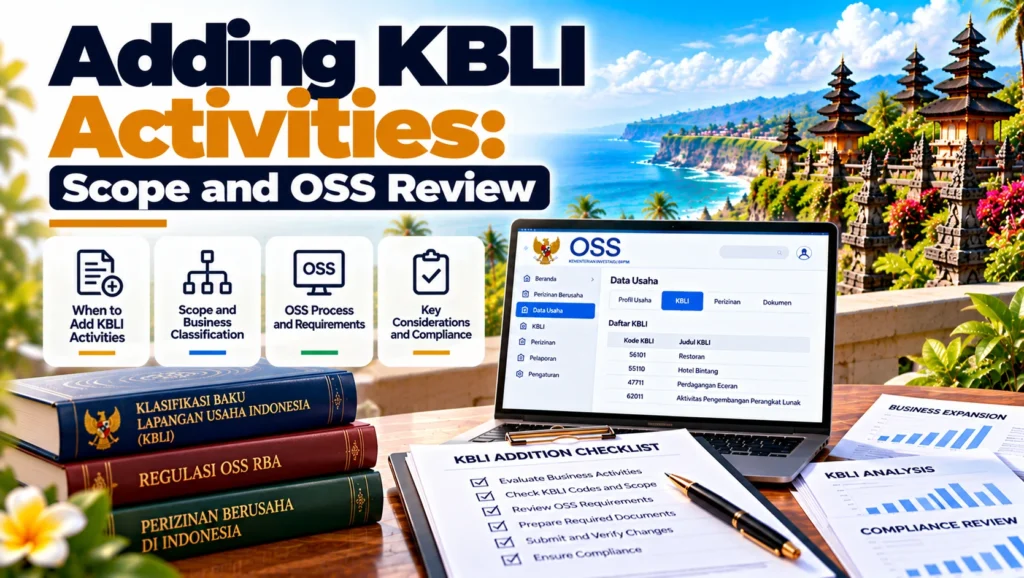
An additional KBLI scope assessment asks whether the proposed service is a distinct revenue activity, an extension of the current business, or an internal supporting function. This is a pre-filing decision guide; the separate registration article explains how to add a new KBLI.
Adding another KBLI activity to an existing Indonesian business should begin with a review of the proposed economic activity, not simply the selection of another code in OSS. A company must first determine whether it is entering a genuinely new business line, extending an existing activity or changing information associated with operations it already conducts.
The purpose of reviewing adding KBLI activities scope is to establish what the proposed activity involves, how it relates to the company’s current business and which corporate or licensing records may need attention.
For an existing PT PMA or PT PMDN operating in Bali, this distinction can help avoid treating every new service, product or business location as an identical registration change.
Additional KBLI Scope Assessment: Define the New Revenue Activity
A business should assess an additional KBLI when it plans to carry out an economic activity that may not be represented by its existing registered classifications.
The first question is not how many codes the company wants. It is whether the proposed activity is economically distinct from the activities already conducted and registered.
For example, an established consulting company considering an independently operated accommodation business is dealing with a different scope question from a consulting company introducing another variation of its existing advisory services.
Similarly, a hospitality company opening another operating location may need to review its location and licensing information without necessarily concluding that it must select a completely different economic classification.
The official OSS guide to adding business activities and using the location map confirms that the government portal provides guidance specifically for businesses adding activities.
The existence of that workflow does not, by itself, determine whether any particular proposed activity qualifies for addition or whether other company records also require amendment.
How to Define the Scope of an Additional Activity
Before choosing another KBLI, describe the proposed operation in terms that explain what the company will do in practice.
A useful business description identifies the product or service, the customers, the business operator, the operating location and whether the activity is commercially independent of the company’s existing services.
Avoid descriptions that are too broad to distinguish the activity, such as general trading, hospitality or consulting. These labels may cover different economic functions.
New Economic Activity or Extension of an Existing Service?
Begin by asking whether the proposed service represents a distinct economic output or remains part of the company’s existing activity.
A business may change its service packages, customer segments or internal processes without necessarily introducing a different classification. In other circumstances, it may begin providing a commercially separate service that warrants an additional KBLI assessment.
The review should examine actual operations rather than rely on the company’s preferred marketing description.
A practical initial assessment asks:
- What new goods or services will the company provide?
- Who will purchase or use them?
- How will the company earn revenue from the activity?
- Is the activity already represented in the company’s current KBLI descriptions?
- Will the activity operate at the same location or another project site?
These are practical decision questions, not a statutory test guaranteeing that another KBLI is or is not required.
Products, Services and Business Locations
A business activity, its products or services and its operating location are related but different pieces of information.
An existing company may add a product within its current commercial activity, open another business location or enter an entirely different field of operation.
The appropriate administrative review depends on what actually changes.
For example, opening a second operating site may require a location-specific assessment. It should not automatically be described as a new economic activity merely because the location is different.
Likewise, a new product name does not necessarily establish that a different classification is appropriate.
KBLI Activity Addition Decision Matrix
The following table helps businesses identify the first question to resolve before making changes in OSS. It is a planning aid, not a substitute for the official classification and licensing outcome.
| Proposed business change | Initial scope assessment | Records to examine |
|---|---|---|
| Introduce an independently provided service | Determine whether the service belongs to another economic activity | Existing KBLI, company purposes and OSS licensing |
| Add a new product to an existing business | Compare the product and activity descriptions | Current activity classification and registered products |
| Open a second location for the same activity | Examine project and location information | Existing OSS business locations and relevant location requirements |
| Expand into another industry | Assess a genuinely new business activity | Company deed, AHU records, KBLI and OSS |
| Correct an inaccurately described existing activity | Distinguish correction from a new registration | Current corporate and OSS records |
| Begin a new service that supports the original business | Determine whether it is independently provided or only internal support | Operating model and relevant KBLI descriptions |
The main implication is that different operational changes can require different administrative responses. The company should identify the exact nature of the change before deciding which registration or amendment process is appropriate.
Review Company Purposes Before Updating OSS
For an existing PT, it is useful to compare proposed economic activities with the purposes and objectives recorded in the company’s latest articles of association.
If the proposed new activity does not appear to fit the existing corporate purpose, the company should obtain a case-specific review of whether its articles require amendment and which currently applicable corporate procedure should be followed.
This is a document-reconciliation recommendation, not a determination that every added KBLI requires ministerial approval or that an older AHU administrative FAQ establishes the full current legal procedure.
Adding an activity in OSS and reviewing the articles of association are different administrative matters. A company should not assume that every KBLI addition automatically requires an AHU amendment, or that changing OSS records itself changes the company’s deed.
The practical approach is to compare the proposed activity with the current articles of association, any later corporate amendments and the existing licensing information.
If a formal corporate amendment is found to be necessary, confirm the applicable shareholder decision, notarial documentation and AHU procedure with the responsible professional and current official guidance before proceeding.
What Documents Should Be Reviewed?
A company preparing to expand into another activity benefits from gathering its existing records before making changes to business registration information.
The following table identifies materials useful for an internal review. It does not represent a universal list of mandatory uploads for every OSS application.
| Document or information | Why it matters |
|---|---|
| Current articles of association and deed amendments | Establish the company’s documented corporate purposes |
| Latest relevant AHU outputs | Identify the existing registered corporate position |
| Existing NIB and OSS activity records | Confirm currently registered activities |
| Written description of the proposed activity | Explain the new commercial operation |
| Relevant KBLI descriptions | Compare the proposed activity with the classification scope |
| Current and proposed operating locations | Identify project or location-related changes |
| Existing business licensing results | Identify licensing conditions that may affect expansion |
| Relevant operational and investment information | Prepare accurate business information for further review |
The company should reconcile discrepancies identified through this review before treating an activity addition as ready to implement. The actual documentary requirements must be confirmed through the applicable current OSS process and any relevant corporate or sectoral procedure.
Examples of Business Expansion in Bali
The following hypothetical situations show how the initial scope assessment can lead to different questions.
A consulting company begins operating accommodation. The company should assess whether accommodation represents an additional economic activity, review whether its current corporate purpose covers the new business and examine the applicable OSS licensing position.
A villa operator adds another property under the same operating model. The company should first review its registered activity, operating arrangements and the new location. It should not assume that an additional property always means an entirely different KBLI classification.
A hospitality business opens a separate restaurant. The company should examine whether the restaurant constitutes another economic activity requiring classification review, while also checking relevant licensing information and whether the existing corporate documents accommodate the operation.
These examples are not determinations that a particular KBLI or license is required. The applicable classification, corporate position and sector-specific requirements depend on the actual circumstances.
For businesses operating villas or other accommodation in Bali, the Bali Legal ID guide to KBLI selection for villa rental and hospitality provides a narrower discussion of classification questions within that sector.
Define the proposed activity using the KBLI selection scope before deciding whether to change the company’s registration. If the assessment supports an additional activity, follow the separate process for adding a new KBLI.
Conclusion
Adding KBLI activities to an existing Indonesian business is a matter of accurately identifying the new economic activity and understanding how it relates to the company’s current registration and licensing position.
Begin by distinguishing a new business line from changes to products, internal functions or locations. Then compare the proposed activity with the current classification, corporate purposes and applicable OSS requirements.
A consistent review of documents and licensing outputs provides a stronger basis for expansion than selecting an additional code without understanding its operational and administrative implications.
Review Your Proposed KBLI Activity Addition
Planning to expand an existing PT PMA or PT PMDN into another business activity? Bali Legal ID can be contacted for a consultation about your intended activities, current company documents and OSS registration questions.
Discuss the proposed expansion and any related NIB OSS RBA registration or corporate-document concerns before proceeding with the relevant administrative changes.
For help scoping the documents and next steps for your business or transaction, contact Bali Legal ID about our business setup services in Bali.
Read More: Business Setup Bali for PT PMA, PT PMDN & OSS RBA Registration
FAQ additional KBLI scope assessment
Can an existing Indonesian company add another KBLI activity?
An existing company can review and seek to register additional business activities through the applicable OSS process. Whether a particular addition is appropriate depends on the actual activity, company documents and current licensing requirements.
Does adding another product always require a new KBLI?
No automatic conclusion should be drawn from a new product alone. Compare the product and the commercial activity with the scope of the company’s existing classification and assess whether a genuinely different economic activity is involved.
Does adding a KBLI require an AHU amendment?
Not in every case. A separate corporate amendment review is appropriate when the proposed activity may change the purposes and objectives in the articles of association. The company’s existing documents and applicable legal requirements should determine whether that procedure is necessary.
Is adding an activity the same as opening another location?
Not necessarily. A new location and a new economic activity concern different types of business information. A company may need to review location-specific requirements without changing the fundamental classification of its existing activity.
Does adding an activity in OSS mean it is ready to operate?
The recorded activity must be assessed together with its applicable licensing status and conditions. A classification entry alone should not be treated as proof that every requirement for the intended operation has been fulfilled.
References & Sources
- OSS Guide to Adding Business Activities and Using the Location Map — oss.go.id
- Government Regulation No. 28 of 2025 on Risk-Based Business Licensing — peraturan.bpk.go.id
- Minister of Investment and Downstreaming Regulation No. 5 of 2025 on OSS Licensing Procedures — jdih.bkpm.go.id
Recommended Next Articles
- KBLI selection for villa rental and hospitality businesses in Bali — balilegalid.com