
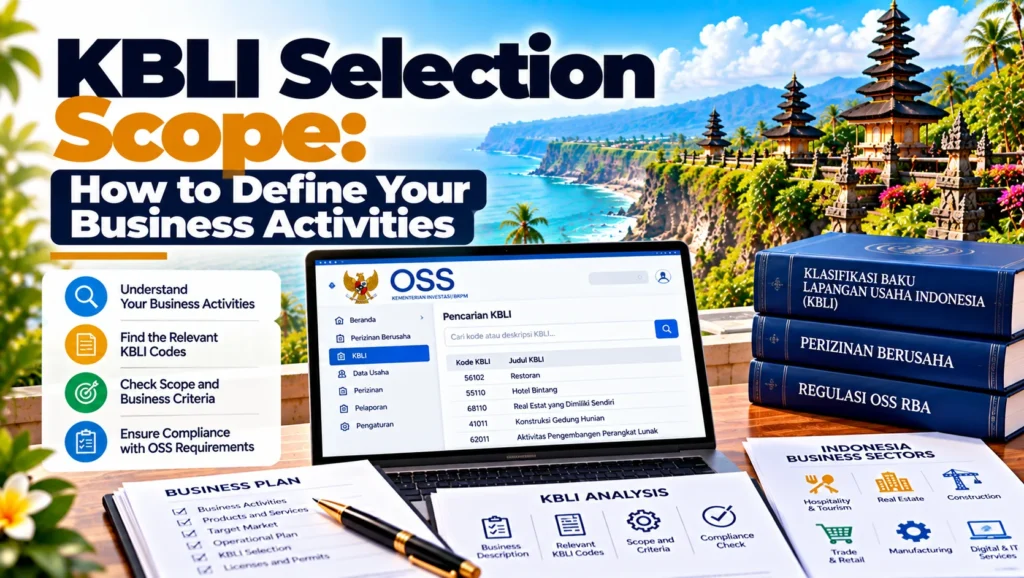
Choosing a KBLI classification begins with understanding what a business actually does. A company name, marketing description or broad corporate purpose is not enough to determine whether one business activity classification is suitable or whether several activities need separate assessment.
KBLI selection scope refers to the boundaries of the economic activities that a business intends to conduct and the classifications that best describe those activities. The review should consider the actual services or products, the operator’s role, revenue sources and how each activity will be conducted.
For business owners and investors in Bali, this assessment should take place before relying on a particular KBLI code, establishing a new operating model or adding activities to an existing OSS registration.
What Does KBLI Selection Scope Mean?
KBLI, or Klasifikasi Baku Lapangan Usaha Indonesia, is Indonesia’s standardized classification of economic activities.
Indonesia’s official economic activity classification is established through the BPS regulatory framework for KBLI 2025, which provides the updated national classification under BPS Regulation No. 7 of 2025.
The scope assessment asks what each activity involves, who performs it and whether the activity falls within the description and boundaries of the proposed classification.
For example, a company that owns accommodation property, operates lodging services and manages reservations for other property owners may be performing different economic functions. Those activities should not automatically be treated as equivalent merely because they operate within the hospitality sector.
The objective is not to collect as many codes as possible. It is to identify classifications that accurately reflect the business operations being undertaken or genuinely planned.
How KBLI 2025 Affects Activity Classification
KBLI 2025 updates the national classification framework previously represented by KBLI 2020.
The official BPS legal database records the regulation as applicable and identifies December 17, 2025 as its effective date.
Businesses reviewing classifications from older company records should compare those entries with the applicable KBLI 2025 categories and the classification information currently available in OSS.
Do not assume that a code retained in an old document always has identical coverage under the updated classification. A transition review should compare the activity description and relevant category, not just the numeric code.
Indonesia’s risk-based business licensing framework is addressed by Government Regulation No. 28 of 2025, which covers basic requirements, business licensing, supporting licenses, OSS services and supervision.
The distinction is important: KBLI identifies an economic activity, while the licensing framework determines how the relevant business activity is evaluated for licensing purposes.
Selecting a classification does not automatically demonstrate that all requirements for operating under that classification have been fulfilled.
How to Determine Your KBLI Selection Scope
The most useful starting point is a short description of how the business will operate in practice.
Instead of beginning with an assumed KBLI number, document what customers will purchase, who provides the product or service and whether the business performs additional activities that are operationally distinct.
Identify the Actual Revenue-Generating Activity
Start with the activity that creates the business’s principal commercial value.
For a consulting company, identify whether the company provides management advice, professional technical services or another type of specialized service.
For a hospitality operation, distinguish accommodation services from property leasing, property management and booking intermediary activities.
For a trading company, establish whether it purchases and resells goods, operates a marketplace or provides services supporting transactions conducted by other sellers.
These examples illustrate why selecting a KBLI based only on an industry label can be misleading.
A useful internal description should answer five questions:
- What product or service does the customer receive?
- Which business entity actually delivers it?
- How does the business earn revenue from the activity?
- Where and how is the activity performed?
- Are there supporting services that operate as separate commercial activities?
The answers provide a more reliable basis for researching candidate classifications.
Distinguish Main and Additional Activities
Some businesses conduct one principal activity with supporting operational tasks. Others independently provide several products or services.
For example, a hospitality company may offer accommodation and separately operate a restaurant. Whether different classifications apply should be assessed by examining the actual activities and the relevant classification descriptions.
By contrast, ordinary administrative tasks performed internally to support the main business should not automatically be treated as separate activities offered to customers.
The central question is whether the additional function is independently conducted as an economic activity or is merely part of operating the principal business.
KBLI Scope Decision Matrix
The following matrix helps identify the classification question raised by different operating models. It is an initial assessment tool rather than a list of approved codes.
| Operating model | Scope question | Recommended review |
|---|---|---|
| Consulting company offering several services | Are the services within the same activity description? | Compare each service with candidate KBLI descriptions |
| Villa operator with accommodation services | What accommodation service does the operator actually provide? | Review the operating model, services and relevant accommodation classifications |
| Property owner leasing premises | Is the activity property rental or an accommodation operation? | Distinguish rental arrangements from hospitality operations |
| Company selling products and operating an online platform | Is the business a seller, platform operator or both? | Examine the commercial role and revenue sources |
| Hospitality operator adding food and beverage services | Is the additional service a distinct commercial activity? | Review the activity separately before selecting an additional classification |
| Existing company expanding into another industry | Does the proposed operation fit the current registered scope? | Review company purposes, KBLI records and applicable licensing |
The matrix demonstrates that businesses operating within the same broad industry may require different classification assessments. Final selection should use the relevant official KBLI descriptions and current OSS results rather than the examples alone.
For a more specialized explanation, Bali Legal ID’s KBLI selection guide for villa rental and hospitality businesses examines how different Bali accommodation models can affect classification choices.
Documents to Review Before Selecting KBLI
A document review helps identify inconsistencies between the proposed activity, existing corporate information and the records used for licensing.
The following materials are useful for an internal classification assessment.
| Information | Review purpose |
|---|---|
| Written business activity description | Identify what the business actually intends to do |
| Revenue and operating model | Distinguish activities by their commercial function |
| Current deed and articles of association | Compare proposed activities with existing corporate purposes |
| Existing NIB and OSS activity records | Identify currently registered activities |
| KBLI classification descriptions | Compare candidate codes against the actual operations |
| Project location information | Identify where each business activity will operate |
| Existing licensing outputs | Understand the current licensing position |
| Proposed additional services or activities | Identify potential changes to the registered business scope |
These records are recommended assessment materials, not a universal list of mandatory documents for every OSS application.
If the activity descriptions differ between company records and the business plan, determine which records require correction or amendment before proceeding.
Adding KBLI Activities to an Existing Business
An established business may need to assess additional KBLI activities when its operations expand beyond the scope previously registered.
The official OSS portal provides guidance on adding business activities and using its location map feature, establishing a relevant starting reference for businesses reviewing additional activity registrations.
However, the existence of an activity-addition workflow does not mean every proposed business expansion can be completed without reviewing the company’s underlying documents or applicable licensing conditions.
Review Corporate Purpose and AHU Records
First compare the proposed activity with the purposes and objectives in the latest company deed and articles of association.
If the activity materially differs from the existing corporate purpose, determine whether a formal amendment through the relevant AHU procedure is necessary.
This should be evaluated before treating a new KBLI entry in OSS as sufficient to resolve the company’s corporate documentation.
For example, a company whose existing purpose concerns consulting should not assume that an unrelated operational activity is already covered simply because OSS provides an option to add a business field.
Review the OSS Activity and Licensing Process
The official BKPM legal database identifies Minister of Investment and Downstreaming Regulation No. 5 of 2025 as the applicable regulation addressing risk-based business licensing procedures through OSS.
Before adding an activity, verify that the selected code accurately reflects the proposed operations, identify the intended project location and review the applicable licensing results.
Existing and additional activities should be examined separately when their operating models or licensing conditions differ.
The relevant workflow and documentary requirements should be confirmed using the current OSS interface and official guidance for the applicable business category.
KBLI Selection Compliance and Implementation Planning
A useful implementation sequence separates research, corporate reconciliation, registration and verification.
Stage 1: Define the activities. Prepare a clear list of the products and services the business intends to offer, identifying the operator and commercial purpose of each activity.
Stage 2: Review classification coverage. Compare candidate KBLI 2025 descriptions with those activities. For existing businesses, examine whether older KBLI entries need a correspondence review.
Stage 3: Reconcile company records. Check the current deed, corporate purposes and available AHU records for inconsistencies with the proposed activities.
Stage 4: Assess licensing implications. Review the relevant OSS activity, business location, licensing classification and any supporting requirements indicated by the applicable system or official guidance.
Stage 5: Verify the resulting records. After the relevant administrative process, check that the business information and licensing outputs accurately reflect the intended operations.
This staged sequence is a practical planning method, not an official statutory processing calendar. There is no universal completion period that can responsibly be assigned to all KBLI additions or business sectors.
Where a company has several planned activities, maintain a separate record of the responsible person, classification decision, supporting documents, unresolved questions and completed administrative steps for each activity.
This creates a useful basis for subsequent compliance checks and future changes to the business model.
Conclusion
KBLI selection scope should be defined by the economic activities a business actually conducts, not by a broad commercial label or an assumed classification number.
Under KBLI 2025, businesses should review the current activity descriptions, distinguish principal and additional activities, and reconcile their selected classifications with company documents and OSS licensing information.
For business owners and investors in Bali, completing this assessment before selecting or adding codes helps identify the correct administrative questions and reduces the risk of inconsistent business records.
The appropriate next step is to prepare a clear activity description, check the relevant official classification and confirm any corporate or licensing requirements that apply to the proposed operations.
Review Your KBLI Scope Before Registration or Expansion
Planning a new business in Bali or adding activities to an existing PT PMA or PT PMDN? Bali Legal ID can be contacted for a consultation about your business structure, intended activities and registration requirements.
Discuss your proposed operations, existing company documents and OSS information to identify whether KBLI selection, corporate record review or NIB OSS RBA registration assistance should be considered.
For help scoping the documents and next steps for your business or transaction, contact Bali Legal ID about our business setup services in Bali.
Read More: Business Setup Bali for PT PMA, PT PMDN & OSS RBA Registration
FAQ kbli selection scope
What does KBLI selection scope mean?
It refers to identifying the economic activities a business actually conducts or intends to conduct and assessing which official KBLI classifications correspond to those activities. The review should examine products, services, operator roles and operating models rather than relying on the business name alone.
Can one company have more than one KBLI activity?
A company may conduct different business activities, subject to its corporate structure, applicable investment rules, classification descriptions and licensing requirements. The need for additional KBLI entries should be assessed from the actual activities rather than assuming every supporting function needs a separate code.
Does adding a KBLI automatically authorize a new business activity?
No. Selecting or adding a classification does not by itself establish that every applicable corporate, investment, location or licensing condition has been satisfied. The actual OSS licensing result and relevant requirements must be reviewed.
Should existing businesses review their KBLI 2020 classifications against KBLI 2025?
A correspondence review is advisable when evaluating existing classifications, amending activities or preparing a new licensing application. Businesses should compare the applicable descriptions and current OSS requirements rather than assuming all older codes correspond directly to identical KBLI 2025 categories.
Does a company need an AHU amendment before adding another KBLI?
Not in every situation. First check whether the new activity fits the existing corporate purposes and whether any change to the articles of association is required. The company should then separately assess the relevant OSS registration and licensing requirements.
References & Sources
- BPS Regulation No. 7 of 2025 on the Indonesian Standard Industrial Classification — jdih.bps.go.id
- Government Regulation No. 28 of 2025 on Risk-Based Business Licensing — peraturan.bpk.go.id
- Minister of Investment and Downstreaming Regulation No. 5 of 2025 on OSS Risk-Based Business Licensing Procedures — jdih.bkpm.go.id
- OSS Guide to Adding Business Activities and Using the Location Map — oss.go.id
Recommended Next Articles
- KBLI selection for villa rental and hospitality businesses in Bali — balilegalid.com