
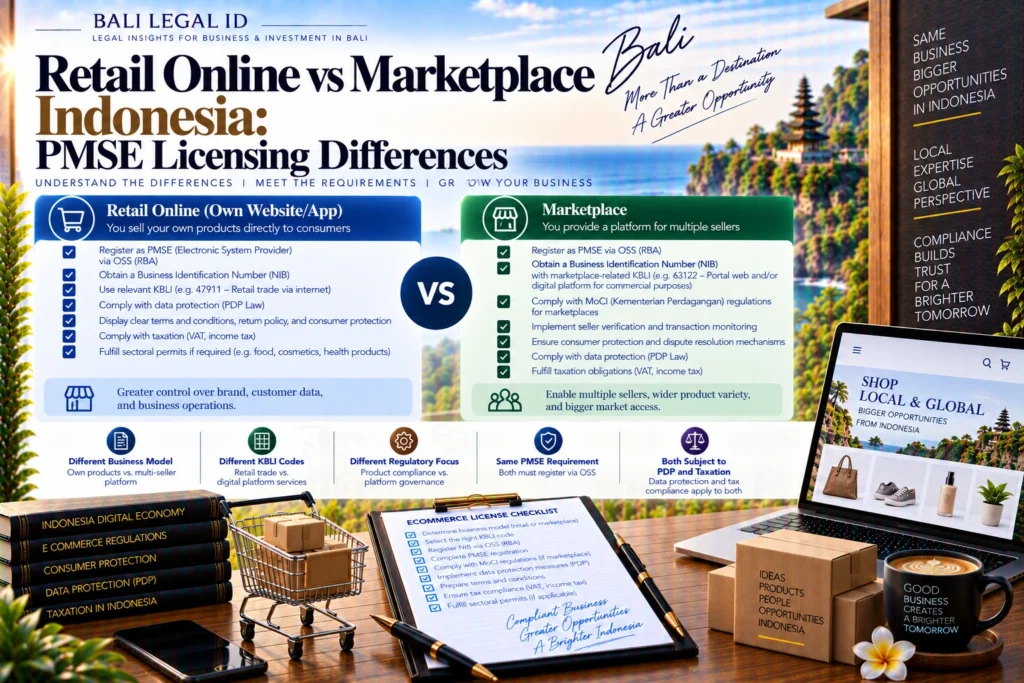
Calling a business an e-commerce company is not enough to identify its licence. Under Indonesia’s current PMSE rules, Retail Online and Marketplace are different operating models with different commercial roles and, in several areas, different compliance obligations.
Indonesia’s underlying PMSE framework includes PP No. 80 of 2019, which JDIH BPK currently lists as in force.
The current implementing rule is Permendag No. 19 of 2026, which has applied since 8 June 2026 and revoked Permendag No. 31 of 2023.
Retail Online vs Marketplace Indonesia: The Short Answer
For retail online vs marketplace Indonesia, the simplest distinction is who is actually selling the goods.
Retail Online fits a merchant that sells through its own commercial website or application. Marketplace fits a platform that provides an electronic environment for other merchants to place offers and participate in transactions.
Both models can enter the PPMSE licensing framework, but a Marketplace also has platform-specific responsibilities toward the merchants using it.
The Core Difference: Who Is Selling the Product?
The legal definitions are different: Permendag No. 19 of 2026 defines Retail Online as a merchant conducting PMSE through a commercial website or application that it creates, manages, and/or owns itself, while Marketplace is a commercial electronic environment where merchants can place offers of goods or services.
That difference should be settled before choosing KBLI codes, preparing the OSS profile, or building marketplace functions into the technology.
Retail Online
A Retail Online business typically sells its own goods or services through a site or application that it controls.
Examples include a fashion brand selling only its own inventory through its website, a cosmetics distributor operating its own online shop, or a retailer taking direct customer orders through a proprietary application.
The important point is that customers are buying from the merchant itself. The business is not primarily providing listing and transaction infrastructure to independent third-party sellers.
Marketplace
A Marketplace provides commercial electronic infrastructure that allows third-party merchants to offer goods or services.
The platform can earn fees, commissions, advertising revenue, or other permitted income from facilitating those transactions. Its compliance model therefore needs to address both consumers and the merchants participating on the platform.
Retail Online vs Marketplace Licensing Matrix
The following table summarizes the main points to compare before choosing the next step.
| Decision point | Retail Online | Marketplace |
|---|---|---|
| Who sells the goods? | The business itself | Third-party merchants use the platform |
| Core role | Merchant using its own PMSE facility | Platform or PPMSE facilitating merchant offers |
| KBLI logic | Retail classification based mainly on goods sold | Intermediation classification where the business facilitates third-party retail transactions |
| PMSE Business Licensing | Required where the domestic merchant operates its own PMSE facility | Required for a non-exempt Marketplace PPMSE |
| Merchant complaint mechanism | Not a marketplace relationship where no third-party merchants participate | Specific merchant complaint and dispute obligations apply |
| Merchant fee agreements | Not applicable in the same way where there are no hosted merchants | Specific fee-transparency and contract rules apply |
| PSE review | Required where the electronic-system operation meets the applicable private-PSE criteria | Required where the electronic-system operation meets the applicable private-PSE criteria |
The commercial question should therefore be answered before the licensing question: are you selling, or are you enabling other merchants to sell?
KBLI 2025 Treats Retail and Intermediation Differently
The online channel itself is no longer the main classification test for ordinary retail.
For ordinary retail, OSS KBLI 2025 states that retail activities are classified according to the goods traded regardless of whether the sale occurs through a store, online channel, kiosk, market, or another method.
A Retail Online company should therefore identify the correct retail KBLI for its products rather than searching for one universal online-retail code.
A marketplace that earns revenue by facilitating transactions without taking ownership of the goods belongs to a different classification analysis because OSS KBLI 2025 includes code 47901 for Platform Digital Intermediasi Perdagangan Eceran.
For a broader explanation of how KBLI affects the OSS result, Bali Legal ID’s OSS requirements by KBLI guide is a useful next reference.
Both Models Can Need PMSE Business Licensing
It is a mistake to assume that only a Marketplace is a PPMSE.
Retail Online is not exempt merely because the company sells only its own goods: Article 7(3) states that a domestic merchant with its own PMSE facility is categorized as a PPMSE and must hold PMSE Business Licensing.
For both non-exempt PPMSE models, Articles 8 and 9 provide that PMSE Business Licensing is applied for through OSS and uses the KBLI corresponding to the business activity being carried out.
The difference is therefore not that Retail Online avoids PMSE licensing. The more important difference is what business activity is being licensed and what additional duties follow from operating a platform for other merchants.
Marketplace Operators Carry Additional Merchant-Facing Duties
A Marketplace has a second commercial relationship that Retail Online normally does not have: the relationship between the platform and independent merchants.
That creates additional compliance questions around merchant complaints, disputes, fees, agreements, platform changes, and information displayed through the system.
Merchant Complaints and Disputes
A Marketplace also has merchant-facing platform duties that a pure own-inventory Retail Online model does not perform in the same way: Article 10 requires Marketplace PPMSE operators and the other named platform models to provide merchant complaint services and a dispute-resolution mechanism.
The regulation requires the complaint service to be clearly accessible and to provide more than one active electronic channel, such as email, live chat, or a ticketing system, together with a stated response time.
For a founder, this means marketplace compliance affects product design. The complaint and dispute functions should be planned before launch rather than added only after merchants begin raising disputes.
Marketplace Fees and Contracts
Marketplace commercial terms are also regulated because Article 14 requires specified platform operators to disclose merchant charges transparently, record agreed charges in a written agreement or electronic contract, and respond to written merchant objections within 14 working days.
This matters where the platform charges commissions, listing fees, advertising fees, penalties, or other merchant-facing costs. The marketplace terms, seller dashboard, downloadable contract records, and change-management process should all be designed around the actual fee model.
A pure Retail Online business selling only its own inventory has no equivalent third-party merchant relationship, so those marketplace-specific duties do not arise in the same operational form.
PSE Registration Is a Separate Question
PMSE Business Licensing and private PSE registration should not be treated as the same approval.
Private electronic-system registration remains a separate layer because JDIH BPK lists Permenkominfo No. 5 of 2020 as in force and amended by Permenkominfo No. 10 of 2021.
For a business that qualifies as a private electronic-system operator, Komdigi’s current portal states that every PSE Lingkup Privat must register and that registration is carried out through OSS.
Both a Retail Online site and a Marketplace can therefore require a PSE review. The difference between the models does not eliminate the separate question of who provides, manages, or operates the electronic system.
For the full entity and licensing sequence, use our e-commerce company setup requirements checklist.
Which Model Fits Your Business?
Choose the Retail Online route when the company is primarily a merchant selling its own inventory or services through a website or application it controls.
Choose the Marketplace model when the business is intentionally building infrastructure for independent merchants to list offers and participate in transactions, with the platform earning commissions, fees, advertising income, or other intermediation revenue.
Do not choose Marketplace simply because the website is technically sophisticated. A direct-to-consumer store can still be Retail Online. Conversely, do not describe a platform as Retail Online when third-party merchants are actually onboarding, listing products, paying platform fees, and relying on the system to transact with consumers.
Before incorporation or OSS filing, document four facts: who owns the inventory, who contracts with the buyer, whether third-party merchants use the system, and how the platform earns revenue. Those answers make the licensing analysis substantially clearer.
Conclusion
Retail Online and Marketplace are both forms of PMSE, but they are not interchangeable business models.
Retail Online is centered on a merchant selling through its own commercial electronic facility. Marketplace is centered on providing electronic infrastructure for other merchants, which brings additional platform responsibilities such as merchant complaint mechanisms and fee-transparency rules.
KBLI 2025 reinforces the distinction: ordinary retail follows the goods being sold, while digital retail intermediation has its own classification path.
The practical decision is therefore conditional: use Retail Online when your company is the seller; use the Marketplace model when your company is building a platform for other merchants—and design the licences, contracts, complaint systems, KBLI, and PSE compliance around that actual role.
Confirm the PMSE Model Before Building the Licensing Structure
If you are planning a Retail Online, Marketplace, or other digital-commerce business in Bali, Bali Legal ID can assist with a consultation to review the proposed PT PMDN or PT PMA structure, KBLI activities, NIB OSS RBA registration, PMSE licensing scope, and related business compliance.
A useful review starts with the actual transaction flow—who owns the products, who contracts with customers, whether third-party merchants participate, and how the platform earns revenue—before the entity and licence applications are finalized.
For help coordinating the records and next steps discussed above, review our NIB and OSS RBA registration services in Bali.
For help scoping the documents and next steps for your business or transaction, contact Bali Legal ID about our business setup services in Bali.
Read More: Business Setup Bali for PT PMA, PT PMDN & OSS RBA Registration
FAQ retail online vs marketplace indonesia
What is the main legal difference between Retail Online and Marketplace in Indonesia?
Retail Online is a merchant selling through a commercial website or application that it creates, manages, or owns itself. Marketplace is an electronic platform where merchants can place offers of goods or services.
Does a Retail Online business need PMSE Business Licensing?
Yes where a domestic merchant operates its own PMSE facility. Article 7(3) of Permendag No. 19 of 2026 categorizes that merchant as a PPMSE and requires PMSE Business Licensing.
Does a Marketplace need PMSE Business Licensing?
A non-exempt Marketplace PPMSE falls within the PMSE Business Licensing framework. The application is processed through OSS using the KBLI appropriate to the business activity.
Is there one KBLI for all Retail Online businesses?
No. KBLI 2025 classifies ordinary retail according to the goods being sold regardless of whether the sales channel is online or offline.
What KBLI applies to a digital retail marketplace?
OSS KBLI 2025 includes code 47901 for Platform Digital Intermediasi Perdagangan Eceran. The complete business model should still be reviewed because a platform may conduct additional activities.
Does a Marketplace have extra obligations toward sellers?
Yes. Permendag No. 19 of 2026 includes marketplace-specific obligations concerning merchant complaints, dispute-resolution mechanisms, fee transparency, written or electronic agreements, and responses to merchant objections.
Is PSE registration the same as PMSE Business Licensing?
No. PMSE Business Licensing regulates the electronic-commerce business activity, while private PSE registration concerns the electronic system being provided, managed, or operated. A business can need review of both layers.
Can a company start as Retail Online and later become a Marketplace?
Commercially, the model can evolve, but introducing third-party merchants changes the activity and compliance profile. Review the KBLI, PMSE licensing, merchant contracts, complaint systems, fee arrangements, and electronic-system setup before launching the marketplace function.
References & Sources
- Current Government Regulation on Electronic Commerce — peraturan.bpk.go.id
- Current Ministry of Trade Regulation on PMSE Business Operations — peraturan.bpk.go.id
- Official Retail Online, Marketplace and PMSE Licensing Provisions — peraturan.bpk.go.id
- Current KBLI 2025 Retail Classification — oss.go.id
- Current KBLI 2025 Retail Intermediation Classification — oss.go.id
- Current Status of the Private Electronic System Operator Regulation — peraturan.bpk.go.id
- Current Amendment to the Private Electronic System Operator Regulation — peraturan.bpk.go.id
- Current Private PSE Registration Portal — pse.komdigi.go.id