
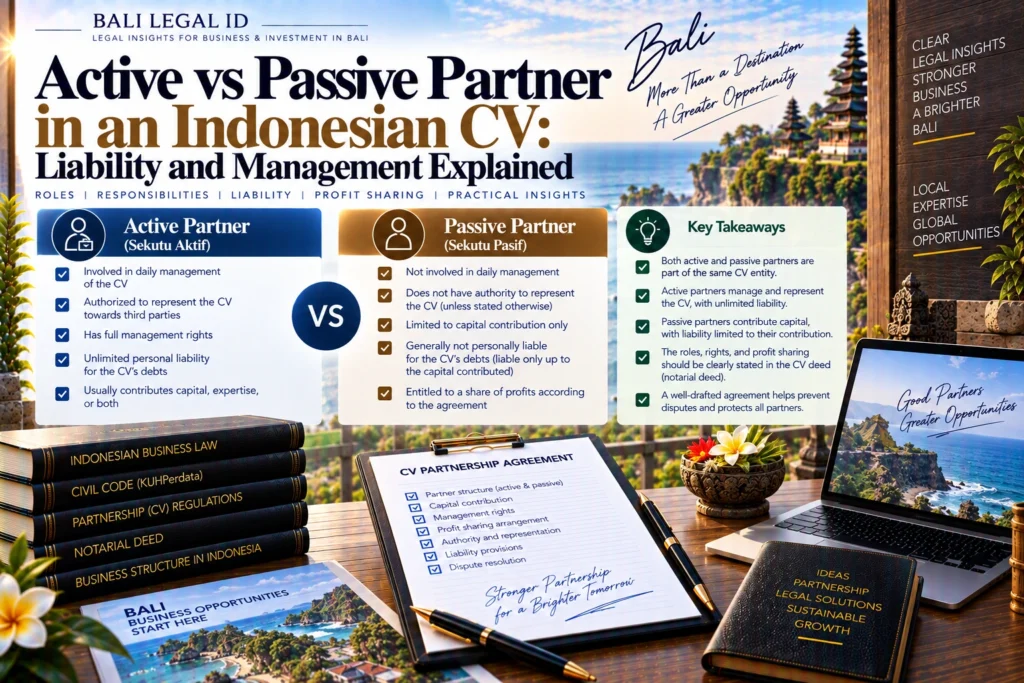
The difference between an active and passive partner in an Indonesian CV is fundamentally about authority and liability. The partner who represents and manages the CV can face personal exposure to third parties, while the commanditaire partner is intended to remain outside that external management role.
The current Ministry of Law framework is Permenkum No. 25 of 2025, which JDIH BPK lists as in force from 13 October 2025 and as revoking Permenkumham No. 17 of 2018.
CV Active Passive Partner Liability Indonesia: The Short Answer
For CV active passive partner liability Indonesia, the everyday labels are useful but incomplete.
An active partner usually corresponds to the sekutu komplementer: the partner who can act for and represent the CV and whose personal assets can be exposed to third-party liabilities.
A passive partner usually corresponds to the sekutu komanditer: the capital-providing partner who should not be treated as the person managing and representing the CV externally if the parties want to preserve the intended liability distinction.
The key risk is therefore not the label written in an email signature. It is whether the deed, registered data, and real conduct are consistent with the role the partner is supposed to have.
The Legal Terms Are Complementary and Commanditaire Partners
The current regulation uses the Indonesian legal terms rather than ‘active’ and ‘passive.’
That means a CV is structurally built around two different partner functions. It should not be drafted as though everyone has identical authority and identical exposure.
A founder should therefore ask two separate questions for each person involved:
- What economic rights does this person have inside the partnership?
- What authority does this person have to act for the CV toward customers, suppliers, banks, employees, landlords, regulators, or other third parties?
Those questions should be answered deliberately rather than left to informal practice after the deed is signed.
What the Active Partner Can Do—and Risk
The complementary partner is the external-facing partner under the current regulation.
The same provision states that the complementary partner may act for and on behalf of the CV and is jointly and severally responsible to third parties up to that partner’s personal assets.
This is the most important liability distinction when founders compare a CV with a limited liability company. The person who accepts the complementary-partner role is not merely receiving an operational title; that role comes with potentially direct personal financial exposure.
Founders comparing this personal-liability profile with a foreign-investment company structure can use Bali Legal ID’s PT PMA setup cost guide as a separate reference for the PT PMA formation framework.
In practical governance terms, the deed should make clear who is authorized to sign contracts, incur obligations, control operational accounts, represent the CV, hire or instruct personnel, and deal with external counterparties.
If there is more than one complementary partner, the founders should also clarify whether authority can be exercised individually or requires joint action for specified decisions. That is a drafting and governance issue that should be aligned with the deed and actual operating practice.
What the Passive Partner Should Not Turn Into
The commanditaire partner is commonly described as the passive partner, but the important issue is what that person actually does.
That makes informal role creep dangerous. A person can be called a ‘passive investor’ in conversation while repeatedly behaving like the person who manages or represents the business.
Examples that deserve legal review include a commanditaire partner routinely negotiating and signing commercial contracts, representing the CV to creditors, acting as the apparent operational decision-maker toward third parties, or otherwise exercising the external management role that the structure assigns to the complementary partner.
The exact legal consequence depends on the documents and conduct in the particular case, so a disputed situation should not be decided only by looking at the title shown in the establishment deed.
Internal Rights Are Different From Acting for the CV
A passive role should not be confused with having no legitimate economic interest in the business.
The deed may need to regulate matters such as capital contribution, profit allocation, access to financial information, consent for exceptional transactions, restrictions on additional borrowing, transfer or withdrawal arrangements, dispute procedures, and exit mechanics.
Those are internal governance questions. They should be drafted carefully so protective or economic rights do not unintentionally become day-to-day external management authority.
A useful test is to separate oversight and agreed internal protections from acting for and binding the CV toward third parties. If the drafting or actual practice blurs that line, obtain specific legal advice rather than relying on the word ‘passive.’
Put the Boundary Into the Deed and Operating Practice
The deed should do more than name one person active and another passive.
For founders, useful points to clarify include:
- each partner’s contribution
- allocation of profit and loss
- who has authority to sign for the CV
- whether complementary partners act separately or jointly
- which transactions require internal approval
- which activities a commanditaire partner must not perform as external management
- access to financial and operational information
- treatment of additional funding
- partner resignation, replacement, death, or incapacity
- dispute and deadlock procedures
- amendment and registration responsibilities
The operating reality should then follow the deed. A well-drafted separation loses much of its practical value if the partners ignore it after registration.
What Happens When Partner Roles Change?
A real change in the partner or management structure should not remain only an internal arrangement.
If the partner or management structure changes, Article 9 treats changes to partners and managers as amendments to the CV’s articles that are registered electronically through the Sistem Administrasi Badan Usaha.
Timing matters because Article 10 requires an amendment registration to be submitted no later than 30 calendar days from the date the notarial amendment deed is signed.
Founders should therefore coordinate a role change with the notarial documentation and registration process rather than simply changing internal titles, bank instructions, or email signatures.
This is particularly important where one complementary partner leaves, a commanditaire partner becomes involved in management, a new partner joins, or authority between several complementary partners is restructured.
Passive Does Not Mean Invisible for Beneficial Ownership
Partner liability and beneficial-owner reporting answer different questions.
Partner labels also do not replace beneficial-owner analysis because Permenkum No. 2 of 2025 applies beneficial-owner identification obligations to corporations including CVs and JDIH BPK lists it as the current regulation replacing Permenkumham No. 21 of 2019.
The beneficial-owner framework looks at matters such as actual control, rights to benefits, and the true person behind funds or ownership interests. A partner should therefore not assume that being labelled passive automatically removes that person from transparency analysis.
For founders, this means the establishment and amendment process should keep the partner structure, beneficial-owner information, and actual control arrangements consistent.
Founder Checklist Before Forming a CV
Before signing the deed, founders should be able to answer the following questions clearly:
- Who will be the complementary partner or partners?
- Who will be the commanditaire partner or partners?
- Who can legally represent the CV to third parties?
- Which complementary partner’s personal assets may be exposed?
- What capital does each partner contribute?
- How are profits and losses allocated internally?
- Which decisions need internal consent before an active partner acts?
- What activities should the commanditaire partner avoid so the management boundary remains clear?
- Who controls bank instructions and contract execution?
- How will access to accounts and business information be handled?
- What happens if a partner wants to leave or change roles?
- Who coordinates the amendment deed and registration when partners or managers change?
- Has the beneficial-owner position been reviewed separately from the active/passive labels?
- Does the liability structure remain commercially acceptable for the size and risk of the business?
If the answer to several of these questions is unclear, the entity may be technically registrable while still being poorly designed for the founders’ relationship and risk profile.
Conclusion
The active-versus-passive distinction in a CV is not just a division of workload.
The complementary partner is the partner who acts for the CV and can face joint and several liability extending to personal assets. The commanditaire partner is intended to remain outside that external management role, and current government legal guidance warns that participating in management can materially change the partner’s liability exposure.
Founders should therefore align three things: the deed, the official registration, and actual conduct.
A commanditaire partner can still have important economic and internal protective rights, but those rights should be drafted without casually turning the person into the external manager of the CV. If roles later change, the notarial amendment and registration requirements should be handled promptly, and beneficial-owner obligations should be reviewed separately.
Define Partner Authority Before the CV Starts Operating
If you are forming or restructuring a CV in Bali, Bali Legal ID’s business setup service can assist with a consultation to review the proposed partner roles, agreement or deed terms, management authority, amendment requirements, beneficial-owner information, and related business-registration issues before the structure is finalized.
The right arrangement depends on who contributes capital, who will represent the business, how internal approvals should work, and how much personal liability the founders are prepared to accept.
For help scoping the documents and next steps for your business or transaction, contact Bali Legal ID about our business setup services in Bali.
Read More: Business Setup Bali for PT PMA, PT PMDN & OSS RBA Registration
FAQ cv active passive partner liability indonesia
What is the difference between an active and passive partner in an Indonesian CV?
The active partner generally corresponds to the complementary partner who represents the CV and carries personal liability toward third parties. The passive partner generally corresponds to the commanditaire partner whose intended role is capital participation rather than external management.
Can an active CV partner be personally liable for business debts?
Yes. Permenkum No. 25 of 2025 expressly defines the complementary partner as jointly and severally responsible toward third parties up to personal assets.
Is a passive partner’s liability always limited?
Do not rely on the passive label alone. Current HaloJPN government legal guidance explains that a commanditaire partner is generally responsible only up to the contributed capital, but management involvement can create joint and several exposure for CV obligations.
Can a passive partner approve major business decisions?
Internal economic and protective rights can be addressed in the deed, but they should be drafted carefully so they do not become external day-to-day management or representation of the CV. The specific arrangement should be reviewed against the intended role and actual conduct.
What if an active partner becomes passive or a passive partner becomes active?
A change affecting the CV’s partners or managers can require a notarial amendment and electronic registration. Permenkum No. 25 of 2025 requires amendment registration within 30 calendar days from signing the relevant notarial amendment deed.
Is a passive partner still relevant for beneficial-owner reporting?
Potentially, yes. Beneficial-owner rules apply separately and focus on matters such as actual control and entitlement to benefits. A passive-partner label does not automatically determine the beneficial-owner result.
References & Sources
- Current Ministry of Law Regulation for CV, Firm and Civil Partnership Administration — peraturan.bpk.go.id
- Official CV Partner and Amendment Provisions in Regulation No. 25 of 2025 — peraturan.bpk.go.id
- Attorney General Legal Guidance on Active and Passive CV Partner Liability — halojpn.kejaksaan.go.id
- Current Beneficial Owner Verification and Supervision Regulation — peraturan.bpk.go.id