
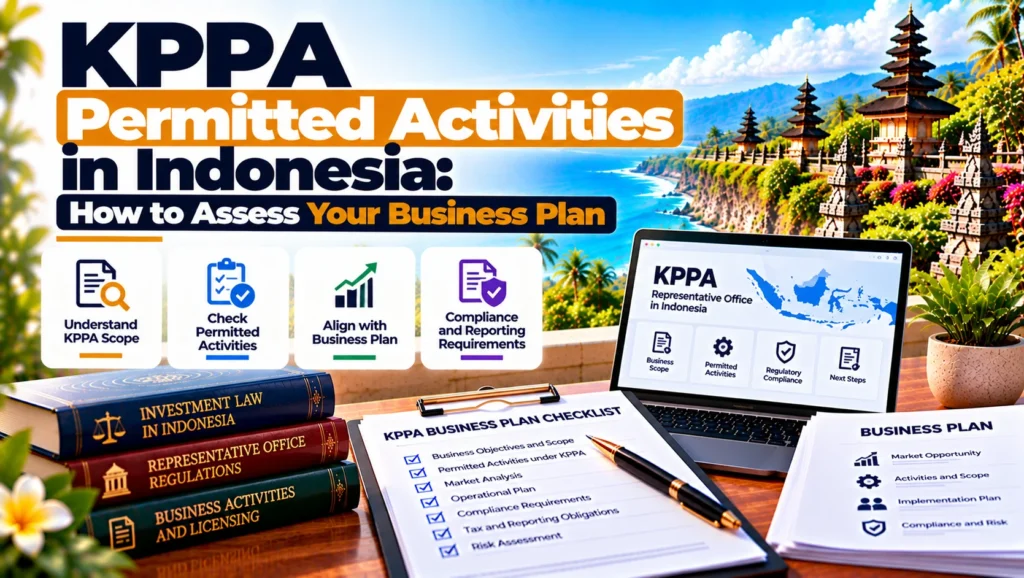
KPPA permitted activities in Indonesia should be assessed against the actual functions a foreign company intends to perform through its local representative office. Activities such as market research, preliminary investment planning, and liaison with an overseas parent may be relevant to a representative-office model, while commercial sales, customer contracting, revenue collection, and direct business operations require closer examination.
A business plan should not assume that every activity described as representation is automatically permitted. The appropriate classification depends on the current rules applicable to KPPA, the overseas company’s purpose, and the actual work performed in Indonesia.
What Activities Should a KPPA Business Plan Cover?
KPPA stands for Kantor Perwakilan Perusahaan Asing, commonly translated as Foreign Company Representative Office.
When considering this structure, the first step is to distinguish between establishing a representative presence and operating an Indonesian commercial business.
A company planning to explore the market may need staff to gather information, arrange meetings, maintain communication with potential partners, and report findings to its overseas management. A company planning to sell services, operate accommodation, or enter customer transactions faces a different set of business and licensing questions.
The distinction is important because a description such as business development may cover several different activities. Preparing a market-entry report, negotiating a customer contract, and managing service delivery should not automatically be classified together.
A practical activity assessment should establish what work will be performed, who benefits from it, which company is legally responsible, and whether the activity results in direct commercial operations.
The Regulatory Framework for KPPA Activities
KPPA assessment must be considered within Indonesia’s current business licensing framework and the rules specifically applicable to the representative-office category.
The official record for Government Regulation Number 28 of 2025 identifies risk-based business licensing, OSS administration, supervision, and related matters as part of Indonesia’s regulatory framework.
The regulatory status record confirms that Government Regulation Number 28 of 2025 replaced Government Regulation Number 5 of 2021, so the previous regulation should not be used as current authority.
The official record for Minister of Investment and Downstreaming/BKPM Regulation Number 5 of 2025 identifies it as the applicable procedural framework for risk-based business licensing through the Online Single Submission system.
The official 2025 regulatory summary confirms that BKPM Regulations Numbers 3, 4, and 5 of 2021 were revoked, meaning their historical procedures must not be relied upon as current filing rules.
The official OSS portal provides a dedicated KPPA guidance page, which applicants can consult when identifying the relevant representative-office registration process.
These official sources establish the current general regulatory context and a KPPA-specific guidance destination. They do not, by themselves, establish that every activity considered below is legally authorized in all circumstances. Exact permissions and conditions must be confirmed against the relevant operative provisions before implementation.
KPPA Permitted Activities Indonesia: Practical Assessment
A useful KPPA review begins with the purpose of each proposed activity rather than the job title of the employee performing it.
The following categories help investors organize their questions, but they are preliminary planning classifications rather than legally binding approvals.
Market Research and Preparatory Activities
A foreign investor may want to understand customer demand, identify possible business partners, evaluate investment locations, or prepare for a future Indonesian business establishment.
For example, a hospitality group considering Bali might gather information about suitable areas, compare potential suppliers, meet advisers, and evaluate the feasibility of a future investment.
The important distinction is between obtaining information to support the overseas company’s decisions and directly conducting an operating business in Indonesia.
A proposed research assignment should specify its objectives, expected outputs, responsible personnel, and relationship to the overseas parent.
Investors should confirm whether the exact proposed work fits the currently applicable KPPA activity rules before treating it as authorized.
Liaison and Coordination with the Overseas Parent
Another potential representative function involves communication between an overseas company and parties in Indonesia.
Examples may include arranging meetings, coordinating the exchange of information, supporting preliminary discussions, or communicating developments to headquarters.
However, the words liaison and coordination do not automatically determine the legal status of a particular activity.
An employee who introduces potential partners may perform a different function from someone authorized to sign contracts, manage client accounts, or deliver paid services.
The review should therefore examine the substance of the work, the representative’s actual authority, and any proposed contractual commitments.
Commercial Contracts, Sales and Customer Revenue
Activities involving customer transactions deserve particular attention during KPPA planning.
A business should examine whether its Indonesian personnel will offer goods or services for sale, sign customer agreements, issue invoices, collect payments, supervise commercial delivery, or manage revenue-generating operations.
These activities should not be assumed permissible merely because the overseas parent remains the contracting entity or receives payment outside Indonesia.
Because the national licensing framework addresses authorization for business activities, investors should assess proposed revenue-generating operations separately from the registration of a representative presence.
The decisive assessment should consider the actual activity, the relevant regulatory category, and whether an appropriately authorized Indonesian operating entity is necessary.
Activity Classification Matrix for Foreign Investors
The following matrix helps structure an initial review of proposed activities. Its classifications identify issues for investigation, not universal legal permissions or prohibitions.
| Proposed activity | Preliminary assessment | What to verify |
|---|---|---|
| Gathering general market information | Potential representative function | Confirm its relationship to permitted KPPA purposes |
| Identifying possible investment locations | Preparatory activity requiring review | Confirm the exact nature of the investigation and any accompanying commercial commitments |
| Arranging introductory partner meetings | Potential liaison function | Confirm whether staff are communicating or entering binding arrangements |
| Reporting market findings to headquarters | Potential representative function | Check the activity against the registered purpose |
| Negotiating customer sales contracts | Elevated commercial activity concern | Review signing authority, contract terms, and applicable operating permissions |
| Issuing invoices to Indonesian customers | Elevated revenue and licensing concern | Determine which entity conducts the actual commercial activity |
| Receiving local customer payments | Elevated commercial activity concern | Review the underlying transaction and operating structure |
| Managing a hotel or villa business | Operational business concern | Assess the need for an appropriately established and licensed operating entity |
| Coordinating preparation for future investment | Preparatory function requiring confirmation | Verify the boundaries of permitted representative and preparatory work |
A low-concern preliminary assessment does not mean automatic approval. Equally, a high-concern classification identifies the need for closer legal review rather than establishing that every possible arrangement is prohibited under every representative-office category.
Five Questions Before Selecting KPPA
Foreign investors can use five questions to assess whether their proposed activities fit a representative-office model.
- What is the principal purpose of the Indonesian presence? Describe the purpose in terms of observable activities rather than broad commercial objectives.
- Who enters into contracts? Identify whether local personnel will only coordinate discussions or will have authority to create binding commitments.
- Where does commercial activity actually occur? Examine where services are delivered, goods are sold, customers are managed, and operational decisions are made.
- Will the Indonesian office handle revenue-generating work? Review proposed invoices, payments, customer relationships, and delivery responsibilities.
- Will the business model change after initial registration? Identify activities planned for later phases that may require reassessing the legal structure.
These questions should be documented before selecting the registration route. Their purpose is to expose assumptions that might otherwise remain hidden within a general business plan.
A Bali Hospitality Investment Example
Consider a hypothetical foreign hospitality company studying whether to establish a business in Bali.
During the first phase, its Indonesian representatives collect market information, examine potential investment locations, arrange introductory meetings, and send recommendations to the overseas management team.
The company should assess these proposed functions against the KPPA rules and document the boundaries of the representatives’ authority.
In a second phase, management proposes operating villas, accepting guest bookings, collecting accommodation payments, and directly managing customer services.
The second phase has a substantially different operational purpose. It should not be assumed covered by the initial representative-office arrangement.
The investor should separately assess the need for an Indonesian operating company, appropriate business licensing, applicable property arrangements, and any relevant sector requirements.
This scenario illustrates why KPPA suitability should be reviewed against the actual business plan rather than the overseas company’s general intention to enter the Indonesian market.
Preparing a KPPA Activity Review Document
Before registration or professional consultation, prepare a concise document describing the proposed Indonesian activities.
For each activity, record the responsible person, the overseas company function it supports, expected outputs, commercial implications, and any authority to communicate or contract with third parties.
A useful review document can include the following information:
- Overseas parent company and proposed representative-office purpose
- Description of each planned activity in Indonesia
- Personnel responsible for the work
- Expected relationships with Indonesian customers, suppliers, or partners
- Contracting and signing arrangements
- Potential invoicing, payment, or revenue involvement
- Proposed office location and operational arrangements
- Activities expected during later business expansion
- Questions requiring category-specific regulatory confirmation
The document is an internal planning tool, not a substitute for the documents required by the relevant current administrative procedure.
Its value is that an adviser or responsible reviewer can evaluate actual work rather than relying on a vague description such as market development.
When to Assess PT PMA Instead
A foreign company should reassess its planned structure when the proposed activities move beyond representation and preparation into direct commercial operations.
A PT PMA may be a structure to evaluate where an Indonesian company is needed to conduct the intended business, subject to applicable ownership, investment, sector, and licensing requirements.
The choice should not be based solely on anticipated operating costs or the desire to establish an Indonesian address. It should follow the actual business activity and the legal permissions needed to perform it.
KPPA registration and PT PMA incorporation should not be treated as interchangeable processes. An existing representative office also should not be assumed to transform automatically into an operating company when commercial plans expand.
If the business model is uncertain, the investor can define an initial representative-stage plan and a separate proposed commercial-stage plan. Each stage can then be assessed against the appropriate regulatory framework before implementation.
Conclusion
Assessing KPPA permitted activities in Indonesia requires more than identifying a representative-office category.
Foreign investors should describe their planned work, distinguish preparatory and liaison functions from commercial operations, review authority and customer relationships, and verify category-specific permissions under current rules.
A clear activity-assessment document provides a better foundation for deciding whether KPPA is suitable or whether a different Indonesian business structure should be evaluated.
The representative-office mistakes checklist helps test the assumptions behind the activity plan. Where the proposed operation instead requires a company structure, review the PT PMA setup framework as a separate workstream.
Review Your Proposed Indonesian Business Activities
If you are considering a representative office or planning a foreign investment business in Bali, contact Bali Legal ID to discuss your proposed activities and company establishment options.
A consultation can help identify which business-structure questions require further review, including whether a KPPA arrangement or an appropriately licensed PT PMA should be assessed for the planned operations.
For help scoping the documents and next steps for your business or transaction, contact Bali Legal ID about our business setup services in Bali.
Read More: Business Setup Bali for PT PMA, PT PMDN & OSS RBA Registration
FAQ kppa permitted activities
What activities can a KPPA perform in Indonesia?
Representative and preparatory functions, such as certain market research, liaison, and investment-planning activities, may be relevant to a KPPA arrangement. However, the exact legally permitted activities and conditions must be confirmed against the current category-specific rules. General examples should not be treated as an exhaustive authorization.
Can a KPPA sign contracts with Indonesian customers?
Contracting authority and the nature of the contract require specific review. A representative communicating with potential partners is not necessarily performing the same activity as a business entering customer sales agreements. Investors should verify the applicable KPPA restrictions before authorizing commercial contracts.
Can a KPPA collect payments from customers?
Do not assume that representative-office registration authorizes customer invoicing or revenue collection. Review who provides the underlying service, which entity is responsible for the commercial transaction, and what operating authorization may be required.
Can a KPPA conduct market research for a future Bali investment?
Market research may be relevant to a representative or preparatory business purpose, but the specific assignment should be assessed against the current rules. Research activities should be distinguished from commercial operations or customer transactions.
When should a foreign company consider PT PMA instead of KPPA?
A PT PMA should be assessed when the proposed activities require a properly established and licensed Indonesian operating company. The appropriate structure depends on the intended business activities, ownership arrangements, and applicable sector requirements.
References & Sources
- Government Regulation Number 28 of 2025 on Risk-Based Business Licensing — peraturan.bpk.go.id
- Minister of Investment and Downstreaming/BKPM Regulation Number 5 of 2025 on OSS Licensing Procedures — peraturan.bpk.go.id
- OSS Guidance for Foreign Company Representative Offices — oss.go.id